Queer (2024)
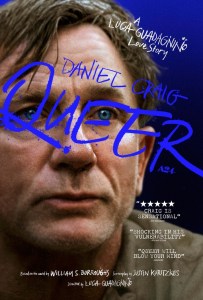
Based upon Beat writer William S. Burroughs, and by the creative team behind this year’s Challengers, Queer is a gay romantic drama equal parts desire and desperation. It also happens to be a confounding artistic misfire and one of the more head-scratching Oscar-bait entries of late.
Set in the 1950s, William Lee (Daniel Craig) is a middle-aged writer living in Mexico City and looking for companionship. One day he meets Eugene Allerton (Drew Starkey, Outer Banks), a young Army expat who he can’t stop thinking about. Lee circles the man, flattering him and throwing affection his way, and eventually the two of them get involved in a relationship, though Allerton is quick to proclaim he is “not queer.” Can they find something lasting or meaningful and work through their own doubts and personal hang-ups?
What really hinders this doomed romance is that it never feels special for either of the participants, at least something to remember through the ages. Unrequited romances in an era where people could never act out their passions because they were considered inappropriate or obscene are their own sub-genre of movies, the Romance That Could Not Be. I initially thought that Queer was going to be a gender flip of 2015’s Carol, Todd Haynes’ film about two gay women trying to carry on a covert relationship through glances and finger touches. Queer is not Carol, and I wasn’t even a big fan of Carol. For starters, even though the setting is in 1950s Mexico City, it doesn’t at all feel like any of the characters are being forced to repress their authentic selves. I’m unfamiliar with whether or not Mexico was so accommodating to gay foreigners, but from a narrative standpoint, it saps the story of conflict on a social scale. If society accepts these men carousing around the neighborhood for homosexual hookups, then what’s halting our gay couple for achieving happiness cannot be external, it must be internal. That means we need to know much more about these characters because we can’t just blame the pressures of society keeping these men apart and/or repressed. The problem with this approach is that the story keeps both of these characters too far at a distance to fully understand them, including any faults that might ultimately lead to their falling out or parting ways.

The burden of romances that are meant to be so powerful they leave a mark, good or bad, is that you need to feel that ache and power so that it feels tragic they could not work out, that they will be haunted by the memory of what they had and what could have been. With Queer, I can’t understand what drew either of these men together beyond lust and inertia. Eugene is an enigmatic blank of a character, a young G.I. who doesn’t consider himself queer. That’s as much as you’re going to get about this man as he’s mostly held as a desirous placeholder, something for our older character to yearn over, but he already feels like a half-remembered, overly-gauzy nostalgic memory of a person even in the present. He’s just kind of there. He doesn’t say much, he doesn’t do much, but he’s reciprocal, and I guess that’s something. The character of William Lee is a writer living abroad, ostensibly writing and publishing with financial freedom. His life abroad is essentially an ongoing vacation where he gets to casually drink, stroll about, and find younger men to warm his bed. Now if Lee had all these things but, because of his middle age, he was seen as less desirable, that these young men only used him for their own gratification and then abandoned him, then we have a scenario where he might find someone who can fulfill what he is missing, who can be different from the others. I don’t know what either of these men see in one another because they’re both so terribly underwritten. It makes it hard to care or become emotionally invested in these men and their connection.
Then the movie just collapses entirely in its meandering, abstract, and generally mystifying second half. I figured the movie would be these two men leaning into their feelings and daring to act them out, becoming infatuated with one another, and that’s really only the first half. Then Lee gets the idea to travel to South America to look for a rare plant believed to offer telepathic powers. Now clearly there’s some metaphors here about the desire for connection and understanding, and you would think the motivation would be spurred by being denied these aspects. Instead, Lee and Eugene seem to lack any real challenge to being together, nor is there any pertinent threat that Eugene will leave him or that there is any competition for his affections. There’s not really a conflict present that can keep them apart; even Lee’s drug addiction plays such a minimal part. I suppose it’s meant to convey the character’s dependency issues, but then present a parallel where Eugene is his new drug, his new obsession, and chasing it leads to his self-destruction. That’s not what we get. We get a boring couple going on a weird vacation. This journey south becomes one very tedious expedition into extended trippy visuals and sketchy symbolism like vomiting out one’s heart. It was at this point that my wife had lost all patience with the movie and just wanted it to end. I couldn’t blame her. Even if the story and characters were lacking for the first half, they’re just abandoned completely in that second half. The movie is actively challenging you to disengage with it when it already gave me little to hold onto.
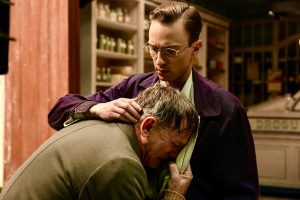
The main headline for Queer was that this is Craig’s big awards gamble, and he is good, but absent the material to really explore the complexity of his character, the performance is limited because Lee is so archetypal. He’s the middle-aged lush, the sad gay man looking for love and connection in an era that was not kind to said pursuit, and yet in Queer he’s not really persecuted, he’s not really challenged, and he’s not really explored in any meaningful manner. Craig has a few moments where he showcases the vulnerable heartache at the edges of this man, giving you a glimpse of a tortured soul that would have been worthy of being explored with more development. Alas, as the movie descends into its second half abstract, Lynchian morass, I gave up my attempts to find meaning and depth and just became morbidly curious where this all could possibly lead. The conclusion is meant to evoke some sense of tragedy and regret, but Queer failed to make me interested in these two men being together and it failed in making me interested in them at all. At two hours, the biggest struggle of Queer is the patience of the audience to keep watching.
Nate’s Grade: C-
Share this:


Posted on January 10, 2025, in 2024 Movies and tagged book, daniel craig, doomed romance, drama, gay, indie, jason schwartzman, leslie manville, luca guadagnino, period film. Bookmark the permalink. Leave a comment.


 nathanzoebl
Leave a comment
Comments 0