Daily Archives: October 27, 2023
Pain Hustlers (2023)
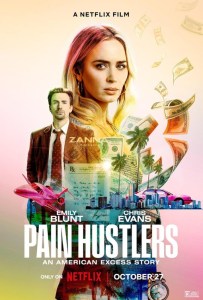
Pain Hustlers is the next attempt to dramatize the numerous stories behind the opioid crisis, a storytelling edict that is becoming its own tragic true-crime sub-genre (Dopesick, Pain Killer, Four Good Days, Recovery Boys, All the Beauty and the Bloodshed). The Netflix original has a starry cast and a topical and serious subject but it’s an un-serious movie caught up in the superficial quirks and appeal of being and making a goofy crime story of greedy sleazeballs.
Liza (Emily Blunt) is a struggling single mother trying to claw her way out of debt and, with her unfinished education and criminal record, few options are widely available. Then enters Pete Brenner (Chris Evans), a loud, gouache pharmaceutical rep for a powerful pain killer. He promises a lifestyle of luxury and power, as long as Liza is willing to ignore or bend a few ethics along the way. Together, they build a sales force of attractive women who wine and dine smaller doctors in order to get them to prescribe their special drug to anyone in need. It’s just that a drug intended for end-of-life pain wasn’t meant for common headaches. As sales boom, Liza begins to worry that her glitzy lifestyle is built upon a mountain of American corpses.

The biggest drawback of Pain Hustlers is that it fully focuses on the glitz and gives lip service to the cost of chasing that avarice. Plenty of movies illuminating bad people doing bad things are accused of glamorizing the misdeeds, from gangster movies to dark romances, though this narrow viewing often seems to conflate depiction with condoning the behavior (see: The Wolf of Wall Street). Watching stories about people stumbling their way into glamorous positions should provide some allure so as to better understand the seductive draw for the characters. The world of vice and power will be a compelling conflict, but for Pain Hustlers, it falters by just focusing on the high-powered lifestyle yet it still lacks specificity to make this story feel interesting on its own. You’ve seen variations of this kind of story before (we’ll call it Scorsese-esque) about the people struggling with less who get a ticket into a new world of access and freedom and then begin to worry At What Cost. Pain Hustlers goes through its plot beats with the most mechanical of movements. The personal details from this supposedly true story feel so generic, reminiscent of similar tales like, Love & Other Drugs and Hustlers. It feels less like an insider account of how these shady people exploited so many and more like the screenplay was cobbled together by what the filmmakers assumed this story must have pertained without reading much of the source novel by Evan Hughes. It’s absent the useful details that allow more of these accounts to prosper as we investigate moral relativism.
The other nagging shortcoming of Pain Hustlers is the consequences for all these bad people. I’m not saying that we need to see comeuppance and justice levied in order for the movie to work thematically; very often these white collar criminal types receive the faintest glance of judicial punishment. What this movie lacks is the emphasis on the consequences, and considering our main characters are pushing sleazy doctors to push highly addictive opioids, that’s a big miss. The movie is all about the climb for its heroine, the comparison of having the fancy life versus a life without. It shortchanges the extremely human cost of its bad actors in a way that does a disservice to the movie and its message. Because of its lack of specificity, this story could have been propelled by any prescription drug, from Viagra to Lipitor. The fact that we’re talking fentanyl, a drug responsible for 200 deaths every day last year according to the CDC, seems immaterial, and that is bizarre.

The effects of the opioid crisis begun by Purdue Pharma and the Sackler family, and then trickled down through the complicated tributaries of the American medical infrastructure, will be felt for generations. This is a major story. It would be like, say, telling the story of a struggling single mom who decides to take a career advancement in the Nazi Party in 1940s Germany. You’re not just doing a disservice to the people who really suffered, you’re doing a disservice to the audience to ignore the gravity of their moral culpability and excuse-making, of the drama of the character having to confront their part. For a movie about people profiting from opioid over-prescriptions, there is a grand total of one scene where Liza has to deal with the harsh real-world consequences of her actions (minor spoilers ahead, but I’d advise you to continue, dear reader). Early in the movie, when Liza was forced out of her home, she spent a few days living in a motel. The neighbor lady at the motel has a husband who dies from the opioid crisis, and this one man is meant to symbolize what she has wrought as a whole. It doesn’t work, and the fact that the movie presents Liza in tears trying to make amends to this widow, a character we haven’t had any thought over since Liza leaving her Act One beginnings, is a pitiful excuse for a reckoning.
Evans (The Grey Man) and Blunt (Oppenheimer) feel on autopilot here, namely because of the broad and bland characterization. Blunt resumes her Southern accent I recall from the Quiet Place movies, but her energy level feels too low, too disengaged, like she’s already at her quiet rectitude character phase when she should be at the gee-whiz giddiness of her moral slide. Evans is meant to be playing a cad prone to vulgar boasts and condescension for those he willfully steps over to reach his goals, but his “sleazeball” acting tics feel too forced, too played up, in all the ways that Blunt feels dialed down. There’s no baseline for the two of them, so the scenes they share together feel over and under-cooked, and with a generically developed rise-and-fall screenplay to boot. Andy Garcia (Father of the Bride) is the most interesting character as the head of the company, a doctor who began trying to ensure those in desperate need could have the dignity of mitigating their pain, and transforms into a megalomaniacal huckster who only wants to keep meeting the next sales projections. His rise-and-fall seems much more steep and intriguing than trying to give us Liza, a gutsy single mom (with a wacky mother of her own played by Catherine O’Hara) who we’re supposed to identify with and forgive for playing her part in a deadly chain that has wrecked untold lives across the country and world. She did it for her own kid’s medical treatment. So it’s all okay, right?

This is director David Yates’ first movie away from the familiar confines of the Harry Potter universe since the ill-fated 2016 Tarzan reboot, and only his second non-Potter movie since 2005. Given that history, I’m curious whenever this man jumps onto a non-Potter project because you would assume it has to be special in some manner. I’ll credit Yates with changing his visual preferences from the very drabby and gray palette of his Potter filmography.Pain Hustlers adopts a lot of the stylistic tics we expect in glitzy crime thrillers, from handheld camerawork to sun-bleached colors. There are other techniques to bring a documentary-like authenticity, but the constant cutting back to black-and-white interviews with the characters after the fact only serves as a narration crutch to keep things moving. The character narration lacks further insight from the distance or remorse of the onscreen events. The whole movie feels like a copy of a Scorsese imitator, something akin to 2009’s forgettable The Middle Men, a crime movie about a plunge into the underworld from a naif that doesn’t try too hard beyond empty reconfiguration of the superior style of its influences that I doubt anyone really remembers (you might as well add directorial narration, “Ever since I was young I always wanted to make a gangster movie…”). As immediate evidence to the case, there is a slow-motion house party in Pain Hustlers set to “Turn Down For What.”
Should you spend two hours watching Pain Hustlers? Not really, though if you have a fascination with the many schemers who contributed to making the opioid crisis as trenchant and terrible as it currently is, and likely will be for the near future, then maybe there’s some mild value to be had here. But even those people would be better served watching another Netflix series tackling the same subject matter, the 2023 limited series Pain Killer. For me, the Pain Hustlers story was too broad, and where it could have broken out with specificity is where it decided to wimp out and defer to genre cliches. It’s hard for me to argue that you should spend two hours watching this movie on the subject when you would be far better served, from an informative and entertainment standpoint, watching the two-part, four-hour 2021 documentary Crime of the Century by masterful filmmaker Alex Gibney. That film is damning and compelling and authentic in ways Pain Hustlers can only hope to imitate.
Nate’s Grade: C


 nathanzoebl
You must be logged in to post a comment.