Monthly Archives: July 2023
Asteroid City (2023)
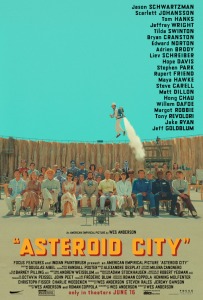 It’s not a good sign that a week after watching a movie I was racking my brain to try and remember what I had watched, and it’s even worse when it’s a movie by Wes Anderson, a filmmaker with such a distinct sense of intricate style it’s now become a go-to A.I. test for untalented people. Asteroid City has the makings of an appealing comic escapade set in a Southwest small town known for its tiny asteroid, and once aliens make their presence known, the entire town and its tourists and wanderers and scientists are quarantined. The problem comes almost immediately, as the movie is presented through several added layers of obfuscating framing devices. The story itself is a play, and we’re watching a movie version, but then also the play of the movie, and the behind the scenes of its now-deceased playwright toiling with his authorial messages and stubborn actors, and it feels like two different movies at odds with one another. The Asteroid City sequence is the more engaging, with some sweet storylines like Jason Schwartzman as a widower processing loss with his family, including his father-in-law (Tom Hanks) who never liked him, while beginning to find a possible romantic kinship with a struggling actress and single mom (Scarlett Johansson). I enjoyed weird little asides about the history of this little town, like a vending machine for land ownership, and s science fair with brainy whiz kids finding their own comradery. There’s even a nice moment in the meta-textual framing where the Schwartzman actor recites an exorcised dialogue scene with the actress who played his deceased wife in the play. It’s elegantly heartfelt. However, the added layers don’t really add extra insight or intrigue but serve as muddy trappings, making meaning less likely rather than more. It feels like Anderson didn’t have enough material with the central story so he added on the meta to make up the difference. There are too many moving pieces and too many characters, and versions of characters, here to settle into something grander. The whimsy and visual style of Anderson is still evident throughout every highly-crafted and pristine arrangement in the movie, so if you’re an Anderson diehard, he still has his charms. This is two Anderson movies in a row that felt disorganized, distracted, and chiefly under-developed, and I’m starting to worry that the form has taken over the function as storyteller.
Nate’s Grade: C+
Share this:

The League of Extraordinary Gentlemen (2003) [Review Re-View]
 Originally released July 11, 2003:
This movie is certifiably insane. While a very literary X-Men seems like a great idea, what exactly does Tom Sawyer bring to the table? What, is he going to convince the bad guys to white wash a fence? And yet, this highly operatic bombast almost succeeds on its sheer level of lunacy, like when you realize you’re watching Sawyer get a crush on a vampire on a giant underwater submarine that’s so big it has end tables and vases in its hallways. Still, the handling of Jekyll/Hyde here is what Hulk should have been like. League of Extraordinary Gentlemen almost works, but its falls apart amidst shabby special effects, outlandish plotting, and very wooden dialogue. The director doesn’t make it any easier to follow, trumping his action sequences with rapid fire edits. Ah well, my bafflement was more entertaining.
Nate’s Grade: C
——————————————————
WRITER REFLECTIONS 20 YEARS LATER

The League of Extraordinary Gentlemen is a fascinating film in that it cannot be good but it also cannot be bad; it exists upon an extraordinary plane where few movies ever transpire, not so-bad-it’s-good but an altogether different realm, where it would be impossible to be good while also impossible for it to be bad. It’s a bizarre yet fascinating contraption of a movie, a literary X-Men that plays to the lowest common denominator, making awe-inspiring mistakes as it careens to a bombast that approaches self-parody but lacks self-awareness to properly execute. I do not regret watching this again in 2023 but I cannot in good conscience recommend that you, dear reader, watch it, and yet I still want every one of you to.
It began as an adaptation of Alan Moore and Kevin O’Neill’s graphic novel which was itself a combination of high art (classic literature) and popular culture (super hero team-up), and from there that high-art mashup got even more… mashy… as it made its way through the Hollywood studio system to become a big, dumb summer blockbuster. You can see the appeal to the studio bigwigs, forming their own superhero team but from recognizable literary characters, and it’s fun to see these classic characters interact as well as slotted into superhero archetypes, though I’m sure there are a few academics that consider this a debasing of canonical literary figures. Jekyll and Hyde (Jason Felmyng) makes obvious sense as the Hulk of the group. Captain Nemo (Naseeruddin Shah) works as the tech-savvy Tony Stark. The immortal Dorian Gray (Stuart Townsend) is practically the group’s erudite Wolverine. I guess Mina Harker (Petra Wilson) would be this group’s Blade. There is a certain intellectual thrill watching classic characters in a new setting that relies upon them to work together and utilize their own special powers, highlighting that we’ve had superheroes long before the halcyon of the twentieth century.

Almost every artistic decision feels designed to fully baffle you if you think about it long enough, and while shattering any sense of reality, I can almost begrudgingly respect this creative license to simply go all out with the absurdity. This high/low combination makes every scene utterly ridiculous while also being fascinating. Nemo’s fantastical Nautilus sub is designed like a giant straight razor, yet the bustling interiors are so stately, including lengthy hallways with end tables and vases, a decorative motif that makes absolutely no sense on a submersible. There is a literal scene where Allen Quartermain (Sean Connery) teaches Tom Sawyer (Shane West in a terrible haircut) how to shoot better when the guy already shoots plenty good and Tom, completely oblivious, asks, “Did you teach your son to shoot like this?” But why would Tom ask that, in this moment, unless to touch upon the fact that Quartermain’s son is dead, a fact that we the audience already know? There are hidden bombs placed that will be triggered by a hidden frequency when played on a record, and somehow every corner of this floating city of a sub will hear this one record player in one room? Why even record a triggering device and have it linked to the villains explaining their plan? Why would you need to steal Da Vinci’s architectural plans for Venice when, I’m going out on a limb here, there are more accessible and modern city infrastructure plans in 1899 Venice?
So much of the character dynamics and characterization are condensed to their formula necessity. Our reluctant lead gets a surrogate son to try and mentor. Quartermain hates the British government because he blames them for his son’s death, but it’s not like he’s abandoned the luxuries of colonialism while retiring in Kenya. The invisible man (Tony Curran) gets an opportunity to prove that a criminal can reform and be counted upon. Jekyll and Hyde learn to work together rather than fighting for dominance. Mina Harker is a powerful vampire and yet her role is to be a possible love interest to the young kid on the team and to seek vengeance on her other lover, placing her entire character arcs as past romantic partner and future partner. Look at the poster art and you’ll see they had to make extra allowance to squeeze in her vampire cleavage, her real feature as far as the movie is concerned. You have a vampire on your team and the movie simply treats her as a walking set of boobs. I suppose Tom Sawyer is meant to serve as our entry point into this world as the rookie, but every character on the team is a rookie, so having an even bigger novice seems superfluous as they’re bringing the League back together, except it’s revealed later there was NEVER any League of the past, which means the bad guy literally commissioned oil paintings of past member combinations that never existed just to sell a false history that never amounted to anything (again, pick at any detail and the entire reality unravels). Even the villain’s plot is needlessly convoluted and also astonishingly simplistic: create conflict, sell arms, get money. The secondary scheme could have been accomplished by just asking each of the League members to sit for a blood test. You didn’t need to destroy Venice for this.

The colossal miscalculations extend beyond the screenplay. This movie essentially ended the career of Connery and its director, Stephen Norrington (Blade). The story goes that Connery was offered the part of Morpheus but turned it down because he didn’t understand The Matrix, and he was offered the role of Gandalf but turned it down because he didn’t understand The Lord of the Rings, and after both became cultural phenoms, Connery was determined not to let his own questions stand in the way of what could be the next sci-fi/fantasy blockbuster. Those notable “no”s lead him to regrettably saying “yes” to this silly movie, and then he was done. In the seventeen years before his death in 2020, Connery only gave a handful of vocal performances, the last one for 2012’s Sir Billie, the first CGI-animated feature from Scotland, and oh is it bad. Norrington and Connery didn’t get along during the production and at one point the director tried to goad Connery into punching him in the face. Norrington refused to make another studio movie and has gone back to his makeup and special effects background for film productions, including providing creature effects for Feast and Exorcist: The Beginning. The fact that Connery’s character dies but they end on his possible resurrection, for a possible sequel never to come, is especially hilarious knowing Connery and Norrington elected to quit their jobs after this.
At some point, you just give into the movie and try and ride its absurdist wavelength. The climax involves an assault on a giant munitions compound making… metal-cased men? Like armor? Don’t we already have that? The movie’s rules posit that the invisible man is only truly invisible when he’s fully naked, and the movie makes sure you understand this at several points, so having a climactic battle in a frigid mountain compound just makes you worry that he’s going to be blue and invisible. I love that Dorian Gray’s weakness, his infamous supernatural doppelganger painting, isn’t like locked in some impenetrable fortress but just something he carries with him, like Superman keeping kryptonite in his travel bag. I also groaned when, while fighting Mina, he stakes her to his bed and blithely says, “I always wanted to nail you one more time.” Again, simply amazing and flabbergasting. Why do we have one member of the team that shoots good when we already have another member of the team who already shoots good? I would have laughed out loud had the filmmakers actually resorted to Tom Sawyer tricking the minions of evil to white wash a fence instead of threatening the new world order. There are no standout action sequences, the special effects can be rather dodgy for its budget, and the editing is jumbled to likely mask the absence of good action choreography, but what this movie has, in rich abundance, is lunacy, a plethora of ridiculous plot elements to digest.

In 2003, I didn’t have many words to say about The League of Extraordinary Gentlemen but all of them are correct and still accurate twenty years later. This is a movie that almost works on its own level of schlocky absurdity, and yet it could never work with this approach, but it’s littered with bizarre, miscalculated ideas and plot elements that make it all the more fascinating, like a car crash of a painting. They don’t really make movies quite often on the scale of disaster that is League of Extraordinary Gentlemen, and we all benefit by examining how something like this slipped through, to remind us all of the folly of man and the strive to do better. Somebody dissect this like a case study for our benefit as a species.
Re-View Grade: C-
Share this:

Gray Matter (2023)

As a lifelong film fan, I’ve always been fascinated with the trials and tribulations of the many seasons of Project Greenlight. It began in 2001 as a contest shepherded by Matt Damon, Ben Affleck, and irritable producer Chris Moore to select the best submitted script and turn it into a movie. The process would also be documented at every stage by TV cameras for an HBO documentary series, but this is an organization defined by its chaos and mistakes, which make for spellbinding schadenfreude television and rather disappointing movies. Each season tried to retool. Season one winner Peter Jones was more a writer than a director and not fully ready when he was thrust to also direct his winning script, so season two had separate submissions to select a winning writer and a winning director to pair. Season three realized that the coming-of-age indies of the first two seasons (Stolen Summer, The Battle of Shaker Heights) didn’t exactly ignite the box-office, so the intent was a more commercial genre script, which ended up becoming the monster siege thriller, Feast. Season four, coming nearly ten years later, decided that the commercial script needed to come from a more trusted and studio-backed source rather than amateurs. That source: Pete Jones, now having become a co-writer to some Farrelly Brothers comedies. That season only sought to select a director, having now completely ditched the screenwriting aspect from the start of the contest, but the winning director ditched the approved script to make a middling comedy feature of his own short film (The Leisure Class). Now, many years later, HBO Max (or now just… Max, because somebody thinks “HBO” lacks brand value) has rebooted Project Greenlight, again, and has another more commercially-minded script to serve the eventual directing winner, this time among a team of ten female finalists. So after twenty years and five movies, what has Project Greenlight proven? Good TV doesn’t mean good movies.
Gray Matter will forever be known as “the Project Greenlight movie,” and if it wasn’t for that series, we wouldn’t be seeing this movie because it’s so generic and underwritten, which, having spent the day binging through the new Greenlight season, are the same problems that all the many producers were complaining about with the script. Well, you folks picked this script, right?

Aurora (Mia Isaac) is a 16-year-old who just wants to feel like a normal teenager. Her mom, Ayla (Jessica Frances Dukes), is afraid she won’t be able to defend herself in this scary world. They’re a mother-daughter psionic duo, exhibiting mind powers. After a tragedy away from home, Aurora finds herself in a weird complex run by Derek (Garret Dillahunt), a mysterious authority figure who says he’s trying to find all the psionics he can to help them better understand their unique abilities. Aurora suspects her captors don’t really have her best interest at heart.
That plot description above sounds like a hundred other YA-tinged stories, from The Darkest Minds to Firestarter to the X-Men TV show The Gifted, which also co-starred Dillahunt. It’s a fine starting point but the story and characters need to find ways to better personalize this formula, and that’s where Gray Matter falters. It’s all too surface-level, from the mother-daughter relationship, to the determination of Ayla, to the self-actualization of our teen. It’s not that you’ve seen it before, it’s that you’ve seen it before much better in so many other stories.
The story pieces are present that can be developed for a more engaging and character-centric sci-fi drama. There is potential here. I think more could be made about Ayla’s past connections to this psionic complex, but instead of being offered to co-chair it as an administrator, it would have been more interesting if she had been younger, a pregnant teen, and her unborn baby was the course of great speculation for the facility, especially being the child of two psionics. This would add an extra layer of urgency why Ayla felt she had to leave as well as why Aurora would be more coveted than other psionics. It could also easily explain why Aurora would be more powerful than any other psionic. It would also personalize the sacrifice of Ayla as well as her paranoia about the lengths they will be hunted. We needed more time with Ayla as a character because once the daughter gets kidnapped around the Act One break, she’s seen more in flashback and fantasy sequences than reality. If this is going to be the emotional core of the movie, then we need to flesh out the mother and the scenes between them. As demonstrated in the movie, Aurora is here to push her daughter, tell her she isn’t ready, then restrict her but also not really restrict her, as Aurora seems to sneak out every night to meet boys. If this woman is so paranoid, why is she alternating between being a strict gatekeeper and a free-range parent? It didn’t make sense. She’s keeping her child out of school and the public and constantly moving, but hey, go ahead and fraternize with these teenagers supposedly behind my back?
It’s also a shame that our protagonist is such a boring blank. The puberty/super power allegory has been prevalent for decades, but for a movie that literally spends so much of its time inside the mind of its main character, she’s unfortunately too underdeveloped and unexplored. She’s just kind of present for too many of her scenes rather than an active participant. This is partly from the nature of the script, where Aurora has to learn about her powers and the history of psionics, but why does the first act of the movie resort to repeating this exposition? We have one scene where mom is explaining powers and what’s at stake, and then twenty minutes later we have another scene of Derek explaining powers and what’s at stake. The biggest problem with Gray Matter is that its central character feels like an afterthought of a simple yet empty empowerment message. It’s about a young woman coming into her own power, externally and internally, but it’s also expressed under such generic terms. What do we know about Aurora? She wants a “normal life” but what does this constitute? Does she resent her mother’s rules? Has she rebelled in the past? What really animates her? What is her sense of purpose? I don’t know, which diminishes all the sequences of her running in terror, and that dominates the middle hour. I wish the script had started with her sneaking out, hanging out with these kids who consider her “that weird homeschool girl,” and then when things go wrong we have to learn with what we see rather than sitting through multiple people trying to explain the world and rules. It would be a better shock when things go wrong, and the added time would allow more breathing room to try and flesh out Aurora before she’s defined by her powers.

Another aspect that needed further re-examination was the nature of the psionic powers. The plot needed to better define the rules of these powers, which are quite varied. We begin with the powers mostly being telekinetic, the ability to move things with one’s mind. Then it jumps into telepathy, the ability to speak through one’s mind, then read the minds of others, then project mental structures, then working all the way to teleportation. There is a good scene where Derek is impressed by Aurora’s ability to hide her thoughts with a false setting construct, and I enjoyed him pointing out the giveaway details, like a character reading a book that is only ever the same page. That was a smart scene that better visualized the powers. However, the characters talk too broadly about the powers in sweeping proclamations. I think the movie could have improved had the story ditched more of the powers and settled down on one, with Aurora having the ability to manifest more than one power being a sign of her extraordinary identity.
As a low-budget genre movie, Gray Matter looks like a professional movie and has good actors doing their best. Debut director Meko Winbush has made a genre movie that looks practically indistinguishable from other disposable Hollywood genre thrillers, and maybe on a sliding scale, feeling and looking like a generic sci-fi thriller might be a success in the history of Project Greenlight. But I doubt all the many people who lent their labor and names to this project were hoping for it to be on par with a forgettable streaming entity eventually crushed by a library of content. Winbush presents enough visual polish that could lead her to future work, something that has also plagued many of the director winners from seasons past (Jason Mann, the season four winner, has one feature credit after The Leisure Class, serving as DP to a 2019 Slovenian movie). It’s hard to feel what exactly people could get passionate about with Gray Matter, and they just waited for a rewrite to supply all the missing emotional engagement and introspection and fun that was absent. Once again, the finished film ends up being a disappointing season finale to a train wreck of reality TV.
Nate’s Grade: C
Share this:

Obstacle Corpse (2022)

Hope Madden has been an esteemed critic, journalist, and writer for many Columbus media publications and television for years. She and her husband, George Wolf, run MaddWolf, a popular film blog, and head the Fright Club podcast and horror film programming at the Gateway Theater. They know movies inside and out and they know horror. So it makes sense for Obstacle Corpse to be Madden’s first feature as a writer and director. It’s a high-concept horror comedy filmed in the Columbus, Ohio area and now available to watch on Amazon. Madden and Wolf are both part of my Columbus film critics’ group, and so I will, as I always strive for with reviewing Ohio-made indies, attempt to be as objective as possible knowing many involved in the cast and crew. Obstacle Corpse is, above all things, enjoyably demented. It’s a low-budget horror movie that understands that an indie horror movie is going to succeed through concept, personality, and mood, and Madden pays attention to each of those winning dimensions.
Sunny (Sylvie Mix) just wants to impress her domineering and dismissive father. She signs up for the Guts and Glory competition, a twelve-event obstacle course, to prove herself. Each contestant is expected to bring a partner, so she brings her best friend Ezra (Alan Tyson) who is ready to get back home and out of the woods pronto. That’s even before they discover that the teams have gathered for some brutal competition. Each team is also required to kill their teammate over the course of the grueling events, so will Sunny and Ezra survive, and will they possibly turn on one another to save themself from the deadly games?

The premise is a quick hook, a deadly version of an obstacle course, and makes twisted sense, not just from a canny take-something-from-childhood-but-make-it-deadly calculus of recent gimmicky horror. There are plenty of adult-oriented obstacle courses known for their physical endurance, like the Tough Mudders and Spartan Race and Ninja Warrior, so an escalation into literal life-and-death stakes as an experiential attraction makes sense in a twisted fashion. Madden has also done what I wish several other indie filmmakers would and distinguished her large net of crazy characters. There’s a wonderful sense of personality to the different groups, which helps the audience keep track of the many different faces, but it also allows the characters to be more playful. I don’t care why some would dress up like clowns for this competition and others as baseball players, I’m just glad that these characters are happy to stand out. I enjoyed a middle-aged man eager to transform every moment into a phony social media tableau. I readily enjoyed the hyper-competitive nature of Stephanie (Gareth Tidball), an intense woman who gets off on the thrill of each challenge. I enjoyed one grumbling angry man (Wolf) who could be counted on to struggle in last place no matter the obstacle. I enjoyed a tracksuit-clad bickering couple. I liked a family of siblings that distinguished itself in paired T-shirts, with one pair wearing “single” and the other wearing “double.” I didn’t quite understand it since they were both pairs but I liked the effort all the same. Even little details can add much.
The mood of Obstacle Corpse is chiefly one of carefree fun, an amiable tone that brings a comedic lightness to even the most ghastly of circumstances. It’s prevalent throughout the movie and makes the 80 minutes easy to digest. Madden’s good times are best summarized by the scene-stealing performance of Mason (Donovan Riley Wolfington, Madden’s son), a costumed chef dishing out cold vengeance from his ice cream truck. This character is presented as a change agent, an unexpected wildcard who is disrupting the establishment overseeing the games. He’s a live-wire of energy, channeling Deadpool or a Looney Tunes cartoon at different points, and he will dismember contestants while gleefully singing his violent versions of Christmas carols. It’s a standout performance in a large cast of varied characters, and Wolfington is just operating on another level of insane amusement. The character also becomes one to easily root for because he’s an antihero underdog taking advantage of others underestimating him, and he’s also that change agent, bringing a bloody sense of justice to those involved in the continuance of the games. A late-in-the-game revelation about his history made me wish for more development to better utilize the key info, but Wolfington is the best mascot for the movie’s demented charms.

Given its large cast, there are several that made a favorable impression as they navigated the comedy aspects. Mix (Poser, Double Walker) is a definite find for Columbus cinema and will be going places in no time. She is a natural actor and serves as our baseline of normality, a shifting concept in a world of violent mayhem. Tyson (Stowaway) is a great foil as Sunny’s friend. He’s more effete and unimposing, at first glance, so his incredulous reactions are a welcomed source of comedy and reason. Tony White does a lot as a clown/mime who befriends our “normal” characters. He gives a very expressive and charming performance, and yet there are a couple of moments where his tortured emotions serve as a surprising well of feelings (he is labeled as Sad Clown, after all). Even producer Jason Tostevin (Hellarious) has a laconic menace as the head of the games security, and he delivers a monologue about achieving your peak greatness that sounds like a self-help guru comfortable into the exploitative routines. He’s our face of the establishment, so as things begin going haywire from our anarchic chef, his discomfort provides a consistent outlet for satisfying comeuppance. You can tell the cast is enjoying themselves, and that casual camaraderie helps to add to the overall silly and bloody fun of the movie.
I wish the parameters of this killer event had a bit more clarity and development to really maximize the possibility. First, I thought that these many obstacles were themselves going to be part of the killer challenge, something akin to Squid Games where familiar childhood playground games have been transformed into life-and-death contests. That’s not the case, so watching characters overcome a cargo net or a set of tires feels somewhat disappointing because what would the appeal of this physical track be beyond the murdering? I think part of the joke is that these are ordinary park obstacles that are causing so many so much struggle. The rules of this course can also be rather murky. We see the enforcement of what happens when a contestant kills outside of an official obstacle course event, but the rest of the rules are left too vague. Contestants are welcome to bring their own weapons, like bats and knives, so could someone simply bring a high-powered gun and mow down the entire competition? How does this work exactly? What prize do the winners receive at the end other than having killed their partner? Did Sunny’s father understand what exactly she was getting into and approved? I’m also left slightly bewildered how many of these teams are family members that are so eager to kill one another. I’m not opposed to the possible fratricide plot, but I think the movie needs to present more conflicts within the couples to present as possible explanation for this murderous intent (maybe an old score to settle like stealing a girlfriend, maybe it’s an inheritance battle, maybe it’s sussing out what the particulars are of the familiar tension, etc.). It’s shocking to watch an older brother pitch his younger brother into a fire and kids killing kids (off-screen), but the shock value only goes so far, and having more setup or context could have added more satisfaction. I guess many are just wannabe psychopaths looking for any excuse to indulge their darker impulses.

I think about the brilliant simplicity of 2019’s Ready or Not. The movie’s premise is essentially a killer game of hide and seek, already a rather uncomplicated children’s game. But the filmmakers carefully established the rules and stakes, with the family holding to he belief they need to kill the person hiding before sunrise or else they will all die thanks to a generational curse. It’s outlandish but the movie presented all the vital information and then let things rip. In the case of Obstacle Corpse, it’s around the fifty-minute mark before our main characters, the normies, discover the actual deadly stakes of the game, and their response seems a tad… relaxed. Part of this is, as earlier described, the amiable low-stakes charm of the movie, so nobody ever brings too much of a sense of actual reality to the absurd competition and its slapstick violence.
I also wish Obstacle Corpse had coalesced more of a class-conscious political commentary. We are introduced to a wealthy couple who are bankrolling the games under the auspices of live online betting, a concept also explored in many other movies that summarize the villains as bored rich people betting on the lives of the poor (Squid Games, Escape Room, The Hunger Games, etc.). That works, though the script only gives us one or two check-ins with our wealthy couple as they seem more interested in canoodling than keeping up with their own spectacle. Maybe that signifies how blase they are about human life but it felt like a missed opportunity. I kept envisioning a version of Obstacle Corpse that really trained its fire on the callousness of the rich, with the teams each being a boss or CEO and some lackey or intern that they’re stringing along, meaning each competitive couple already has a class distinction. The plot informs us that the veterans know they are inviting their guest to their intended doom, so why not project onto a corporate or wealthy head and their contempt for a lower-class worker they see as literally disposable? Perhaps these fragile wealthy men think they’re so much more capable or threatening than they really are, a concept given some attention through the hyper-macho character of Richard (Brian Spangler) who can’t live up to his overblown expectations. There’s an overinflated sense of toxic masculinity that relates to physical dominance that was worthy of even more deconstruction and criticism. I think this dynamic would have allowed the movie to hone and target its ire with more potent satirical firepower.
Even with some of my misgivings about clarity and untapped thematic potential, Obstacle Corpse is an enjoyable horror comedy for fans. The blood gushes constantly and the gore is impressively grotesque for its minimal budget. There are some impressive shots for a movie 95 percent filmed in the woods. Madden has crafted a movie that works regardless of budget, with its larger-than-life characters and conflicts resulting from a strong and memorable high-concept premise. The emphasis is more on comedy than horror, like the world’s most demented summer camp outing. Given the large cast of characters, the movie always has a new batch of people to jump through, which keeps the movie fresh even when the suspense can slacken because of the comedic emphasis. It’s not a one-joke movie, and the fun of the cast can often be felt, especially the grand ball of a time had by Wolfington. There are things left out I wish had been explored further, but this is a solid start for Madden and her team in the realm of indie genre filmmaking. If you enjoy your comedy with a heaping helping of blood and bad taste, give Obstacle Corpse a chance.
Nate’s Grade: B-
Share this:

Sound of Freedom (2023)
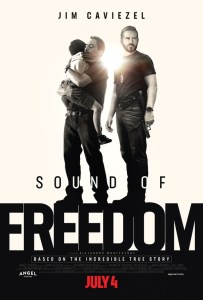 The surprise of an otherwise underwhelming summer at the box-office, so far, has been an indie movie made for only a fraction of the bigger studio fare. Sound of Freedom is an action drama originally filmed in 2018 and even resorted to crowdfunding for post-production assistance, so you’d be curious as to what about this movie is making it the hot commodity in 2023? Well, the answer is both uplifting and also dispiriting, with good intentions running against possible bad faith. However, as an action drama chronicling the ills of human trafficking, it’s pretty mediocre genre stuff and indulges too often in wallowing in the danger of these innocent children under the guise of raising awareness of a pertinent problem that too many may unfortunately misconstrue.
Reportedly based on the experiences of Tim Ballard (Jim Caviezel), a former Homeland Security agent who was tasked with breaking up child-trafficking rings. He even goes undercover to bust skeevy mustachioed pedophiles looking to meet up with buyers, which causes obvious physiological distress and a strain on his marriage, although his wife seems saintly (played by Mira Sorvino, who is only here briefly to urge her man on). A Honduran brother and sister are sold through the front of a child beauty pageant into sex slavery, and after rescuing the brother, he’s determined to reunite the siblings. His efforts lead to Ballard quitting his government job and going to Columbia to try and rescue the children being held as commodities by gangs.
 Allow me to be a little glib, dear reader, as I summarize what the plot of Sound of Freedom boils down to. Here goes: the movie quickly establishes sex trafficking as bad. Not hard. Got it. Our hero sees this and says, “This is very bad. I should do something.” The government says, “This is very bad. But what are you gonna do, you know?” Then our hero proclaims, “I can do something,” and the government brass says, “Well, we don’t know if you should,” and then our hero declares, “Well, I’m gonna!” Then he infiltrates the trafficking ring and reunites a little girl with her brother, and by the end we all learned a valuable lesson that human trafficking is very bad. The end. Now, yes, when you reduce any movie to its most essential plot points, it can feel reductive and like you’re missing something (Star Wars: farm boy leaves home, has adventure with hermit, saves princess), but there isn’t anything more to this Sound of Freedom than any of the Taken movies. It’s not exactly illuminating though it feels very sincere in its convictions.
As an action movie, there sure is a deficit of action to go on for a movie pushing two hours. There’s a climactic rescue but the majority of this movie is the overly simplified journey of trying to find one missing girl. Criminal procedures can be intriguing when there’s a real sense of continuity and progression, chasing down leads, connecting the dots, building the case. It can be invigorating when done well by smart people, like in 2012’s Zero Dark Thirty or the more recent true-life tale of exposing the murderous subject of 2022’s The Good Nurse. With Sound of Freedom, the problems are too easily overcome and the details are minimal. A lot of the breakthroughs are reliant upon chance.
Sound of Freedom feels like a professional action movie, with grimy cinematography and a mournful score, but there’s too little else going on here that is unknown to a general audience. It’s all pretty straightforward and yet sludgy with its overwrought pacing. This is a slow burn of a movie with an obvious end point manufactured for audience uplift, with Caviezel appearing as himself during the end credits to plead for others to donate to the cause and buy tickets for others for the “Uncle Tom’s Cabin of the twenty-first century,” which is what many are doing and donating them to others or passing them off to strangers.
 There is one moment that I thought was unexpected, where reliable character actor Bill Camp (The Queen’s Gambit) plays an ally to assist Ballard in putting together a fake sex trafficking palace for pedophiles (this is much of the last act). Camp plays a businessman who indulged in the illicit excess of power until one fateful sexual encounter with a prostitute that he believed to be in her mid twenties. He’s sickened by the revelation that she was only fifteen years old, and this causes him to have a moral shakeup of his behavior, his complicity, and the entire system of wealthy and powerful people indulging in vices that leave others trapped in cycles of violence and degradation. It’s a potent moment that I wished that Camp’s character was the actual protagonist, a character with flaws trying to overcome a shameful past and do some measures to rectify change. That’s a more interesting starting point than a stoic yet familiar action hero who is defined by his dedicated calling to save the lives of children.
Nobody needs much persuasion to believe that sex trafficking is a definite bad thing, and yet the movie spends so much time wallowing in the grotesque terror of its captive children. It’s one thing to highlight the harsh reality of real-world trauma, but it’s another thing to keep going back for dramatic weight not provided through the rest of the movie. It’s hard to watch young children, gasping and crying, knowing they are likely minutes away from being abused, but why go back to this repeatedly? Did they think the audiences forgot what was happening? Because there is so little else to this movie, plot and character-wise, the frequent stops to watch kids in horror right before being abused are galling, and not just for the intended artistic purpose. Too much of Sound of Freedom is watching a grief-stricken dead-eyed Caviezel gravely intoning, “How can we let this happen?” intermingled with prolonged scenes of terrorized children. It feels too exploitative and gross. I recognized it as a cheap emotional cudgel, and one I didn’t appreciate considering the film’s intended message about the well-being of children.
Here’s where I think the movie’s good intentions run up against the reality of trafficking. The far majority of people who are victims of sex trafficking are not being abducted in public by foreign strangers, they’re not being grabbed at Target stores or somehow hidden in Wayfair furniture (this specific and moronic conspiracy theory was propagated by Ballard as well, sigh); instead, the common perpetrators are friends and family. Often it’s low-income parents with significant substance abuse issues who, in desperation, resort to the most cruel outcome to resolve their addiction. The far majority of trafficking victims are in their teens, seventy percent between 15-17. Victims are also often members of the LGBTQ community who have been kicked out of their homes, and some of these victims resort to trading sex for their own survival. Victims are often those seeking out relationships because of abuse and neglect at home and those coercive relationships then transforming into trafficking. The reality of human trafficking is a lot more complex. It is a worthy topic of imminent concern, but it’s not scary brown-skinned foreigners coming to steal your unsupervised babies. It’s not a cabal of Democrats wanting to drink the blood of children for its power (this specific and moronic conspiracy theory was propagated by Caviezel as well, sigh). The problem with crusading against sex trafficking is when your concept of the topic does not match the reality of the problem. It’s this sensationalized boogeyman, and not knowing the actual reality of the problem will only lead to misapplied solutions for a different reality. Also, the far majority of human trafficking is with labor trafficking, which will be much easier to succeed by lowering the age of child labor in certain states, so there’s that too.
 By every objective measure, Sound of Freedom is a hit. The movie cost $14 million and has already grossed over $50 million at the U.S. box-office. While part of this is a campaign for people to buy tickets to then give away to others, the tickets are still purchased regardless of whether the seats are filled in their entirety. Many people have been inspired by the movie and its heroics, and far be it from me to deny them their uplift. I was let down by the deficiency of the find-and-rescue plot details and the sludgy pacing. I was especially put off by the excessive time spent exploiting the terror of abused children for unnecessary drama. Obviously the subject should make anyone feel uncomfortable, and sex trafficking is a very real evil that everyone should be able to condemn, but there needs to be more to this movie than reminding you that sex trafficking is very bad. I will credit Sound of Freedom with not depicting any specific pernicious QAnon conspiracies, but there’s significant overlap between that community and the audience for this. As a genre exercise, it’s kind of dull. As an expose on human trafficking, it has potential but skirts complexity for the finality of a feel-good mission with clear cut heroes and villains. There are obvious good intentions here wanting to highlight a worthy cause, and that might be enough for many viewers who can coast on the slick production values and overall stoicism.
Nate’s Grade: C
Share this:

Robots (2023)
 Robots takes the romantic comedy genre and adds a dash of science fiction satire. Charles (Jack Whitehall) is a sleazy womanizer who likes to use his robot double, named C2, to put in all the getting-to-know-you effort with dates so then Charles can jump in for any later physical intimacy. Elaine (Shailene Woodley) uses her robot double, named E2, to bilk dumb men out of money and gifts. Then one day Charles and Elaine meet cute at an ice skating rink and begin a relationship. She doesn’t know Charles is really C2, and he doesn’t know Elaine is really E2. This confusion is cleared up when E2 and C2 run away together and abandon their human selves. The real Elaine and Charles must work together as they cross the country to find and regain their robots before they cause trouble.
Where Robots goes wrong is with its clunky execution, as its promising premise succumbs to gassed rom-com cliches and some tonally confounding comedy, when it does remember to be a comedy. It’s a given that our two human characters, or at least the flesh-and-blood versions, will grow closer together over the course of their road trip to find their runaway mechanical selves. This unique situation pushes them out of their comfort zones and allows them to better open up. The possibility is there to even follow a strict rom-com formula and still be satisfying, if the romance felt organic and charming. It does not. If anything, the movie uses your knowledge that these two will likely fall in love against you, speeding through the process with haste. The movie’s idea of romance consists of a montage sequence where our two characters laugh, get drunk, and hang out in a hotel room. It’s like the screenplay zapped over the actual development of the romance, the moments where one character saw another differently, where the initial conflict began to thaw, so what we’re left with feels hollow and artificial. The actual robot versions have a stronger bond than their human counterparts (I’m sure this is part of the joke). I didn’t care about our romantic couple because the movie itself didn’t seem to care enough about them to develop their romance beyond the basic framework of convention.
 The comedy and commentary can also be very off-putting and incongruous. The premise deserves more scrutiny, either by the characters or the script itself. These two people are duping their prospective dates, one for money and the other for sex, and the movie just kind of shrugs about using robotic slaves for manipulative gain. I assume the filmmakers wanted to keep things light, but there’s at least more comedy to be had from the bad things these bad people made their innocent robots do for them, even a point of arguing who is the worst person. If they’re bad people, then dig into it. The movie also dispels with the contrasts between the couples too quickly. The screwball romance ramifications are ditched too early to send Charles and Elaine on their mission. When your premise has mistaken identity programmed front and center, you would think the comedy would take full advantage of this and escalate to farcical levels. Nope. There isn’t even anything approaching the cringe comedy co-director/co-writer Casper Christensen (Klown) is better known for. The humor is stuck on broad slapstick and easy jokes that confuse vulgarity with instant comedy. Robots includes a video of C2 and E2 committing a mass shooting. The plot purpose of this is for the robots to vilify their human identities and to force them to hide from the public out of fear of being caught, but why an implied mass shooting, especially in this day and age? Why not have them rob a bank? The purpose is to commit a crime and publicize themselves to make life harder for their humans. It’s too blunt a choice to work.
Likewise, the political commentary that pervades the opening is completely absent throughout the rest of the movie. We open with a buffoonish U.S. president celebrating the construction of a border wall with Mexico, never mind that it’s easy to slip through. Unexpectedly, the cry of “them Mexicans took our jobs” has now been replaced by “them robots took our jobs.” You would think there would be ample room here for satire on the economic struggles of Americans, the salivating exploitation of big business, or even the xenophobia that often coincides with economic distress. Any political commentary is done away with after this opening. If offices can just have robot doubles doing all the boring drudgery, then what does that do for human interaction? Surely businesses would prefer workers who technically lack human rights and never need to eat or sleep. The screenplay gives us one character to discuss any of these topics, an obnoxious best friend (Paul Jurewicz) to air out his hatred of robots. There’s also another character that serves as a plot convenience for how our two leads got their doubles. Other than that, the world seems oddly absent from any significant cultural shifts from robot inclusion. Part of this is the convenient plot point that “personal use” robots are outlawed, which again you would think would produce more conflict with our pair having to hide their ownership. Mostly though, it feels like the writers just didn’t think through how their world would be different in a meaningful way, which robs the movie of better satire, comedy, and simply ideas.
 What makes the movie mildly worth watching are the talents of its two leads. I wouldn’t exactly say Woodley and Whitehall have a spark-worthy chemistry, but both actors are professionals who have no qualms about getting silly in the name of comedy. Whitehall (Jungle Cruise) is amusingly droll, and while his deadpan can be hilarious, it can also sap the energy of certain scenes. Still, he’s an enjoyable performer who has fun playing a louse. Woodley (Divergent) isn’t exactly the actress you’d think of for broad comedy but she has great fun playing the different versions of her character and tweaking sexist male fantasies. Both of these actors are good with the material that they’re given, so it makes you even more wistful about what could have been with even better material for them to really shine.
Robots is a comedy that could use more comedy, a romance that could use better romance, and a social satire that seems to forget pretty suddenly what it’s satirizing. That’s quite a surprise considering one of the co-writers/co-directors has both Borat films on his resume. It feels like a poorly developed episode of Black Mirror; however, I know I’m in the minority on this one, I find the majority of Black Mirror episodes to have intriguing premises that go nowhere. So, by that assessment, it is a Black Mirror episode. The actors are enjoyable and some of the jokes land, but you’re mostly left wondering what could have been from this wasted premise. The whole enterprise just seems to run out of ideas and energy and inspiration halfway through, stranding good actors and a fun premise in a movie that needed more beta testing to be its best version.
Nate’s Grade: C


 nathanzoebl
You must be logged in to post a comment.