Daily Archives: May 25, 2023
The Matrix Reloaded (2003) [Review Re-View]
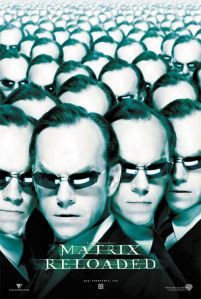 Originally released May 15, 2003:
Imagine my disappointment as I viewed the highly anticipated sequel to 1999’s sci-fi smash The Matrix and learned that the writing and directing team of the Wachowski brothers had taken a page from good ole’ George Lucas on how to make sequels: the “bigger is better and more is more” approach. Like the first two Star Wars prequels, the second Matrix movie is overstuffed and unfocused. Unlike the Star Wars prequels, it’’s also extremely talky when it comes to psychobabble that would only impress the bong-carrying peanut gallery.
Reloaded picks up some time after the first. Morpheus (Lawrence Fishburne), Neo (Keanu Reeves), and Trinity (Carrie-Anne Moss) are late for a pow-wow with other leaders including Morpheus’ former flame, Niobe (Jada Pinkett Smith). In this meeting, which is within the Matrix, we learn that the humans have discovered that the machines are drilling at an incredible speed and will reach Zion, the last human city far beneath the Earth, in a matter of days. Add this to the bad dreams Neo keeps having where Trinity falls out of a building and gets shot by an Agent, and things are not looking good for our heroes from the first film.
At Zion, Morpheus stokes up the crowd who already believe that Neo is The One in the prophecy of the Oracle (Gloria Foster). They believe he is the one who will lead them to topple the machines. Morpheus informs the many citizens of Zion (okay, the last battalion of the human race lives in caves under the surface and people are STILL wearing sunglasses all the time? Watch your heads.) that the machines are digging to a town near you, and they have 250,000 Sentinels to wipe out what remains of humanity.
 So what do people do next; what would your standard response be? Apparently, in Zion, it involves a massive spontaneous, sex-charged rave. The multitudes of Zion start grinding and sweatily dancing to electronic beats. And curiously, as you’ll notice with the slow camera movement in the scene, NO ONE in the future wears a bra. Perhaps the machines got those too. So after a tremendously long span of raving with nipples, inter cut with Neo and Trinity knockin’’ boots (though could you imagine zero-gravity sex in the Matrix?), the heroes set off to find the Oracle once more. Zion is preparing to mount a counterstrike against the burrowing machines and is hopeful that it will buy them some time. They plan on sending the entire fleet out, save Morpheus’ ship and one or two to aid him in his quest.
Neo finally regroups with the Oracle along a park bench inside the Matrix. She puts forth more psychological babble about choice and how choices are already made before you make them. You may start zoning out and wondering when people are gonna’ start punching people again, because it takes a good 45-50 minutes to get into this movie. The Oracle does have an interesting tidbit of information however. She reveals that the Matrix if just chock full of rogue programs living out their days in the confines of this virtual reality. Included in this group are werewolves, vampires, ghosts, angels which are all programming errors that walk among the Matrix. So, wouldn’’t it be kind of neat to see Neo fight the monsters from Universal Studios (“Hey Frankenstein monster … I know kung-fu” “Fire baaaaaaaaaad!”)?
The supreme drawback of Reloaded is that it introduces us to a plethora of new characters, all with minimal screen time and even more minimal plot impact, and then fails to advance the story. Niobe is pointless except for the old action picture adage of being at the right place at the right time to rescue our seemingly doomed heroes. A rogue program that calls himself The Merovingian (Lambert Wilson), who decides on being a European playboy with an accent that renders all speech useless, snoots and huffs his way around. Monica Bellucci plays his wife. This Italian actress can be enthralling, and not just on the eyes, but she also serves minimal purpose other than some heaving chest shots. Then there’’s the Keymaker, who will somehow lead Neo to his destiny or whatever. There’’s about fifteen or so new characters and hardly any of them matter. The coolest additions are the twins, a pair of pasty dreadlocked fighters who can go through walls and parry any enemy assault. More time is needed for these two before they turn into another wasted villain, like Star Wars‘ Darth Maul.
 All of this criticism is moot, of course, because the center of The Matrix is on inventive and pulse-pounding action, right? Well I’’d say that is so with the 1999 film but its sequel suffers when its action sequences drone on and become repetitious and dull. Neo fighting twenty or so replicates of Agent Smith (Hugo Weaving) is interesting and fun, but when ninety more show up and it’s painfully and slightly embarrassing when the people fighting are CGI, then the fun level drops with the film. Neo ends the big brawl by flying away. My friend next to me whispered in my ear once this scene concluded, “If he could fly, why didn’’t he fly away at the beginning?” My response: “That would be using your brain.” Seriously, this action sequence is nifty and all but it serves no purpose, just like much of the first half of the film.
The freeway chase scene seems to already be famous and with due cause. Trinity and Morpheus zooming through traffic, fighting Agents and the twins, is a fantastic set piece that is reminiscent of the inventive action the first Matrix gave us. When Trinity zooms through oncoming traffic on her motorcycle the film comes alive and my attention was certainly front and center. The scene does fizzle a bit as it segues into Morpheus fighting an Agent atop a speeding semi. Again, the CGI rotoscoping of the landscape and the people is painfully obvious and detracts from the enjoyment.
What ultimately kills The Matrix sequel is that no one had the heart to question if maybe more wasn’’t better. Sure the Wachowski brothers had all the riches unto Caesar to make this movie, but what perplexes me is that once we do get much more it only feels like more of the same, and disappointment sets in. Agent Smith is shoved to the side of the film and pops up here and there to glare. He’s more or less just repackaged with nothing new and no personality, like much of the film. The purposely perplexing psycho-babble does not help. I’’m sure hundreds of websites will dissect the exact philosophical links the movie presents, but man, all this talking about stuff that’s shutting down my brain is getting in the way of ass-kicking. I felt bloodlust the more I heard people, usually some old bat, endlessly blab about causality and choice. When it comes to action-packed sequels from 2003, I’ll take X2 any day over Reloaded.
 This is not to say that Reloaded is a bad film because it does have some nice special effects, cinematography, and some cool action sequences. These points of interest do not, however, justify its bloated running time. Some things were better left to the imagination, like the city of Zion, which looks about as dreary and dull as you might expect the last bastion of human civilization to look like in a ruined world, but this is science-fiction. Where’s the fun in dreary and dull? Again, whereas the first Matrix took place mainly in the false virtual reality where we could watch fantastic feats defying the laws of physics, Reloaded spends half its time running around the dank real world.
Some moments did have me giggling, like the Merovingian’s joyous creation — an orgasm cake. A woman has a piece of cake and her temperature rises. Finally the camera literally zooms into her vagina (it’s in computer-code so it’s all columns of spicy green numbers) and we see an explosion of light. Very interesting indeed. Essentially, this is a key metaphor for the film itself: an attempt to have its cake and eat it too.
The Matrix: Reloaded is an occasionally entertaining and often mind-numbingly talky summer entry. You’ll get some thrills, maybe the philosophy will connect more for some (even though to me, at the heart, they say very little very eloquently), but because The Matrix is a colossal franchise that will make a gazillion dollars and then some, the power of editing has been kicked to the curb. If that power had been present perhaps someone could have trimmed a few of the many peripheral characters, kicked the pace up a few notches, reworked the fight scenes to advance the plot and stopped events from being so repetitive, and while they were at it maybe they could have done away with all the philosophy and stilted love dialogue. As it stands, The Matrix sequel has lost a lot of edge and this is because of the initial success of the first film. Sure, you might have an intermittently good time, but you should have had a great time. The Wachowski brothers had every tool at their fingertips but they became so enamored with fame and fortune that their work of creativity and genius has morphed into a self-indulgent, adolescent (with its hormone-driven sexual events and its stoner philosophy) cash cow.
Nate’s Grade: C+
——————————————————
WRITER REFLECTIONS 20 YEARS LATER

It’s taken me close to twenty years but I’ve come around on the notorious 2003 Matrix sequels. Before the release of The Matrix Resurrections in 2021, I sat and re-watched the two prior sequels, both of which I was dismissive and disappointed with when they were originally released, as it seemed was the general public. I had an ongoing joke about lambasting The Matrix sequels whenever I could in other film reviews, and my takeaway was that the Wachowskis had turned their masterpiece of a single film into a mediocre franchise. There are still criticisms to be had with Reloaded, released in May of 2003, and Revolutions, concluded in November of 2003, but I feel confident to say that the much-maligned sequels have gotten an unfair rep. Yes, part of this reappraisal was a result of just how staggeringly stilted and self-loathing the 2021 sequel/reboot was, so I guess we can just shift the sequel ire to the newest member of the club. I only selected one Matrix movie for my twenty-year re-watch and I chose the more controversial of the pair, the talkier and more esoteric one, and I’m here to say that The Matrix Reloaded, while not soaring to the same sci-fi heights as the first, is actually a worthy sequel that is ultimately sabotaged by unrealistic audience expectations as well as a pedestrian concluding movie.
 The charge against Reloaded, and one that I was making with the rest of the keyboard mob, was that it was pretentious and filled with too much bloated speechifying and not enough fun action. This is untrue on both counts. Much of the charges of pretension related to two specific characters within the virtual reality Matrix, the Merovingian (Lambert Wislon) and the man behind the curtain, The Architect (Helmut Bakaitis), and both of the characters are meant to be pompous. The Merovingian enjoys the sound of his own voice, though the language he most prefers is swearing in French (“Like wiping your ass with satin”). He’s the virtual equivalent of a self-satisfied mobster, experimenting and collecting old code that was meant to be eliminated over time, such as literal werewolves and specters. He’s full of himself because of his position and definitely condescends as a means of appearing even more the elite information broker. He cites choice as an illusion because he’s the collector and creator of code, controlling his reality. He’s annoying on purpose, so his verbal excursions are only meant to land in a broad sense. Choice versus fate will be the biggest and most obvious theme of Reloaded, so the Wachowskis don’t care about one more character nattering on a philosophical tangent of his own flattery.
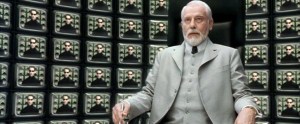
The Architect was such a letdown for me in 2003 but I now appreciate the choice more for its subversive slap. You’re expecting our hero Neo (Keanu Reeves) to confront the machine version of himself, and instead it’s this fussy old man and his above-average vocabulary is part of his disdain and boredom. The revelation that Neo is not the Chosen One but the sixth Chosen One in an ongoing cycle of destruction and renovation is a startling revelation. It’s the necessary step to push Neo out of his boring overpowered Superman role. Now he has a real choice, to follow the script in order to save the masses, or to risk everything for the human equation of love. If everything in the two movies was following a predestined path, this is when the franchise and Neo chart their own path, choosing to be reckless in the face of redundant and never-ending conflict. The knowledge that what happens next will be a significant change is a far better ending than simply watching a CGI Neo pummel more CGI Agents. It’s the ending audiences weren’t prepared for but it redefined the conflict between the machines, the nature of Neo, and the relationship between Neo and Trinity (Carrie Anne-Moss). It was more interesting by rejecting the same old. It deepens the conflict and the personal sacrifices, and it set up the humans versus machines war to have even more meaning, a promise that Revolutions could not fulfill satisfactorily. There wasn’t even anything as weird as the slow-mo cave rave or the orgasm cake.
 As far as action, there are some clunky fight sequences that feel perfunctory, like the Wachowskis are closely monitoring the 140 minutes and making sure they have some fisticuffs at precise moments to sate their mass audience. However, the massive highway sequence is legitimately one of the greatest action set pieces of the twenty-first century. The movie takes a while to get going but once it hits the Merovingian part everything that follows is good-to-great. The fight with the Merovingian’s henchmen eschews guns for bludgeoning tools and allows a more interesting array of fight choreography. Then we’re introduced to the ghostly twins who can phase in and out of physical being, which adds a fun new complication to fight choreography. Then we’re onto the highway, the place that Morpheus (Lauerence Fishburne) always warned others to avoid at dire cost. We see why because it becomes a bumper-car collision course with Agents jumping in and out of drivers and creating even more havoc (Ford donated over 300 cars to the production and by the end each one was totaled). This entire sequence is exhilarating, morphing from new complication to another, and the Wachowskis make it clear at every point what is essential, what the geography is, and how the organic challenges emerge. It’s a big, splashy sequence and it’s no coincidence that Neo isn’t involved until the very end, serving as a convenient deus ex machina to snatch our characters from imminent danger. The problem with Neo is that he’s too powerful that it removes stakes. He can stop bullets, take on a hundred Mr. Smiths (Hugo Weaving, the devious highlight of the 2003 sequels), and even restart human hearts. Watching Neo flex his muscles in various fights is fine (though the CGI people drain the momentum of many of these brawls) but it’s far more exciting to watch “normal characters” against daunting challenges. Even the final mission involves an alignment of many people working together so it creates some sense of risk. The action might not be as innovative as it was in 1999 but it still packs its own explosive entertainment with a clear vision and sense of style.
I think my own previous sour feelings were a result of The Matrix Revolutions flubbing the hand-off, dropping many of the more interesting additions from Reloaded and spending far too much time in the dingy underground real world. It’s confusing to introduce a reality-defying world of the Matrix where characters can act like superheroes, and then the movie spends more of its time on people in mech suits firing endless bullets at a shapeless cloud of robot tentacles. The clever redefining of Neo as but one of many Chosen Ones is downplayed when it turns out he might be the most Chosen One-d of chosen ones, having mystical powers inexplicably outside the world of the Matrix. And the romance between Trinity and Neo was yet another aspect that felt swept up in an overly familiar messianic mission, which might be why Lana Wachowski chose to re-emphasize this relationship as a romance for the ages in Resurrections. It’s not Reloaded’s fault that the next two Matrix sequels failed to live up to its promising ideas, new characters, and dynamic action. I think the jilted reaction to Reloaded lowered the expectation bar for Revolutions, which might be why I, at the time, preferred the third movie to the talkier and more esoteric second entry.
 Re-reading my original 2003 review, I was clearly charged with my disappointment. There is a healthy level of snark throughout the review, as per a 21-year-old smart aleck. There’s more than a couple iffy references to stoner philosophy. I still agree with several of my old criticisms, such as spending far too much time in the “dank real world,” but I believe my hostility was misplaced. I was expecting a very different movie than the Wachowskis were interested in exploring, and it took me twenty years (technically 18 since I watched them all again in December 2021) to reassess my feelings and appreciate them on their own artistic terms. If you’re like me and only remember The Matrix sequels in a rather negative fashion, I recommend visiting them again with an open mind. That’s not to say they’re bulletproof, but after twenty years of rampant superhero movie escapades, I appreciate the thoughtful and subversive attempt to re-insert stakes and meaning into their original Chosen One franchise. Now, if Resurrections is any sign, please pass the creative reins to a worthy successor and let someone else dabble in this virtual reality sandbox for any possible future tales.
Re-View Grade: B


 nathanzoebl
You must be logged in to post a comment.