Daily Archives: December 27, 2022
Aftersun (2022)

I feel slightly like a movie philistine for my opinion concerning Aftersun. This indie drama has become one of the critical darlings of 2022, enough so that there may even be some serious Oscar buzz starting to foment. It’s a movie with a strong beating heart and rich in authentic details and naturalistic performances, a movie that feels practically like a home video ripped from the past. However, while I appreciated the artistry on display, I kept waiting for the actual “movie” to form, the reason this story was given its big screen status. Aftersun is a lyrically felt movie but also one I wish had a more sustained plot to better develop its dramatic potential.
It’s the mid 1990s and Sophie (Frankie Corio) is staying at a seaside Turkish resort with her father, Calum (Paul Mescal). Her parents are separated and she has a complicated relationship with her father, who covers up his own spiraling sadness by trying to be the “fun dad.” At eleven years of age, Sophie is feeling that awkward middle-ground of not being a child but still not being fully grown, and over her vacation, she observes her world and father with new eyes.

The strength of the movie is the richness of its characters and world, with each moment feeling like it was plucked straight from the memory of debut writer/director Charlotte Wells. The movie is framed as a home video of Sophie’s and makes clever use of her narrating footage, allowing the perspective to be directed literally by its source. It’s also interesting because there’s a degree of performance for Sophie, as the presence of a camera usually goads people into acting differently, to play up to the camera, and this channels Sophie into being a goofy performer. Off camera, she’s less prone to making jokes and being broad and silly. She jokes with her father, chiding him for his “advanced age” and other such topics, but there’s more hesitancy and relatable awkwardness with Sophie in real life. Her dad says she should go introduce herself to other children at the resort, to make friends and have partners in play, and she scoffs that at eleven she’s “not a little kid anymore.” She wants to hang out with the older teens and eavesdrop on their conversations, not fully aware of their meaning and context, as that hurried desire that young children have to cast aside their childhoods in favor of immediate maturity. There isn’t any defining experience at this resort, no direct humiliation or formative wisdom to point to. It’s more the small moments of a young girl between the different phases of her life. Sophie comes across as an achingly realistic portrayal of adolescence and the yearning for real connections.
The majority of the movie is about the relationship between father and daughter, and I was waiting for the movie to hit me hard, especially as I’ve recently become the stepfather to an eleven-year-old daughter. The relationship is there but there’s nothing too demonstrative of what is going on between these two people. It’s unclear whether this might be the last time Sophie will see her father for some time, or whether the divorce was recent and still a sore subject, or anything of extra significance. It just feels like a vacation, and that’s as it’s presented, and maybe that’s the larger unspoken point of Wells, that the mundane moments only become more cherished in hindsight or when we realize they were the last moments before whatever happened.

I think Wells might suspect the narrative on its own is missing that larger significance, so distributed throughout the movie are flashes from a rave with an older woman, and it’s revealed later that this thirty-something woman is actually Sophie as an adult, and a new parent herself. This juxtaposition then serves as an ongoing film-length Kuleshov Effect. This cinematic effect, named after the Soviet filmmaker from one hundred years ago, reasons that placing two objects together forms an implicit connection or reaction, so seeing a picture of soup and then a man looking forward might convey hunger or a picture of a coffin and then a man looking forward might convey grief. By this juxtaposition, we’re left to infer larger meaning and processing, as older Sophie is looking back on these scenes as distant memories. We’re left to deduce what that means to her, what new insights she has as an adult looking back, and what has happened since, and I’m sure some viewers will find this a tantalizing human puzzle to unpack. For me, it felt like extra homework without the key elements to make the depictions dramatically involved.
The acting is another laudible element that adds to the overall authenticity of the movie. Corio is a star in the making and has a natural screen presence. Mescal (God’s Creatures, Normal People) carries much of the film’s larger thematic weight, and I kept waiting for some small moment that would provide more meaning behind the surface level. Mescal is very good and his dynamic with his young co-star feels heartwarming and genuine. I enjoyed spending time with both of these actors, and while they charmed me, I kept wishing that they had a little more material to flex.
Aftersun is an easy movie to admire and see what Wells was going for, reflecting perhaps some biographical experience and something that every adult can insert themself and think about their own parental relationships, wondering what sort of things they took for granted during those innocent days of childhood and the acknowledgement of the quiet struggles of parents. It’s filmed beautifully and acted with sensitivity and plenty of understatement, the kind of thing that indie film fans and critics vaunt as revelatory filmmaking. It’s a solid movie that only comes to 90 minutes, but it also felt like I was watching a stranger’s home movies without context.
Nate’s Grade: B
Share this:

Causeway (2022)
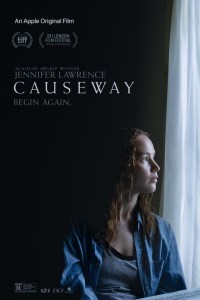 Jennifer Lawrence has been in four movies since 2017, so the once ubiquitous Oscar-nominated actress is getting more selective with her film roles, so now with each role the question becomes what made this project the one. Causeway is a fairly straightforward drama following Lynsey (Lawrence), a soldier who is recovering from her traumatic brain injury and ensuing memory loss. She’s stateside and living back in her hometown and trying to speed through physical therapy to re-enlist back to the life she knows but may not be equipped to handle. This is definitely a character piece but I don’t know if there’s enough interesting material here with these characters. Causeway is one of those indie dramas that lean into a lot of contemplative staring, which could be very meaningful if I felt like I had been given access to the characters internal dilemmas beyond a general assessment. Much of the movie follows Lynsey’s friendship with a local mechanic, James (Brian Tyree Henry), who has his own tragic past that he’s trying to come to terms with. The movie is at its best when they’re sharing time together and it begins to feel like an introspective hangout movie that will allow both of these people to let down their guards and develop. It moves in starts and stops but Causeway never feels like it gets anywhere fast or that transcendent. By the end, the journey doesn’t feel earned. Lawrence is good, though rather restrained, as the movie fills much of its time with her long pensive stares. There’s a movie here, for sure, but nobody feels in a hurry to uncover it. It’s a perfectly “nice movie” but one that underwhelms because it feels too afraid of pushing too hard or delving too far, for that would betray some artistic ode of “realism.” Causeway is a minimal, plaintive drama with much left unsaid, but what is said and honestly dealt with is compelling enough to make me wish I could trade in the many stares for more words spoken by these talented thespians.
Nate’s Grade: B-
Share this:

Emily the Criminal (2022)
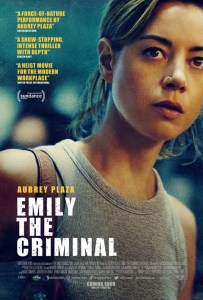
This Sundance indie thriller packs more anxiety into 90 minutes than most Hollywood thrillers combined. It’s a starring vehicle for Aubrey Plaza as the titular Emily, a woman with a prior criminal record who finds herself in debt and struggling to find a better paying job. In desperation, she joins a small-time credit card fraud squad, using stolen identities to purchase expensive electronics and pass along to her employer to resell. At first, it’s a quick and easy fix and she can walk away at any time, but the money is good and Emily begins to take on bigger and riskier jobs. It’s here where I really started sweating as Emily gets into some very serious jams, but she comes back swinging, and it’s a thrill. At the same time, you worry that she’s going too far and there may be no turning back. The movie reminded me a lot of 2016’s Good Time, an electric indie thriller that vibrated with anxiety as well as a surprising but thoughtful cause-effect story flow. Emily the Criminal begins as an indictment on the social mechanisms that trap the poor into poverty but then in its second half escalates urgently, spiraling into a tragic confluence of violence and vengeance. Plaza is outstanding from the first scene onward. Even her posture speaks volumes about her character. It’s a performance where you can see the gears of her decision-making, whether it’s fight-or-flight impulses, swallowing her pride, holding to a façade, or regaining what has been taken from her. The very ending of the movie is perfect and a fitting end of Emily’s character arc. It’s the American Dream turned into a modern nightmare of perfectly perpetual desperation.
Nate’s Grade: A-


 nathanzoebl
You must be logged in to post a comment.