Monthly Archives: May 2020
Constraint (2019) [PART TWO]
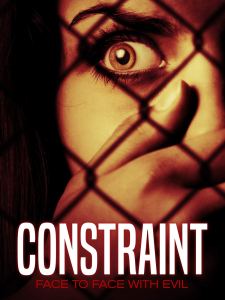 Please read PART ONE if you have yet to as I try and better articulate my questions over this Columbus, Ohio indie and its confounding creative decision-making. Dear reader, I am going to take you live through this very intellectual and artistic assessment as I continue to watch Constraint.
The main plot revolves around Oracabessa (Brooklyn Sabino Smith), a young cellist, who becomes entangled in a web of human traffickers, led by Tuco (Ralph Scott).
I am now 45 minutes into the movie and screamed, “What?” to my screen. Oracabessa (Brooklyn Sabino Smith) is once again playing cello for a ballet class and the instructor doesn’t like the musical selection. She requests Wagner, and Oracabessa says she won’t. The instructor is animated and agitated and demands to know why she can’t play the composer. “I didn’t say I couldn’t play it. I won’t,” she replies. Why? Is this going to be like some character moment like in La La Land where Ryan Gosling gets fired for refusing to play the holiday music his boss asks for as dining accompaniment? I would think refusing to play what a client was requesting could cease in you getting more work from that client. And considering this one ballet class is the only thing we’ve watched her do for money, I wouldn’t be too pushy.
Oracabessa sees Tuco walking along the street again which begs the question of how protected does this guy think he is? She follows him but the ensuing tailing sequence goes through a blender of edits so it more implies the chase than allows it to establish. She then joins the college professor, and Derick, and others at a hookah bar to translate a French speaker. “What about having your own racial identity?” Why does this scene exist in a story about sex trafficking? Is the professor Oracabessa’s sister? Why was this never established earlier? There’s now a discussion over whether or not Jewish people should be defined by the Holocaust and its impact and it’s like a family dinner squabble, still with the omnipresent ADR dialogue, and I’m starting to lean into the arbitrary madness of Constraint as it further infects me.
 We transition back to the life of Tuco, our beleaguered sex trafficker. He kills a guy for being late to a drug deal and I cannot say but this might have been Oracabessa’s brother from the previous family dinner scene. Tuco has his kidnapped women line up in their underwear so they can be “inspected” by his superior. He warns them not to “embarrass him,” though I have no idea how that would be achieved. And then the women start stripping off their clothes and the camera angles are PURPOSELY AIMED to highlight their full-frontal nudity, even one side view that captures all three women’s breasts in a row while cutting off their heads. That’s when I stood out of my chair, cursed this movie out loud, and paced around the room in building anger.
Nudity in film by itself doesn’t have to be sexual or gratuitous, but this nudity is meant for titillation, framed for this purpose, and to squeeze this into the context of sex trafficking, a very depressing and all-too-real reality for many, I felt extremely grossed out. The scene doesn’t need visible nudity to feel the distress and vulnerability of the captured women. I love exploitation movies as entertainment, and have even supported a few financially, but story context and tone are key. The women of this moment are there to be objectified and the camera objectifies them too. You know how I know how these actresses felt about this scene? None of their last names can be found in the film’s credits, so I don’t think they were too happy to have their full names associated.
We now transition to another new perspective, this time Nicolas’ parents (Dino Tripodis and Kristina Kopf, The Street Where We Live). “He experimented with something exotic,” the father says, and I don’t know if this implies that dad is racist for thinking “black” equals “exotic.” This entire scene feels even more student film-esque than the rest, with the editing choices and the characters dancing around critiques of domesticity and parenting. The wide angles that suddenly cut to extreme close-ups of faces, the jump cuts, and ADR sound design, it’s all starting to make this feel like a foreign film that’s trying to be New Wave arty. “You didn’t even leave your son with the hopeful illusion that maybe his parents were in love at one time,” mom says. The dialogue in this movie feels like it was written by an A.I. at many points. Nicolas later confronts dad who is apparently out on a date with another woman, and he does so with his mom in tow. “My whole life, the one thing you’ve been good at, is making people cry,” Nicolas bemoans. The wide shots showcase a bar/restaurant with nobody else in attendance, again another mistake with revealing the limitations of filmmaking. Now the scene is suddenly in black and white, so is this an established flashback? If the whole thing was a flashback for Nicolas then why wasn’t it all coded in black and white? Wait, then Nicolas’ own voice over narration is coming in while dad is talking in the present. We then pull into a flashback of Nicolas telling the story of meeting his divorced father in the park to Oracabessa, so we witnessed a flashback-within-a-flashback for a side character. “What would you say is the most devastating thing to happen in your life?” he asks Oracabessa. Sheesh, if this is your pillow talk no wonder she dumped you, dude. There’s now a flashback 23 years to Jamaica with Oracabessa’s biological father. There’s an ongoing streak of whispered poetic voice over from Terrence Malick films. What movie am I watching now? I can’t keep up with the shifting perspectives and visual vocabulary that keeps being broken so flagrantly and randomly.
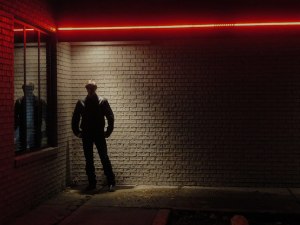 Folks, the erratic edits have not gotten any better and a conversation will randomly jump from four different camera positions from line to line to completely obliterate flow.
Derick and Nicolas are fighting over Oracabessa, who doesn’t want either of them, and then Oracabessa is playing at a big recital, and again I have to remind myself this is supposed to be a movie about sex trafficking but it’s playing like some small-town ensemble piece (why else do the same people keep running into each other in a city of over a million?) but like a Christopher Guest mockumentary (Waiting for Guffman) played straight. Why does Tuco even attend this recital?! Oracabessa follows him and the chase has several nice camera angles for a low-budget indie, and it’s also edited in a way that maintains the suspense and is readable for the audience, going from better selected angles to convey the progression of the chase and Oracabessa following closely. The music, however, is way too overwrought and we watch Tuco go into a restaurant, eat, and then leave with Oracabessa following again. Why did we need a pitstop? She didn’t even go inside.
Tuco finally ambushes Oracabessa and runs her over, which triggers a flashback of her son (?) she confessed she lost (in the flashback with Nicolas) being run over in the past. The way the scene plays doesn’t make it seem like she was witness to this event for recollection. Nope, it’s just a kid that Oracabessa’s father ran over while she was a child, which explains why she could recall this moment but also makes it too confusing for an audience to adjust to what is being thrown at us without context as it plays. It wasn’t even in black and white, which is the established code for flashback. A drunk driver then plows into Tuco’s car, which smashes into Tuco, finally killing him and setting Ralph Scott (Minus One) free from the earthly bonds of this movie. Oracabessa takes his I.D., gun, and sets off, presumably, on a path of righteous vengeance as she… wanders into the woods, but what do I know?
So this one woman had her father run over a child, abandon her, then she lost a child of her own, and has been stalked by human traffickers. This is getting into telenovela territory of melodrama. And so ends PART TWO of my real-time review of Constraint.
Share this:

Constraint (2019) [PART ONE]
A most unusual thing happened when I was watching the Ohio-made indie Constraint on Amazon Prime; I was so bewildered by the filmmaking choices that I had to stop and begin writing my thoughts immediately on the movie even as it continued playing. This is a rarity, a movie that causes such confusion that I feel compelled to articulate my thoughts in the moment rather than, as I normally do, assessing them upon completion. I wasn’t expecting any of this. Constraint has a very serious subject, sex trafficking, and filmed in my hometown of Columbus, Ohio, which has itself a very serious problem with sex trafficking networks. It starred familiar faces from my other Ohio indie viewings of recent. But then within only three minutes, I had to pause at several points, walk around my room muttering questions to myself, and couldn’t go much further in the movie without repeating this process. So, dear reader, I am going to take you live through this very intellectual and artistic assessment as I continue to watch Constraint.
The plot revolves around Oracabessa (Brooklyn Sabino Smith), a young cellist, who becomes entangled in a web of human traffickers, led by Tuco (Ralph Scott). Other characters will come and go into her orbit but Oracabessa is our guiding point.
Within minutes, I was already starting to question decisions, or practical limitations, exhibited by writer/director/editor/cinematogpraher Richard A. Nelson (The Endangered). Even the opening credits are strange with listing an assistant director before blocks of cast names and then zipping by in a blink as to render their inclusion seemingly moot. Then there was the realization that all of the dialogue sounded like it had been ADR, meaning recorded later and indoors. Not just outdoors scenes, which can be notorious for wind and auxiliary noise, but also indoor settings. Honestly, it made me immediately think of the notorious Mystery Science Theater 3000 high point/low point, Manos: The Hands of Fate, a movie from 1966 where every line of dialogue was recorded after filming and, what sounds like, in a bathroom, and sometimes with one actor providing both voices to a conversation of two characters. Immediately, my mind starts going into formulating some kind of explanation why this might be, what could have led to this, and I’ll fully admit to striking some of my criticisms if they vanish later in the film.
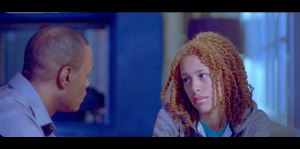 The editing choices can be jarring and forced me to stop the movie at several points. An early scene, at the four-and-a-half-minute mark, has our lead Oracabessa visiting her boyfriend, Nicolas (Aaron Geib). The camera moves to a wide angle as they settle at a kitchen table. Within seconds there are two jump cuts but they eliminate mere seconds or fractions of seconds of footage. Then there’s a quick cut to an exterior of the apartment, presumably to “clear the edit” and allow a passage of time or at least a new camera angle. Nope, we come right back to the same shot. Why? Why not just start with the shot from after the exterior cut of her passing her drink to him? Why did the previous moments need to be seen? What then follows is a close-up of the food, fully prepared, and the boyfriend has his line entirely off screen. This is the stilted dialogue that follows:
Him: “It’s a peace offering? What are we, at war?”
Her: “Man and woman in any kind of relationship are always at war. It’s just a matter of what degree.”
She then passes by him and it jump cuts (same camera angle) to him responding, then it pans over to her at the other end of a doorway, and then after her line it literally cuts back to his position on the doorway (same camera angle) to walk over to her. What? Why not just pan both ways? She responds and then we have ANOTHER JUMP CUT (SAME CAMERA ANGLE) and then ANOTHER JUMP CUT (YOU GET IT) of her a step forward walking past him, and then ANOTHER JUMP CUT (YOU KNOW IT) of him looking off screen at her. The camera angle then changes, mercifully, to a medium shot (with her head cut off) of her pulling off her ring followed by a different medium shot (with her head now visible) of her placing it atop a bookshelf. We then cut back to the EXACT SAME previous shot of the guy still looking off screen in response. There’s a couple more cuts as she leaves and then the movie jumps into a bizarre montage of images as she’s riding on her moped with a fixed handlebar-POV shot, a closeup in slow motion, and black and white inserts of her presumably as a child.
Ladies and gentlemen, I have no idea what to tell you beyond watch the segment (5:30-6:30) for yourself and join in my mounting alarm and confusion. Even if the production was stuck with minimal camera setups, why jump so haphazardly from moment to moment with jump cuts? Why use pans so sparingly when they could keep an audience in the moment? If the point of the scene is to impart a distance, a lack of engagement in this couple’s relationship, the staging and editing could have better communicated this without resorting to off-putting decisions.
The next moment of curiosity occurs seconds later as Oracabessa attends a very sparsely populated college lecture (I literally counted 12 people in a hall that likely seats 200). Again, the noticeable ADR sound, again the annoying jump cuts, and again confusing choices about the staging of the scene. The professor is arguing over reparations and there’s a moment where it cuts to a black and white still image of the professor and then cuts back to her talking. Is this an Oliver Stone movie? A (white male) college student protests he shouldn’t have to pay for his ancestors’ bad deeds and gets into a fight with another student, but the majority of the crowd shots are taken from one very wide angle. When the students confront one another, the camera doesn’t move, doesn’t get us closer, and they just occupy a small portion of our screen, which then cuts to another exterior shot and back to the same interior angle again. I’ll accept that the professor, and the older man monitoring her teaching, were filmed at a separate time and cut to look together with the crowd of students. I get scheduling shortfalls, but why make it all the more apparent to your viewer? Why film in a way that highlights how empty the space of this lecture hall is? Why shoot with such static angles? And why again do we get so much weird edits that break up the flow of the scene? Reader, I am only eight minutes in.
I just counted six edits and three different camera angles just to capture Oracabessa copying a paper on a copy machine. It’s a twelve-second scene which raises the question why multiple camera angles were needed to simply convey she copies something and why we needed twelve seconds on this task. I am just completely bewildered by the editing choices of this.
Credit where its due, the investigation scene of Oracabessa looking through old microfilm at the library on missing person reports is the place where jump cuts and rapid edits are beneficial. The black and white flashback is confusing though whether it constitutes the events that actually happened, seeing a young woman and little boy somehow separately being stalked by an unseen driver in a car regardless of the fact that they’re walking in opposite directions, or whether it’s Oracabessa’s imagination playing out over what might have taken place.
The movie then seems to transition its protagonist, switching to Alice (Maya Sayre), the mother of the missing boy, who is identified via a subtitle at the bottom as if this was a documentary subject. She seems to be sitting in a coffee shop with a stack of missing fliers and… signing them? I don’t know. There are more quick cuts of things like a closeup of a teacup and then Alice sitting alone at a park. The trees all around her have missing posters of her son tacked on, which starts to beg the question of why put it on twelve trees in close vicinity to one another unless Alice has an endless supply of disposable money for unlimited copies or really hates trees. She is literally posting the same flier within mere feet of one another.
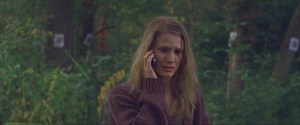 Here, finally, is an example I can praise for its filmmaking choices. Alice is postering the neighborhood when the bad trafficker Tuco then pulls up to her in his car and says, “Oh, your son is missing?” As he asks about her circumstances, the camera hangs on Sayre (One Dollar) to deliver the moment with her performance and it works. It works because the camera allows us to stay in the scene and because of the trust in the actors. She’s heartbroken but still unable to fully articulate her grief, and it’s a beautifully acted moment of desperation. She even looks like Jessica Chastain in certain angles, especially profile. When Tuco walks up to her, the camera angle remains the same but to the benefit of the scene this time, as his size towers over her, dwarfing her, his head cut out of the frame, his arm thrown around her shoulder, providing potential comfort or potential constraint, and we already fear for her safety. She invites him into her home and they have a nice talk, with Alice lamenting how people are no longer kind. The irony seems to be building, and finally Constraint feels like a movie with purpose.
This is legitimately a good scene as Tuco vacillates over what to do with Alice. Her dubbing him a gentleman seems to dial up his sense of shame and he leaves for another room where we see him take out his gun and then put it back. Will his compromised sense of morality win out? Even the clipped framing helps this case by placing the emphasis on Scott’s hands and the gun. Their conversation lingers and the camera continues running, and that’s how to drive tension. Unfortunately, her horny desperation to get him to stay and the weird song that plays in the background as if they were trapped in an elevator undermine the scene’s suspense.
More bizarre editing choices as the scene of Tuco talking with a crony literally jumps from a super wide shot to a closer shot as they trade lines. It makes me think of the Sesame Street bit where Elmo demonstrates near and far. After several more erratic edits, the film leaps to a shot of Tuco waiting in his car, but it’s being filmed from an angle where a pole or pillar is obscuring his very face from being seen on camera. Why choose an obstructed view of this? Even more baffling, a minute later the movie indicates Oracabessa is observing Tuco kidnap another young woman and throw her in his car and drive off. And. Oracabessa. Does. Nothing. Not even call the police, try and yell back and create attention, even jot down a license plate number. Perhaps she wasn’t literally viewing this spectacle, but when you cut to her walking in what looks like the same setting as this is going down, then you’re going to convey this interpretation to your audience.
A stranger who has been hardcore eyeballing Oracabessa as she played cello for some little ballet dancers stops her on the street. He compliments her playing and then leans a hand out and says, “May I?” and then bizarrely strokes the side of her face. “Your face is flawless,” he says in an accent that invites imitation, all while gripping her face. “It is like glass. Like caramel-colored glass.” Why is she allowing this creeper to continue doing this? This is even before he says he’s a music school bigwig and think she has real talent. Does this woman have any sense of self-preservation? The characterization for her doesn’t make any sense from scene to scene.
 There’s another flashback where she recognizes Callie (Jennifer Ann Hickey), the female partner for Tuco, and that she had the missing boy beside her in the same car Tuco was driving. Again, is she imagining this and trying to connect mental dots (it’s played in a kind of black and white) or did this happen, which means that yet again she should have recognized Tuco as he was abducting a new girl in front of her. Then I laughed out loud when the camera does a sudden zoom into Tuco’s car followed by a close-up of Callie turning to face the camera and glaring. I thought Tarantino’s Kill Bill music was going to commence. Does Callie somehow recognize Oracabessa too? She starts running away, and again this is an opportunity for Oracabessa to call the police or write down Tuco’s license plate number, and she does nothing, eventually fleeing herself.
The editing proceeds as follows: Oracabessa is on the run. We hear a classical music piece to note the tension. We then see Tuco’s car trailing Oracabessa. Inside Tuco’s car, the same classical music piece is playing but noticeably softer, trying to imply the music is diagetic to the car radio? Then we cut to a hand on an acoustic guitar and a young woman singing at a party, which also seems kind of like an attention-grabbing thing to do unless the party is centered upon your performance. It’s only revealed later that Oracabessa is at this party. The same professor from earlier asks to dance with Oracabessa and literally holds her hands and barely sways, like a child’s idea of what slow dancing would be. This same professor then admits to inviting Oracabessa’s ex Nicolas and then says to dance with her. All of this is the same shot too. Nicolas then hovers over Oracabessa, butts into her dance, and then they awkwardly stand next to one another without saying a word for thirty seconds, and then the other dancee comes back. What?
The movie jumps perspective again, this time following the ex Nicolas, who goes home and sits on the bed he and Oracabessa used to occupy. There’s a post-coital flashback, which features Smith nude, and I felt protective of the actress, like she shouldn’t have to get naked for this. There’s even more stilted dialogue between the pair:
Him: “In every great love affair, you gotta have a nickname. Yeah, I gotta come up with a nickname for you.”
Her: “I detest nicknames. They’re arbitrary.”
Him: “Naw, your birth name is given before your personality has time to develop. A nickname is usually based on a personal trait.”Her: “It’s an intimate thing naming a person.”
Him: “Well… I think you’re a… ‘Saffron.’’Her: “Why Saffron?”
Him: “It’s got a malevolous ring to it. And you with your angular edges. I gotta name you something pleasant, right?”
Oh my God, people do not talk like this, at least the people of Earth. This scene could have been cute and a snapshot of their better times as a couple but now it just makes whatever they had feel even more bizarre. The dialogue is very unnatural throughout Constraint and reminiscent of something I would find in a Neil Breen movie, and it pains me to make that comparison.
 Another guy, Derrick (Kenyatta Foster), is also interested in Oracabessa and having a flashback of falling for her, and why am I seeing any of this? Her anecdote about “sympathetic vibrations” from a cello is actually a well written aside that she can explain her dating goals with, but it’s hobbled by the guy just leering over her: “I can give that to you baby, you just have to see.” He goes for the kiss and she consents, which makes me question whether she cheated on her now-ex-boyfriend or what the timeline was for this, or even whether this might just be in his head. I do like that it cuts from him kissing Oracabessa to him kissing the professor, and he’s clearly not into her. That’s an honest-to-God clever editing choice and better conveys the character’s response.
So many jump cuts, so much day-for-night shooting, so many confusing geographies, so many quick exterior shots after spending time indoors just to cut back to the same indoors, and now even more nudity from our lead actress with a gratuitous shower scene. This woman deserves better.
Tuco has somehow tracked her though we have no idea how and hidden in her closet. Instead of killing her when she was in the shower, to avoid the Psycho homage I suppose, he waits until she’s performing her cello. They fight and she beats him with her cello and uses the bow like a riding crop. Yet she doesn’t call the police after nearly being stabbed by an intruder, when the assailant’s weapon is still there, as well as his blood, for physical evidence. Tuco comes back but she has a few intimidating dudes standing around as a posse. Then we cut to ballet! Why? Is the threat over? Why does this guy even see Oracabessa as a threat considering she’s never reported him? How did he find out where she lived? Her apartment looks like the interior of a school. How is any of this adding up to the larger narrative? I am just so lost with the creative choices here.
I’m actually going to turn this review into a multi-part series to make it more digestible for you, dear reader, so thus concludes PART ONE. Read PART TWO.


 nathanzoebl
You must be logged in to post a comment.