Monthly Archives: December 2016
Miss Sloane (2016)
 Miss Sloane is an intelligent and exacting political thriller that should appease fans of the genre who enjoy a good arm-twisting from a powerful manipulator, in this instance the towering and intimidating full force of Jessica Chastain. She plays the titular Sloane, the best lobbyist inside the beltway, and a woman who leaves the comfort of her firm for the challenge of taking on the gun industry to help pass a reform bill. From there it’s an underdog tale powered by the winds of moral righteousness and given a tough-talking yet flawed hero that will burn down whatever she can, including her own reputation, to win. The biggest draw is the performance from Chastain (Zero Dark Thirty) as she gets to yell at people for approximately two hours and look good doing it. It’s a game of persuasion and leverage and D.C. voter politics, and she makes the constant stream of information accessible while providing a focal point for our interest. It’s a pretty information heavy film with a minimal of supporting characters that stand out (Gugu Mbatha-Raw as a school shooting survivor-turned-team member is the notable exception). With her victory never in doubt no matter the odds, the movie establishes that it exists in a parallel world where actual gun control reforms can be advanced. In the wake of doing nothing from Sandy Hook, this must be a fantasy world. Director John Madden (The Debt) keeps the tone as cool and calculated as his heroine. The script by Jonathan Perera is plenty smart though the final act relies upon some unbelievable shenanigans that betray its sense of pragmatic realism. Still, the cunning gamesmanship of a pro working the levers of power for a worthy cause allows for some liberal fantasy indulgence. Miss Sloane is a suitably entertaining thriller that whisks you away and says even “bad people” have a purpose in our broken political system.
Nate’s Grade: B
Share this:

La La Land (2016)
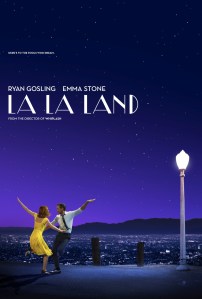 I understand that the year 2016 has been, charitably put, unkind to many people and why we all could use a little escapism around this time of year. Writer/director Damien Chazelle made a big Oscar splash with 2014’s Whiplash to make his passion project, a sincere musical that recreates the style of classic Hollywood. La La Land is a stylistic throwback that has enchanted critics and seems destined to compete for some of the biggest awards this season. Just imagine how much better it would be if it was great.
Chazelle and company certainly knows how to make an impression. The opening number transforms an L.A. traffic jam into a full-blown song-and-dance explosion, with commuters exiting their cars and coalescing into a teaming mass of jubilation on the freeway. It’s a moment that is sincere and full of energy and promise. The brightly colored commuters come together in long unbroken shots with a widescreen camera that dives and dips and leaves plenty of space for the audience to appreciate the dancing. This is a movie that wants you to see all of the rainbow-colored performers while they strut their stuff. It’s here that we’re introduced to Mia (Emma Stone), a part-time barista and struggling wannabe actress, and Sebastian (Ryan Gosling), a jazz musician who dreams of opening his own club at a historic site. These two dreamers resist each other but of course destiny has another plan. A highlight is a flirty sequence set atop a Hollywood Hillside overlooking the purplish dawn. Mia and Sebastian sing how beautiful this scenic view would be if only they were with someone they loved, playfully antagonizing the other into a dancer’s rivalry. The dancing is mischievous and fun and performed in wide angles to soak in the movements. It’s easy to get caught up in Chazelle’s early swell, a transporting experience that extols the virtues of classical musicals by the likes of Vincent Minnelli, Gene Kelly, and especially Jacques Demy’s The Umbrellas of Cherbourg. Chazelle fills out his frame like a painter. There’s an infectious love for Old Hollywood that tries to alchemize its influences into something new and old, and for a good while Chazelle is able to maintain this fizzy, effervescent experience and remind you of the soothing joys of a good movie musical told with finesse and brio.
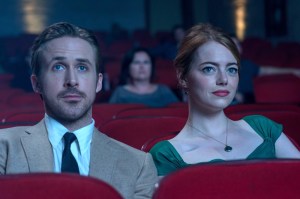 Then after about forty-five minutes the fizz gets a little staler and that’s when I felt the gnawing emptiness underneath all the Old Hollywood homage. It reminded me of 2011’s Best Picture winner, The Artist, as a movie that is more affectionate imitation than genuine substance. As I wrote in my review for The Artist: “The entire affair has such a slight feel to it; the movie is a confection, a sweet treat that melts away instantly after viewing. If you strip away all the old Hollywood nostalgia, there is very little substance here.” It’s all mimicry of the highest order but Chazelle hasn’t put enough authentic feeling into his imitation. There’s a fealty to the sources of his inspiration that Chazelle is replicating, and his screen pops with coded visual reminders (look, it’s Gosling leaning off a street lamp), but it fetishizes the inspirations rather than building from them. Quentin Tarantino is transparent about his outré influences but he doesn’t forget to tell an engaging story too. It’s in the movie’s dispiriting second half that it becomes all too clear just how little substance there is to our lovers as well as the industry satire. This is miles away from Singin’ in the Rain, folks (my favorite film musical, for the record) and more the same old broadsides about the industry: they’re shallow, they’re inconsiderate, they swallow up the dreamers, they “worship everything and value nothing,” as Sebastian put it. It’s not like the movie is telling you anything you haven’t heard before, and that’s fine but it limits any impact. It also seems to exist in a universe where minorities are mere background players to prop up the dazzling lives of the beautiful white leads. Imagine the enjoyment if some of that snappy industry satire was reserved for its less progressive casting practices. Can you imagine this kind of movie starring Tessa Thompson (Creed)?
Affection can only go so far because eventually the gravity of your characters, their relationship, their goals and dreams and relatability will need to kick in, and it doesn’t. I think this is because the first forty-five minutes are the typical rom-com story of the boy getting the girl. It’s the portion where the movie weaves its old Hollywood spell and courts us too, and it’s fun. And like bad relationships, once it has you La La Land feels like it has to do less work. Chazelle has to manufacture a series of pity problems (more below) to push his lovers apart and question whether these two star-crossed kids might make it after all. If the beginning half is the swirling romance that reverently celebrates old Hollywood, the second half is the attempt to “ground” the film in a sense of realism. It feels too late tonally to switch gears and it undercuts the first half. It might sound contradictory but if La La Land was just going to be a trifle then I wish it went all-in rather than half-heartedly trying an “edge” of harsh reality to mix the sour with the sweet. Just because the movie sets up the dreams of its characters, puts them together, and says not so fast doesn’t mean that Chazelle has properly set up this nascent melancholy.
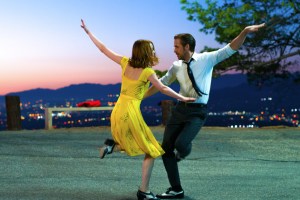 Mia and Sebastian are not particularly strong characters. The unified star power of the lead actors is enough to disguise this fact for a majority of the movie and maybe for some the entirety. They don’t have anything of import to say beyond their dreams and their jobs that are presently in the way of achieving said dreams. I couldn’t tell you anything else about these characters. For Mia and Sebastian, the world is divided into those who are pure and those who are impure, the real artists and the phonies, and the dichotomy will rankle anyone who has interacted with more than their share of hipster. Sebastian is a music snob who wants to impress upon the world the importance of jazz even as it shrugs indifferently. Nobody gets it, man. He’ll fight the good fight no matter what because Sebastian’s fight is Chazelle’s: taking outdated material and exporting value to a new generation. The characters serve the plot and exist to entwine and then be dutifully pulled apart. It’s hard to invest in the characters when they won’t show who they are and why they should be together. Maybe that’s the point ultimately, a rich meta commentary on how attenuated the central courtships in movies themselves are, or the fleeting relationship between film and audience, or maybe I’m just hoofing as hard as the leads to insert more meaning here.
The second half paddles into what my friend Ben Bailey affectionately termed White People Problems: The Musical. I won’t fully concur but the conflicts are too forced and the characters become whiney. Sebastian rejoins a pop band where he doesn’t feel 100 percent creatively fulfilled because he isn’t performing “true jazz.” The band is also popular and this causes friction because he has “sold out” on his dream, as if toiling during for any period of time is giving up. I guess you must be single-minded or it doesn’t count. Their combined egos won’t allow for different variations of success. La La Land pretends to endorse the dreamers but does it really? The only dreamers who seem to count are Mia and Sebastian. What happened to Mia’s lively group of roommates and friends from the beginning party? What about the nebbish screenwriter the movie mocks for an easy laugh? There are no significant supporting characters in this movie; the universe belongs to Mia and Sebastian. They’re not as insufferable as the characters from Rent but it’s definitely a detriment. Look at the characters in Fame, a group of hungry teenagers who came from all walks of life and circumstances to try and achieve their titular dream of stardom.
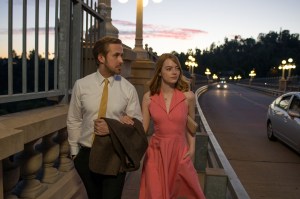 The limitations of its doe-eyed leads present some issues. Stone (Birdman) is smashing in the movie but part of that is because, aside from some song-and-dance choreography, the movie asks very little of her other than to be cute, a trait Stone has in natural abundance. There are two standout scenes for the actress. The first is an audition where she pretends to be a mistress getting the “sorry, I can’t do this” phone call from the man she thought had loved her. The sheer variety of emotions that Stone is so able to quickly convey on her face, in her tremulous eyes, and posture are remarkable. Of course the problem is that she’s too objectively good to keep getting blithely rejected by cold-hearted casting agents. The second is a musical showcase where Stone belts out a story about how her aunt inspired her to be a thespian. Stone is effortlessly captivating but she deserves better than to be foil to a grumbly Gosling. I feel that Gosling is one of those actors who can be amazingly talented when plugged into the right role and with the right director (see: Half Nelson, The Believer, The Big Short). He has an easygoing charm that all-too easily morphs into smarm without the right guidance or motivation on his part. Sebastian feels like a scowling grump who wants to bludgeon the world with his point of view. It feels more like he’s in it for submission. Gosling’s performance left me wanting someone else to play his part. They were so strong on screen in Crazy, Stupid, Love but that sizzling chemistry of old is gone here. They feel inert together, amplified by Gosling’s antiseptic performance. They’re both rather limited singers, very thin of voice, and that does hurt a musical. The songs by composer Justin Hurwitz and lyricists Benj Pasek and Justin Paul are exceptionally milquetoast. They’re all slight renditions on the same blandly pleasant tune. They evaporated from my memory by the time the end credits started rolling. Moana has nothing to fear come Oscar time from these at-best competent compositions.
If imitation is the highest form of flattery, then Chazelle’s anodyne musical is brimming with appreciation and adoration for the world of classic Hollywood, and that alone will be effectively transporting for many film critics and select audiences bred on a diet of Fred Astaire and Ginger Rogers. La La Land is an airy confection but one that dissipates all too easily after viewing thanks to the limited characters, the limited singing, the limited dancing, the limited songs, and the lack of overall substance independent from imitation. It has its lovely moments and Stone is an ingénue worth loving, though not as much her slim character, a dreamer who dreams the dreams of a dreamer. The breezy and bubbly first half doesn’t really mesh with the second half. I think it’s telling that Mia and Sebastian’s “love theme” is a sad plaintive piano trinkle. As the characters get more sullen and sour, the fizzy fun fades away and it starts to feel like a New Year’s Eve hangover that left you addled and warm but only in a vaguely ephemeral sense. If it leaves you toe tapping and giddy, I’m glad. I’m already mentally prepared for it to practically sweep the Oscars, as they do love celebrating their own importance. La La Land is a movie musical that is stuck looking backward that it loses its own footing.
Nate’s Grade: B-
Share this:

A Monster Calls (2016)
 A young mother (Felicity Jones) is dying from a terminal illness. Her son Conor (Lewis MacDougall) escapes into the world of his art and imagination to cope. This includes envisioning a giant living tree voiced by Liam Neeson who visits Conor to tell him three stories, and in the end he demands one from Conor. It’s a Hollywood cancer weepie with stylistic fantasy elements, kind of a Lifetime TV approach to Pan’s Labyrinth, and I must say I was rather unmoved through every drop of treacle. Part of my problem was that Conor has this larger-than-life fantasy creature… who only tells him stories, which lead to extended animated sequences that are beautifully rendered in watercolor paints. What’s the point of having a giant monster if all it does is tell you stories? He might as well be anything and any size then. The plot also follows a very familiar path as Conor must confront his grief and anger as his mother, one of those regular movie characters who become heavenly and wise when stricken with cancer, declines in health. I felt removed too often and kept at the fringes. Rarely did I care about these characters and that’s because the movie didn’t give me a reason to. Yes she’s dying, and yes he’s sad and troubled, but so what? A Monster Calls needed to lay more foundation with these characters who come across very thin. The ultimate purpose of the monster is a rather pat revelation and the emotional climax felt undeserving of all the swelling strings on the musical score. There just isn’t anything in A Monster Calls that separates it from a pack of maudlin imitators. The actors all do pleasant work but they aren’t given more than the barest characters to work with, which forces an audience to feel things simply by grief association. Coming from director J.A. Bayona, a visonary who startled and amazed with The Orphanage and The Impossible, I’m even more confused and let down that a man this talented would choose this. Also, at no point does a CGI tree monster Liam Neeson utilize any specific plant-based set of skills.
Nate’s Grade: C+
Share this:

Moana (2016)
 The Polynesian-based animated musical Moana is a throwback to the Disney formula of the 1990s that became so familiar and entrenched. The time away has made it a welcomed return, especially when executed to this magnificent magnitude. A formula by itself is not a problem, in theory. Many of our favorite movies follow storytelling paths that others have trod well before, but it’s all about the level of execution, building characters that an audience cares about, a conflict that feels involving and escalating, and payoffs that are naturally setup throughout the plotting. With a formula, it’s not the song it’s the singer, and Moana is a splendid and delightful animated movie that should enchant all ages with colorful characters, catchy songs, and the familiar formula of old given surprising and rewarding depths. It’s a lovingly made movie I fell in love with.
In ancient times among the Polynesian islands, the demigod Maui (voiced by Dwayne “The Rock” Johnson) stole the literal heart of the goddess Te Fiti, a shining green emerald responsible for creating life. Many years later, Moana (voiced by Auli’i Cravalho) is a teenage girl next n line to be the chief of her people. Much is expected of her for the betterment of the island but Moana would rather be out there on the water, a passion that her father forbids. Her island is in dire trouble when the food supplies are rotting or disappearing. Moana’s eccentric grandmother (voiced by Rachel House) tells her what must happen: she must venture out to sea, find Maui, retrieve his magic fishhook, and force Maui to return Te Fiti’s heart to the source. Moana sneaks away and embarks on a great adventure that will test her skills and her sense of who she is and what her calling should be.
 With a few clever nods, Moana intimates to its audience that it knows what they expect and will be delivering the best of the old formula without being slavishly lockstep in its execution. The Disney formula of the hero or heroine yearning for something grander from their supposedly drab existence became a crutch after the apex of the Disney Renaissance in the mid 90s. The overprotective father who doesn’t want their daughter or son to break far from tradition will also be plenty familiar. With Moana, the masters who kickstarted that Renaissance, directors Ron Clements and John Musker, return to the formula but also know what to subvert, what to tweak, and what to dive right into. While it’s not as subversive as mildly revolutionary for a Disney movie as Frozen, this is still a movie that anticipates the connections an audience will make and knowingly tweaks them. On her island, Moana has a cute little pig sidekick who you expect to make the journey with her… except it doesn’t. Instead the brain-dead chicken, a reliable source of comic relief, is her traveling animal companion. Moana prickles at being called a princess; she’s the daughter of the chief and actually already functions in a ruling capacity. “If you wear a dress and have an animal sidekick, you’re a princess,” he nonchalantly retorts. There’s also a lesson in what constitutes good and evil as all the villains and reprobates of legend are far more ambiguous. There’s also a refreshing lack of a central romance. We have a strong heroine whose goal is completely unrelated to romantic love. This girl has bigger things on her mind than boys.
This movie is primarily a two-hander as we witness Moana and Maui interact, grow, and change, much to our amusement. I can’t recall another Disney film that had such a small focus on a limited number of characters and this decision pays dividends. While only 103 minutes, we really get to understand these two people and what drives them and what fears keep them from accomplishing their goals. Moana is a terrific character. She’s pulled in different directions from her sense of duty and her own ambition to explore the world outside. She’s feisty but still clumsy, empowered but still filled with doubts, independent but considerate of others. After all, her plight is to save her people. Pairing this character with Maui provides plenty of narrative sparks, especially as Maui is forced against his will by the power of the ocean to assist in doing right with Moana. Newcomer Cravhalo makes quite a debut. Her singing voice is flawless but I was highly impressed with the emotion she was able to convey through her vocal performance. She makes you care deeply for her character because she brings such life to the lively Moana. Johnson’s boundless charisma is amazingly channeled into the character thanks to the animators. Johnson isn’t lazily sleepwalking in his performance like so many celebrity vocal actors. Moana and Maui both intrinsically have their identities tied up in their sense of obligation to others, and this provides a common area for them to bond and also to stretch as characters. Theirs is a dual journey of self-discovery and defining themselves on their own terms. The actions of others and their demands do not have to define you. The charged interplay between Moana and Maui, two characters at cross-purpose in their goals, is a scenario that places them in our focus and endears them to us as they deepen.
 The fantasy setting also allows for plenty of fun and imaginative diversions and turns. The mingling of man and god with the whimsical and weird magical creatures made me think of the great Miyazaki (Spirited Away, Princess Mononoke) as a direct creative influence. There is a delightfully wonky sequence with a wild band of pirates that are best described as living coconuts from a Mad Max film. Their floating ships are patched together with ramshackle planks and pieces and a thunderous drumbeat for pacing. All that’s missing is a coconut with a flaming guitar. It’s such a visually delightful and daffy segment and it doesn’t wear out its welcome. Maui’s living tattoos (traditional hand-drawn animation) provide further personality and serve as his conscience. The underwater land of monsters is also begging for further exploration. Maui’s shape-shifting powers are brought to the forefront during key battles with the giant lava monster Te Ka. Even when the movie isn’t dazzling you with a song or its character development it can pull off inventive and visually gorgeous world building that sucks you in.
While not hitting the earworm heights of Frozen’s best, the songs in Moana are uniformly good and, even better, advance the story and give additional light to characters. Lin Manuel-Miranda is still a musical genius and imbues the sounds of Moana with Polynesian culture and history, lots of powerful percussion and harmonies. Moana’s personal theme of “How Far I’ll Go” has some wonderful melodic turns especially as it builds, and it’s a fine musical throughline for her journey with each repetition building in emotion. I enjoyed the Hamilton-style rhyming flourishes as well as the extended rap interlude on The Rock’s jaunty signature song, “You’re Welcome.” That tune is quite playful with a strong hook and it boasts all Maui’s accomplishments and his hefty ego, but it also has a narrative purpose. Maui uses the song to distract Moana and steal her boat. My current favorite might actually be the outlier on the soundtrack; “Shiny” is an absurdly enjoyable Bowie-esque glam rock number from a giant crustacean admiring his fascination for all things shiny. Jermaine Clement (Flight of the Conchords, What We Do in the Shadows) superbly sinks his teeth into such a theatrical and comical villain. It’s a short scene but Clemente’s impression is irresistible. His song is also a strategy, allowing Maui to steal back his fishhook while the opportunity for gloating distracts the giant crab. The songs are a reflection of the characters singing them and serve narrative purpose, which is a rarity in big-screen musicals. The musical score by Mark Mancini beautifully matches Manuel-Miranda’s songwriting themes and provides a lush sonic backdrop.
 This has been an absolute dream of a year for animated movies. From Zootopia to Kubo and the Two Strings to the heartwarming indie Life Animated, the movies have enchanted and entertained and also dared to challenge, uplift, and engage an audience. These are more than mere babysitting tools for exhausted parents to put on; these movies are some of the best of the year, animated or live-action. For my tastes, Moana is just a touch below Zootopia due to the latter’s complexly inventive world and articulate social commentary. However, Moana is a lavishly produced adventure with great characters, more than a few pleasant surprises, and an emotional core that becomes more evident as the two characters we’ve grown attached to come full circle. The visuals are lively and colorful, the plotting is carefully paced and comes to a meaty conclusion, and the emphasis is on the relationship of the two main characters and their function. There was nary a moment during Moana where I wasn’t smiling from ear to ear. Do yourself a favor and savor this second Disney Renaissance because since 2012’s Wreck-It Ralph the Mouse House has been on a near unprecedented creative tear. This is starting to get to peak Pixar levels, folks. What can I say except… you’re welcome?
Nate’s Grade: A-


 nathanzoebl
You must be logged in to post a comment.