Monthly Archives: December 2013
The Starving Games (2013)
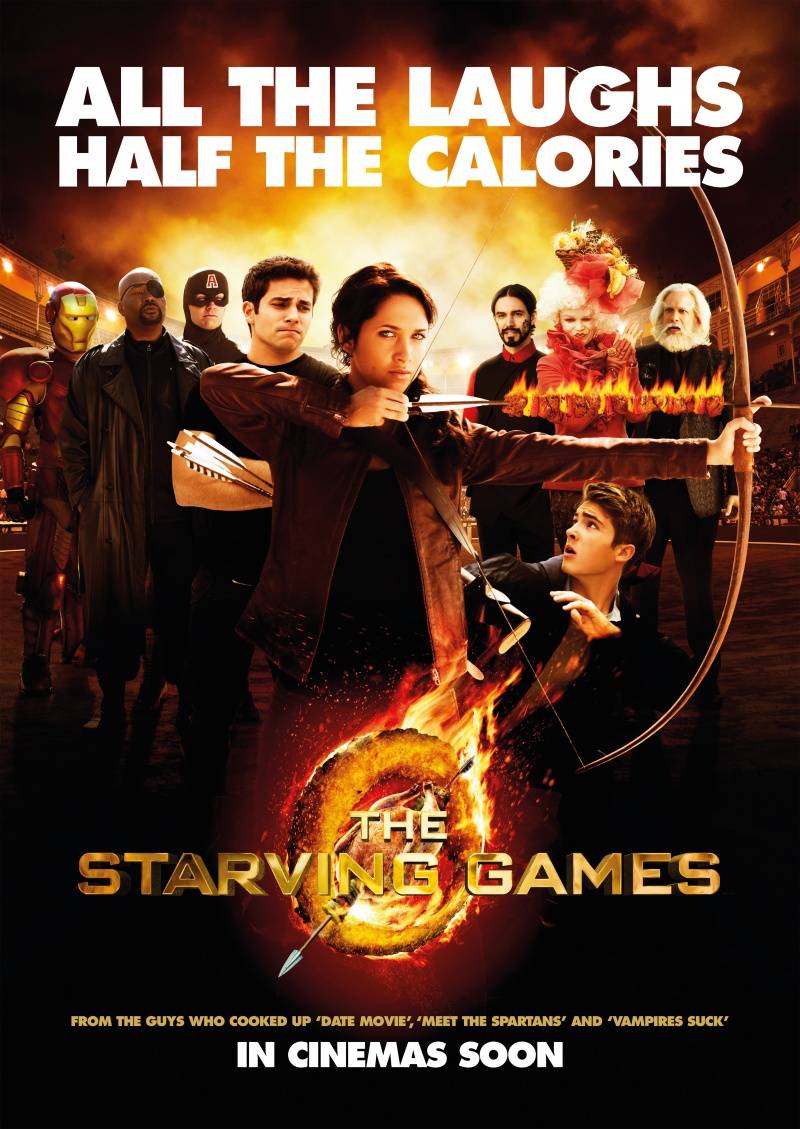 I feel like lambasting the duo of Friedberg and Seltzer has gotten to the point of beating a dead horse. I’ve been railing against their misbegotten sense of comedy (really just pointless and soon-to-be-dated pop-culture references) for years, declaring three of their terrible spoof movies as my worst film of that year. There is no love lost between me and these two men, and yet I feel the sense to restrain my ire when it comes to their latest, The Starving Games. It’s another witless comedy caper, this time using the popular Hunger Games series as its skeleton to hang its desperate jokes upon. These guys don’t know what parody is, don’t know the particulars of comedy and how to build and payoff a joke. It’s the same pattern of ineptitude that will never change. Yet while sitting through all 80 laborious minutes of Starving Games, I felt like Friedberg and Seltzer have come to the realization that the end is nigh for their spoof careers. This last movie didn’t get a theatrical release and the production values look chintzy even for them. They used to crank these lousy films out one a year; hell, in 2008 they gave us two. Now they’ve released two in the last five years. Usually they’ll pack a celebrity or, barring that, MadTV alums. Even those are absent. That’s right, even this movie couldn’t snag a MadTV alum or D-list celeb. Perhaps, as I’d long prayed, the public has grown sour on Friedberg and Seltzer’s misunderstanding of comedy and matured enough to realize that pointless references are not the same as parody. In all fairness, I did laugh two times in The Starving Games, both related to Diedrich Bader as President Snowballs. The lead actress, Maiara Walsh, displays a lot of potential. She’s a good comic actress, has a tremendous smile, a memorable face, and sturdy poise to slough through this mess. She deserves a better movie and more opportunities.
At this point, you know what you’re getting with Friedberg and Seltzer, and that’s all you’re going to get. However, I just looked online and discovered they have two movies scheduled for release next year, one a Fast and Furious parody (goody), and the other an honest to God spoof-free straight comedy. I’ll be fascinated to see what these two have to offer when it comes to non-spoof comedy, but their background fills me with equal parts dread and derisive excitement. Hey, it can’t be worse than InAPPropriate Comedy, could it?
Nate’s Grade: D
Share this:

Out of the Furnace (2013)
 The last time writer/director Scott Cooper looked at a rural, low-income, hand-to-mouth existence, he helped lead Jeff Bridges to Oscar gold with Crazy Heart. It would make sense then for Cooper’s follow-up, Out of the Furnace, to populate those same hills. It also makes sense why actors would flock to Cooper’s next project. It’s a film that strives to be a little of everything, a slow burn and artful revenge thriller, but ultimately will please few, the actors wasted here included.
In rural Pennsylvania, Russell Baze (Christian Bale) is a diligent steelworker who always has to be on the lookout for his younger brother, Rodney (Casey Affleck). Prone to impulsive decisions, Rodney routinely finds himself in debt to bad people. The situation magnifies when Russell is sent to prison for a few years due to a fatal car accident he was responsible for. When he leaves the penitentiary, life has only gotten worse. Russell’s ailing father passed away while he was locked up. His girlfriend, Lena (Zoe Saldana), has moved on with police chief Wesley Barnes (Forest Whitaker). Most distressing, Rodney has gone through four tours of Iraq and is deeply troubled. He’s fallen into old habits and gotten involved in an underground bare-knuckle fighting ring run by the ferocious Harlan DeGroat (Woody Harrelson). Rodney runs afoul of Harlan and disappears, and Russell goes on the warpath for vengeance.
 The problem is that Out of the Furnace doesn’t do enough to separate itself from the pack. We get little insight into the hard lives of these men. Both brothers are haunted by guilt and trauma, squeezed by few economic opportunities, and feeling like life itself is trapping them in corners. However, their path is already predetermined. Russell is destined to stay on the narrow path of responsibility, suffering slings and arrows, but striving to do the right thing. We see this time and again. And Rodney is destined to make poor decisions, desperately getting in over his head and reaching out to all the wrong people. We see this time and again. Each part is solidly locked in, and so we wait because we know their exact trajectory. We know something bad will happen to Rodney and we know Russell will be driven to seek justice his own way. Likewise, Harlan is a scary psycho without complexity. He’s just a drug-addled, violent, scary dude, but he’s so one-note. Lena, once she briefly reunites with Russell, is completely absent in the film, as if her unrequited position is all she serves for our purposes. Cooper displayed a terrific ear for lived-in characters with Crazy Heart, and the details of this world feel honest, it’s just that there aren’t enough of them. The storyline is engraved with little variation, and Cooper doesn’t take full advantage of his great cast, relying upon familiar scenes and elements to establish his loosely drawn characters. We’ve seen these burnouts and lowlifes and dignified blue-collar workers all before. This is a film that wants to be challenging but too often seems to take the easy road.
The very plot structure also seems amiss. As stated above, the journey seems set in stone, so then when something bad does happen to Rodney, it feels overdue. Rodney doesn’t meet his ultimate bind until halfway through Act II, and then when the plot shifts to vengeance, it becomes an uncomplicated straight line. And a streamlined plot with little variation or surprise, with characters that are customary, can get boring. Once Russell is on the warpath, there is little complications or obstacles, or even moments to contemplate the full extent of his actions. And then the movie is done. Because the final act plays out exactly as you anticipate, the movie leaves you feeling anticlimactic. The payoff is unsatisfying. Plot reorganization would have benefited the Russell vs. Harlan storyline. Rather than draw out Rodney’s ultimate screw-up, which everyone is just waiting for from minute one, why not have his screw-up be the Act I break, coming around the half-hour mark rather than more than an hour into the film? That sets the story forward and provides enough space for Russell to work upwards toward Harlan as well as examine what kind of man he is becoming. As it plays out, Harlan is crazy but also easy to access despite the threats of what the rural hill people will do to visitors. If a revenge story was the method that was going to test Russell’s character and redemption, then we needed to get to this crossroads sooner, especially since everyone is waiting for it to happen.
 The power of the acting goes a decent way to compensate for the film’s unresolved investment. Bale (The Dark Knight Rises) internalizes most of his character’s emotions, always trying to hold back a swell of anger and guilt, to just keep going one day at a time. He delivers another strong performance as a man struggling to do the right thing. In this day and age, even a passable Bale performance is going to be above average. Affleck (Ain’t Them Bodies Saints) is a go-to actor when you have a desperate character that is clearly outmatched. His volatile performance is laced with sadness, as you understand how cursed Rodney feels, how the universe hands him bad break after bad break. Affleck tinges his hopelessness with a resigned weariness, as if he’s just seeking a final release. Harrelson (Now You See Me) stews villainously, erupting with extreme violence. He’s a scary guide helped by Harrelson’s flicker of madness he imbues the character with. It’s too bad he doesn’t do anything memorable outside the opening minute. Whitaker (Lee Dainels’ The Butler) probably gets the worst of it, and I think he knows it, which is why the actor adopts a gravely speaking voice that sounds like he has a frog in his throat. Beyond the fact that he’s linked with Russell’s old flame, there isn’t anything important to mention about the character, nor is there anything for Whitaker to do other than make limp threats about letting the police focus on Harlan.
Out of the Furnace is one of those movies that gets details right but loses sense of the big picture. Its blue collar, working class characters are given the right clothes, posture, look, but they’re not given enough material to breathe as characters. The people in this movie end up becoming dispensable parts of the background, serving their strict plot purposes and then dissolving again, lacking complexity and personality. The characters aren’t strong enough for this to be character-driven; the plot isn’t given sufficient structure for this to be a searching moral exploration; the pacing and direction don’t provide enough thrills for the film to work as a revenge thriller. And so Out of the Furnace, while not being a bad film, falls short of truly working as a character study, as a moral examination, as a traditional pulpy revenge thriller. It’s got a great cast and some wonderful production values that convey the weight of low income America, but the movie just lacks an engaging story to justify the talent in use. A few more revisions would have helped, but Out of the Furnace ultimately comes up short because it lacks any sort of lasting heat.
Nate’s Grade: C+
Share this:

Violet & Daisy (2013)
 It’s not often that I say this but… what the hell did I just watch? I know it’s a movie called Violet & Daisy, written and directed by Geoffrey Fletcher, the man who won a screenwriting Oscar for adapting Precious. But what is this? It is some meta commentary on film violence? A twisted fairy tale? A dark comedy? Whatever it is, I know for certain that it was not very good or entertaining.
Violet (Alexis Bledel) and Daisy (Saoirse Ronan) are teenagers who also work as hired assassins by their boss, Russ (Danny Trejo). Their next assignment has a personal angle: Michael (James Gandolfini) stole a large sum of money from Russ. The gals hide out in Michael’s apartment only to fall asleep. When they wake up, Michael is sitting there, accepting his fate, begging the girls to complete their job. He’s dying from terminal cancer, estranged from his daughter, and hoping to exit this world on his own terms. Over the course of one long afternoon, the gals run into rival gangs, a trained sniper, police, neighbors, and all sorts of other plot contrivances to delay the death of Michael.
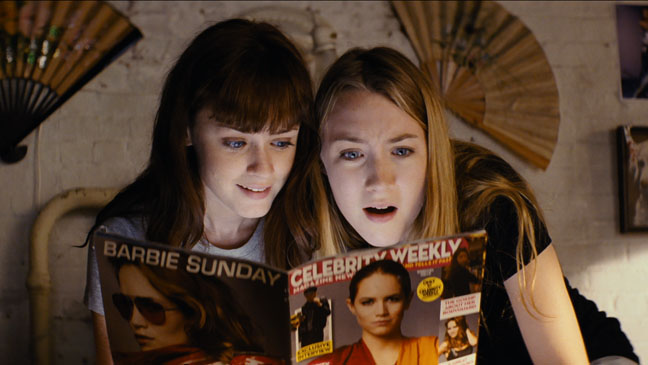 If you’re like me, with similar expectations when it comes to your moviegoing experiences, you’ll be left scratching your head and fumbling for some kind of rationale why people decided to make a film like Violet & Daisy. It feels instantly dated, relying upon the hook of young teen girls with big guns, you know, the same model that has translated to many a successful video game. More so than that, the aspiration, or at least direct inspiration, appears to be a Tarantino-knock-off. Not ripping off Tarantino, as many did in the mid-to-late 90s, but ripping off a poor Tarantino knock-off, like Two Days in the Valley or, the more adept comparison, The Big Hit. There is so much crap in this movie that exists merely because somebody thought it would look cool. Violet and Daisy open the movie dressed as pizza-delivering nuns (is this a fetish I am unaware of?) and open fire on a gang of criminals. But before their fateful gunfight, you better believe it, they have an innocuous conversation about something small, you know, like Jules and Vincent. Why are they dressed as nuns, let alone nuns delivering pizza? It doesn’t matter. This is a movie that doesn’t exist in a universe minutely close to our own. Everything about this film feels painfully and artificial. You know what previous job Violet and Daisy had? They worked at the “doll hospital,” a literal ward for dolls. The decisions of this movie are driven purely by a stylized self-indulgent whimsy. Once you realize this, and you will, the movie becomes even more of a chore to finish.
Then there’s the bizarre and sometimes uncomfortable infantilization of the female lead characters. These ladies do not act like adults; they don’t even act like teenagers. Even though they’re both over 18 years old, their behavior more closely resembles that of a flighty seven-year-old. Their speaking patterns are often in an annoying and partially creepy baby coo. They play paddy cake after successful hits. They ride tricycles. They chew bubblegum and blow bubbles during hits. They get excited about new Barbie Sunday dresses, and this is their real motivation for taking assassination jobs. Yes, to buy dresses. Then there’s their game, the Internal Bleeding Dance, where they hop up and down on the chests of their dying victims, blood spurting out of their mouths, the girls giggling, as if they were bouncing on a bed at a slumber party. These women aren’t remotely actual characters; they are masturbatory quirky hipster fodder, the ironically detached, sexy baby doll killer approximation. Except there is never any commentary at work. The depiction of Violet and Daisy as petite killers never approaches anything meaningful. They are killers because it’s cool. They talk like lobotomized film noir archetypes because it’s cool. This is quirk run amok, quirk with a gun and no purpose. I’m trying hard to ignore the obvious sexual kink undercurrents of the whole enterprise.
 Even with all these flaws, perhaps Violet & Daisy could have been morbidly interesting, except that the circuitous plot twiddles its thumbs, padding out a half-baked story. This is a movie that takes its time and seems to go nowhere. Once the girls meet Michael, the plot has to come up with numerously lame excuses to delay Michael’s execution. I kid you not, there are THREE instances where the girls run out of bullets and have to stop and walk back to the hardware store to go buy ammo. This happens. This is a thing that keeps the plot moving. It’s like as soon as the main characters get into a room together, Fletcher has to struggle to come up with reasons why his narrative should still exist. So we get a second group that Michael stole from because this guy has an even bigger death wish. This second group of spurned bad guys is on their way. If Fletcher was going this route, he might as well gone whole-hog imitating Smokin’ Aces and just had numerous crews all fighting over taking out this schlub first. It feels like Fletcher is making up the story as he goes, taking us on relatively pointless nonlinear interludes to pad the running time. The film, like Tarantino, breaks up the story into a series on onscreen chapters, though one of these only lasts like a minute. Then there’s a loopy dream sequence. The narrative is so stagnant that whatever interest you may have had will long be gone. By the time the movie actually does end, at about 80 minutes, it has long felt creatively exhausted, totally gassed. Fletcher throws out all the stops to get across that finish line.
Even though it was filmed way back in 2010, it’s hard to escape the morbid irony of Gandolfini (Enough Said) playing a character discussing his own inevitable death. He’s the best actor in the film, offering a paternal warmth that goes wasted amidst all the stylistic nonsense. Our other two featured players, Bledel (TV’s Gilmore Girls) and Ronan (The Host), have a sprightly chemistry together that works. I just wish all three actors had something to do rather than strike artificial poses and quip.
After enduring The Paperboy, and “enduring” is indeed the correct term, I was certain that the messy, tonally uneven, sometimes garish flights of fancy in Precious were due to director Lee Daniels. After enduring, and again “enduring” is the correct term, Violet & Daisy, I’m starting to think that Fletcher is deserves equal credit. Violet & Daisy is a curious exercise in twee indie hipness, suffused with quirk standing in place for characters, story, meaning, etc. It feels like the development stopped once the core concept of teen girl assassins was concocted. The off-putting childish nature of the adult girls, juxtaposed with the baby doll sexuality of the film, makes for an uncomfortable watch. To call the film bad taste is too easy. Whether this is a bizarre dark comedy, a whacko modern fairy tale, or whatever term you want to apply to justify the artificial excesses and emptiness, Violet & Daisy is a contrived mess that labors to fill out a basic feature running time, often doubling back and delaying. There isn’t a story here, more just an incongruent, irregular style. If you’re content with a knockoff of a Tarantino knockoff, with an extra dose of whimsy, then enjoy Violet & Daisy and you can dance your cares away atop bleeding bodies.
Nate’s Grade: D+
Share this:

All is Lost (2013)
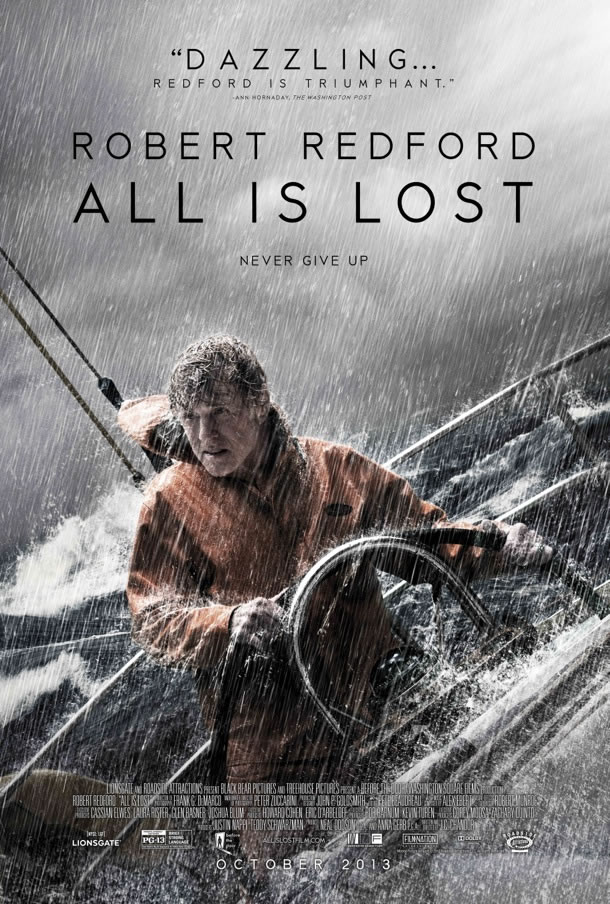 J.C. Chandor, nominated for an Oscar for writing Margin Call, chose a curious follow-up. In All is Lost, Chandor serves as writer/director and takes acting legend Robert Redford, strands him in the middle of the ocean, and watches him flounder. Considering Margin Call was heavily dialogue-driven, it’s an interesting detour to a nearly wordless film. Redford plays an older sea-faring gentleman who discovers one morning that his boat has been damaged by a floating shipping container. He has to repair the hole and take inventory of his remaining supplies. As his boat takes on more water, being battered by storms, Redford must strive to reach a shipping lane as his best bet to be rescued.
 Allow me to furor my brow at the reception All is Lost has gotten thus far. It’s not a bad movie but when you boil it down it’s a rendition of The Old Man and the Sea minus, you know, the giant fish. I knew going in that the film was going to be minimalist, but I didn’t think it would be this dull. It is literally a guy manning a boat for 90 minutes, patching things up, with the situation getting worse. Then he’s in a raft. Then he’s low on supplies. Then, well, it ends pretty much how you’d expect though with a flicker of ambiguity for the squeamish. The drama of human survival, of man against nature, can be plenty invigorating, but instead Chandor takes a more leisurely and studiously pessimistic approach, and so we watch Redford slowly fail. The filmmaking can barely keep your interest. He hoists the sale. He tends a hole in his boat. He salvages electronics. There are a couple of choppy storms that throw the ship around, but The Perfect Storm this isn’t. Nor is it Open Water. There is a certain brainy enjoyment from survival thrillers, thinking alongside the characters, but our opportunities are absent here unless you know a thing or two about sailing, otherwise I just kept thinking, “fix the hole in your boat.” It takes a good while, until the third act when Redford is forced to abandon his sinking vessel, before the perilous reality seems to settle in. Beforehand it feels like the film is dawdling, and I just found myself shrugging and growing restless. It feels callow of me to complain that not enough happens onscreen when I’m watching a man struggle to survive at sea, but that’s because the sense of urgency is nil. I watched Redford eat beans out of a can more than I saw him sweat over his predicament. I wish Redford had been paired with a tiger or a volleyball for decent screen company.
This is very much a one-man show with Redford ably holding the screen, but will you care about his character and his plight? The character is nonexistent, far more so than the similar charge against the other awards-friendly survival thriller, Gravity. I always felt like I was observing Redford from a distance, never fully emotionally engaged, and more so just studying his survival skills like there might be a test later. That’s because Redford serves as a metaphorical stand-in for all of humanity (the character’s listed name is “Our Man”); the movie feels replete with allegory, which makes the tedium all the more unbearable for me. I didn’t feel the man’s horror or nerves or despair or urgency. I didn’t feel much of anything. That’s because I believe that Redford’s acting history is meant to fill in for the absence of character. We’re not watching any man brave the dangers of the ocean, we’re watching the aging Hollywood screen idol dig into his own screen history and showcase what remains. It’s a fine performance that kept me watching but it felt too modulated, too controlled, too internalized to translate the myriad of emotions necessary. It’s 90 minutes of Redford standing in for himself standing in for humanity, named “Our Guy,” remember. That already sounds laborious.
 Chandor received notoriety for his smart, hard-hitting Mamet-esque dialogue, and deft handling of actors, but All is Lost showcases a whole other set of skills in his storyteller toolbox. Being nearly wordless, the movie is one giant exercise in visual storytelling. Chandor’s camera angles, editing, and in particular the use of sound and lighting, keep the audience oriented smoothly. While it may take a moment to gauge what Redford is doing, there is a logical connection to his actions. There’s a visual mastery here that was not even hinted at with Margin Call, which was mostly a stage play of boardroom conversations put on film. The special effects are seamlessly integrated into the film and having Redford perform many of his own stunts adds to the overall verisimilitude, the film’s calling card. I feel like Chandor the director outdid Chandor the writer.
All is Lost is a film I can better respect than support, an intellectual exercise in a deteriorating and seemingly doomed survival scenario, the anti-Cast Away. It’s probably as realistic as these things get, but does that make it interesting? The details of reality are there but the story and especially the character work is lagging. It’s nice to see Redford with such a meaty part, and obviously one he is connecting with, but I wish his talents were put to greater non-metaphorical purposes. With the plot and characterization stripped, it appears that Chandor’s film is rife for allegorical analysis, noting the struggle in the face of overwhelming odds, the futility of existence, etc. To me, that sounds like you’re doing the movie’s work for it. The overall lack of urgency just wrings out what entertainment there could have been with this tale of survival. When your main character doesn’t recognize the threat, then that transfers to the audience, and we too shrug. All is Lost is certainly well made from a technical standpoint, with Chandor showing impressive visual storytelling prowess, but it drags and offers little incentive to connect. What ends up being lost is your patience and attention.
Nate’s Grade: B-


 nathanzoebl
You must be logged in to post a comment.