Daily Archives: August 1, 2009
Funny People (2009)
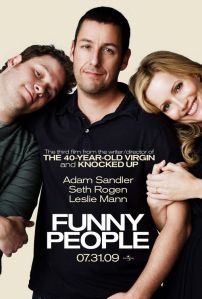 In two short years, Judd Apatow has become the king of comedy. He’s co-written and directed two bona fide hits that will go down as comedy classics (40-Year-Old Virgin, Knocked Up), and produced gut-busters with heart, like Superbad and Forgetting Sarah Marshall. The Apatow brand of comedy centers on characters and less on contrived set pieces. He’s built up enough comedy capital in Hollywood that he felt he could write and direct a project less ideally commercial, something tagged as being more personal and serious like in the James L. Brooks mold. Funny People is the mixed results. I applaud Apatow for trying to grow as an artist, but as the saying goes, if it ain’t broke don’t fix it. Funny People is a broken movie that isn’t funny enough to be fully redeemed.
George Simmons (Adam Sandler) is a famous comedy actor that has made several hit Hollywood comedies. He may live in a giant mansion but his life is extremely isolated and lonely. He has no real close friends and years ago he drove away the love of his life, Laura (Leslie Mann). He has no one to comfort him in his time of need. This prickly man has been informed that he has a terminal blood disease. Simmons decides to go back to his comedy roots, to stand-up, and it is there that he meets the young comedian Ira Wright (Seth Rogen). Ira has grown up with the comedy of George Simmons, so he is flabbergasted when the man himself asks Ira to write jokes for him. Ira’s roommates, fellow stand-up comic Leo (Jonah Hill) and crappy sitcom actor Mark Taylor Jackson (Jason Schwartzman), can’t believe his dumb luck. Ira and Simmons build an unorthodox friendship, and Ira is the only person George has confided in about his disease and his fear of dying. And then something amazing happens. George Simmons gets better. He’s got a new lease on life and he aims his attentions on the girl that got away. Laura is married to Clarke (Eric Bana), a handsome Australian businessman, and she has two adorable kids (Apatow’s own girls), which makes it a very poor time to restart her romance with George.
 Funny People is the first Apatow-helmed film that feels sadly incomplete, even at two and a half hours. The movie is staggeringly sloppy when it comes to plot structure and character work. First off, when a character is informed that he has a terminal illness at minute three, it doesn’t have the impact that it would if the audience got to know and feel for that individual. In fact, the first half of this movie feels like, and this may get confusing, the second half of another movie. It centers on a selfish character coming to grips with his choices in life, mostly wrong, and beginning to reconnect with people once more, building a mentor friendship and finding the “one that got away.” But there are segments during this first half of Funny People where the impact just cannot be felt because the dramatic legwork has not been achieved. Watching Simmons’ estranged family berate him through tears doesn’t have much of an impact when they discover the news. Seeing George Simmons spend his potential last days jamming with Jack White and other musicians is cool, but it doesn’t come across as anything but another indication that the fake George Simmons is famous in this alternative Los Angeles. It doesn’t have setup, like Simmons talking about one of his life’s pleasures is strumming the guitar or playing before things got complicated. So it’s basically just another celebrity cameo snapshot. While I’m on the topic, the multitudes of celebrity cameos are strangely unfunny, save for a bit where Sarah Silverman describes her lady parts.
This is also the first Apatow comedy where it feels like twenty percent of what I saw promised from TV spots, trailers, making-of specials (there was a good one on Comedy Central to check), the advertising unit if you will, was not in the movie. This gave me the distinct impression that even at a lengthy 150 minutes that Funny People feels misshapen, that there are swaths of material on the cutting room floor that would have assisted the narrative and sad amount of underwritten supporting characters. I’m not saying Funny People would necessarily be a better movie at three hours length, but it would at least feel more fully formed and satisfying.
 The main problem with the film, outside of the reverse plot structure, is that everything just goes slack during the uneven second half. George and Ira spend about an hour of the movie with Laura and her family, and it feels like one long uncomfortable detour. Part of the squirmy feeling is intentional, as the audience is supposed to be in Ira’s shoes and see George’s homewrecking as the bad decision train wreck it is. But I also felt uncomfortable because George kept extending his stay day after day and I was getting impatient. I wanted these characters to head back to L.A. and deal more with the Ira/George relationship. During this second half, Ira becomes a background figure that is good for nervous reaction shots. This stalls all the character work that had been done up to this point and Ira goes to pause mode for an hour. This second half section isn’t particularly funny, it isn’t romantic, and it gives little insights into the past between George and Laura. She has established a nice living for herself, with two cute kids and a hunky husband who seems to be a good father when he’s around. In fact, despite the movie’s insistence that Clarke is a cheater (thus ensuring the movie law that it is then acceptable to cheat on him), I found myself liking the hyperactive and sensitive lout. Every plot movement in this second half feels wrong, some of it intentional, but it makes Funny People feel like it has been hijacked and taken hostage. Where did the movie I was kinda liking go? What happened here? This hour feels like a separate movie and one that Funny People would have benefited from simply being dropped entirely.
Perhaps I’ve been watching too much Mad Men in anticipation of its third season, but this movie also disappoints by failing to delve into the creative process of comedians. Despite its running time and subject matter, there isn’t that much standup witnessed. Usually the movie will display about one line or one bit and then cut back to the characters offstage again. We don’t get to see the evolution of comedy or the professionals talking shop about what makes a good joke. There isn’t even much collaboration, so we don’t get to see multiple minds banging out jokes together. There’s a comedian named Randy (Aziz Ansari) who is popular with audiences because he’s loud and spastic, and all the other comedians hate him, but then the movie doesn’t return to this. Go back to this topic. I want to hear more about the divisions within the comedy world, the people that feel like they are more pure or textured in their funny compared to the people that play to the crowd and lap up the easy yuks. Ira’s character work is mostly explored through his changing standup persona, where he seems to gain more confidence and a voice. But there’s this whole other storyline where Ira is a “joke thief” and takes other people’s material and repackages it as his own. This is an interesting story and provides conflict and glimpses into the character of Ira as an insecure and ethically challenged opportunist in a competitive field. It makes him a more dynamic character. I saw more of this storyline in the making-of special for Funny People, and sadly it is only hinted at in the final product. The other comedy players, like Ira’s roommates and his quasi-love interest (Aubrey Plaza), are barely explored as people and professionals.
Apatow comedies are notable for being character-based, but Funny People doesn’t seem too concerned with establishing characters that you want to be around. I found little reason to care. I found most of the characters to not be engaging; some were unlikable but most were simply flat. George Simmons is supposed to be a selfish man, though there’s something inherently selfish about being famous in Hollywood. Comedy itself is inherently selfish, where individuals guard their observations and exploit personal stories for the endorphin highs of audience approval. Is successful comedy linked to selling out? Funny People occasionally visits the dark recesses that comedians utilize for material, like self-lacerating humiliation and family trauma that gets aired out as a means of therapy. Simmons is a selfish and lonely guy and the point of the whole movie is that even after a near-death experience, he’s still selfish and lonely. He’s said he’s changed but has he really? That seems to be the movie’s cosmic joke. This is clearly a personal movie for Apatow, which might explain why it has less resonance for an audience that isn’t as steeped in the history of comedy or the rigors of fame. I just don’t have the same point of interest.
 Sandler revealed his acting talent in 2002’s beguiling Punch-Drunk Love, and in Funny People he plays a completely different character than his other adolescent roles. He doesn’t pander to be likable at any point, and he’s generally standoffish from beginning to end. He hasn’t done a lewd, crude movie in over ten years, and this return to raunch rekindles the Sandler I remember listening to constantly in the mid 1990s. This role isn’t as taxing for him as an actor, nor is he given too many chances to reveal deeper layers to George Simmons. I think this is by design from Apatow. Rogen is less his charming self and during the second half of the movie he pretty much shifts his eyes and makes pained faces. He feels at ease in the stand-up sequences, probably because Rogen performed stand-up comedy when he was 13. Mann gets her biggest acting role in years and cries enough, but it made me realize that she works best as an actress that can steal scenes rather than an actress who has scenes built around her. I think Bana (Star Trek) actually comes off the best. He showcases an exuberance for comedy not seen before, and when his character gets emotional it still manages to be funny and believable.
In the end, Funny People just isn’t that funny. There aren’t any particularly clever comedic setups, the characters don’t get many chances to be humorous even as comedians, and the movie just goes slack during its uncomfortable and uneven second half. The Hollywood satire lacks bite, and the best bits are saved for the scathingly unhip and formulaic “Yo, Teach!” sitcom of Schwartzman’s. Apatow is more interested in purging a personal tale onto the screen rather than fashioning a relatable mainstream comedy. I feel that the salutations that Funny People is “more challenging” and “serious” are unwarranted. This is certainly a different movie but is it any more serious than navigating the uncertainty and awkwardness of an unplanned pregnancy or beginning sexuality at middle age? I don’t think so. Beyond this, the movie doesn’t establish its plot well and spends far too much time in side diversions, failing to round out characters and ignoring intriguing premises and storylines. Even the camaraderie, usually a hallmark of Apatow productions, feels lost as the characters have much more friction. On a personal note, I saw this movie while I was on vacation in the Outer Banks. On our car ride back to our beach house, my then-partner and I got into a car accident. We were both physically fine but her little Ford Focus was totaled. I will now forever associate Funny People with a car accident. If that isn’t enough of an on-the-nose metaphor, while we waited along the hot road for police and tow trucks, I thought to myself, “I just wish the movie was worth this.” It wasn’t.
Nate’s Grade: C
Share this:

The Room (2003)

I consider myself to be a connoisseur of crappy cinema, thanks in large part to growing up on the fabulous TV series Mystery Science Theater 3000. To me, truly bad movies can be just as enjoyable to witness as great, competent works of filmic art. So imagine my surprise when it I had never heard of a little flick called The Room until a month ago. I was reading an Entertainment Weekly article about this tiny 2003 movie that has developed a rabid cult following. I felt betrayed. How did I go five years without ever hearing about this movie? The Room is writer/director/star Tommy Wiseau’s magnum opus. It must be seen to be fully believed.
To watch The Room is truly a life-altering experience. This movie goes beyond bad. It’s so bad that it almost seems like Wiseau is a mad genius. This movie is bad on multiple levels and hooks you from the beginning, instantly daring the audience to stick around to see if it gets worse. And it does in the most wonderful ways. If I was stranded on a deserted island and could only bring five movies, right now The Room would be one of them (I may even be tempted to just bring five copies of this movie). Wiseau’s film cannot displace Manos: The Hands of Fate as the worst film of all time, but The Room easily belongs in the upper echelon of craptacular cinema among the likes of The Land of Faraway and Lady Terminator and Bulletproof Monk. I am simultaneously appalled, bewildered, fascinated, delighted, and comforted by this movie, comforted by the fact that something this singularly inept could still sneak through the system. But this film is so perfectly inept on a multitude of levels that it feels like it could never be recreated again, like the human race benefited from this chance artistic encounter. The only way I can fully describe my unhealthy appreciation for this cinematic slice of the absurd is to simply list off my list of loves.
 1) The film’s plot involves a love triangle with the three least personable people imaginable. Johnny (Wiseau) is a broad shouldered, marble-mouth Austrian who supposedly works at a bank, we’re told. Lisa (Juliette Danielle) stays in their apartment doing very little, though she says that she shouldn’t have gotten into the computer business because it’s “too competitive.” Lisa declares in damn near every scene that after five years together (though the characters say seven at the end of the film) she no longer loves Johnny. She now loves Mark (Greg Sestero), Johnny’s best friend. And if you forget that key point then Mark will assist you because one third of his dialogue is declarations of “Johnny’s my best friend.” Another third of his dialogue might as well be, “What are you doing?” Mark is one of the thickest dolts in history. Even after Lisa has sex with him twice, calls him repeatedly, and leads him to places where they can be alone and intimate, he looks at her dumbfounded and says, “What are you doing?” like a kid who will never comprehend that 2 + 2 = 4. This is the basis of the plot and yet so much of the movie is gloriously repetitive and involves characters sitting around, saying the same things over, without ever really advancing the plot.
2) The Room hooks you from the start, and it’s all thanks to the weird neighbor kid/surrogate son Denny (Philip Haldiman). This supposed student is an orphan that Johnny has taken a shine to; Denny has his rent and tuition generously paid for by Johnny. In the very opening scene Johnny gives Lisa a slinky red dress as a gift. She tries it on and both Denny and Johnny make favorable remarks. Johnny says he’s a bit tired and leads Lisa by the hand up the stairs. The camera stays on Denny, who, instead of taking the hint and leaving, remains standing, grabs an apple, takes a bite out of it, then slowly walks up the stairs after the amorous couple. He then hops on their bed and joins in on their pillow fight foreplay. The characters have to literally spell it out to the guy that they want some privacy for sex. “I know, I just like to watch you guys,” Denny responds. What? Denny confesses to Johnny about experiencing weird feelings for Lisa. This kid is supposed to be in college but he acts like he’s developmentally challenged. A friend has a theory that Denny has a confusing gay crush on Johnny, but I believe that would be way more deep and subtle than the movie seems capable of.
 3) The movie is littered with subplots that come out of nowhere and never resurface again. All of a sudden Lisa’s materialistic mother (Carolyn Minnott) announces she has breast cancer. This is never commented upon again. All of a sudden Denny is confronted by an angry drug dealer who wants his money, which means he’s also the world’s worst drug dealer if he’s willing to give out drugs on credit. The characters all collect on the roof and yell. This is never commented upon again. Lisa makes up a story that Johnny hit her. He publicly denies it. This is never dealt with again in any capacity. Lisa lies to Johnny that she’s pregnant, just to “make things interesting.” Her rationale is that they’ll eventually start trying to have a baby anyway, which conflicts with her frequent statements that she doesn’t love Johnny and wants to leave. This fake baby is never commented upon again. About thirty minutes into the movie, another couple sneaks into Johnny’s apartment to have sex. Why I cannot fathom. When Lisa and her mother intrude upon this scene, the mother asks astutely, “Who are these characters?” Exactly madam. The movie keeps going over the same material because nothing new ever sticks.
4) The line readings are astoundingly inauthentic. Half of the film seems to be dubbed, especially Johnny’s lines. Much of the dubbed dialogue fails to match up with the actor’s mouth movements. There is one sequence in a flower shop that is nothing but dubbed dialogue and it happens so quick. The scene itself lasts like 10 seconds but it still manages to squeeze in this entire conversation: “Oh hey Johnny, I didn’t see you there.” “Yep, it’s me.” “Here are the flowers you wanted.” “How much?” “18 dollars.” “Here ya go. Keep the change. Hi doggy.” “You’re my favorite customer, Johnny.” “Byeee.” It happens so rapidly with so little breath in between. Wiseau’s quick changes in temperament with consecutive lines will amaze you. He goes directly from, “I did not hit her! I did not! I did naaaaaaaut,” to a very casual, “Oh hey, Mark,” in a nano-second flat. The speech patterns rarely approach realistic human cadences.
5) Lisa is routinely told by the several male characters that she is exceptionally beautiful and lovely, but this woman’s personality is like a dead plant. Danielle is a fine enough looking woman, though the hair and makeup people do her no help with those thick eyebrows, but as a beauty that could manipulate multiple men? I don’t think so. Danielle has a bit of a tummy to her, which is fine by my standards of beauty, but from a Hollywood perspective a woman that lacks a concave stomach is considered “fat.” Lisa’s friend Michelle (Robyn Paris) is in fact a more attractive female and might have served as a better Lisa. I think perhaps Danielle was willing to do nudity and Paris was not, but really, if you’re a struggling L.A. actor and you’re willing to agree to be apart of something like The Room, surely you’ve already ignored any internal misgivings. What possible hang-ups could there be left?
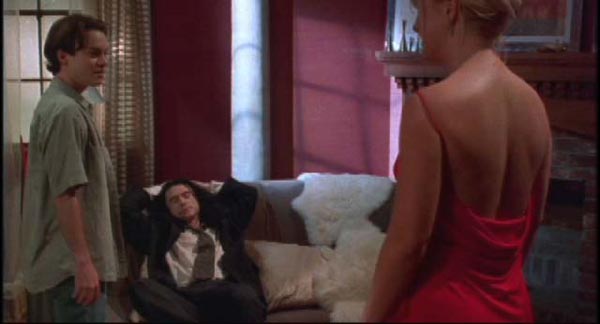 6) The film is structured like the soft-core porn that dot the late hours of premium cable channels. There are four lengthy sex scenes in the first hour, though one of them is composed almost entirely with recycled footage from the first bout of lovemaking between Lisa and Johnny. The sex scenes are deeply un-erotic and consist of several camera angles that make it impossible to see what is actually happening. There is nothing sexy about watching Wiseau’s pasty posterior humping the hips of Danielle (seriously, the body alignments are way off here). When Lisa and Mark have sex on top of a spiral staircase, Wisuea can barely frame the action coherently. Why would anyone want to have sex on a spiral staircase? That’s just asking for chronic back pain. Mark fails to even take his pants off. For such lengthy sex scenes, Wiseau does so little with the talent on display. What makes all the sex scenes even better is that they each get a wretched pop song as a soundtrack. It’s all mid 1990s R&B with some growling sex guitar, and it’s all awful. There’s one song that repeats the phrase “you are my rose” like nine times in a row. If you fail to cringe and howl from the sex scenes then the songs ought to do it.
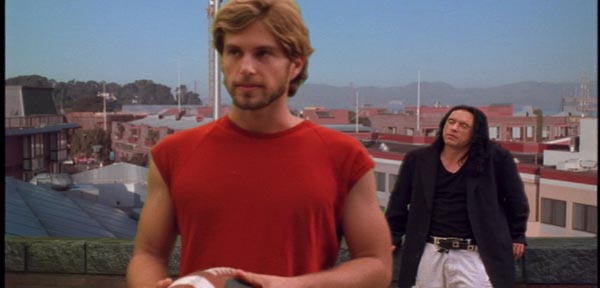
7) Wiseau makes the most mysterious decisions as an artist. He sticks to a minimum of locations and one of them happens to be the roof of Johnny’s apartment complex. The sensible thing would be to film on an actual roof. Wiseau decided to film on a roof set and use an ineffective green screen backdrop that makes San Francisco look like it inherited Los Angeles’ smog. The film keeps cutting back to exterior stock footage of the city that signifies the passage of hours, a day, or no time whatsoever. When Denny is confronted on the same rooftop about his sudden drug disclosure, Lisa berates him. As she cries and shrieks and overacts, you cannot see it because Wiseau’s camera has cut her facial reactions out of frame. The scene cuts back and forth between Denny facing the camera and the left side of Lisa’s head. At another point Lisa is talking about her cheating ways with her pal Michelle, who seems way too giggly to be disapproving. During this scene Lisa has angled her body in such a manner that when she speaks it appears like a subcutaneous alien is about to burst forth from beneath her neck. Wiseau did not catch this unnerving and distracting sight. The film’s lone idea of male bonding involves tossing a football together. So Mark and Johnny will go out running in a park and toss a football back and forth, all the while having a faint conversation that gets drowned out by an overly anxious score. There will be swaths of the film where the score just competes with the onscreen dialogue.
8) There’s like a whole other level of offhand dialogue throughout, where characters will stand around and Johnny or someone else will mumble to no one in particular. The actual dialogue is full of other memorable head-scratchers, such as:
Random disapproving guy to Mark: “Keep your stupid comments in your pockets!”
Same disapproving man: “It feels like I’m sitting on an atom bomb that is going to explode!”
Michelle using chocolate candies as a means of foreplay: “Chocolate is a sign of love.”
Lisa’s mother: “Nobody ever listens to me.”
Lisa: “You’re probably right about that, mom.”
Johnny’s profound wisdom: “You know, if more people love each other the world would be a better place.”
Johnny refers to someone as a chicken and then proceeds to make this accompanying sound: “Cheep, cheep, cheep, cheeeaaaaaaaaiiiiiiiiiip.” This bizarre chicken impression will be repeated no less than three times.
 This brief exchange at a coffee shop between Mark and Johnny:
Mark: How was work today?
Johnny: Oh pretty good. We got a new client… at the bank. We make a lot of money.
Mark: What client?
Johnny: I cannot tell you. It’s confidential.
Mark: Oh come on. Why not?
Johnny: No I can’t. Anyway, how is your sex life?
And finally, the signature line, where Johnny has had enough of Lisa’s mental games and he roars, “You are tearing me apart, Lisa!”
I could keep citing further evidence of The Room‘s cinematic shortcomings, but listing the faults of one of the worst films ever made can be pointless after a while. The staggering amount of faults in Wiseau’s film is also its combined strength. Most bad movies have a finite level of badness, like a poor plot or some troublesome acting. The Room is a movie composed of nothing but 99 complete minutes of badness at every facet of filmmaking. I am a more complete person having seen this remarkable film. I highly recommend gathering a group of friends around and holding a viewing party; the movie plays to even higher levels of enjoyment with a group atmosphere. The Room is Tommy Wiseau’s accidental masterpiece and, to me, proof that a loving God exists.
Nate’s Grade:
Artistic Merit: F
Entertainment Value: A+


 nathanzoebl
You must be logged in to post a comment.