Blog Archives
Nine Days (2021)
 Oddly enough, over the course of less than a year, we now have two movies about young souls competing to find their sense of self before being born. Will (Winston Duke) lives in a small cottage in the middle of the desert. Or so it would appear. He’s a former human who now serves as a spirit who watches over the lives of a select group of others on Earth through P.O.V. monitors. After a car accident, one of his people is killed, leaving a new opening. It’s Will’s job to interview a group of candidates and determine who is best equipped to handle being born. Will takes the process very seriously but he is also more emotionally affected by the loss of life under his guidance than he admits. Where did he go wrong, or is right and wrong even the right markers for assessment? Will must choose wisely over nine days of deliberation and insight into what it means to be human and what it means to live.
 Nine Days is a tender and thoughtful movie that has much under the surface given its metaphysical context and probing questions about spirituality, identity, and existence, but it doesn’t simply rely upon the artistic weight of ambiguity. There’s a genuinely involving emotional drama here that’s accessible while offering greater depth to be unpacked by the viewer who enjoys metaphor and implication and debate. At its essence, the movie is about a series of job interviews but for a position that we don’t fully understand what the requirements are and if even meeting the requirements is enough for the hire. It’s a primarily dialogue-driven procedure but it’s also character-focused as the entire process examines what animates Will, what haunts him, and why he does what he does. Early on, the surreal nature of what should be an ordinary event, job candidates interviewing with a boss, gives the movie an air of mystery and offbeat humor. The candidates are showing up, going through a series of questions and role play scenarios, and with each session, the candidates evolve into the personas that will define them. There’s something mildly profound about watching the development of an identity before it’s even been born. As the movie progresses, Will turns down candidates and the news is truly devastating. Not only will these spirits/souls miss out on being born on Earth, they will cease to ever exist and fade away. That is some heavy stuff. Watching each one come to terms with that sort of death can be heartrending. Just imagining having to accept the end before life ever even began.
Rather than simply fade away into the blank of nothingness, Will chooses to help these souls get one last moment of peace before their ultimate end. He becomes a celestial one-man Make-A-Wish spiritual service. It’s unknown whether these “positive memories” are from the souls’ own development or their observation of the souls that have been placed on Earth. Regardless, each rejected candidate gets a moment that Will studiously recreates as an act of kindness. This section can be rather moving as each soul gets a personal sendoff and, in those final moments to savor, we watch them become affected with the generosity and the fleeting moment of life that will be tragically denied to them. One candidate climbs aboard a stationary bicycle, and Will positions one screen after another, each with projection from that angle of the street. When taken together, it creates the illusion of a nice bicycle ride through a town square. The homemade production, even sprinkling cherry blossoms and a swinging light to illustrate a traveling through a tunnel, provide small moments of affectionate conviction. I found each of these moments to be emotionally rich and beautifully rendered on screen. The care and craft Will puts into these acts is wonderful and a tremendous insight into who he is as a character and what he values in others.
 Will is haunted by the idea that he may have been oblivious to the pain of one of his pupils, and this indecision is coloring his interview process for a replacement soul. It’s unclear what exactly Will is, or his boss, or his duties, but he vaguely amounts to a guardian angel. He has a bank of old TVs that he monitors and obsessively documents the lives of a few. He takes particular pride in one soul on Earth and listens to her virtuoso violin playing as a means of personal relaxation. Her sudden death rocks him, and when it’s revealed that she was depressed, he tries to make sense of being able to see and hear everything these souls do but not fully knowing them. Did he get something wrong in his clerical assessment? Did his understanding of her have its limits? Could she have been hiding something so all-consuming without his suspicion? It all upends Will and fosters self-doubt. He’s trying to make sense of something that may not ever make sense. That is how inscrutable human beings can be and how tragically fleeting life can become in an instant.
The other change agent for Will is the presence of Emma (Zazie Beetz), a candidate who shows up late, questions the nature of the questions she is given, and is empathetic to a fault. The other candidates are playing within the rules of Will’s questions but she’s pushing back, and it only makes Will think more and more about her and her aims. I don’t consider it too much of a spoiler that Emma will be one of two final candidates for the open spot for life. Her character causes Will to reassess his own biases, his own way of doing things as they have, and his own conception of himself and what life can be about including his own time spent on Earth, which he likes to remind the others like it’s bragging rights. I suppose one could argue that, yet again, we have a quirky female character in service of teaching the male hero about the importance of embracing life to the fullest, but I think the general makeup of the characters is superfluous to the impact of the story. We’re dealing with spirits taking a physical form here. Their appearance is immaterial to their identity at this point, at least in an otherworldly realm that (hopefully) knows no sexism and racism.
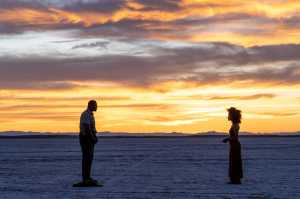 Nine Days is the film debut from commercial director Edson Oda and the movie is utterly gorgeous from a technical standpoint. The photography favors gleaming sunsets and pristine vistas to communicate the exquisiteness and otherworldly plane of existence. The desert landscape is beautifully filmed, and the interiors are also pleasing with their visual arrangements and the mingling of natural and artificial light. Oda won a screenwriting award at the 2020 Sundance Film Festival and for good measure. This isn’t just a good-looking indie, which it assuredly is, but there is deep melancholy and beauty and transcendence to be had with the very humane and compassionate storytelling trying to get at larger truths about our limited time. The storytelling has plenty of ambiguity and nuance and metaphor, but there’s an accessible core that I believe most viewers can align with and then, if they choose, can discover further meaning. There is a slightly basic “stop and smell the roses” moral, but I found there to be more lyrical beauty at different points that affected me deeper than any condensed message. The conclusion hinges on a recitation of Walt Whitman’s “Song of Myself” and it conveys not just Whitman’s celebratory humanism but also taps into Will’s own character arc. The poetic performance itself is an expression with multiple levels, celebrating life in multiple ways, and serving as a heartfelt and personal goodbye. It’s a lovely ending for a lovely little movie.
Nine Days is packed with recognizable acting faces (Tony Hale, Bill Skarsgaard), several of whom have graced Marvel superhero movies (Duke, Beetz, Benedict Wong), and there must have been something compelling for them to all accept this low-budget, contemplative indie about the human condition. It’s a little movie with a lot on its mind but it doesn’t feel the need to explain everything. There’s a sturdy foundation to begin with but enough ambiguous room for discussion and debate. It reminds me of 2003’s beguiling, divisive, and highly metaphorical indie Northfork. Both movies are poetic, understated, and deeply involved in human connection and spiritual meaning while providing room for interpretation. There’s plenty here to unpack but even on a literal level the movie works as an emotional experience. I found myself under the gentle sway of Nine Days and its mighty beating heart of humanism that extends even beyond the realm of flesh and blood.
Nate’s Grade: A-
Share this:

Us (2019)
 I think it’s important to state that Us is not Get Out and that’s perfectly okay. Not every movie can be a Get Out, an experience that was so refreshing, socially relevant, wickedly fun and dynamic that I immediately wanted to see it again and tell everyone I know to join in. Writer/director Jordan Peele shed his funnyman past and flexed his impressive genre know-how to make a knockout of a movie with an amazingly structured story, allowing all of the pieces to snap together with clever precision. It was my own second favorite film of 2017 and I was highly looking forward to Peele’s follow-up in the realm of what goes bump in the night. Don’t go into Us expecting Get Out. It’s not quite the sum of its parts and has some storytelling shortcomings that limit the impact of its visceral thrills. It’s an engaging horror movie, but it’s far more allegorical and far less tidy and satisfying.
The Wilson family is spending their summer vacation at a rental home in Santa Cruz, California. Adelaide (Lupita Nyong’o) and her husband Gabe (Winston Duke) are trying to enjoy a getaway with their children, teenage daughter Zora (Shahadi Wright Joseph) and young son Jason (Evan Alex), when strange coincidences keep occurring. This is the same beach town where many years ago Adelaide had a traumatic childhood experience getting lost from her bickering parents. Then one night Jason informs his family that there’s another family standing in their driveway. The Wilson family is hounded by mysterious doppelgangers, each a cracked mirror version of themselves. This new family wants what the Wilsons have and will use any bloody means to see that they get it.
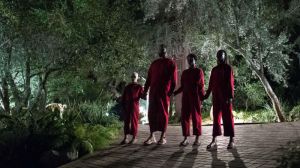 Us is more a straight horror film and has plenty of excellent, terrifying, and smartly directed scenes to make an audience squirm in their seat. Peele has established in two movies a strong instinct for horror and how to expertly stage a scene. His camera is judicious in what it does and does not show the audience, holding onto moments to escalate tension and providing no escape for an eager audience. The majority of the second act is a home invasion thriller and these scenes and subsequent chases and escapes can be nerve-wracking. Each character has their own opponent and each has their own method of trying to outsmart or out maneuver their downtrodden doppelganger. I was getting plenty of Funny Games vibes, a movie I downright despise, but what it could have been if the creator actually cared about the inhabitants. The family and their bonding is a strong empathetic anchor for the audience, so we watch each member of the family battle a literal incarnation of their inner demons. Peele also assembles an effective collection of spooky imagery, from caged rabbits, to the slice of golden scissors, to a carnival funhouse, to even the nature of that 80s social event, Hands Across America. You can sense Peele’s love of horror and the entertainment value horror movies afford. There’s a strong central mystery to guide the narrative and the sense of discovery from Act Two onward keeps things fresh as we learn more and more about these doubles.
From a technical craft standpoint, Us has the upper hand over Get Out. This is a movie that wants to scare you and Peele has devoted great consideration into his artistic elements to achieve that key principle. Peele knows exactly how to craft a particular mood and what genre elements to pepper in and to what amount for the right response. The photography by Mike Gioulakis (It Follows) is evocative and makes great use of limited light to capture an eerie and unsettling feeling. The musical score by Michael Abels is also exceptional, making the most of each heightened scene and doing wonders with a dark, operatic version of the chill 90s song “I Got 5 On It” by Luniz. It makes for a fun, frightening, and favorable film experience in the moment-to-moment sequences of build and release.
The performances are another strength, with each member of the family getting extra range thanks to their dual roles. Nyong’o (Black Panther, 12 Years a Slave) is the standout and emotional center of the movie. Her double is the leader of her clan and the only one that has the ability to speak, except speaking isn’t quite the right word. It’s more like the words escape her throat, raspy and without intonation. It’s a remarkable commitment on her part and she tries a lot of weird character tics, most of them work, from her herky-jerky to robotically possessed physical movements, unblinking eyes, and then there’s that startling voice. Duke (Black Panther) finds his footing as a comedic foil, starting as a corny but loving dad and thrust into a family defender that gets more and more tired of the horror movie nonsense he endures. The kids all do solid, effective work with what they’re given, seizing their moments. Elizabeth Moss (The Handmaid’s Tale) plays a bourgeoisie friend and has a fantastic moment with lip gloss that made me horrified and entranced all at once.
 This is where the merits of the film start running into conflict with Peele’s muddled intentions and messy execution toward the finish. As I said, it’s far more allegorical in approach; meaning for the longest time it seems to be a film outside the bounds of literal interpretation. That’s fine since many horror films rely upon a heaping helping of metaphor for larger implications. I was prepared for Us to stay in this creative territory. Except Peele makes a late decision to squeeze his movie into a bizarre and distracting middle ground, where it feels like the metaphor is the real message, if you can decode it. Once you stand back and assess the full Us, it doesn’t hold together in allegory or explanation.
Even hours after seeing the movie, I cannot say whatsoever what the intended theme is for Us, and this really befuddles me since Get Out was laser-focused in this regard. Peele isn’t just cranking out fun, throwaway genre movies, he’s trying to make statements through horror and elevating the genre in artistic ways. Get Out postulated how being a black man in America was like living in a horror movie and a Stepford Wives-meets-Being John Malkovich commentary on the usurpation of minority agency and the commodification of black bodies. It’s not every day that a horror movie wins an Oscar for Best Original Screenplay, let alone deserves it, and Peele’s treatise on race relations was perfectly structured, each piece snapping together and better informing the whole, with setups and payoffs galore, and at its heart was its relevant message. With Us, I don’t really know what Peele is trying to say here. There’s a simple duality theme but that seems pretty weak and underdeveloped. There may be a have/have not inequality discussion but this gets into trouble in the final act (more on that below). I don’t think race even factors into the overall message, as a late turn reveals that the doppelgangers extend beyond our central African-American family. What is Peele trying to say with Us? I’m at a real loss and I’m trying to process that confusion and my own expectations.
This might have worked better had Peele not elected to supply a hasty sci-fi explanation for why things are the way they are, and in the process he strands his film in a contentious middle zone that tries to find a logical context to plant his allegory. I won’t get into what exactly the details of this explanation are but suffice to say it doesn’t really hold together and invites far more questions, each one picking apart the reality of the film, which disintegrates at an ever-increasing speed. How far-reaching is this conspiracy? What is the ultimate goal? How do these people think they will win? Why now? There’s also a big twist ending that should be obvious for anyone paying attention, but what makes this decision worse is not that it’s predictable but that it hardly sheds any new dimension to what came before. It doesn’t really change our reading of certain people because of the time it happened and so the big meaning is its existence as a twist. It doesn’t redefine the narrative in the way that great twists should. It might play into a larger thematic point except, as described above, that area is hard to ascertain. The last third of Us gives a sense of scope and rationale but the movie also loses its form, trading in dream logic and then trying to provide a new real world context that cannot hold.
 Friends have already asked me whether Us is a good movie, and I’ve found myself saying, “Yes, but…” Peele’s follow-up left me with more questions than answers and a nagging sense of dissatisfaction that began to eat away at my otherwise good time in the theater. Us has some fantastic moments and tense scares but I cannot say what its muddled theme is, the hazy explanation doesn’t really work, and the overall intent left me perplexed. It’s an evocative horror movie with solid to great performances from a very game cast of characters. Given its more free-floating plot, it feels like the kind of movie that would hold together by a strong thematic core. I think most people will leave Us somewhat scratching their heads and wondering what it was all about, but not as an accessible puzzle to decode. It’s more a puzzle that doesn’t resemble the picture on the box and is frustratingly missing a few too many pieces to come together.
Nate’s Grade: B
Share this:

Black Panther (2018)
 Black Panther is unlike any other Marvel Cinematic Universe (MCU) film prior. It’s unlike any other super hero film prior. Yes, there have been African-American leading men in comic-based movies, notably Wesley Snipes’ half-vampire-all-badass Blade. However, this is the first movie I can think of with this kind of budget, this kind of backing, and with this kind of ownership over its cultural heritage and the heavy burdens it carries.
We last saw T’Challa (Chadwick Boseman) in Captain America: Civil War mourning the loss of his father, the king of the African nation of Wakanda. The outside world does not know that Wakanda sits on a vast supply of virbanium, the strongest and more durable metal in the world and the key to Wakanda’s impressive technology. Under a holographic cover, Wakanda is a thriving metropolis with flying cars, skyscrapers, and next gen weapons. T’Challa goes home and must earn the right to the throne. However, Erik Killmonger (Michael B. Jordan), a former top-level black ops solider, is looking for his own path into Wakanda and onto the throne. Killmonger teams up with arms dealer, Ulysses Klaue (Andy Serkis), to force Wakanda to deal with being cut off from the world.
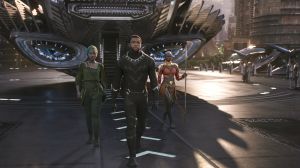 This is a movie populated almost entirely by black faces, notably black women (more on that later), and they are given a mainstream platform that celebrates its multitudinous African roots and traditions thanks to co-writer/director Ryan Coogler (Creed). This movie is proudly black, which will rankle some on the fringes of society, as if celebrating one’s own identity is somehow denigrating those who do not apply to that status. Black Panther is not an exclusionary movie because of its content and execution; this is a very accessible movie to a mass audience, even those who haven’t been paying attention to every nitty-gritty detail in the previous seventeen MCU entries. There are only two characters from other MCU films that appear, one as a post-credits cameo and the other an officious representative (Martin Freeman) of the outside’s clandestine organizations. This is a unique world isolated from the long shadow of colonialism. Wakanda has never known, to our knowledge, the depravity of the European and American slave trade. They have continued to develop uninterrupted by conquerors, slave traders, and the crippling aftereffects of racism. The Wakanda people could very easily be the conquerors themselves. They’re the most technologically advanced nation on the planet and hide as a “third-world nation,” utilizing the ignorance of the Western world to its security. The world of Wakanda is a fascinating, awe-inspiring, and defiantly independent nation.
The larger theme is over the responsibilities inherent to those with privilege. The nation of Wakanda is vastly successful by all conventional metrics. T’Challa must wrestle with whether to continue their exclusionary stance, ignore the plight of the larger world and say it’s none of their business or engage with the world, potentially putting his own kingdom’s peace and prosperity at risk. It’s a simple enough theme and yet it has tremendous weight to it especially when you account for those on the other end of the Wakanda borders. The character of Killmonger is a direct reflection of this. His experiences in Oakland are not the ideal pairing with the luxury of Wakanda. Killmonger sees Wakanda’s great influence as a way to protect beleaguered black citizens of the world and especially in the United States. It’s a way to prevent more senseless deaths from black citizens who were slain as a result of the fear of just being black (a powerful example was Coogler’s debut film, Fruitvale Station). It’s a pointed political statement that doesn’t get too heavy-handed (even though I would have preferred that). It questions the value of isolationism especially when suffering can be prevented. Killmonger works as a villain because you can understand his point of view. He goes beyond the need for vengeance. The wrongs he wants to right are larger and historical. Even Killmonger’s last line really attaches itself to this theme. T’Challa offers him a way out but with imprisonment. “No,” Killmonger declines, “My people were the ones who leaped over the sides of the slave ships. They knew death was better than bondage.” The emphasis is “his people,” not T’Challa’s, not Wakanda. His people were the ones who suffered from slavery. Could Wakanda have possibly prevented it?
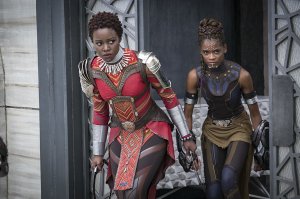 Another wonderful surprise of Black Panther is its incredible all-female ensemble that provides expert support to their king. T’Challa has the good fortune of four strong women, each of them having a different and vital relationship to him. The standout will be Danai Gurira (TV’s Walking Dead) as the fierce chief of security, Okoye. She has a swagger that vacillates between being intimidating and being brashly enjoyable. Okoye has many of the best lines and she throws herself into every fight. There’s also a sense of duty that transcends a single man that challenges her loyalty. Letitia Wright (TV’s Humans) plays Shuri, the Q of this world, the top scientist and creator of many a gadget. She’s T’Challa’s little sister and their interplay is very competitive and teasing. She’s looking to be more involved in the action and a highlight is when she teams up with her big bro. Lupita Nyong’o (The Jungle Book) is Nakia, a former flame of T’Challa’s who comes in and out of his life as an undercover spy. All three of these women have a powerful sense of agency and are integrated in important and essential ways. Even though Nakia may slide into that romantic interest role, she still has a vibrant life outside whatever feelings she may or may not have for the hero. Then there’s T’Challa’s mother, Ramonda (Angela Bassett), who radiates strength and fortitude. These women gave me some of the biggest moments of entertainment in the entire 135 minutes of movie.
Now some careful readers might note that I haven’t done much to emphasize the actual action of the super hero action movie, and that’s for a good reason. Black Panther stands stronger on theme and character than it does its actual action sequences. Coogler had a wonderful sense of scale and verisimilitude with 2015’s Creed, relying on long takes to put the audience in the heightened drama of the boxing ring. With Black Panther, the action sequences can lose a sense of immediacy. Many happen at night or are filmed and edited in ways that diminish some of their impact, like hand-to-hand combat in splashing water where the splashes obscure the activity. Other scenes felt like a video game CGI cut-scene. Speaking of video games, Black Panther’s suit has a crazy ability to absorb the kinetic energy of weapons, which means the stakes take a dip when our hero can merely just stand and allow himself to get shot repeatedly. The payoff for this absorption is a giant energy shockwave but it plays out like a fighting game’s special feature. It’s an aspect that’s not really utilized in a satisfying or unique way. The final showdown between Black Panther and Killmonger feels too weightless in execution. It’s meant to even the playing field by nullifying their extra abilities, but if they both have the same “Panther powers” isn’t the field already even? The third act, the usual punching bag for MCU critics, is the best part of the movie from an action standpoint. It utilizes the characters in significant ways and allows for organic complications while still maintaining its wider sense of spectacle. Plus it’s one of the few action sequences that allow all the pyrotechnics to be enjoyed during the visibility of day.

Boseman (Marshall) was an excellent choice for a stoic and too-cool-for-school character that can glide right on by. The ageless Boseman is at his best when he’s working off the other actors, especially his female posse. He has a couple of very effective emotional confrontations as he learns of his family’s secrets. As steady and soothing a presence as Boseman can be, this is Jordan’s movie. Michael B. Jordan (Creed) has been Coogler’s cinematic good luck charm and we’re still benefiting from that divine kinship. His character is at the heart of the central thematic question. While T’Challa is ultimately the one who has to decide, it is Killmonger who embodies that need for change and the desire to rectify the past. There’s a flashback with Jordan that got me to tear up, and this guy was the villain! It’s one of the film’s biggest mistakes sidelining Jordan for far too long. After his introduction, Killmonger is strangely absent for the next hour or so of the movie, ceding the spotlight to Serkis (War for the Planet of the Apes), a more antic and goofy scenery-chewing baddie who has a few regrettably “faux hip” lines of dialogue that land awkwardly. Serkis is having a blast but can feel like a holdover from a different film.
Much like last summer’s Wonder Woman, this is a movie that is going to mean a lot to a lot of people. It has a personal significance that I will not be able to fully tap into, no matter the expansive powers of empathy. Black Panther, as a long-awaited cultural moment, will have many ripples of inspiration. After my early screening, I sat back and watched an African-American boy, no older than seven or eight, walk out of the theater in a daze. His eyes were wide, his mouth agape, and he said in astonishment, “That was the best movie ever.” That kid has a hero he can call his own. That matters. Black Panther, as a work of art, is rich in topical themes and has a wide supporting net of exciting, robust, and capable women. I enjoyed how personal and relevant and political the movie could become, folding new and challenging ideas onto the MCU formula. Coogler is a marvelous director and storyteller showing rare acumen for being able to handle the rigors of a Hollywood blockbuster and deliver something hearty. The action has some issues and there are some structural hiccups that hold it from the MCU’s upper echelon (I enjoyed all of the 2017 MCU movies better). Black Panther is a winning movie when it features its sterling cast celebrating their virtues and solidarity and a still respectable enough action spectacle when called upon for big screen duty.
Nate’s Grade: B


 nathanzoebl
You must be logged in to post a comment.