Blog Archives
Only God Forgives (2013)
 Only God Forgives is an apt title for a movie that is replete with such suffering and brutality. Here is a movie that thinks wanton bloodshed and depravity is the same as character depth, and the fact that it’s from Nicolas Winding Refn, the writer/director of Drive might not be as surprising as you’d believe. I enjoyed 2011’s Drive but I wasn’t as taken with it as other critics, my chief complaint being a groping pretentiousness that confused emptiness as contemplation. I see the same issue with Only God Forgives, a grisly morality play that’s simplistic and overwrought at the same time. Once again Ryan Gosling plays a man of few words, so few that I counted he only says eight by the 28-minute mark (at this pace, he’ll dissolve into the background by 2015). Gosling’s brother was killed after the creep raped and murdered a 16-year-old prostitute in Thailand. Gosling’s ferocious mother (Kristin Scott Thomas) demands retribution on the Thai police, but Gosling has his reservations. What ensues is a string of glossy gore, tedious reprisals, and nonsensical plotting, including numerous karaoke sequences with the Thai cops. The movie’s emphasis is almost entirely on a hellish atmosphere, lots of lurid reds and harsh lighting, providing style but minimal substance. The characters are all detestable and unengaging, the story is awash in dreary and ponderous plotting, and the movie just reeks of pretension, every frame oozing with Important Symbolism (catch the emphasis on hands and wombs yet?). Only God Forgives would be forgivable if all of its admirable style and mood had some greater purpose. It’s a grueling movie to endure but the hardest part is getting through all the tedium thanks to the near-mute characters and a script overdosing on torture. At this rate, Refn’s next film will just be 90 minutes of Gosling punching a baby. Silently, of course.
Nate’s Grade: C
Share this:

Gangster Squad (2013)
 It’s hard to mention the action thriller Gangster Squad without a passing reference to the Aurora, Colorado movie theater shooting in the summer of 2012, the reason for the film’s five-month delay and reshot action sequence. Gone is a shootout at the movies and now we have a confrontation in the streets of Chinatown. I wish they hadn’t stopped there. If given the opportunity, and remember they did have an additional five months, I would have scrapped Gangster Squad almost completely and started fresh.
In 1949, former boxer Mickey Cohen (Sean Penn) has seized control of Los Angeles organized crime. His influence extends even into a police, which forces Chief Parker (Nick Nolte) to go to desperate measures. He asks Sgt. John O’Mara (Josh Brolin) to assemble a team of enforcers to fight back. They won’t have badges but they will be pushed to use whatever means necessary to carry out their mission, which means blurring the line between what is considered lawful. O’Mara assembles a super group of former officers and one of them, Sgt. Jerry Wooters (Ryan Gosling) gets into even deeper danger when he starts seeing Mickey Cohen’s main squeeze, Grace Faraday (Emma Stone).
This movie is like if The Untouchables and L.A. Confidential had an illegitimate child and then abandoned it in a sewer where degenerate hobos raised it. Gangster Squad rips off other gangster movies with liberal abandon that I can’t even begin to list the lifts. I’d be less offended if I felt that the movie had more on its mind than just replicating the tone and look of noir cinema. Actually, it feels more like what they want to replicate is the tone or style of the video game L.A. Noir.
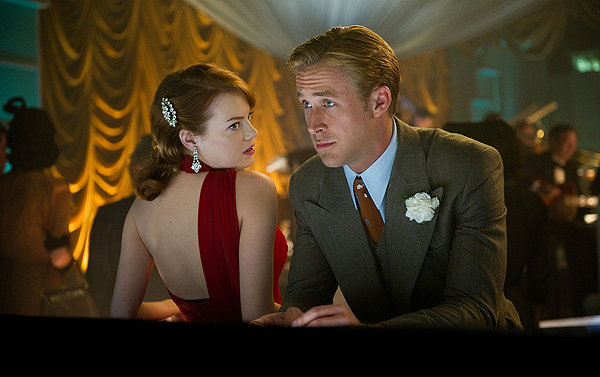 The main problem is that Gangster Squad really only has the skeletal outline of a plot. It’s missing any essential character and plot development. Here, I’ll summarize the barebones plot for you: Mickey Cohen is a bad guy. O’Mara forms a team. They have a montage taking out bad guys. Mickey takes out one of them. They have a showdown. That, ladies and gents, is it. There really aren’t any scenes that diverge from those scant descriptions. It felt like only five minutes passed from one of O’Mara’s guys getting killed (and just like The Untouchables, it’s the nerdy one) to them descending on Cohen’s headquarters and duking it out. Why does the film introduce the conflict of Wooters seeing Cohen’s girl if he never finds out? There isn’t even one scene presented to take advantage of this conflict. It just ends up being another half-baked plotline. It feels like the only development we get with Gangster Squad is through montages. What is also apparent is that O’Mara and his team really don’t have anything resembling the faintest notion of a plan. We watch them take out some bad guys via fights and shootouts but there’s no higher plotting to it. You get a sense that these former cops are just playing it by ear, looking for a fight every night. It’s hard to imagine that these people, even with their law enforcement and war experience, could be effective in the long term. Without any formative organization or greater planning, these guys just seem like dull bruisers bouncing from fight to fight with no sense of direction.
Then there’s the paucity of character work, relying solely on genre archetypes to do its work for the movie. O’Mara is the determined family man but his team can best be described by one-word classifications: The Black Guy (Anthony Mackie), The Nerdy Guy (Giovanni Ribisi), The Mexican Guy (Michael Pena), The Young Guy (Gosling), The Old Guy (Robert Patrick). That’s about it, though I suppose they do have different weapon preferences meant to supply all that missing characterization. Oh look, Officer Harris (Mackie) brings a knife to gunfights. That’s pretty much the beginning and end of his character. Wooters is so lackadaisical he feels like he’s on drugs, and Gosling’s soft-spoken, mealy-mouthed line delivery only adds to the effect. It feels like Gosling, in a stretch to find something interesting out of the mundane, said to himself, “I wonder if I could give a whole performance where I only speak under a certain vocal register.” Then there’s the woefully miscast Stone (The Amazing Spider-Man) as the femme fatale/mol to Mickey. I love Stone as an actress, but man-eater she is not and sultry seductress doesn’t fit her well either. Perhaps with the aid of a sharper script and a greater depth of character she could rise to the challenge. At no point does Gangster Squad really even attempt to make these people multi-dimensional. They never reflect on the moral turpitude of their own vigilante justice or the ramifications of their actions. There’s no room for ambiguity here.
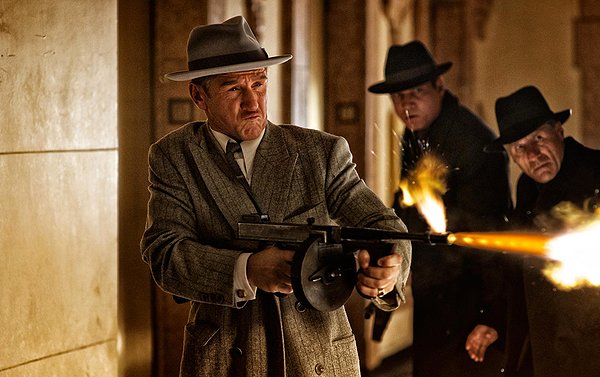 Finally, we must speak of Mr. Sean Penn (Milk). The man’s actorly gumbo goes into campy overdrive. In these rare circumstances, you aren’t watching Sean Penn Esteemed Actor so much as Sean Penn Human Vortex of Overacting. Normally I would criticize Penn for going over the top but over the course of 110 minutes, he single-handedly becomes the only entertaining thing in the movie. He’s chewing scenery up a storm, yes, but at least he’s channeling the pulpy silliness of the whole movie. I came to enjoy his antics and outbursts and thus became more empathetic of Mickey Cohen and his efforts than I did with O’Mara. Such is the danger screenwriters run when they spend more time crafting an interesting villain than a hero.
Gangster Squad is what happens when a movie is sold on title and genre elements. To be fair, it’s a bang-up title. The plot is half-baked at best, really only serving as a thin outline of a gangster movie, but instead of adding complexity and intrigue and characterization, they just ran with it. The actors are either camping it up or out of their element, the action and shootouts are pretty mundane, and the story is just uninvolving, even for fans of film noir like myself. It’s a good-looking film from a technical standpoint, but that’s as far as I’ll go in my recommendation (it could be an odd pairing with Milk considering the two shared actors). It feels like it just wants the setting elements of film noir, the atmosphere, and then figures just having good guys and bad guys shoot it out will suffice. That glossy, high-sheen period look just seems like a cool façade, and a cool façade seems like the only ambition of Gangster Squad. I can’t really recall any signature action sequence, snappy quote, plot development, or peculiarity worthy of remembering. It may be one of the most forgettable gangster movies Hollywood has produced.
Nate’s Grade: C
Share this:

Crazy, Stupid, Love (2011)
 Crazy, Stupid, Love was sold as being a smart, urbane romantic comedy for adults, and this is accurate to some degree. It’s certainly worlds better than anything Katherine Heigl has been inflicting upon the public. At the same time, this film exists entirely within that familiar universe known as Movie World. It polishes old genre clichés, but in the end they’re still clichés. The movie follows playboy Jacob (Ryan Gosling) coaching Cal (Steve Carell), a divorced dad, on how to get back his mojo and seduce women in a modern world. Along the way, Jacob falls for the cute Hannah (Emma Stone), Cal’s teenage son (Jonah Bobo) is hopelessly in love with his 17-year-old babysitter (America’s Next Top Model contestant Analeigh Tipton), and the babysitter is secretly crushing on Cal. There are passing moments of awkward but recognizable reality, especially the free-falling nature of divorce, but they are eventually smothered by the gloss of rom-com schitck. Because this exists in Movie World, every character, including a one-night stand (Marissa Tomei), will pop back up because every character is related to everyone else in this tiny fishbowl. That also means that contrivances and misunderstandings will culminate in a comic clash. Oh, and don’t forget the grand public pronouncements of love. This is the only movie I can ever recall where the dissemination of child pornography is treated like a payoff or as something to cheer (naked babysitter pics are passed along). Huh? Crazy, Stupid, Love is a fitfully entertaining movie but don’t let the pretensions of maturity fool you, this is strict rom-com stuff.
Nate’s Grade: B
Share this:

The Ides of March (2011)
 The Ides of March is that rare political thriller that pulls the curtain away to come to the stolid conclusion that our entire political system is incontrovertibly stuck in the muck. This is a deeply cynical movie that posits that politicos are just about spinning truth, cutting backroom deals, attaining power and influence, and living to fight another day. Even the ones who champion integrity have plenty of salacious skeletons in their closet. So while Ides of March is in one way a liberal reductive fantasy, casting co-writer and director George Clooney as an Obama-style change agent, and Clooney can assert all the rabble-rousing missing from the current occupant of the White House, it still sticks to its deep-seated cynicism. There is nobody that looks good by the film’s end. Ryan Gosling stars as a magnetic campaign director trying to push his guy over the top by winning the all-important Ohio Democratic primary. As the primary gets closer and the race gets tighter, Gosling has to cover up potential scandals while skillfully using his intimate knowledge of them for opportunistic deal making. The film moves at a great clip, the dialogue is intelligent, the characters are rich and ambiguous, and every one of the sterling thespians gets at least one big scene to stretch their acting muscles. The film has plenty of intriguing twists and turns, as the pieces all fall into play for one final power play. If you’re a fan of smart political thrillers, then do not beware The Ides of March.
Nate’s Grade: B+
Share this:

Drive (2011)
 Driver (Ryan Gosling) is a Hollywood stunt driver who has a lucrative side-project. For the right price, he can be hired as a personal driver. He gives the client a five-minute window. Whatever happens in that window, he’s their driver no matter what. Miss it and he’s gone. As you can imagine, this kind of job offer is mostly filled with getaway driving duties. Driver takes an interest in his apartment neighbor, Irene (Carey Mulligan), a young mother. Her husband (Oscar Isaac) has just been released from prison and already feeling heat to pay his debts. He gets winds of a pawnshop holding a million in cash. Driver offers his services to square the guy’s debt and to keep Irene and her son safe. But of course things go wrong, as they tend to in these sorts of pictures, and Driver is left with a sack of money and two very angry gangsters. Nino (Ron Perlman) and Bernie (Albert Brooks) would like the money back and to eliminate the number of people that know about their involvement in this scheme.
Drive is being sold as one kind of movie, a high-octane action thriller with plenty of car chases, when it’s really a European art-thriller paying fawning homage to those kinds of movies. That means that Drive plays out much more placidly and contemplatively with sudden bursts of gruesome violence. My audience seemed to grow restless with the purposely plaintive pacing so when the violence exploded they would laugh or cheer, happy that something of conventional entertainment value was finally occurring. I was growing restless myself, not with the infrequent appearances of genre action or the artistic flourishes, but just with the prevalent pauses. Danish director Nicolas Winding Refn (Bronson) will have his camera hold onto a scene for several seconds longer than what feels necessary, or he’ll shoot dialogue between actors and Gosling will pause a full 20 seconds before answering. I understand that Refn is establishing a stoic loner akin to Clint Eastwood’s celebrated stable of strong silent types, a modern American cowboy. I’m sure that you could cut 10 minutes of out the film just from snipping these extended pauses and overlong shots, moments that seem to be filling time and giving the audience an opportunity to step outside the movie. I doubt that was ever the intent but it’s certainly the effect. When a scene or camera shot holds on longer than it should, we can feel it, and when it keeps going we start to wonder why, and when an answer is absent then we start to snicker or second-guess the artistic choices. I’m sure audiences that watched Drive will probably be scratching their heads wondering why there isn’t more, well, driving.
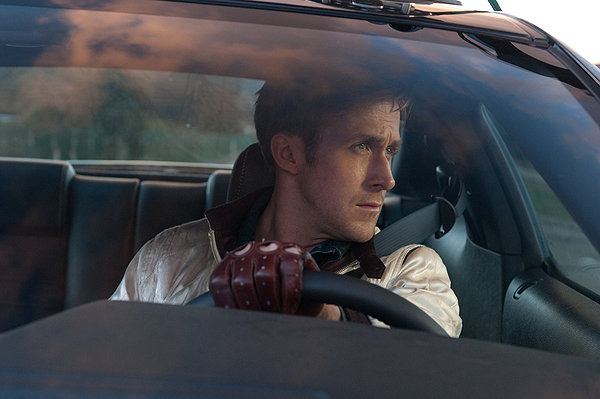 The action that does appear onscreen is extremely well choreographed. The car chases thrill and the edits allow for full audience orientation. You know what’s happening and you know what’s at stake. And we care. A car chase after a botched robbery is particularly exciting when Driver starts driving backwards to block his opponent’s view of the road. The opening chase sequence is notably almost an anti-car chase. Driver is listening to a police radio and choosing when to duck around side streets and wait out the patrolling cop cars. The tension isn’t watching one car chase another, it’s watching one car idly sneak away. What I’ve described, however, is about all the movie offers for car action, though Driver does ram one motorist off a ravine later.
You can tell Refn is a fan of Hollywood genre films, and Drive takes typical thriller tropes and puts them through an art-house prism, bringing a near Kubrickian level of beauty to the violence. Drive is a gorgeous movie to watch; the shot selections, the chiaroscuro lighting, the use of the 80s style Euro-synth score by Cliff Martinez (Traffic, Contagion), it all coalesces into a near hypnotic blend of visual and sound. It’s a beatific landscape even when horrible things are going on. There’s a sequence where Driver, Irene, and one of Nino’s thugs are in an elevator together. Driver notes the imminent danger and slowly motions Irene behind him. He then turns and kisses her, and while he does this the elevator lighting seems to brighten and darken, like it too is being charged through the power of a kiss. And then Driver sharply pivots, blocking the thug’s attack, knocks the guy to the ground and stomps on his head until it bursts. The looming violence is teased through slow motion, and then it hits with the power of a crescendo. The violence is always looming, always seeming to be just on the cusp of an explosion. But under Refn’s direction, the movie fulfills that audience bloodlust in unexpected ways. Instead of a big fight, Driver casually drowns one of the toughs in the surf of a beach. Instead of a brutal elimination, Bernie dispatches someone with what can almost be described as compassion, slitting a major artery and whispering, “It’s done. It’s all over. There’s no pain. Just let it happen.” Even the big showdown between Driver and Bernie plays out with flash-forward edits, giving the meeting an extra level of gravitas knowing what awaits when they leave the table.
Refn has created a beautiful movie, it’s just that it has so much empty space pretending to be nuance. And that’s the rub. I appreciate an art-house sensibilities elevating and celebrating classic American genre pictures. I though Joe Wright did an excellent job of this with Hanna earlier this year. However, Refn shortchanges his actors. The script by Hossein Amini (The Four Feathers) is light when it comes to character detail. Again, this might be because Refn wishes to make a statement on genre films by having his movie populated with genre types and sticking to this limited route of characterization. Whatever the rationale, it makes for some pretty elusive one-note characters. Irene is less a character than a symbol of innocence. It doesn’t help matters that Mulligan has little chemistry with Gosling. Nino and Bernie are interesting characters who have such unspoken histories. They’re mid-level criminals stationed out of a cheap pizza joint in a strip mall. Nino is tired of the criminal higher-ups always disrespecting him. Bernie used to be a movie producer in the 80s, and may have bankrolled something like Drive. He hates getting his hands dirty but he shows an eerie talent for violence. These small glimpses are hints at something more, but that is all Hossein and Refn leave us with.
 Gosling (Crazy, Stupid, Love) has very little to say in the film. He probably only ever speaks 80 words, but brevity does not mean he’s just sitting around. Gosling goes for understated in a genre known for histrionics. He plays things very close, a taciturn mystery man. The existential drifter. Gosling sure knows how to hone his flinty stares. Mulligan (An Education) gets very little to do in the film, so it’s another round of her crinkling her pretty face and blinking those glassy eyes. Christina Hendricks (TV’s Mad Men) also appears as a third wheel on the pawnshop scam. The real surprise is Brooks (The Muse). The famous comedian is shockingly believable as somebody you don’t want to cross. Even when he’s trying to be cordial there’s a veil of menace. If only there was more to his role. I would have loved to see him regrettably step back into his past, taking care of business with ruthless yet disdainful efficiency.
Drive is an action thriller that’s more a Euro-infused commentary on the genre. Fans of Hollywood action will likely be put off by the elusive characters, the sluggish pacing with numerous pauses, and the overall art-house nature of the finished product. Refn’s movie is beautiful to watch, with intricate precision taken to making the imagery and sound design mesmerize. If only that same level of care was paid to character and plot. We’re dropped into this criminal scenario and left to flesh out the characters given the hints and nods we accumulate in 100 minutes. I don’t need to be spoon-fed but I’d like my movie to have better attention to character than ambiance. Drive is a beautiful looking vehicle that just doesn’t have any particular place to go.
Nate’s Grade: B
Share this:

Lars and the Real Girl (2007)
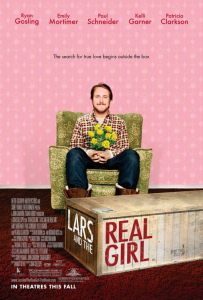 In order to be affected by the sweet romantic spell of Lars and the Real Girl, the viewer must accept everything as a fable; to try and apply real world logic would destroy the film’s magic. Lars (Ryan Gosling) is a painfully shy man still haunted by the knowledge that his own birth killed his mother. He lives in his brother’s garage and has difficulties interacting with regular folks. Then one day comes Bianca who just happens to be made of silicone; she’s a Love Doll, though Lars’ relationship with the upgraded Barbie is completely platonic. Lars is using the doll to deal with his own intense loneliness and his family and the town, a.k.a. the most understanding town in the world, play along to help Lars along on his emotional recovery. Gosling, in short, acts the hell out of this movie. His performance is a bit mannered but he channels so much pain and unresolved emotions that it’s a marvel to watch. He makes Lars more than just a weirdo with a weird coping mechanism; he makes Lars deeply, excruciatingly human and filled with unmet desire for affection. Gosling is so immensely talented that I don’t know if there are any limits to what he can bring to a character. The film has just enough psychology to it that the slew of characters deepen as we progress and the audience grows attached. By the end, I was amazed at how much genuine emotion I felt for a giant hunk of silicone. Give credit to the filmmakers who play Lars out with conviction and grace, and give major credit to Gosling.
Nate’s Grade: B+
Share this:

Fracture (2007)
 This is a genre movie, pure and simple, but it has a tricky plot and is aided by two exceptionally high caliber performances from Anthony Hopkins, once again personifying evil and confidence, and Ryan Gosling. He imbues such meaty resonance to a character that would have seemed flimsy and altogether stock in another actor’s hands. Gosling and Hopkins have great tit-for-tat moments where each is trying to outwit the other, and their verbal chess match provides the best scenes in this procedural thriller. The disintegrating murder case keeps the audience guessing, but it’s Hopkins and Gosling that elevate the material into delicious crackling Southern-fried entertainment.
Nate’s Grade: B
Share this:

Half Nelson (2006)
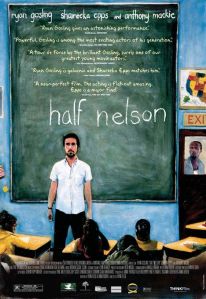 Ryan Gosling gives a devastating performance as an inner city schoolteacher addicted to crack. This is a thoughtful look at friendship and vice as Gosling befriends one of his female students and becomes something of a mentor, trying to steer her in a good direction. The film is refreshing because of how awkward and authentic it is, and it does not pull punches; there are no happy endings or storylines wrapped with bows. The biggest drawback from this powerful film is that it’s too insular and doesn’t get much of an outside perspective. Scenes have a tendency to drag, but the movie is set ablaze by the troubled yet hopeful turn by Gosling, already firmly established as the most astonishing talent of his age. Who ever would have guessed a former Mousekateer would be our next Marlon Brando?
Nate’s Grade: B+
Share this:

Stay (2005)
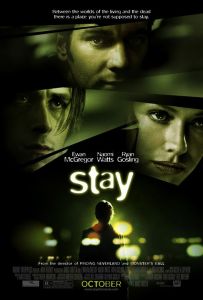 This is a movie that piles on the mystery and clues but once the finish does arrive I was left saying, “That’s all there is?” There’s so little to this film that, in retrospect, it’s simply blowing off the dust on An Occurrence at Owl Creek (I may have said too much). The trickery Stay throws at you is slightly intriguing but mostly confounding and, once the reveal tidies everything up, wholly unsatisfying. Part of the problem is that I didn’t care about any of the characters, so I didn’t really care about their plight. Yes I get it that there is a reason for how shallow they are, but the only thing Stay had to keep me going was my waning interest in what the hell is going on with everything. I’m not the biggest fan of Marc Forster (Finding Neverland) as a director, and he serves Stay to good and harmful effect. Forster gooses the film with all sorts of visual trickery like jump cuts, using twins and triplets as extras in backgrounds, repeating scenes, playing around with blocking, and lots and lots of spiral staircases (hello, Vertigo). And you do realize that most of these disorienting stylistic decisions have a seemingly coherent reason in retrospect, but it also effectively pushes the audience away from the story, aided by the fact that no one can get into the characters. The entire affair seems pointless and empty but it is pretty to look at. I’m sure I’d garner more from a second look, but I really just don’t want to see Stay again.
Nate’s Grade: C+


 nathanzoebl
You must be logged in to post a comment.