Blog Archives
Lady in the Water (2006)
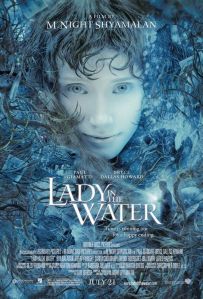
Writer/director/twist-abuser M. Night Shyamalan must have been smarting from the cool reception to his last high-concept thriller, 2004’s The Village. Shyamalan has built a reputation for smart, eerie, complex movies, as well as forced twists and endings that leave the films in shambles. He went back to basics. Lady in Water started as an ongoing story he told his kids at bedtime. His kids participated in the creation of the story. If we didn’t learn from last year’s The Adventures of Sharkboy and Lava Girl, movies where children helped shape the story should be left as bedtime stories. Lady in Water is further proof of this.
Cleveland Heep (Paul Giamatti) is the fix-it man at an apartment complex. Someone’s been swimming in the pool late at night and clogging up the filter. The unexpected culprit is Story (Bryce Dallas Howard), a waif of a girl. She says she is a “narf,” a sea nymph who’s crossed from her world, the Blue World, to ours. Her purpose is to plant the seed of change by finding a special individual. When her mission is complete a giant eagle will carry her back to her world. Cleveland accepts being her guardian and protector and assists her on her quest. He mingles with the apartment complex’s eclectic residents, trying to figure out who fits what role to help Story. There is one hairy problem. A scrunt, a wolf-like beast with twigs and long grass for fur, is after Story. An evil monkey creature is overseeing the whole weird affair.

Early on, Lady in Water was advertised as “a bedtime story by M. Night Shyamalan,” and just like your typical bedtime story, the thing feels entirely made up on the spot. The story sounds like a little kid making up a book report: “There’s this grass wolf, see, and it’s after this sea lady, and there’s these evil monkeys that oversee everything, and an eagle carries her away when she’s done, but she’s like the unknown Queen of the sea ladies, and she has helpers but can’t say who they are, and they all have special abilities, except some of them can only do stuff, and no one can see her leave.” What? Was Dio an unaccredited co-writer for this? Lady in Water feels like Shyamalan is haphazardly throwing spontaneous obstacles and rules into his story, hoping something sticks when it just muddies up the story.
Naturally, there are many unanswered questions brought about by the supernatural subject matter. Why is it an eagle that plucks Story away to safety when she?s fulfilled her mission? Wasn’t part of the schism between man and the Blue World because man moved to land? Wouldn’t something aquatic make more sense to rescue her? What about the entirely unnecessary evil monkey judge? Why is it even there? Why does it just sit there idly if the scrunt breaks the rules (and if the scrunt is a rule-breaker then why not just bust inside Cleveland’s home and eat the chick)? For that matter, if the monkey judge is so evil then why does it even respect the rules? Why don?t the evil monkey judges side with the already evil scrunts? Why do the scrunts hate the narfs so? Who established these systems of rules for narf contact and scrunt hunting? Do the monkey judges allow the narfs to get killed as long as it’s during the right time? Is it like a boxing match (“Touch gloves, to your corners, and no biting after the bell”)? And of course everyone believes this tripe. Shyamalan could fall back on the excuse that his tale is a bedtime story and not meant for extensive examination. Sure, not everything needs to be explained but that doesn’t mean Shyamalan can get away with being lazy.

There’s no finesse in the writing. Shyamalan seems to have taken his frustration with the dwindling critical reception of his works hard. The movie critic character, Mr. Farber (a droll Bob Balaban) is one of two items, either the embodiment of his ire, a figure out of touch with human emotion and the public’s trust, or Shyamalan making a preemptive strike. The critic complains there are no more original stories left in Hollywood; well, Mr. Smarty Pants, what do you think of a tale of narfs and scrunts? The problem is that the film critic is not unlikable, just cynical, and despite how dismissive Shyamalan may wish to be, the critic’s complaints and observations about the film industry are solid. In Lady in Water, characters do speak their feelings so casually. People explain back-stories and motivations like it was written on foreheads. The critic character is so inconsequential as well, so the notion that Shyamalan spends so much energy on him makes it feel like a score being settled.
What’s more irritating is how self-involved the movie comes across. The whole purpose of Story’s venture to our world is to inspire a gifted writer, a writer whose work will be seen as unchecked genius that will cause great change throughout the world. Nations will renounce war, men and women will greet each other as brother and sister, and the world will be a profoundly better place to live, all thanks to one artistic genius that changed the world. And who plays this artistic genius lying in wait? M. Night Shyamalan. In conjunction with the critic character, perhaps Shyamalan is proclaiming that his movies will stand the test of time, despite what those fuddy-duddies at their typewriters say. Lady in Water is either an intense example of artistic insecurity or an unflappable, monstrous ego.
Shyamalan is too gifted a filmmaker to make outright bad movies. However, he is prone to making very misguided choices. The addition of the monkey judge just mucks things up and more unanswerable questions. Are the monkeys like the regional overseer? Is there a tri-state office run by a giraffe with twigs on its head? Shyamalan’s plot is too formless and relies on some garish ethnic stereotypes, like the nattering Jewess and the screechy, rail-thin Korean teen. His sense of direction takes a back seat to his writing. Many moments are filmed out of focus, or the camera bounces around trying to capture whoever’s talking, always seemingly just out of reach. His visual aesthetic feels noticeably simpler. There’s a certain unapologetic yearning in Lady in Water to be a Steven Spielberg film, from the John Williams-like score, to the assembly of characters wanting to believe again, to the heaping helping of schmaltz. Lady in Water is proficiently crafted (special thanks to cinematographer Christopher Doyle) but the movie is an unmistakable artistic misfire.

Giamatti is a dependable sad sack, and he deploys an array of stutters and tics to convey how damaged Cleveland Heep is. He’s good but then he always is, no matter how stupendously awful his material may be (he did survive Big Momma’s House). Howard is one of the more beguiling and intriguing young actors in the movies right now. She bewitched me in The Village, but in Lady in Water she befuddled me. It’s hard acting as a made-up creature. Howard relies on lots of vacant, supposedly, ethereal staring. She comes across as less supernatural and more like a club kid on ecstasy.
Lady in Water is not an unmitigated disaster but it’s definitely not good by any stretch of the imagination. M. Night Shyamalan seems to fray with every new movie, and Lady in Water is by far the man’s most ridiculous and self-involved flick. He’s too great of a talent to write off, even during his misfires, but we can’t be expected to iron out his narrative kinks every time. Shyamalan’s films generally center on broken people looking for their place in the universe and finding a grander plan for their pain. Hopefully, after the birth pain of Lady in Water, Shyamalan can find his place in the artistic landscape and spare us more half-baked bedtime stories.
Nate’s Grade: C-
Share this:

Cinderella Man (2005)
 Let’s talk a little about screenwriter Akiva Goldsman. This is the man responsible for travesties like Lost in Space and the franchise killing, pun-crazy Batman and Robin. There’s plenty of junk writers in Hollywood and plenty of good writers just saddled by junk to make a living, and either might apply to Goldsman. How in the world did he become a Hollywood go-to guy?It probably has something to do with Ron Howard. Goldsman adapted the screenplay for Howard’s film A Beautiful Mind and both walked away with Oscars. Suddenly the man who wrote Mr. Freeze saying, “You’re not sending MEEE to the COOLER,” had an Oscar on his mantle. Goldsman and Howard, in retrospect, seem like a match made in heaven. They both enjoy big Hollywood event movies that spoon-feed an audience and shave off the gray areas. Cinderella Man serves as the duo’s second collaboration and it’s exactly what you would expect a big Hollywood event movie to be from them.
Jim Braddock (Russell Crowe) is an up-and-coming New Jersey boxer who’s on a warpath to the heavyweight title. His wife Mae (Renee Zellweger) loves him dearly and he dotes on his three kids. Life seems so perfect in 1929 America. And then the Depression hits. Braddock breaks his hand in a fight and his skills slip tremendously. The boxing commission revokes his license and Braddock is forced to take a dock job to provide for his family. Times are tough and there doesn’t appear to be a way out, until Braddock’s old boxing manager (Paul Giamatti) offers him a one time only bout in the ring. Braddock is seen as a has-been but he knocks his opponent flat out. More fights come and so do more victories, and Jim Braddock seems destined for a remarkable storybook comeback. But then there’s the reigning champ Max Baer (Craig Bierko), an arrogant playboy. Baer also is a ferocious fighter and has actually killed two men in the ring. The championship leads through him and Braddock is unafraid. Mae is terrified she’ll become a widow and pleads with her husband not to fight. But now that he’s been through the gutter, Braddock knows what he?s fighting for: the survival of his family. To do that, he?s headed for a title match with Baer.
 What elevates Cinderella Man from an “okay” film into a “mostly good” film is the singular brilliance of Russell Crowe. This man is simply one of the most amazing actors we’ve ever seen, and he’s been on an incredible hot streak since 1999’s The Insider (forget 2000’s Proof of Life, please). Yet again mastering another accent, Crowe excels at playing a noble man with guarded emotions and honest intentions. He’s an actor that can display such an intense wealth of emotions in the same moment. When he visits his old boxing bosses, hat in hand, begging for enough money to turn the electricity back on, Crowe has laid a sucker punch to your emotions. It’s getting to the point where I will go out and see any movie Russell Crowe stars in just to soak up his brilliant performance. He can throw a phone at my head anytime. Crowe’s stellar and resonant acting will hopefully be noticed come Oscar time; however, I doubt much else of Cinderella Man will be remembered.
Crowe’s sparring partner doesn’t fare as well. I’ve liked Zellweger in a lot of her roles (even the sappy One True Thing), but she’s entirely miscast as Braddock’s underwritten stand-by-your-man wife. She scrunches her face too much and squints for most of the movie.
Two great actors make the most of their meager roles. Giamatti serves as Braddock’s growling pit dog of a corner man and works up a good froth. Bierko almost transcends the film’s one-note villain caste and becomes a figure of showboating sensuality. He struts in the ring with a gallant pride that’s fun to watch, even though you know Howard?s whispering in your ear, “Booooo. Don’t like him. He’s the mean man. Booooo.”
The production design on Cinderella Man is great and really recreates the look and feel of the 1930s in all walks of life. The cinematography, on the other hand, seems washed out and overly dark in spots, though it may have just been my theater?s projection. I miss Roger Deakins, DP on A Beautiful Mind. Deakins knew how to beautifully light a scene and capture the audience with a precise, eye-pleasing angle. In contrast, Cinderella Man seems to think that sepia tones defined the time period of the 1930s.
Howard still has little to no trust in his audience. He can’t rely on the performances of his actors to express their motivation. We know why Braddock is fighting during the Depression, Howard. We don’t need split-second cuts of his family for reminders. It’s almost like Howard wants to point to the screen and tell the audience what to feel. It should be obvious by now but ambiguity doesn’t work here. That’s why Braddock is seen as almost saintly (never mind the connections to organized crime). That’s why Baer is seen as dastardly (never mind that in 1933 Baer heroically wore a Jewish star and knocked out Hitler’s favorite prize fighter, Max Schmeling). It seems that the details just get in the way when Howard wants to turn true-life stories into calculating crowd-pleasers.
At the docks, just in case we don’t get how tragic the Great Depression is (you know, in case you forgot what either the words “great” or “depression” meant), Howard has to bend over backwards to show someone stepping over a newspaper declaring how high unemployment is. When Braddock finds a friend in Hoovertown (Central Park turned into a neighborhood of shanties) we see him run over by a horse and buggy as another man crushed by the system or a runaway metaphor. When Baer fights in the ring Howard makes sure to get that sneering close-up of our villain. And surely anyone who’s a womanizing playboy must go down for the good of the nation. Howard is aggressive in his pandering.
Thanks to Goldsman and Hollingsworth’s mawkish script, Cinderella Man has the myth of complexity to it when it’s really content to go the easy route. It plays this story too close to the rules: embittered hero with humanity intact, stalwart wife, cocky villain, the grumbling manager. Cinderella Man is stripped of complexity and Goldsman and Hollingsworth want to lead the audience by the nose. When Braddock promises his son in a heart-to-heart that he’ll never split up the family, we know it’s only a matter of time before it happens. Their script is also full of workmanlike dialogue that does enough to just push the story forward but give little shading to its people (Zellweger’s, “You are the champion of my heart, Jim Braddock” is particularly not great.
 Cinderella Man really is a film more about the Depression than boxing, except for its pummeling and gritty final act of non-stop boxing. The script paints an almost insulting idea that the Depression was good for people to learn important life lessons, like family comes first, hard work will be rewarded, and one man can heal a nation. Seabiscuit fell into this same trap with its depiction of the Depression but at least Gary Ross’ film dealt with characters that weren’t tired genre archetypes. Cinderella Man could be described as “Seabiscuit in a boxing ring,” as yet again the triumph of an underdog pulls the country back together and gives the common man something to believe in. What I’d like to see is Braddock vs. Seabiscuit in a ring or even on the horse’s turf. Then we can finally decide once and for all who is responsible for getting America out of the Depression (somewhere FDR is spinning in his wheelchair-accessible grave).
The film does come alive when Braddock steps into the ring. The boxing matches are finely choreographed and pack a real wallop. You can practically feel the bruises and taste the sweat during the 15-round bout between Braddock and Baer. These scenes give you a good understanding of the progression of a boxing match and the real strategy that can turn a loser into a winner. Howard also has a smart visual cue during these lively moments. Whenever a bone gets broken, like Braddock’s hand, we cut to an X-ray shot of that scene and see the bone snap. It might seem old in a CSI-drenched landscape of entertainment but it’s effective and neat.
Cinderella Man is a rousing, heartstring-tugging crowd-pleaser that will inspire hope and redemption. Until you look at it more objectively. It?s easy to get sucked into Howard’s underdog tale and that’s because it’s been tailored to satisfy your emotions. Crowe rises above this heavy-handed yesteryear yarn with a riveting performance. I’m positive most people will walk away from Cinderella Man feeling uplifted and touched and would view me as being overly cynical. But with a maudlin story by Goldsman that simplifies the details, Cinderella Man feels like a feel-good-movie that’s been rigged. These people have no trust in their audience, so why should you put your trust in them?
Nate’s Grade: C+
Share this:

Planet of the Apes (2001)
 Taking a storied, and for the most part successful, franchise like Planet of the Apes and trying to rework it is frightfully difficult. You don’t want it to turn off the original’s fans but not be different enough to have its own voice. When I heard that Tim Burton was going to helm this reworking I became optimistic about the prospects of a Burton Planet of the Apes and began to eagerly anticipate its release. What I got, despite some stellar visuals, is a disappointing low point for many people involved, and that does include the man that gave us “Good Vibrations.”
Capt. Leo Davidson (Mark Wahlberg) is a trained pilot inhabiting a space station orbiting the rings of Saturn. The members inside are performing tests on the intelligence of apes (foreshadowing poking you in the eye) and seem to be coming back with optimistic results. A cosmic energy storm erupts near the station and Leo’s chimp is sent out into a pod to investigate. When the ape disappears (oh the foreshadowing is starting to hurt) Leo decides to venture out himself to save his monkey despite the instructions of his superiors. He gets pulled into the energy field and crashes on a distant planet where he discovers that apes are on top of the food chain and humans are the sport. Captured by the ape commander Attar (Michael Clark Duncan), he is taken to Ape City. He is sold into slavery but wins the attention of a human rights activist Ari (Helena Bonham Carter) who agrees to help him escape and get to his crashed vessel. General Thade (Tim Roth) still carries a torch for Ari but has an entirely different viewpoint when it comes to humans. At one moment he grabs Wahlberg and pulls apart his mouth to murkily inquire “Is there a soul in there?” When Thade begins to learn about Ari’s assistance to the human escape he mounts a full army to travel to the Forbidden Zone and annihilate the humans once and for all.
 Burton’s Apes remake, excuse me… “re-imagining,” lacks the social commentary, originality, and heck, even entertainment level that its predecessor possessed. Burton adds his usual great touches of style and the sets are vast and a wonder to see, but what movie is all set watching? This isn’t the simian Home and Garden channel. Burton dresses his players up nice thanks in part to Rick Baker’s fantastic makeup but the components in Apes redux are all dressed up with nowhere to go.
The script is credited to four writers but I wonder why anyone would want to take any credit for it. The story is not only half-baked it seems to never have come out of the oven. The tale is full of numerous incongruities that make this new Apes feel stagnant, especially during its middle portion. The story never gives us any real characters or an exciting line to follow. It’s more like a story pitch than a full story. There are many moments where dialogue is paraphrased from the original in an attempt at a humorous wink, but it’s worthy of more groans than applause.
Unlike the first Apes series, the humans of Burton’s ape world can speak… they just don’t have anything interesting to say. Estella Warren fills in as the good looking and useless heroine that spends her days frolicking about in ripped rags. She’s supposed to be the love interest for Mark but she fails at that (even though she’s the planet’s only attractive female) with Carter getting more googly eyes cast her way. There’s something weirdly natural seeing Kris Kristofferson as a scrubby post-apocalyptic dweller. It seems like he was made to lurk through caves and grunt. Wahlberg himself seems to sleepwalk through the entire film and speaks in only one monotonous tone.
Roth gets to huff and puff a lot and does quite a good menacing job. Every expression of his has a dominating glare of power and every piece of dialogue spoken in a gruff snarl. He has total capture of a great villain and serves his end well enough as the story provides. Carter gives a light touch as the sympathetic human defender but the long awkward moments where her and Mark gaze at each other gave way to great howls from my audience. Giamatti hams up his role with verve and provides some of the best moments of levity for this overwrought film.[
The original Planet of the Apes ending was one of the greatest twists of cinema. It was entirely logistical and packed a great punch. The ending of Burton’s “re-imagining” packs as much punch as a wet noodle. The ending is TOTALLY IMPOSSIBLE given the set-up of the events in the film. Not only is it a disappointing head-scratcher but ]it also manages to rip off the first film’s ending with no shame. It truly may be the worst ending possibly ever. I bet a room full of monkeys could have written a better ending, and I’m willing to put money on it.
 Let me explain why it’s impossible through the use of spoilers. So Mark is in the future. He follows his little monkey friend and crash lands on a separate planet IN THE FUTURE. On this planet, Mark’s space station has been looking for him and crash landed. Their monkey experiments get loose and bing, bang, zoom, we got fully evolved monkeys ruling the place (don’t even bother asking where the horses came from). Now, after learning all this, Mark takes a space pod and zooms his way back to present day Earth. He crash lands against the Lincoln Memorial steps only to discover that Lincoln has been replaced with General Thade and Earth is populated with highly evolved apes that still speak English. What? How? What? This cannot be because the film establishes a frame where Earth already has a long history of non-evolved monkey rule. Wahlberg crash landed on a DIFFERENT planet in THE FUTURE that should, therefore, have no bearing whatsoever on what happens to Earth or its past. The Apes remake rips off the most famous twist ending ever by serving up an incongruous version that makes no sense and cannot happen.
Planet of the Apes had all the right components for an exciting and sleek sci-fi ride but falls far short. Burton adds enough of his Gothic vision but this will likely go down as the weakest film on his resume. The usually reliable Danny Elfman’s score is nothing more than hyped up symphonic white noise. Burton may go home with a large check but I pray they don’t do a “re-imagining” of the next Apes picture. Marky Mark and the Furry Bunch are stuck in a hollow, head-scratching bore. Fans of the original series may find interest in comparing and contrasting, but if that’s cause enough to make a film then give me 100 bucks and I’ll make my own versions in my backyard. And they’ll at least make more sense than this monkey mess.
Nate’s Grade: C
Share this:

Man on the Moon (1999)
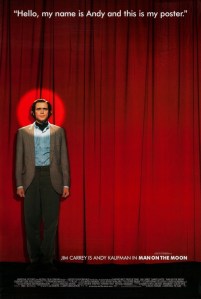 After many years the big screen biopic of one of comedy’s greatest figures of recent finally emerges to the awaiting public. Many never knew what to make of Kaufman or what he was attempting to do, and the movie displays this attitude to its core.
First things first, there is no Jim Carrey in this picture, only Andy. Carrey’s performance is pitch-perfect and swarming and enthralling that he becomes the glue of an otherwise sticky movie. Carrey IS Andy Kaufman, it’s like seeing dear Andy alive and well back on screen still terrorizing the easily duped. It almost brought a tear to my eye. Carrey takes the sheep skin and pulls off an incredible career best performance that demands attention come award time.
But without Carrey’s masterful performance Man on the Moon is not worth venturing out of the home for. The movie never delves beneath the surface to discover who the true Andy Kaufman was or why he did the things he did. And if the point is that there was no true Kaufman but merely a stage character then fine, but did we need a movie? Without any inner depth the flick becomes a shapeless reassembling of TV stints and clips Andy pulled. If I wanted to see this I’d watch Comedy Central at odd hours of the night.
Courtney Love pops her head in late into the running time to establish herself as the love interest, but her character like everyone else, is never fleshed out. Love just becomes a hollow foil to Kaufman’s antics in some vain attempt to add heart to the madness. The most lingering problem is that of the relationship between Kaufman friend and co-conspirator Bob Zmuda never being shown beyond communal frat brothers. Man on the Moon gives the reigns of the picture to Carrey, and rightfully so, but then seems to believe Carrey as Kaufman is the only substantial character in the story.
Man on the Moon is for the most part an entertaining retelling of the rise and fall of Kaufman, and his indifference all the way. Director Milos Foreman and his two Larry Flint scribes try their hand at uncovering the man behind the curtain, but stumble along the way. Maybe this is the film Kaufman would have wished, one that doesn’t answer any questions or is forced to entertain its patrons. But me thinks that the Hollywood version of Andy stays true to his stubborn nature, but trips its feet towing the mystery that was one of comedy’s most peculiar influences.
Nate’s Grade: C+


 nathanzoebl
You must be logged in to post a comment.