Blog Archives
Bridesmaids (2011)
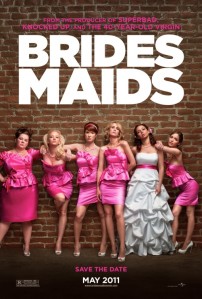 To refer to the bawdy new comedy Bridesmaids as a “female Hangover” seems disingenuous and a facile comparison cooked up in some marketing laboratory. This is nothing like The Hangover, a conceptual comedy that, can we all agree, was a funny movie but not the funniest movie of all time? Bridesmaids is a byproduct of the Judd Apatow comedy factory, and that’s what it feels like. This is no mere concept comedy built around a madcap premise. This is a magnificent character-based comedy that lets the women finally be in on the joke rather than the butt of it. Bridesmaids proves that the ladies can do everything their gender counterparts can do and better.
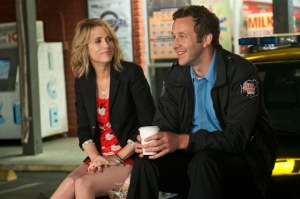
Annie (Kristen Wiig, who co-wrote the screenplay) is a woman down in the dumps. She lost her bakery due to the crummy economy, she lives with a pair of cretin roommates, and she’s a sleazy creep’s (Jon Hamm, wonderfully douchey) number three choice whenever he needs some casual sex. Her lifelong best friend, Lillian (Maya Rudolph), has just gotten engaged and asked Annie to be her Maid of Honor. Annie is threatened by Helen (Rose Byrne), a rich socialite who has grown close to Lillian in Annie’s absence. Helen is also apart of the bridal party and is always at the ready with a classy alternative when Annie stumbles. Annie gets pulled over by state patrol Officer Rhodes (Chris O’Dowd) who takes pity on her but warns her to get her taillights fixed. She continues to meet Rhodes at different spots and the two seem to be circling something romantic. Annie’s life seems to be unraveling just as Lillian’s is coming together.
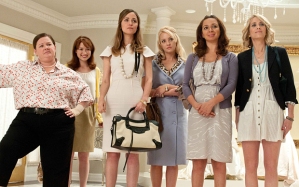 Apatow himself has been accused of making overly guy-centric comedies about rude adolescent man-children (I wouldn’t agree fully with that statement), and people have been rightfully asking when do the girls get a chance? When will the ladies be able to be something other than “love interest” or “device that triggers male character’s metamorphosis into maturity” (Forgetting Sarah Marshall, even from a clear male POV, was rather charitable and empathetic with its feminine characterizations). Well here it is, folks. Bridesmaids let’s the ladies are just as rude, crude, crass, and sexual as the men in the comedy universe. Bridesmaids is a terrific gross-out adult comedy told from a distinct feminine point of view. They can be just as crude as the dudes. But what really sets it apart is that it’s even more so a story about the dynamics of female friendship and the pain of growing apart due to the circumstances of life. Much like the joyous male camaraderie as one of the hallmarks of an Apatow film, we get to witness an entirely female dynamic that feels authentic. These women, their troubles, their friendships, all feel real and deeply felt. Even the supporting characters get a chance to be fleshed out with added dimension rarely seen in mainstream comedies, like Becca (Elli Kemper) and Rita (Wendi McLendon-Covey) confiding in each other about their disappointments with married sex. In other movies these ladies would just be “Bridesmaid #3” or “One-note Bridesmaid,” and while Becca and Rita could both be designated as types, they transcend classification when the script allows them to become rounded out as people. Another hallmark of an Apatow production, this is a true ensemble work.
You really do care for these people because of how relatable they are. I’ve never been the operator of a uterus, but that doesn’t stop me from being able to greatly relate to the anxieties of the female characters on screen. I know how significant female friendships are, and that is the central focus of the movie. You buy the relationship between Lillian and Annie, the comfort level they have with one another, the importance, the history, and you feel the pains of Annie’s plight. You feel like the entire bridal party could actually be a group of friends instead of a collection of wacky caricatures. These feel like real people, and people you want to see experience good times. Even the treatment of Helen feels thoughtful. She’s not this shrewish antagonist, but a trophy wife trying to impress the one person she could call a friend in her own life. For Helen, her friendship with Lillian means the world to her. She comes across as another real person, albeit a fabulously looking one. Annie’s romance with Officer Rhodes is indelibly cute and the duo has a warm, charming interaction. You pull for their union. Their relationship spawns a very funny sequence where Annie tries an assortment of illegal driving activities to get his attention. A romantic subplot is expected but that doesn’t mean it has to feel like rote, and in Bridesmaids the romance feels just as authentic and charming as the female friendships.
But don’t let my adoration with its character-work fool you into thinking this is some sort of “chick flick,” a divisive term tragically slapped onto anything female-centric or female-led. Just because there is rarely a Y chromosome on screen does not mean that this is some frilly, frothy sentimental fantasy replete with a “trying on clothes” montage and some sequence where the main characters break out into song in a bar. A wedding central to the plot should hopefully not be disqualifying for male audiences (men don’t get married too?). This is not a story about a crazed, jealous woman who wants to shiv another pretty lady in her pretty lady ribs because she stole her Maid of Honor duties. The cinema is littered with plenty of awful movies that revolve around women battling over petty squabbles. This is not that movie. It is not about who wields the title of Maid of Honor. It is a tale about your friends making new friends, entering new phases of their lives and possibly leaving you behind in the process. It’s about insecurity and holding onto those important people in your life, despite a gradual pulling apart. Relationships change over time, and it’s terrifying to have to adjust to the people closest to you taking lesser stations. It’s terrifying to feel like you’re being pushed out by new people. That sounds fairly universal to me, not some chick flick pabulum.
 There were several spots where I laughed so hard I was crying; the film kept me in fits of laughter throughout. The fact that a great majority of the comedy is character-based and not situation-based makes the jokes richer and more satisfying. Even a hard-to-top gross-out sequence where the girls are trying on bridal dresses at a chic store and all start losing control over their bodies due to food poisoning is related to character. Annie took the bridal party to a cheap restaurant to save money, because she’s too proud to admit her own penniless nature and too stubborn to allow Helen to swoop in and claim another victory. So the women all get terrible bouts of food poisoning, which causes them to spew vomit and forces Megan to make one very unfortunate decision with a sink (“Don’t look at me!” she bellows). The movie doesn’t shy away from the gross-out goods but doesn’t overly rely upon them for surefire gags.
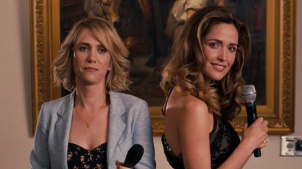
The film has several terrific comedic set pieces that connect back to the fractious relationship between Annie and Helen. The two get into a competition when it comes to party toasts. They must upstage the other, asserting who has the closest relationship with Lillian. Just when you think it’s done, one of them grabs the mic again and takes it to another level. Bridesmaids has several comic set pieces that carry on longer than you would expect for a comedy. Director Paul Feig (director of episodes of Arrested Development, The Office, and co-creator with Apatow of Freaks and Geeks) has the resolve to keep the situation alive, steadily building the comic momentum as situations get more and more out of hand, but pulling back before we reach farce levels. The movie goes one step further, convinced that the audience would be there to follow. The movie expertly lays out setups, finds satisfying payoffs, and ties up its storylines in worthwhile ways.
The dialogue is sharp and jokes work on a very fundamental level of context and defying expectation. Annie is terribly nervous to fly. She sits next to a passenger (Wiig’s co-screenwriter, Annie Mumolo) who is also deadly afraid of flying. “I had a dream last night. This plane went down,” she sys. “You were there.” That last part just turns an okay joke into a great joke. There’s a great visual gag where people keep assuming that the unkempt men standing behind Annie at a party is her husband or boyfriend. And then there’s a conversation between Annie and Officer Rhodes about being born for a profession. He encourages her to get back to baking, relating that if he were not a police officer he would still “patrol the streets and… shoot people.” These are just a few small examples I wanted to share that illustrate that, to its core, Bridesmaids is a funny story and knows the fundamentals of comedy.
Wiig has been a comic that I have found grating due to her ever-present dominance of Saturday Night Live. Her stable of wacky characters grew tiresome, but now she gets to play someone who has three dimensions. Annie is often as big an antagonist in the story as Helen. She can be self-destructive and stubborn and when she finally decides to stop being quiet is when people get hurt in her wake. You give her some latitude because, like many comedies, Annie begins as a put-upon character and has to regain her dignity and put her life together. Her life hasn’t turned out as she’s hoped, and how relatable is that? Wiig is a tremendous center for the film. Her rapid-fire eyes communicate so much nervousness and indecision, as well as her crinkly defensive smiles. But she’s also funny, tremendously funny as she loosens up and becomes more aggressive. The film is impeccably cast from top to bottom, another Apatow hallmark.
 What Melissa McCarthy does in this movie is incredible. You’ve never seen a person steal a movie at this high degree of theft. McCarthy, best known from the TV show Gilmore Girls, is Megan, the sister of the groom and an unapologetically brash woman with limitless confidence. She’s built like a linebacker but, thankfully, no attention is made to the fact that McCarthy is an overweight woman. That’s not significant to her character, though it does provide for a nice character moment as she confides to Annie late about the horror of being fat in high school. It’s not funny because she’s overweight; she’s just a brash woman without a filter who happens to be overweight. The fact that nobody cracks a joke at her expense or even comments on her weight is refreshing, and a reminder that character is not confined to outward appearance. With all that said, McCarthy is flatly hilarious. There won’t be a scene that McCarthy doesn’t get in one solid belly laugh out of. She is consistently funny from scene to scene, but stays true to her character at the same time. I would love for Megan to have her own spin-off movie much like what Russell Brand earned after his scene-stealing work in Sarah Marshall.
Bridesmaids is a comedy and it is one hell of a comedy. It may no be the best movie under the ever-expanding Apatow banner, but it is easily the funniest film yet. Yes, I said it. Bridesmaids is funnier than Knocked Up, The 40-Year Old Virgin, Superbad, and all the rest. Wiig deserves to become a star and so does McCarthy. This movie left me sore from laughing and giddy with happiness. It’s funny, touching, and genuinely entertaining, and destined to become a modern classic worth revisiting. I foresee this becoming a word-of-mouth sensation this summer, particularly from appreciative female ticket-buyers who feel like they finally have a worthy, relatable, very funny comedy that they can call their own. It’s kind of like the old slogan for female deodorant: strong enough for a man, made for a woman. That may sound too flippant, so I’ll just put it like this: do yourself a favor and RSVP ASAP for the funniest film of 2011 and one destined to charm members of both genders.
Nate’s Grade: A
Share this:

MacGuber (2010)
 Far far worse than I was expecting, this is what happens when you expand a 30-second Saturday Night Live sketch to a full-blown movie. MacGruber, a one-joke parody of MacGyver, becomes a one-joke movie. It’s about an inept special agent who has to save the world from a criminal madman (Val Kilmer, why?). The flimsy plot would be acceptable if the movie had any sort of comedic momentum, but the jokes are sloppy and uninspired, often confusing naughtiness with humor. Just because something is brash or raunchy or shocking doesn’t necessarily mean it’s funny. Will Forte, as the title agent, tries too hard with material that doesn’t work hard enough. Villains with naughty sounding names? Sight gags a plenty? This movie makes the Austin Powers franchise look cutting edge. There isn’t enough focus for this to work as parody. MacGruber feels like what a bunch of 12-year-old boys would throw together if left unattended for a weekend with their parent’s credit card. The sketch was never meant to last over a minute by design, so you can expect what 87 more dreary minutes would produce.
Nate’s Grade: D
Share this:

Grown Ups (2010)
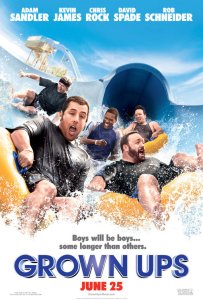 Adam Sandler keeps his friends from the unemployment line with this lowbrow, middle-aged themed, yet still entirely juvenile, comedy, Grown Ups. The movie is really a giant fetid waste of potential. It’s Sandler and his old Saturday Night Live buddies (David Spade, Rob Schneider, Chris Rock, and Kevin James obviously filling the Chris Farley spot) chumming it up and decrying the foibles of being 40. They don’t get the kids today, nostalgically reflect on their summer camp days, and try to recreate some of that old magic with a combined family get-together. Each man falls into a rigid type and will learn some half-hearted, disingenuous form of a life lesson by film’s end. The entire dimwitted plot is as stunted as the male characters. These guys just pal around and it’s termed a movie. The female characters are all one-note: figures of lust, saintly significant others who never get to be in on the joke, shrews, or Schneider’s older wife who is a constant butt of some mean-spirited jokes. The actors do have an amiable chemistry that allows the film to coast for some time before the whole affair just becomes wearisome. These guys have played these types for many many movies, and so everyone just operates on autopilot. The heavy slapstick momentarily distracts from the truth that Grown Ups is an unfunny, crass attempt by Sandler to get audiences to pay for his class reunion. The fact that this junk won the Best Comedy Award from the People’s Choice Awards illustrates the limitations of democracy.
Nate’s Grade: D+
Share this:

Away We Go (2009)
 Away We Go sort of came and went in the blink of an eye over the summer. Some critics dinged the indie production as being insufferable, hipster, smug, and unlikable. I agree that the plaintive guitar-strumming score grates, and the costumes have that trying-hard-not-to-be-hip coolness, which can be insufferable, but Away We Go is more than just faulty hipster packaging. There is a moving and entertaining drama inside here. The problem is, you have to sift through some of the junk to reach it.
Burt (John Krasinski) and Verona (Maya Rudolph) are in their early thirties and about to have a baby. They aren’t exactly hipsters but they have been living a somewhat fringe existence; Verona even points out that they have a cardboard window. Their existence has been mostly ramshackle and now its about to change forever. Burt and Verona decide to journey across the country and reunite with family and old friends. They’re studying widely different family units across the country to discover not just what kind of parents they will be but what kind of family they will be.
Just by the fact that nobody dies at the end, this is a big departure for director Sam Mendes (American Beauty, Revolutionary Road). This low-key road trip comedy is quite different from the meticulous prestige pictures associated with the Mendes name. Away We Go is a scruffy, small, and disarming little picture that wants to say something. I was taken aback at how affecting I found moments of Away We Go, though it is only moments. Burt and Verona are not exactly the best equipped to start a family right now, which makes them anxious and nervous, and anxious about not being more nervous. They haven’t exactly matured much since graduated college years ago. But amidst their search for the definition of a “working family” they must accept the uncertainty of life. Burt and Verona have a comfortable interaction, from his upbeat sarcasm to her grounded realism. There’s a great running gag where Burt tries to raise the baby’s heart rate, so his goofy bouts of fake agitation will be immediately followed by a stethoscope and an adorable grin of satisfaction. They are a compatible couple and it is refreshing to see a movie couple that compliments each other in personality. They actually love each other, are good for one another, and are not beset with contrived conflicts. In fact, the movie ends up pretty much exactly where it began, only with a smattering more of wisdom. The lesson learned in Away We Go is that it doesn’t matter what the bumps in life may be, it’s all about who you have as your co-pilot.
 Screenwriters and married partners, Dave Eggers and Vendela Vida, mix in small moments of weight and an overall tone of genial sweetness. The drama and the comedy are given equal share of the script, though the elements don?t mix that often. The funniest moment, by far, is when a little boy tells his mother exactly what he knows about babies (I won’t spoil the guffaw-inducing surprise). There are some quiet yet weighty moments of human observation here. There was a tender exchange between Verona and her sister Grace (Carmen Ejogo) that had me on the verge of tears. The sisters reminisce about their parents, long dead, and then Grace says that having this baby keeps their parents alive; the sisters can see parts of their mother in the baby’s face. Verona is giving back life to her dearly departed mother and keeping her parents’ legacy ongoing. This lovely thought struck me with such sudden force that I felt overcome with emotion. It could be dismissed as a common sense fact of genetic proliferation, but I had never thought of the birth of a child as a means of keeping the past alive and honored. To me, this is a simple yet wonderful and powerful statement. Another great moment is when Burt and Verona make lifelong promises to each other on a trampoline. Verona doesn’t want to marry, so the scene is the equivalent of the two lovebirds exchanging vows. It’s heartfelt and sincere and well within the bounds of the characters.
What?s frustrating to me is that the movie?s poignancy is undercut by its excisions with grotesque cartoon versions of bad parents. Burt and Verona visit different imperfect family units, but it isn’t until the end of the movie where we see anything resembling a semi-authentic brood. Alison Janney plays an obnoxiously loud parent who berates her children for laughs and accepts the brokenness of children; to her, she can’t fight against genetics and thus gives up parenting. On the flip side, Maggie Gyllenhaal plays a narcissistic earth mother who still nurses her children and condemns the very idea of strollers (“I love my babies. Why would I want to push them away?”). In each case, the depicted family is a caricature and readily ridiculed for some easy and snide laughs. Even Burt’s parents (Jeff Daniels, Catherine O’Hara) are figures set to be mocked for their self-absorbed bourgeois values. In some ways, Away We Go started to remind me of that awful movie North, where a young Elijah Wood travels the globe in search of new parents. At each stop, Wood encounters broad caricatures of different family units. In Away We Go, half of the movie is spent palling around with repulsive idiots who overstay their welcome fast. What’s even more frustrating is that the script becomes locked into a pattern, meaning that we spend the same amount of time (10-15 minutes) with each family. This is not helpful when Burt and Verona finally reach the relatable families, in Montreal and Miami, then the movie shortchanges the palpable drama. In Miami, Burt’s brother has had his wife run out on her family, abandoning their daughter. We’ve finally reached interesting and complex character, each with an aching sadness just below the surface about the hardships of parenthood, and the movie has to keep on moving because we spent too much time with the crazies for easy laughs. You’re supposed to spend more time with the good stuff, not the bad.
 The noisy, exaggerated supporting characters are balanced by the believably baffled Krasinki (TV’s The Office) and Rudolph (Idiocracy). He’s effortlessly charming and Rudolph plays her character with subdued texture, uneasily taking everything in for due consideration. Both actors are likable and we grow in empathy with them as they go from stop to stop. The couple is so charismatic that it makes the drama-free reality of functionality forgivable. The rest of the cast play their parts to the hilt, but special consideration should go out to Melanie Lynskey (The Informant!, Heavenly Creatures) who plays the mother of a large adopted clan of kids in Montreal. Her problem is that she cannot conceive and she’s endured five horrible miscarriages. Her slow and melancholy dance around a stripper’s pole is heartbreaking, and that?s something I thought I would never write in my life.
Despite some missteps, Away We Go is a sweet and affectionate little movie that fights against being overly twee and precious. It’s definitely not sentimental but at the same time it rejects cynicism and detached irony, embodied by the compatibility of a couple that truly love each other. At the same time, the movie can be annoying with its loud side characters that act as distractions. The best moments in Away We Go are the small ones centered on Burt and Verona. It’s those handful of small moments that pierce your heart. It’s strange but after writing this review, I realize that I like the good moments even more and the bad moments even less. It’s like Away We Go has become more entrenched in my mind. This is a sometimes promising, sometimes frustrating, drama that knows enough about life to not settle for easy answers. If only it didn’t settle for easy jokes with stupid characters.
Nate’s Grade: B+


 nathanzoebl
You must be logged in to post a comment.