Blog Archives
Atlas (2024)
 In the world of Netflix releases, it’s hard to judge what is gauged as a success. Take for instance their new sci-fi action movie Atlas. It cost the streaming giant $100 million and they now tout it as being the top movie across the globe on their platform. This could very well be true, though Netflix has long been cagey about sharing their viewing numbers, instead preferring to go with the, “Hey, just trust us, okay?” defense, which hasn’t exactly been reassuring in an era where bonuses are linked to number hits. With the ever-expanding catalog of titles, being a reported hit on Netflix can sometimes feel like being, say, Homecoming Queen from 1989, an accomplishment soon eclipsed and forgotten. What was the last big Netflix action movie that had cultural staying power, that caused people to continue to discuss weeks or months later? Netflix swears their most-watched movie is 2021’s Red Notice, a star-laden breezy adventure caper that I challenge anyone to remember much about besides its stars. This is the challenge of gaining traction in a world of near endless content choices. Atlas is an above average film benefiting from a strong character dynamic at its core even if the rest of its story elements feel forgettably disposable.
Atlas (Jennifer Lopez) is a data analyst who has also helped develop Earth’s orbital security system. An A.I. program/robot named Harlan (Simu Liu) was born from Atlas’ mother, and then Harlan went and murdered millions of humans. The killer robot fled Earth with his robotic followers and Earth has been awaiting his return for decades. Atlas joins a mission to land on a distant planet where they think Harlan has operated as his base. However, Atlas must work with an A.I. program inside her mech suit that calls itself Smith. In order for them both to survive in this new world, they must work together.
 I found everything within the mech suit of Atlas to be engaging and dynamic, and everything that happens outside that giant suit to be underdeveloped and mediocre. I was genuinely surprised how Atlas essentially becomes a buddy survival movie. It’s the human who is distrustful of accepting help from others and especially from advanced technology with a mind of its own, and an A.I. program that is trying to improve its capabilities by getting to know its user and learning how to grow from her. They need each other to survive and that requires a trust and relationship to be fostered, and it’s a surefire enjoyable plot to watch two enemies become allies and maybe even friends over the course of their united struggles. The growth between them also feels relatively organic, coming at a natural progression with personal insights and offerings without clunky leading dialogue lines, like, “So why don’t you trust robots, huh?” This dynamic reminded me a bit of 2004’s I, Robot where Will Smith played a detective who hates robots who has to work with a robot and the two of them form a bond (there are other similarities I’ll get to later). Much of the movie takes place within a three-foot window from the capsule inside this mech suit, and the shared struggle between Atlas and Smith is the heart of the movie, and it’s actually quite good. Both of these characters find ways to surprise one another, both of them shed preconceptions, and both of them will discover the lengths they go to protect the other even if it puts their own existence in question. As a story about a woman and her robot, Atlas is a fun and fairly involving sci-fi buddy movie adventure.
Now, the world building and story that gets Atlas to this alien world, and the escalating stakes of world destruction are where the movie dissipates into an amorphous cloud of sci-fi action keywords. I don’t know why it had to be killer terrorist robots that brought out Atlas and her team of mech-suited warriors to this foreign planet. The reason why the characters are stranded on this unknown planet is unimportant. It could just as likely be a science team exploring a potential new habitable world for an Earth burning through its natural resources too quickly. It could be exploring the remnants of a possible alien civilization. It could even simply be the closest planet available during a distress from their spaceship going down for whatever mechanical or orbital obstruction. The story is about the relationship between the human being and the robot/A.I. working together to survive in an unfamiliar and hostile land.
 The robot insurrection feels like an acceptable plot device but it’s so under-explored until the movie needs to dramatically escalate the stakes into an apocalyptic cataclysmic scale. The fact that Harlan, which let’s agree is a terrible name for the villain of your movie, determines that the best way to save humanity is to annihilate humanity is already a tragically familiar refrain we’ve heard from numerous sci-fi villains, from The Hunger Games to Infinity War to The Day the Earth Stood Still to even I, Robot. In that last movie, the A.I. system determines the only way to protect humanity is through controlling and ultimately eliminating them, and this same motivation comes to Harlan. This character is introduced as our Big Bad through an opening montage, he disappears, and then only comes back at the end to be a force to threaten Earth. The entire robot uprising is so tremendously underwritten that the movie doesn’t even do the barest whiff of ambiguity to question whether humanity has been mistreating its robot servant class. Instead, Harlan is introduced right away as a terrorist figure and stays true to this characterization. I thought that Act Three would be upending for Atlas, where she learns the robots were framed or at least the conflict is more nuanced and her “side” might be more culpable than the military’s cover story. Nope. Evil Robot King is simply Evil Robot King. Fine, he’s a boring killbot, but then why go to such lengths to provide a personal connection for Atlas and Harlan. It’s unnecessary when she has to stop the killer robot from killing the Earth; we don’t need a personal connection for this to work. The level of personal guilt attached to Atlas is ridiculous, including multiple levels of tragedy that feel far too overwrought. Atlas didn’t need to feel guilty over her involvement in developing Evil Robot King as a child; she could have been simply the daughter to the woman who unintentionally brought this killer tech forward, or she could have simply been a woman who experienced a tragedy linked to the robot uprising without having a mom who developed the technology. She could just be a victim. She doesn’t have to be the first victim.
 Atlas is really a one woman show, so your feelings of Lopez (Hustlers) as an actress will dominate how you feel about the overall experience. I don’t know if Atlas is made substantially better with her as the lead actress but she certainly performs ably and doesn’t seem left unmoored by the fact that she’s talking to a voice in an empty space for most of her months filming. Lopez has a determination that gives her action novice character an underlying strength to tap into upon the call of action.
As a sci-fi action spectacle, the blockbuster aspects are sufficient for our casual entertainment fulfillment. The special effects and action are pretty solid under director Brad Peyton (San Andreas, Rampage) who knows his way assuredly around effects-heavy spectacle (he was also co-creator of the delightfully daffy 2019 Netflix apocalyptic series Daybreak). Much of the movie takes place within one mech suit, but I never felt a sense of visual claustrophobia thanks to the buddy dynamic and Peyton’s use of space. The big action sequences at the end have their share of impressive cool moments, but they also benefit from coming at the end of a character relationship that has helped to make the action more satisfying. I do lament the modern trend of filming on such large green screens or LED stages that lighting is always the same bright overhead setting without significant variance with shadows and other light sources.
If you’re looking for a Netflix action movie to divert your attention, or even barely pay attention to, then you could do far worse than Atlas. It might even hold your attention and keep you engaged thanks to the fun buddy film dynamic that serves as its foundation. There are plenty of elements that feel tacked on, underdeveloped, or blandly familiar, but the core works and Atlas is worth a couple hours of escapism.
Nate’s Grade: B
Share this:

Jersey Girl (2004) [Review Re-View]

Originally released March 25, 2004:
Writer/director Kevin Smith (Dogma) takes a stab at family friendly territory with the story of Ollie Trinke (Ben Affleck), a music publicist who must give up the glamour of the big city to realize the realities of single fatherhood. Despite brief J. Lo involvement, Jersey Girl is by no means Gigli 2: Electric Boogaloo. Alternating between edgy humor and sweet family melodrama, Smith shows a growing sense of maturity. Liv Tyler stars as Maya, a liberated video store clerk and Ollie’’s real love interest. Tyler and Affleck have terrific chemistry and their scenes together are a playful highlight. The real star of Jersey Girl is nine-year-old Raquel Castro, who plays Ollie’’s daughter. Castro is delightful and her cherubic smile can light up the screen. Smith deals heavily with familiar clichés (how many films recently end with some parent rushing to their child’’s theatrical production?), but at least they seem to be clichés and elements that Smith feels are worth something. Much cute kiddie stuff can be expected, but the strength of Jersey Girl is the earnest appeal of the characters. Some sequences are laugh-out-loud funny (like Affleck discovering his daughter and a neighbor boy engaging in “the time-honored game of “doctor””), but there are just as many small character beats that could have you feeling some emotion. A late exchange between Ollie and his father (George Carlin) is heartwarming, as is the final image of the movie, a father and daughter embracing and swaying to music. Jersey Girl proves to be a sweetly enjoyable date movie from one of the most unlikely sources.
Nate’s Grade: B
——————————————————
WRITER REFLECTIONS 20 YEARS LATER

When I started putting together my list of 2004 movies to re-watch for this year’s slate, my wife was not pregnant. We had been trying for a year and experienced some heartbreaking setbacks, but now, as I write my review of Jersey Girl, my reality is that my wife is indeed pregnant, and we’re expecting a baby this October and very excited. As you can expect, I’m also nervous. Now this movie about the changes of fatherhood has significantly more meaning for me personally.
In 2004, I was but a 22-year-old soon-to-be college graduate but also a devotee of writer/director Kevin Smith since my teenage years of discovering movies in the oh-so-exciting go-go decade of 1990s independent film. This was supposed to be Smith’s career pivot, as he’d reportedly closed the book on his View Askew universe of crude comedies and stoner hi-jinks with 2001’s Jay and Silent Bob Strikes Back. Smith had become a parent in 1999 and, naturally, this altered the kinds of stories he wanted to tell. Although this didn’t last too long. In 2004, America was sick of Bennifer 1.0 and Jersey Girl was the second movie in less than a year pairing real-life couple Ben Affleck and Jennifer Lopez. The stink from 2003’s Gigli, and the tabloid overexposure, had tamped down the country’s demand for more Bennifer, so Miramax removed all publicity of Lopez from the movie, pushed the release date back half a year, and even publicly revealed that Lopez’s character dies in childbirth in the first ten minutes. Even with its relatively modest budget for a studio film, Jersey Girl under-performed, critics lambasted it, and Smith returned to his vulgar adult comedy playground with 2006’s Clerks II, the sequel to where it all began. With the occasional stop into horror, Smith has stayed in his own insular world and only gotten more insular with sequels to his early comedies for his ever-shrinking fandom.
 More so than any other movie, Jersey Girl is the outlier, the oddity, the path not taken. Watching it again in 2024, I’m more forgiving of this outlier even if it proves harder to love. Much of this is likely my own relatability with the main character’s plight, a New York City workaholic publicist Ollie Trinkie (Affleck) who loses everything in a short window of time, namely his high-profile city job and his wife Gertrude (Lopez). Now he’s back living with his father Bart (George Carlin) in New Jersey and raising a little girl Gertie (Raquel Castro) on his own. It’s not a revolutionary film concept, a selfish adult takes on the responsibility of another and changes their perception of themself and the world. In a way, it likely happens to every new parent, or I would hope, a paradigm shift of perspective. The insights that Jersey Girl offers about parenthood and priorities are nothing new but that doesn’t mean they are bad or not worthwhile. Without the context of Smith’s tonal pivot, Jersey Girl would likely be forgotten, more than it already has been to history. It’s Smith’s spin on the family movie cliches we’ve seen before, and that means there’s a limit to how much further he can take the overly familiar.
It’s a little deflating to watch an artist known for his imagination and vocabulary utilizing the building blocks of maudlin family movies for his new story. Even with a different storyteller, they are still the same recognizable pieces seen before in hundreds of other feel-good movies about parents learning that children are more important than that big meeting or promotion. Of course reducing everything down in life is reductive, and maybe that big meeting could allow the parent to be more present for their kid, provide a better life being neglected, but whenever you set up the climactic choice between family and career, family always wins. Maybe David Wain (They Came Together) is the kind of subversive genre artist who could send up these age-old cliches and end with the workaholic parent choosing their selfish career. Regardless, the movie’s strengths are its sincerity rather than ironic detachment. It would be hard to make this kind of movie from a cynical smart-alecky approach, and Jersey Girl reveals what any View Askew fan has long known, that deep down at heart Smith is a big softie. It’s more apparent nowadays with Smith’s recent output of increasingly sentimental movies about relationships, as well as Smith’s copious social media posts showcasing his torrent of tears in response to a movie or TV show (as a man who frequently cries from movies and TV, this is no affront to me). Smith wanted to tell a personal story of his own life changes through the familiar family movie vehicle, and while it doesn’t entirely stretch beyond its copious influences, it’s still singing true to Smith’s sincerity.
 This is far from the disaster many have made it out to be in the past twenty years. Lopez is really good in her brief opening appearance with a natural radiant charm that makes you mourn her absence just like Ollie. Liv Tyler (Armageddon reunion) shows up midway through as Maya, a sexually progressive video store clerk who becomes the next love interest for our widower. When she discovers, to Ollie’s embarrassment, that he hasn’t had sex for seven years, the entire time after his wife’s passing, she takes it upon herself to help the guy out with some charitable casual sex. The scene is funny and finally makes use of a setup Smith has taken time with prior, Gertie not flushing the toilet after use (something I can already regrettably relate to raising children). When his daughter comes home early, Ollie and Maya hide in the shower, and it appears they have gotten away with it, except Gertie finally remembers to flush the toilet, sending a burst of hot water that causes Maya to screech and reveal their half-naked tryst. From there, little Gertie sits them both down, reminiscent of what Ollie did with her and a friend when he caught them playing “doctor,” and she squares her gaze and intones, very maturely: “What are your intentions with my father?” Even the big climactic event, the children’s musical performance the parent can’t miss lest they break their child’s heart, gets a little edge when Gertie and her family perform the throat-slitting/pie-making number from Sweeney Todd. There’s a terrific exchange between Ollie and Will Smith all about the changing dynamic of fatherhood, what they do for their kids, and how rewarding it proves, and having Smith be your ace-in-the-hole is great.
It would be neglectful of me to forget the postscript that, nearly twenty years after the demise of their engagement, that Affleck and Lopez reunited and married in 2022. We’re in the current realm of Bennifer 2.0 (unless your version of Bennifer 2.0 was when he married Jennifer Garner, but I’ll let you decide if this era is 2.0 or 3.0) and Lopez has released a companion documentary to her 2024 visual album (a.k.a. collection of music videos) that features her relationship with Affleck, and it’s called The Greatest Love Story Never Told, and it’s gotten good reviews. Also of note, Castro grew up into a budding pop idol and appeared on The Voice and Empire.
 There are things that work here, enough that Jersey Girl might honestly age better than the majority of Smith’s rude and crude comedies (see: re-reviews for Dogma and Strike Back, and Reboot). It will never garner the love of Smith’s more successful movies, but it doesn’t deserve any reputation as a forgotten stepchild among Smith’s oeuvre, especially when you consider the man also has Yoga Hosiers on that resume. In 2004, I referred to Jersey Girl as a “sweetly enjoyable date movie,” and this still stands twenty years later. I’m a little softer in several ways and more forgiving as an adult cinephile, and more welcome to genuine acts of sincerity, so the winning moments of the movie still hit their mark for me. I write this as my wife is still in her first trimester, and while the due date seems so far away I know it will rush by, and then I, like Ollie, will be juggling my life as I knew it with my life as I now know it (you better believe the scene where he loses his spouse in childbirth hit me harder as a new intrusive nightmare to occupy my mind). Jersey Girl isn’t anything new or special, but it was special for Smith, and he finds ways to make you understand what that means for him, and what it might mean for you. I’ll take that.
Re-View Grade: B-
Share this:

Gigli (2003) [Review Re-View]
 Originally released August 1, 2003:
It’s the feel-good movie of the year revolving around a lunkhead mobster (Ben Affleck) and his mentally challenged kipnapee and their attempts to covert a lesbian hitman (Jennifer Lopez) in between her yoga/horrific monologues concerning the superiority of female genitalia. Believe the hype people; Gigli is indeed as bad as they have told you. It’s not even entertainingly bad, like Bulletproof Monk, no folks; Gigli is just mundane and awful. During the entire two-hour stretch, which feels much much longer, I kept saying one thing aloud: “How could anyone making this think they were making a good movie?” Did they think audiences would find it funny that Affleck’s mother (the mother from My Big Fat Greek Wedding) shows us her big fat Greek behind? Did they really think that a mentally challenged kid (who has an affinity for gangster rap and wishes to travel to the mythical “Baywatch”) would come off as endearing? Well instead it comes across as insulting. And what else is insulting is the laugh-out-loud dialogue Lopez is forced to spit out concerning her attraction for women. I can’t think of any actress that could say the line, “I love my pussy” convincingly. And I’m sure a lot of actresses out there have true affection for it. The writing is just atrocious. And so much else fails as well. The score is a perplexing mix of upbeat jazz and inappropriate string orchestra. I don’t understand what emotions they were going for during scenes in Gigli but a full string orchestra playing music better suited for a real drama does not fit. Maybe it was for a tragedy. In that case, then it’s right on the money. You won’t see a more sloppily executed, horribly acted, painfully written, lazily directed, inept film this year. And what the hell did Christopher Walken walking in have anything to do with anything?
Nate’s Grade: F
——————————————————
WRITER REFLECTIONS 20 YEARS LATER

Gigli. It’s a word that instantly trigger shudders and shivers, a code name for fiasco, for career-destroying miscalculations. Writer/director Martin Brest was a Hollywood heavyweight with hit adult comedies like Going in Style, Beverly Hills Cop, Midnight Run, and Scent of a Woman, and since the cataclysmic disaster that was Gigli in 2003, this man hasn’t directed a single thing in these twenty years. The man is still reeling from the wafting stink from this very bad movie. I thought it might be worthwhile to revisit what I dubbed the worst film of 2003, though I was not the only critic to make this distinction, but now I’m questioning why I even bothered. It’s not like this movie was somehow going to get that much better with two decades of safe distance. The amazingly miscalculated artistic decisions will still be the same, still bad. I guess it must have been primarily my own morbid curiosity, much like revisiting 2001’s Freddy Got Figured, about whether this famous flop could still live up to its reputation. Well, dear reader, allow me to put any lingering doubts to rest you may have had about Gigli. It’s still very very very bad.
I might possibly recommend watching this once in your life (depending upon how many years you are lucky to earn) for the sheer fascination; Hollywood so easily makes mediocre and boring and familiar movies that feel like pale imitators of some prior hit, but Gigli is something different in the realm of studio stinkers, a project where just about every single creative decision warranted the incredulous Tim Robinson gif response: “You sure about that? You sure about that?” Gigli feels like two tonally dissonant movies in conflict at every moment. The plot elements feel lifted from some mid-to-late 90s indie crime comedy, the likes where they would just throw together a grab-bag of ironic provocative plot elements you wouldn’t expect together. “Mobster doofus kidnaps mentally challenged kid who is obsessed with gangster rap and wants to visit the ‘Baywatch’ which he thinks is real! Romance with a lesbian! Severed thumb ruses!” The collection of strange parts feels like it’s supposed to be a madcap, wacky comedy, and yet the tonal approach is complete treacle, with a shockingly syrupy score that rises and falls throughout, trying to convince you that what you’re watching is quixotically aiming for Oscars. It is astounding if you stop and pay attention to the film score at any moment, no matter how strange, as it attempts to provide jazzy saunter to “comedy” scenes, like an ex-girlfriend showing up into an unstable situation, and then it segues to Spielbergian emotional heft, like when that same ex-girlfriend attempts to take her own life to convince Jennifer Lopez to come back. There were so many moments where my only response possible was to avert my eyes, shake my head, and wonder whether anyone at any stage had any misgivings, tried to reach out to Brest, but then shrugged and dismissed their very legitimate worries as, “Well, he made Midnight Run after all. What do I know?” You know enough that these different tonal approaches will not work.
 Apparently, the movie was intended to be a straightforward mob comedy but the studio wanted the focus to shift toward a romance because of the actual romance between its stars, Lopez and Ben Affleck. Whenever actors begin a relationship after a movie or over the course of making one together, it provides another lens to review the movie, to gauge their chemistry and, if you’re so lucky and observant, able to “see” them falling in love with one another. That is nowhere to be found with Gigli. Maybe it was the shared experience of finding what they could to cling to while making this movie that nobody fully understood but committed to anyway (I guess love can be described the same way under some circumstances). Regardless, the romance between the two characters is, like all other plot elements, haphazard and spontaneous and foolhardy.
The characters are all awful and they never remotely come across like relatable or even remotely interesting people. Affleck’s Italian lunkhead Larry Gigli is just awash in early 2000s misogyny and bravado, dubbing himself the “sultan of slick, the rule of cool, the straight-first-foremost, pimp-mack, hustler, original gangster’s gangster.” Allow that macho boast to also exemplify another critical problem with the movie in that almost all the dialogue will make you cringe. There’s an entire monologue by Lopez, while she’s contorting her body in a plethora of lithe yoga positions, all about how superior the vagina is in appearance and function. What about when Lopez, as an indication that she wants to engage in heterosexual congress, utters the immortal phrase: “It’s turkey time. Gobble gobble.” Larry slams a kid’s computer on the ground and triumphantly says to suck an appendage of his, but then adds, “dot com” because the kid’s a nerd or something because he likes computers. Ho ho, the kidnapped young man insists that he be read to before going to bed, and what does Larry have at his disposal? Not books, oh no, so he’s forced to read him instructions on shampoo and toilet paper. Hilarious, right? What about when this same mentally challenged kid says, “When my penis sneezes, I say, ‘God bless you.’” The early 2000s weren’t an enlightened time with depiction of mental handicaps, and poor Justin Bartha (National Treasure, The Hangover) goes fully into the worst of these impulses, making the performance feel like a minstrel show for those with mental challenges. At least this aspect is not alone. Nothing ages well in this movie and its comedy only falls flatter and the drama is only more inexplicable twenty years later. It’s a special kind of bad so rarely achieved at this level of Hollywood.
Given that the majority of the movie consists of kidnapping a naïf, most of the movie is set in Gigli’s apartment keeping the man unseen and unheard from. This makes the movie feel for a long stretch like a glorified one-set play, with special appearances from traveling guest actors popping through for a brief moment in the spotlight. Here’s Christopher Walken dispensing with a monologue and then never being seen again. thanks for coming. Here’s Al Pacino, yelling so hard I’m surprised Lopez and Affleck didn’t need to wash the layers of spittle off. Here’s Lanie Kazan (My Big Fat Greek Wedding) who needs an insulin shot in her butt and let’s make sure we see her thong while we’re at it. These incursions of well-known actors re-explain the plot, not that it was hard to keep up with, and it all feels like stretching for time when the movie is already two hours long. The resolution, where our characters drive off into their sunny endings, lasts twenty minutes itself, which feels as long as the endings of 2003’s Return of the King. It’s a screenplay that feels like it’s holding itself on ice, content that the kooky characters butting heads and trading quips and monologues would be enough, and one that feels unsure of those same impulses, relying upon a revolving door of one-scene guests to remind us what we already know. It makes you feel simultaneously trapped with awful characters yet also in the hands of someone who doesn’t quite think you’re understanding the nuance and hilarity of the strained effort.
 I’m not an automatic Affleck hater. I enjoyed his rise from the films of Kevin Smith to Hollywood leading man. I can understand the draw of working with a filmmaker like Brest, and it’s probably that same appeal that lead him to also star in 2003’s Paycheck, directed by John Woo, who like Brest never worked in Hollywood again. This was the period where Affleck’s star was on the decline, and Bennifer was dominating tabloid space, and if it weren’t for the failures we might not have ever gotten Affleck as film director, so maybe we never would have gotten The Town or Argo or Gone Baby Gone had it not been for Gigli, so there’s a silver lining for you.
Look, you already know you shouldn’t even get near Gigli and with good cause. It’s a rarity to see something this colossally bad with this level of artistic freedom to be bad, not simply having too many cooks in the kitchen but having one very wayward chef nobody felt they could interfere with. This was a runaway chef, the kind of fiasco that only comes from unchecked artistic hubris. In that regard, there may be some rubbernecking appeal here for those who can endure bad characters, bad drama, bad comedy, bad acting, and horrible depictions of human beings who never at any point sound like human beings. It’s hard to watch and two hours of your precious time. 2003 began as a rough year for movies, sporting fascinating disasters like Bulletproof Monk and The League of Extraordinary Gentlemen. Watch those movies if you’re looking for a good-bad time. With Gigli, it’s only going to be a bad-bad time, whether it’s 2003, 2023, or any year until the sun explodes. Hey, if Ben Affleck and Jennifer Lopez could put this movie behind them and reunite, and even get officially married in 2022, then we can put it behind us as well.
Re-View Grade: F
Share this:

Marry Me (2022)
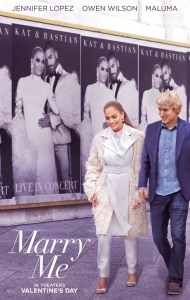 Marry Me has a premise that is so silly that it feels like it would be the setup of a fake movie within some other movie universe, something depicting the creative lunacy of Hollywood for easy satirical laughter. But no it’s real. Based upon a graphic novel by Bobby Crosby of the same name, Jennifer Lopez plays music superstar Kat. She’s a best-selling and provocative performer and her latest single, “Marry Me,” is ruling the charts. She co-wrote the track with her fiance, and the two plan to marry live during one of her stage shows. Then news leaks that her fiance has been cheating on her with her assistant. Kat is stunned and as she’s still processing her hurt feelings onstage she spots a “Marry Me” sign in the audience, held up by Charlie (Owen Wilson), an ordinary math teacher and single father. She agrees to marry him on the spot, and Charlie is rushed onstage and the two tie the knot. Now, what to do and can they make this actually work?
 Think of Marry Me as Notting Hill but where it starts at the level of international fame for romantic coupling. I found the premise to this movie, at first glance, to be absolutely preposterous. I was hoping that the movie wasn’t going to spend so much time worrying how to legitimize this silly impulsive marriage between two complete strangers. Fortunately, from their first “I do” onward the pair doesn’t really view their subsequent “relationship” as more than a publicity stunt. He’ll get more attention for his school and causes that are important to him. She’ll get a run of media attention and allow her to rebrand herself in the wake of her history of cheating louses. I was happy that the movie, at least early, doesn’t try to make this spontaneous union credible. Kat wonders, “Hey, maybe something so crazy just might work,” and of course we know it magically will, but at least they’re not panicking about how they just got married and how they are going to make this relationship work when they could as easily get annulled and got about their separate lives again. So from there, Marry Me follows the path of having these two fake lovebirds become real lovebirds over the course of their shared time.
We know it’s all going to work out, their romantic fate is sealed, but the process needs to still feel organic and earned, and that’s where I found Marry Me to be unsatisfying. Rom-coms will live and breathe depending upon their quotient of cute moments to swoon moments, ultimately winning you over and desiring the coupling. This movie already starts with the couple together, at least in a legal sense, but they don’t know one another and have no immediate feelings for one another, so the movie is like any other rom-com. They have to fall in love for real now, almost like an arranged marriage. However, I found the interactions between Kat and Charlie to be far chummier than passionate or romantic. Lopez and Wilson have zero chemistry together. There is no heat between these two. He’s too laconic and she’s too pressing. As the movie progressed, I could believe they were becoming friends. He got her to be more self-reliant, and she pushed him outside his moderate comfort zones with social media and self-promotion. They’re better friends but I felt nothing romantic between them and that’s a pretty big problem. In fact, that’s the biggest problem in a romantic comedy. If I walk away feeling like the leads would be better friends than lovers, then you haven’t put in the work, and that’s the case here.
 We associate fun and cute moments from rom-coms, amusing scenarios that force our couple to work together or wacky situations where they learn more about the other in a new setting, and Marry Me feels too unimaginative here as well. This is another vital area for the development of the relationship to feel genuine, and simply just for audience enjoyment. The three screenwriters are unable to take the Notting Hill-dynamic of an ordinary person thrust into an unwanted, elevated level of fame and scrutiny and do anything with it. Charlie’s life never feels too disrupted from before; his casual public walks with Kat do not have dozens of paparazzi hounding them, annoying fans inserting themselves into his personal life, envious family members and exes coming back into the picture for attention, or even Charlie’s past being litigated by the media. His new life feels strangely absent the surreal touches we would expect and want from this plucked-from-obscurity setup.
The script assembles the standard rom-com tropes without anything more personable to make it feel meaningful to this story and these characters and their conflicts. Charlie asks Kat to come to the school dance, and this sounds like it has potential to be fun, but it never goes further than the mere idea. She’s there, the kids are flummoxed and naturally starstruck, and she sings a song to them. That’s it. When the third act comes calling, we’re left impatiently for the resolutions to hit their predictable end points. We know that the bad ex will still be the bad ex, we know that the big decision about whether to go to the fancy music industry gig or the humble Mathlete championship is no struggle, and we know the valiant efforts to travel back in time will be crossed at the exact moment desired. Marry Me disappoints because it squanders its unique or alluring plot elements and too often settles for resuscitating stale genre tropes.
 Marry Me feels almost out of time, like an early 2000s rom-com star vehicle for Wilson (Loki) and Lopez (Hustlers). Both actors are in their 50s now, and ostensibly playing characters in their 40s, but the movie treats them like they might as well be in their late 20s. He’s divorced with a pre-teen daughter and she’s had multiple high-profile marriages, but so much more could have been articulated, especially about a 40-something woman trying to keep her perch in an industry always looking to replace aging superstars with the next young pretty thing available. This perspective gets the occasional mention, but that conflict feels mysteriously ignored, like even approaching the idea would be insulting rather than establishing an intriguing new level of self-reflection and potential connection for these two middle-aged characters. A big screen rom-com with characters in their 40s, or beyond, is such a rare find, let alone having one of those characters in the shallow field of entertainment. Ignoring this opportunity is confusing.
While the writing and chemistry is lacking in Marry Me, the two stars are still enjoyable to watch. I didn’t believe their romantic union but I believed that they genuinely enjoyed hanging around one another. So while Marry Me doesn’t work as the story of two people miraculously falling in love under contrived circumstances, it can work as the story of a burgeoning friendship of unlikely friends. If you think of it from that angle, the movie is a lot more agreeable and entertaining to watch over the course of its 110 minutes. Lopez and Wilson are still charming leads, and the movie never gets too serious or overwhelming to actively dislike. It’s ultimately a middle-of-the-road rom-com, low-key enough to coast on the appeal of its stars but absent anything to make the characters and their romance feel personable and meaningful. It’s no different than something you might see on cable in the middle of an afternoon. You can do worse than Marry Me as far as formulaic rom-coms go, but you could certainly do better, and I advise you dear reader, in your rom-coms as well as your relationships, not to settle for less.
Nate’s Grade: C
Share this:

The Cell (2000) [Review Re-View]
 Released August 16, 2000:
Welcome to the not too distant future where the miracle of science (i.e. red bodysuits and washcloths over people’s faces) allow you to transport your mind into that of another individual. So what happens when a serial killer snags a catch only to be dropped into a coma with no way of discovering where his victim is before time runs out? Well we send Jennifer Lopez into his head — duh! The Latina songstress transports herself to learn the secrets of Mr. Madman before his next victim becomes just a number on a sheet. Sound contrived, like the movie was in production before they had a workable script? You’re not alone. One-named director Tarsem is from the land of music videos but for the life of me I can’t think of one he’s done.
Perhaps the excruciatingly long Nine Inch Nails promo would be less frustrating if the outpourings of creepy imagery meant something. Despite the desire to explain the inside cerebrum of a crazy man, 90% of the imagery is there for the simple sake that it looks cool. Lopez plays Alice to a lumbering wonderland of dark images and a mind-numbingly clattering musical score. Would someone please explain to me why a CGI vine grew on screen for five minutes then went away?
Lopez speaks in whispers, Vaughn speaks like he’s on Ritalin, and the movie speaks that if you had abuse as a kid it’s okay to trap women in self-filling aquarium cubes and bleach them into albino Barbies. Won’t see that in your typical after school special.
The Cell may present some things you’ve never seen before, like a jack-in-the-box theme to twirling intestines, but too often it presents things you have seen much too often in film — boredom.
Nate’s Grade: D
——————————————————
WRITER REFLECTIONS 20 YEARS LATER

I really thought The Cell might be better twenty years later but no. I was fairly critical back in 2000, referring to it as one of the worst movies of that year, and twenty years later it put me to sleep. Never a great sign for your entertainment. I had to re-watch the final act of this movie twice, and then I reviewed certain scenes a few more times just for good measure to make sure I wasn’t missing anything essential. The Cell doesn’t really play like a movie. It plays more like the film adaptation of a video game. The premise is promising, a psychologist (Jennifer Lopez) that has to venture into the twisted mind of a serial killer (Vincent D’Onofrio) in order to extract key info before time runs out finding his latest victim. We got something there. However, the actual movie becomes little more than an enterprise for director Tarsem Singh (Immortals) to get drunk on his lavish visual self-indulgences. As my 18-year-old self observed, it does feel like a 90-minute Nine Inch Nails music video.
I suppose The Cell could have been a harbinger of a sub-genre of movies that has multiplied in indie horror, namely the atmospheric movie where the atmosphere is the entire point. Forget story, forget characters, forget setups and payoffs, forget basic emotional investment; the film is simply constructed to deliver strange and memorable imagery and an overwhelming feeling of discomfort and/or transcendence. This isn’t a new sub-genre. David Lynch has been dabbling in this realm for decades, and Terrence Malick fully converted around the time of The Cell’s theatrical release (granted his atmospheric dawdles are considered more high-art). Dear reader, I’ll fully admit my own filmmaking tastes and biases and confess this sub-genre rarely does much for me. That’s because, in my personal experience, the atmosphere gets repetitious and predictable and without greater investment I just grow bored. I completely acknowledge that there is an audience that feels the opposite, that celebrates the immersive quality of giving one’s self into the visual decadence of a filmmaker creating a vivid dream to tempt and confuse your senses. I get it, but it’s not for me, and so I found The Cell to be overall empty and tedious.
 Credit where it’s rightfully due, the visuals on display are often striking and luscious, as are the amazing costumes that were shockingly not nominated for the Academy Award that year (The Cell did receive a nomination for Best Make-Up). The sequences are gorgeously composed starting with the opening of Lopez riding a black horse through the desert and then scaling the dunes, each shot so artfully composed that it could be mass produced as a postcard. Tarsem is a gifted visual artist and has been from his early days as an in-demand music video director in the 1990s (R.E.M.’s “Losing My Religion,” En Vogue’s “Hold On”). The mind of a serial killer allows the man to open up the bizarre and grotesque imagery we would expect from that slippery setting. There’s one scene where a series of glass partitions slice a horse into slimmer portions and then spread out the still-breathing remains. There are definite nods to classical baroque painting, like Caravaggio. The various incarnations of our serial killer’s demons gave me a reason to keep watching. There’s demon horn version, giant purple curtain caped version, Alice in Wonderland version, and a final incarnation that resembles a Star Trek alien crossed with Michael Keaton’s Birdman. There is a draw to exploring a brain built upon trauma and abuse and mental illness. It’s like the horror version of Inception. However, while commendable from a production and visceral standpoint, the plot diversions have the feel of visiting the most messed up museum, taking in display cases and then moving onto the next. There’s little here beyond the superficial and the imagery, while artful, is too disposable and ephemeral.
I’m slightly surprised Tarsem hasn’t had a bigger career in feature films. He delivers pretty much what you would ask a visually decadent director to do with this material. It took him many years to get his next film up and running, 2006’s The Fall, and from there it’s been a series of studio-friendly jobs, each further neutering his distinct visual style (watch 2015’s Self/less and tell me it’s the same director of The Cell). He seemed like the kind of artist who might follow Michel Gondry’s (Eternal Sunshine of the Spotless Mind) path but it didn’t seem to play out that way.
 Music videos in the 1990s became the fertile training ground for Hollywood to snatch up-and-coming talent for their projects, but looking back, very few of those directors had lasting feature film careers. Not everyone is going to be a David Fincher or a Spike Jonze or even a Francis Lawrence. Many of the most influential and prominent names, like Hype Williams (Belly), Samuel Bayer (A Nightmare on Elm Street 2009), Joseph Kahn (Torque), Mark Romanek (One Hour Photo), Floria Sigismondi (The Runaways), Jonathan Dayton and Valerie Faris (Little Miss Sunshine), Jonus Akerlund (Spun), and Dave Meyers (The Hitcher 2007) only got one or two movies to prove themselves as long-form filmmakers. You have your directors that were attached to action movies, like McG, Marc Webb, Marcus Nispel, Mark Pellington, and most successfully, Michael Bay (strange that they all start with “M”). I’m sure my general ignorance of contemporary music videos (beyond Billie Eilish it would seem) has kept me from citing more names that made the big leap. I guess this paragraph was just examining that most prominent music video directors don’t seem to last in the studio system unless they can prove themselves to be reliable purveyors of mainstream action.
The only real actor worth noting here is D’Onofrio (Men in Black). He gets to be gleefully weird, his favorite kind of acting. He looks like he’s having fun scaring Jennifer Lopez (Hustlers) and inhabiting the different demons of a very disturbed soul. Lopez is perfectly fine but almost entirely reactionary here, like she’s a video game avatar going from one dark corner to another as she clears stage after stage. Her biggest acting was simply putting on the weighty costumes. Vince Vaughn (Wedding Crashers) is completely wasted as a determined F.B.I. agent desperate to find the last victim before she drowns in one of those movie-world elaborate death traps. All of the scenes outside the killer’s psyche are a general waste and serve as monotonous running-time padding. That also includes a deleted scene, restored for the BluRay release, where the killer suspends himself from metallic piercings over a corpse and masturbates onto her body while watching another woman drown in his elaborate death trap. It’s so absurdly try-hard that it’s stunning. This scene offers no further insights into the character, only another gratuitous excuse to be transparently “edgy.”
Looking back at my original review at age 18, I’m struck by how much I agree with my younger self (good job, me). I didn’t have much to say beyond my general dissatisfaction with the boring narrative and the pretty yet vacant visuals. I would classify this review as one of my glibber entries, something I’ve noticed with bad movies and generally being a smart allecky teenager. I do think that perhaps I should raise my grade only slightly due to the level of visual flair. It’s certainly not a fun movie, or an interesting one, or even a good one, but The Cell is first-rate fetish wallpaper.
Re-View Grade: C-
Share this:

Hustlers (2019)
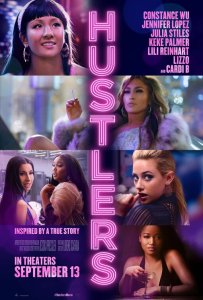 Think of it as a feminist companion piece to The Wolf of Wall Street or The Big Short. Inspired by a true story, Hustlers follows a diverse group of strippers who wine and dine Wall Street middlemen and execs, feeding off the spoils of their feeding frenzy, and then eventually upping their game, drugging them and fleecing them for one wild night that they’ll be too embarrassed to report that next morning. The story grabs you early on and is stuffed full of interesting details about the ins and outs of the stripping industry as well as how to service and manipulate the wealthier men who frequent said clubs. Hustlers becomes a combination of a crime caper, a con artist thriller, and a class-conscious drama about the haves and have nots, but it really becomes a showcase for the talents of one Jennifer Lopez, a woman who does not seem at all close to her fifty years on this planet (her introduction is quite the jaw-dropper). Lopez plays Ramona, the alpha leader of the group, a loving single mom with a healthy distaste for the hand she’s been dealt. She is sensational and delivers the best performance of her long career. Even when she’s doing bad things, even when she’s taking bold risks, there is a moral center to that woman, an unbreakable heart for the people she chooses to let into her life, and it does not budge, which was a poignant note. In many ways she is more the main character than Constance Wu (Crazy Rich Asians), a figure that serves as more entry point than fully-fleshed out character. I enjoyed learning the various tricks of the trade writer/director Lorene Scarfaria (Seeking a Friend for the End of the World) peppers throughout with her love of montage and stylish transitions, but it really picked up after the 2008 financial crash where the women cross over into direct criminality. At first they figure they’re just skipping ahead, drugging with MDMA rather than waiting for their marks to get drunk (“Drunk enough to order the bill but sober enough to sign the check,” Ramona cautions). Then things get escalated and sloppy and the women are in trouble. It’s a fun ride watching the ladies get theirs, and I was challenged to muster much of any sympathy for their Wall Street marks. Part of me wishes more women would be inspired by this movie and follow suit, fleecing the people who fleeced our economy. The movie rides that wave of the good times you know can’t last, prolonging the fall we’re all anticipating coming. The supporting characters can be a bit weak; several of the other girls involved in the scheme merit one note of description, and some of the humor feels a bit out of place, like a running joke where one of the women nervously vomits often (this is like her single character trait, and it’s weird). It’s also likely the stripper-centric movie with the least nudity I’ve ever seen, thanks to Scarfaria treating a sensational story with candor rather than exploitation. Hustlers is a glitzy drama that will entertain you with its flash and then surprise you with its edge. And all hail, Jennifer Lopez, ageless wonder and underrated actress getting her due.
Nate’s Grade: B
Share this:

An Unfinished Life (2005)
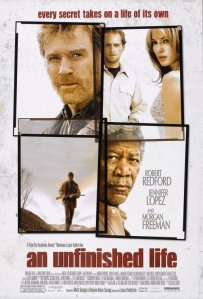 Einar (Robert Redford) is a gruff rancher living with his long-time friend and ranch hand, Mitch (Morgan Freeman), who has been recovering from a bear mauling. Jean (Jennifer Lopez) and her young daughter (Becca Gardner) have run away from her abusive boyfriend and seeking temporary refuge with Einar. There’s still a lot of tension and unspoken anger between the two. Einar blames Jean for the death of his son from a car accident. As their stay continues each member imparts wisdom to the other, hard exteriors get warmed, and lessons about forgiveness are learned.
This is melodrama with a capital M. An Unfinished Life is clunky, the movie hasn’t the foggiest idea when it comes to subtlety, the characters all shout out their feelings all the time, and worse yet, it’s also incredibly transparent. A scene where Lopez breaks a dish and Redford goes nuts is just too much. Of course they’re talking about his dead son but the moment is played to the hilt that I half expected every line to end in a wink (“It’s just a dish” wink “Maybe it’s more than a dish to me!” wink “Maybe that was my favorite dish!” wink). Honestly, it was at this point that the film lost me. The metaphors are another symptom of the film’s overly ramped-up obviousness; Redford might as well be pointing at the bear to pantomime that it?s supposed to represent his pain and anger. And Freeman’s eventual forgiveness of his attacker is meant to encroach upon Redford to do likewise to the source of his pain, and many other moviegoers, Jennifer Lopez. I cannot find a movie emotionally involving when it doesn’t even bother to mask its grand statements.
Seriously, this movie is brimming with sprawling earnestness meant to cover the narrative shortcomings. This is a simple tale that could have suckered the audience in with its framework to showcase complex characters and their personal interactions, like a Million Dollar Baby, but even though An Unfinished Life is simplistic it still manages to beat you over the head. Every line of significance is underlined so you get it. It’s like director Lasse Hallstrom was making a seething parody of these overarching, small-town, large cast, homesy feel-good flicks he’s specialized in for a decade.
The acting is all fine. Redford is fun to watch and get his Jeremiah Johnson back on. Lopez makes you forget how much you hate her in other movies. Freeman is settling into a weird groove as a disfigured narrator. The acting of the ensemble really isn’t the issue with An Unfinished Life.
Despite all its earnest intentions and lush scenery, An Unfinished Life is too much melodrama squeezed into such a small space. It’s an old fashioned tale that feels too convenient, too simplistic, too perfunctory, and too unhappy with being any of those things. This feels like a Hallmark card turned into a movie by someone who has no grasp for human emotion. Everything is shouted when it needs to be a whisper and explained when it needs to just be experienced. And yet there will be an audience for this slow burn small-town tale of forgiveness and accountability. It may please people immensely, but I prefer a little subtlety to my drama. I won’t say the film is bad but I’ll never say An Unfinished Life is particularly good, even as melodrama.
Nate’s Grade: C
Share this:

Jersey Girl (2004)
Writer/director Kevin Smith (Dogma) takes a stab at family friendly territory with the story of Ollie Trinke (Ben Affleck), a music publicist who must give up the glamour of the big city to realize the realities of single fatherhood. Despite brief J. Lo involvement, Jersey Girl is by no means Gigli 2: Electric Boogaloo. Alternating between edgy humor and sweet family melodrama, Smith shows a growing sense of maturity. Liv Tyler stars as Maya, a liberated video store clerk and Ollie’s real love interest. Tyler and Affleck have terrific chemistry and their scenes together are a playful highlight. The real star of Jersey Girl is nine-year-old Raquel Castro, who plays Ollie’s daughter. Castro is delightful and her cherubic smile can light up the screen. Smith deals heavily with familiar clichés (how many films recently end with some parent rushing to their child’s theatrical production?), but at least they seem to be clichés and elements that Smith feels are worth something. Much cute kiddie stuff can be expected, but the strength of Jersey Girl is the earnest appeal of the characters. Some sequences are laugh-out-loud funny (like Affleck discovering his daughter and a neighbor boy engaging in the time-honored game of “doctor”), but there are just as many small character beats that could have you feeling some emotion. A late exchange between Ollie and his father (George Carlin) is heartwarming, as is the final image of the movie, a father and daughter embracing and swaying to music. Jersey Girl proves to be a sweetly enjoyable date movie from one of the most unlikely sources.
Nates Grade: B
Share this:

Gigli (2003)
It’s the feel-good movie of the year revolving around a lunkhead mobster (Ben Affleck) and his mentally challenged kipnapee and their attempts to covert a lesbian hitman (Jennifer Lopez) in between her yoga/horrific monologues concerning the superiority of female genitalia. Believe the hype people; Gigli is indeed as bad as they have told you. It’s not even entertainingly bad, like Bulletproof Monk, no folks; Gigli is just mundane and awful. During the entire two hour stretch, which feels much much longer, I kept saying one thing aloud: “How could anyone making this think they were making a goodmovie?” Did they think audiences would find it funny that Affleck’s mother (the mother from My Big Fat Greek Wedding) shows us her big fat Greek behind? Did they really think that a mentally retarded kid (who has an affinity for gangster rap and wishes to travel to the mythical “Baywatch”) would come off as endearing? Well instead it comes across as insulting. And what else is insulting is the laugh-out-loud dialogue Lopez is forced to spit out concerning her attraction for women. I can’t think of any actress that could say the line, “I love my pussy” convincingly. And I’m sure a lot of actresses out there have true affection for it. The writing is just atrocious. And so much else fails as well. The score is a perplexing mix of upbeat jazz and inappropriate string orchestra. I don’t understand what emotions they were going for during scenes in Gigli but a full string orchestra playing music better suited for a real drama does not fit. Maybe it was for a tragedy. In that case, then it’s right on the money. You won’t see a more sloppily executed, horribly acted, painfully written, lazily directed, inept film this year. And what the hell did Christopher Walken walking in have anything to do with anything?
Nate’s Grade: F
Share this:

The Cell (2000)
Welcome to the not too distant future where the miracle of science (i.e. red bodysuits and washcloths over people’s faces) allow you to transport your mind into that of another individual. So what happens when a serial killer snags a catch only to be dropped into a coma with no way of discovering where his victim is before time runs out? Well we send Jennifer Lopez into his head — duh! The Latina songstress transports herself to learn the secrets of Mr. Madman before his next victim becomes just a number on a sheet. Sound contrived, like the movie was in production before they had a workable script? You’re not alone. One-named director Tarsem is from the land of music videos but for the life of me I can’t think of one he’s done.
Perhaps the excruciatingly long Nine Inch Nails promo would be less frustrating if the outpourings of creepy imagery meant something. Despite the desire to explain the inside cerebrum of a crazy, 90% of the imagery is there for the simple sake that it looks cool. Lopez plays Alice to a lumbering wonderland of dark images and a mind-numbingly clattering musical score. Would someone please explain to me why a CGI vine grew on screen for five minutes then went away?
Lopez speaks in whispers, Vaughn speaks like he’s on Ritalin, and the movie speaks that if you had abuse as a kid it’s okay to trap women in self-filling aquarium cubes and bleach them into albino Barbies. Won’t see that in your typical after school special.
The Cell may present some things you’ve never seen before, like a jack-in-the-box theme to twirling intestines, but too often it presents things you have seen much too often in film — boredom.
Nate’s Grade: D
Reviewed 20 years later as part of the “Reviews Re-View: 2000” article.


 nathanzoebl

You must be logged in to post a comment.