Blog Archives
No End in Sight (2007)
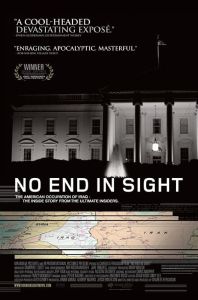 Director Charles Ferguson lived his life as a PhD political scientist, and then he felt compelled to make a movie. No End in Sight doesn’t focus much on the origins of the current Iraq War, which have been well documented and discussed in many other realms, instead the movie takes an exacting look into where the U.S. government fouled up the occupation after toppling Saddam Hussein. Because of this approach, Ferguson’s expose cannot be dismissed under false propaganda claims, and because his interviews mostly consist of the people on the ground who were responsible to stabilize the country, No End in Sight is blessed with plenty of hard-hitting first-hand accounts by the people given the hurried, thankless job of rebuilding a conquered nation.
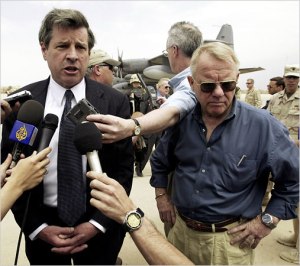
General Jay Garner and his team, including Colonel Paul Hughes and Ambassador Barbara Bodine, were given 60 days to plan for a post-war Iraq. In contrast, FDR spent years planning ahead for an occupation of Germany. Planning was difficult because when they arrived in Baghdad the post-war looting made setting up a government a formidable task. They not only had to find means to contact people but they had to figure out ways simply to operate in an environment where looting had destroyed buildings and proper tools for communication. They were in charge of ORHA, the Office of Reconstruction and Humanitarian Assistance, which was not run through the State department, as would be normal, but run by the Defense department.
 The film holds its harshest criticism for L. Paul Bremer, the man appointed to run the Coalition Provisional Authority, formerly ORHA. Bremer, like many who planned the post-war occupation and were placed in key positions within the occupation, had no military experience, no foreign policy experience with the Middle East, a notoriously tricky region, and he didn’t speak a lick of Arabic. In any other scenario, he would be judged unqualified for his heavy duty ahead. No End in Sight lays out three grievous errors that Bremer made in the summer of 2003 that gave birth to the ongoing insurgency and sent Iraq spinning out of control. The first was absolving any previous work to reach out and include Iraqis in helping to form a working provisional government. Bremer was more a my-way-or-the-highway kind of guy, which may be why he was esteemed in a presidential administration filled with these types. This alienated the Iraqi people and began Bremer’s calamitous habit of bridge burning. His second error was his decision to eliminate the Ba’ath party, Saddam Hussein’s ruling party, and bar members from any future government service. This stripped teachers, engineers, intellectuals, the very people integral to build the infrastructure of a nation, and made them permanently unemployed in Iraq. Many members had merely joined the Ba’ath party because it was the only way to secure a steady job.
But by far the most baffling and incompetent decision Bremer made was to disband Iraq’s army. This boneheaded move went against the recommendations of U.S. military figures, and in the blink of an eye, the 500,000-strong Iraqi army were without a job and an income. There were overtures from military leaders to ORHA; Paul Hughes recounts that one officer promised him 12,000 men in a week if asked. So, in a situation where the U.S. military did not have enough soldiers on the ground to even halt looting, Bremer disbanded Iraq’s best solution for restoring law and order. Half a million angry, disenfranchised, combat-trained, well-armed men were now left to fend for themselves, and if the U.S. didn’t care for their expertise then death militias would. It should come as no surprise that shortly after this colossal miscue is when Improvised Explosive Device (IED) attacks on the U.S. troops surged along with U.S. casualties. It seems like at that point the verdict had come against the U.S. occupation.
 Bremer’s decisions alienated, humiliated, and inflamed the people of Iraq, and they went against the recommendations by people that knew what they were talking about. The greatest tragedy that comes to mind is that, despite morally questionable, downright repugnant reasons for entering this conflict, the U.S. could have done this right. Saddam was indeed a bad man and the people of Iraq were initially receptive to see what the U.S. occupation would bring about. They weren’t expecting rampant unemployment, no tangible security force, being excluded from decision-making, having American private contractors bleed them dry, and an utter lack of basic human services like power and clean water. Add a long-standing religious feud into the mix and it’s no wonder the country has descended into a quagmire. No End in Sight makes the dots easy to follow and connect the cause-effect relationships into where we are today.
It’s hard to watch the film and not feel your blood boil. While No End in Sight is presented soberly and with clear-headed precision, watching the absurd miscalculations and naiveté prevail over the opinions of experts is infuriating. General Shinseki recommended to Congress that several hundred thousand troops would be required after toppling Saddam. Paul Wolfowitz, deputy Secretary of Defense, swiftly countered this assertion by claiming that it was unimaginable that it would require more troops to secure the peace rather than engage in war. “Unimaginable” is the key word here; Wolfowitz just couldn’t potentially fathom a reality that was known by most high-ranking military officials. Stabilizing a country is far more taxing than simply taking out an opposing force. Shinseki, who guided occupation forces in Bosnia and Kosovo, was ignored and pushed into “early retirement,” and Wolfowitz’s plan was followed (Wolfowitz also famously stated that the war would pay for itself thanks to Iraq’s oil revenues).
 No End in Sight does have a figure of amusement and it just so happens to be Secretary of Defense Donald Rumsfeld. The film opens with his farewell address after the 2006 midterm elections where Republicans lost control of Congress and Rumsfeld was shortly ousted from his job days later. He calls the Iraq War little understood and declares that Bush and his team’s accomplishments will one day get the full historical notation they deserve. Of course, the irony is that the designers of the Iraq War had little understanding of what they were getting into and ignored the warnings and advice of those whose opinions conflicted with the Administration line. Many clips of Rumsfeld news conferences are shown and the man comes across as flippant and disingenuous. He dismisses the looting as “stuff happens” and argues TV news is re-running the same image of a man absconding with a vase (“And you have to wonder, are there that many vases in the whole country?” he adds). The Iraq looting destroyed a museum that had artifacts dating back 7,000 years to the dawn of civilization and a library with hundreds of ancient manuscripts was burned to the ground; an entire country’s deep culture and history went up in smoke and Rumsfeld was using it as a setup to a vase joke. The clips further remind the audience that Rumsfeld, one of the chief architects of the war along with Vice President Dick Cheney and Wolfowitz, simply disregards information he doesn’t agree with, whether it may actually be right. The leaders of the Bush Administration demonstrate time and again a supreme disconnect from reality.
No End in Sight is one of the best documentaries yet on the Iraq War and a definitive indictment on the lack of substantial care given to post-war planning. No one can accuse this film of slander or pushing an agenda; this is an exacting autopsy on the current chaos in Iraq, and it has cold facts and hard truths to back up its convictions. Even if you feel that you know all the blunders tied to Iraq, this sensational film is not merely a repackaging of dogma. It’s eye-opening and intensely fascinating and one of the better films of the year; it’s an argument made on the merits of evidence and testimony, and it is damning. One soldier reflects upon the current conditions and flatly asks, “This is the best America can do? Don’t tell me that.” Then after a small pause he adds, “That makes me angry.” You are not alone, brother.
Nate’s Grade: A
Share this:

Shut Up & Sing (2006)
 With the clarity that a few years offer, can we all agree that what happened to the Dixie Chicks on the eve of the Iraq War was insane? Lead singer Natalie Maines, in concert in London, told the crowd that the group was not for war and was ashamed President Bush hailed from Texas. What followed was a maelstrom of irrational behavior; boycotts beckoned, people protested, and long-time Dixie Chicks fans threw out their CDs and called the group traitors, my God, someone even sent a death threat, all for disagreeing with a country’s march to war. Shut Up & Sing chronicles their lives at the time of the 2003 controversy and their 2006 follow-up album, mostly compromised of songs inspired by the anger and frustration they felt. The documentary itself is nothing too slick or overproduced; it really just follows a headlining group through the most volatile time of their life. For that, it’s intensely fascinating and bizarre to watch the Chicks backlash, but there’s little else as compelling. Several of those in protest questioned the Dixie Chick’s patriotism for questioning whether the war was necessary, and some said they should be strapped to bombs over in Iraq. Four years later, 3500 American deaths, no WNDs, scandal after scandal, no discernible way out, a civil war, and a president that can’t even get the time of day, I wonder how many of those decrying the Chicks would be apologizing to them today. Another highlight of Shut Up & Sing is the most ludicrously ignorant statement I may have ever heard, courtesy of Toby Keith defending his songwriting skills: “She said ‘We’ll put a boot up your ass’ is ignorant, and that anyone could write that. Well, she didn’t write it.” Bravo Mr. Keith, bravo.
Nate’s Grade: B
Share this:

Death of a President (2006)
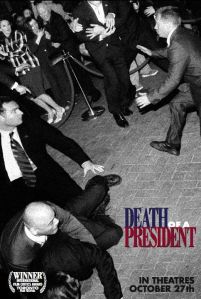 It’s been called morally reprehensible and obscene. Theater chains have refused to even touch it. The White House is concerned it will spawn a deadly array of copycats. The controversial movie in question is a little independently produced mock documentary about the assassination of George W. Bush in the year 2007. It’s kind of funny that this small talking-heads piece has so many people talking, because without its central gimmick, no one would be utterly a word about Death of a President. No readers, they would all be fast asleep.
We’re introduced to various people involved in the fateful event. In October 2007, Bush is appearing in Chicago and the city is overrun with protestors armed with angry signs and angrier words. A handful of protestors even break police lines and come within a hair of the president’s motorcade (to his credit, Bush doesn’t take it personally). Then as he’s leaving a speech, shaking hands along a roped line, shots are heard and the president goes down. In the aftermath many are suspected, including disenfranchised Iraq war vets, protestors, and a Muslim man who may have a connection to al-Quaida.
 Death of a President has the potential to be little more than extreme left-wing wish fulfillment. No matter your thoughts on Bush as a president and a person, I hope the majority of people would not wish death upon him. I think the appeal of this mock-doc is the ghoulish rubbernecking of watching the president die right before your eyes. The moment is quick and mostly just Bush bending over in pain. The lead-up to the kill manages to quicken the pulse. Is it offensive to flirt with the idea of killing our elected leaders while they are still in office? Is it more repugnant when filmmakers use advanced computer effects and archival footage to make the moment as real as possible? It seems that the movie is coming at the peak of an unpopular president and an unpopular war, so some moviegoers will buy their tickets just to vicariously watch Bush die. Those same folks will be surprised how sympathetic and likeable Bush comes across in passing.
Questionable ethics aside, the movie is a whodunit built around a fortuitous gimmick, but once the title death takes place the movie utterly collapses. The ensuing hour turns into an investigation into who had their finger on the trigger. Death of a President has a baffling lack of political insight. The government centers their investigation on a Middle Eastern man of Syrian descent, fudges evidence out of pressure, and tries to build support for a unilateral military response, civil liberties get trampled upon in the name of security, and yet it’s all so sadly predictable. Death of a President is merely repeating the news of our tumultuous times, and it feels so stiltedly scripted. You can?t help but think that the current political scandals are far more weird and fascinating than this ho-hum what-if political science scenario. It’s just recycling current events and changing corresponding details. There?s nothing new or interesting here. As soon as Bush gets shot down so too does the film?s chances of exploring anything meaningful.
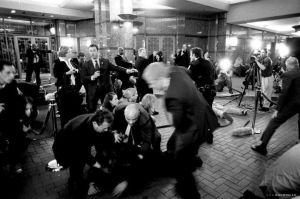 The second half of this film is downright narcoleptic. The investigation is deep in procedural gobbledy gook and the film feels impersonal. I mean, a sitting president has been assassinated in the age of cable TV, global economy, and the war on terror, and all the film can muster is trying to piece together the minutia of how to prosecute a case? I’m sorry, presidential assassination ranks a bit above your standard Law & Order output. There are so many interesting doomsday outcomes that could come about (especially with the scary thought of a President Cheney) and yet the film finds the most boring, insignificant, tedious path. This is inexcusable. It all feels so pathetically small for an act that would be immeasurably monumental. The film is shocking in how little it has to say about anything. It is devoid of commentary and complexity.
Director/co-writer Gabriel Range stages the entire film exactly like a prime time TV news report. It’s slick and packaged well, and the cut-and-paste magic creates an eerie realism. Range uses a mix of archival footage and CGI to illustrate Bush’s assassination. Cheney’s eulogy is actually extensively culled from the speech he gave at Ronald Reagan’s funeral. Don’t know if that?s respectful or not. The technical credentials are worthwhile; the heavy-handed message is not. This is not satire. This is shallow and secondary and pointless. I think Range has treated Death of a President more like an audition film, hoping for bigger and better things. At least, I hope whatever comes next for this man is better.
Death of a President isn’t a terrible movie but it’s way too simplistic, ham-fisted, myopic, and freakin’ dull. The controversy attached to this tiny movie may mislead you into thinking it’s something worth seeing. It’s not. The visual trickery and talking-head structure makes it seem like something you’d see on TV, and you should take that to heart. Wait for TV with this one. Its direct-to-TV ticket is booked as soon as audiences find out what the movie really is. That is, if you can manage to rouse them awake.
Nate’s Grade: C-


 nathanzoebl
You must be logged in to post a comment.