Blog Archives
Fireproof (2008)
 Earlier this fall, a small flick financed by evangelical Christians broke into the top of the box office. It was written by the Kendrick brothers, Alex and Stephen, both associate pastors, and directed by Alex. They previously wrote and directed 2006’s small hit Facing the Giants, a Christian-based sports movie. Fireproof is a story about Caleb (Kirk Cameron, the Russell Crowe of direct-to-video Christian produced movies) and his strained marriage to his wife Catherine (Erin Bethea). She works as a public relations rep in a hospital and feels that it may be time to divorce her irritable, selfish, and overall jerk of a husband. Caleb’s born again father convinces him to hold off on any divorce proceedings and passes along a book called The Love Dare, which challenges couples to 40 days of guided help.
This movie is bad. You probably already knew that. I am somewhat alarmed that there appears to be a whole lot of eager Christian filmgoers that will plop down plenty of dollars to see anything, no matter how horrible, if it conveys a Christian message. Just because you can agree with a message doesn’t mean the product is worthwhile. Here are some things to think about if someone ever asks you if you’ve seen the movie Fireproof.
1) Fireproof exists in a world not our own. The characters behave in odd ways that do not appear to resemble observable human behavior. Some leeway is given because, yes, they are fictional characters, but they say dialogue that sounds forced and clichés, and they do actions that are contrived because the movie requires them for the plot. Here are some minor examples that play to this theme:
 a) The town of Albany, Georgia is designed like a small town even though it has a metropolitan population of about 160,000. And yet the town only has one crew of firefighters consisting of five guys, and three of those guys are clearly not in a physical condition that would be deemed passing. Seriously, these guys are too overweight to be firefighters. Because of the film’s small town presentation and the fact that the county clearly doesn’t care about physical fitness for its emergency responders, Fireproof thus gives us a fire crew that has a whole lot of time on their hands. This complicates things because it makes it seem like Caleb would have more time to be nice to his wife.
b) The women are presented in completely unflattering ways. There are two main female characters, Catherine and Caleb’s mother, and a gaggle of female nurses that simply cannot help themselves when it comes to gossiping and clucking like hens. Every black woman in this movie at some point must say the utterance, “Mmmhmmmm,” and of course bob their head as they talk. The dialogue feels forcibly “black” for these characters when it just could have been anything. Caleb’s mother is briefly presented as a concerned figure but Caleb just tells her to shut it and asks for alone time with dad, you know, the man of the house. She never stands up for herself and her husband, Caleb’s father, does a lousy job of telling his idiot son to respect his mother. Now Catherine is given plenty more time and she has some serious grievances with her lunkhead mate, but when he tries doing helpful and nice things she still decides to be cold to him. Why? Maybe Catherine is just a cold person, after all. One of the very first moments we see her character is when she’s talking to her mother, who has recently had a stroke. Catherine is venting about her troubled marriage and then begins to break down to her mother and says, unbelievably, “I miss the real you.” Excuse me? Just because your mother had a stroke doesn’t mean she’s any different mentally, and she can still hear and understand you, dear.
 c) Internet pornography is played with more drama than the Holt’s marriage. When it comes to dramas that center around marital discord, it shouldn’t take much effort to create a compelling conflict. But I just didn’t buy the conflict between Caleb and Catherine from the start. The conflicts in their marriage are rather mundane, which is likely very realistic for many couples but it makes for poor drama. He wants the respect he feels he’s entitled to. She wants her husband to spend time with her and be nicer to her. He wants to buy a boat with his money. She wants new shelves. How expensive can shelves be? Catherine does feel temptation at work from a doctor that takes time out to listen and make her feel special. That’s a real dilemma. On Caleb’s side? His big moment comes when he battles his addiction to Internet pornography, which was an issue the filmmakers also addressed in their previous flick, Facing the Giants. Caleb is looking at boats online when a pop-up appears that asks if he “Wanna see?” a sexy lady. Oh, the horror. Caleb lingers. Then he paces, all the while staring at the tempting pop-up ad a mere click away. He paces more. Dramatic music starts to build. “Why is this so hard?” he angrily asks to no one in particular. This goes on for like a minute solid. Then he resists the temptation and is determined to be a better man for his wife, sans pornography. Great. Except that’s not exactly what he decides to do. He decides to take the computer outside and literally smash it to pieces. There is likely plenty of personal information, credit card numbers, family photos, personal documents, and more on that computer, but alas Caleb decides to get smash happy with a baseball bat. I understand that Internet pornography is a realistic addiction for many people but, again, it makes for terrible drama in a PG-rated movie. His wife is nonplussed when she finds out about the computer being smashed. Human beings do not behave like this! At the very least, she should have been angry that he just wasted money. You know, you can get Adult Web site blocking software for much cheaper than a new computer.
d) Caleb totally got hosed when it came to hospital supplies. This is a lesser charge but it still sticks in my memory. Caleb has saved up $24,000 for a boat but ultimately spends all of it to pay for a wheelchair and a hospital bed for Catherine’s mother. Catherine is so thickheaded that it takes her weeks to figure out her husband spent the dough and not the nice doctor she talks with at the hospital. There is no way that a hospital bed and one electric wheelchair cost that much money. Caleb got taken for a sucker. Catherine’s mother had a stroke, and you’re telling me that in her situation she doesn’t qualify for Medicare? The government probably should have covered the whole thing, if not most of the expenses. But then this incident is just a cheap conflict that makes Catherine look stupid and Caleb look naïve.
 2) The metaphors are leaden and inane. Given the title and the nature of Caleb’s profession, you can bet your bottom dollar you’re going to be inundated with “fire” metaphors: “You never leave your partner behind, especially in a fire.” Or how about: “Fireproof doesn’t mean the fire will never come. It means when the fire comes that you will be able to withstand it.” You get the idea. What’s even worse is that the movie offers metaphors that are intended to be profound but are astoundingly shallow. One character says, “You know a woman is like a rose. If you treat her right she’ll bloom, if you don’t she’ll wither.” That is quite possible the worst simile I’ve ever heard in my life. Read it again, please. It is essentially saying, “A woman is like a [thing]. If you are [good] to her then [good will happen to thing]. If you are [bad] to her then [bad will happen to thing].” This is basic attribution, people. I can come up with equally profound comparisons using this model. How about this one: “A woman is like a ’62 Chevy. If you treat her right she’ll keep running, if you don’t she’ll need to be put up on blocks.”
3) This Love Dare book is tripe. This book actually exists now, by popular demand from the many people that watched Fireproof and asked for this guidebook. I’m supportive for anyone out there that actually tries to save their marriage rather than give up, but let’s face it, sometimes some marriages were meant to be dissolved. Just ask Britney Spears. Caleb’s mentoring firefighter buddy reveals, shocker, he was previously married at one point, and he confesses, “I got married for the wrong reasons and then divorced for the wrong reasons.” Well, if you were married for the wrong reasons and not truly compatible then perhaps you got divorced for the right reasons. Ignoring this, the book that Caleb’s father presents has some tepid advice. Day One: Don’t say anything negative to your spouse. Day Two: Do a small act of kindness. Day Three: Check in on your spouse. Yawn. This is common sense marketed as life-changing behavior recipes. You really needed a book to tell you that a successful marriage is aided by holding your tongue? What really makes the book questionable is what happens on Day 23 or so: remove parasites from your marriage, a.k.a. addictions like gambling, drugs, and pornography. Why is such a monumental step placed at the halfway point? Will saying nice things and buying flowers really matter if you still have a heroin habit?
 4) Little to this movie feels authentic or genuine. I’ve already gone into plenty of detail about why the movie feels unrealistic, but the $500,000 budget doesn’t help matters when it comes to authenticity. Visually, the Kendrick brothers know the language of film but are clueless when it comes to making a visually appealing picture. Fireproof does the term “bland” a disservice. I counted exactly five shots that I thought were visually interesting, and I might have been generous. The editing is also poor and frequently shots will not match up well. Yes, shortcuts are going to have to be made but monetary shortcuts don’t interfere with writing good characters and realistic interplay. Not one single character feels like you would ever find them existing outside of this movie. Even the Christian characters come across unflattering and not genuine. My favorite part in the entire film was when an old nurse at the hospital spotted Catherine and the hunky doctor flirting in the hall. The camera fixed on her disapproving stink-eyed glare and it held for so long, and the woman put so much distaste in her expression that I instantly wanted her face as a Halloween mask. When she appears again to eat with Catherine she takes great pains to excuse herself so she can call attention to her praying before her meal. I cannot fathom a random moviegoer warming up to this woman via her portrayal. Even Caleb gets to threaten the hunky doc with a not so subtle call to a brawl.
I’ve already espoused more words on this movie than it deserves. Fireproof isn’t so much a movie as it is an accessory to a Bible study guide, or a marketing tool for selling the Love Dare book. It cannot stand on its own merits as a worthy film. It’s predictable, unabashedly cheesy, poorly written, poorly directed, and poorly acted. I know Kirk Cameron isn’t a terribly good actor, but man he blows every other actor away in this. There is some fairly pedestrian acting, especially from Bethea. I’m happy if people can walk away from any movie and want to be better people, even if it’s because of dumb movies like Fireproof. I think the most annoying aspect of the film is how insistent it is that a faltering marriage must turn to God in order to be saved. Look, if you need God to tell you to clean the house or be nice to your wife, then you have bigger issues.
Nate’s Grade: C-
Share this:

Slumdog Millionaire (2008)
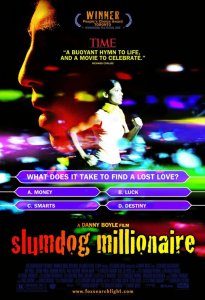 If there is one independent movie that seems to be picking up momentum this awards season, it’s Slumdog Millionaire. The film seems destined to break out into the mainstream, especially in a time where audiences could use a happy story given the ongoing news of economic downturns. Slumdog Millionaire is a highly spirited rags-to-riches tale that marries Hollywood and Bollywood into one fantastic product.
Jamal (Dev Patel) is an 18-year-old kid who grew up impoverished in India’s favellas. He’s also on the verge of winning 20 million rupees on the Indian version of the Who Wants to Be a Millionaire? Game show. The TV host reminds Jamal that lawyers and doctors have never gotten as far as he, a lowly “slumdog” from such humble origins. As each question emerges we discover more about Jamal’s life, from escaping a riot, touring India as a stowaway on a train, conning American tourists at the Taj Mahal, to his assistant work at a call center. Throughout Jamal’s life are two constants: Salim (Madhur Mittal) and Latika (Frieda Pinto). Salim is Jamal’s scheming older brother who has a loose sense of morals. He finds a life of crime as a suitable escape from poverty. Latika is a young orphan girl that Jamal befriended as a child. He declared that she was the “third Musketeer” in their group and has always sworn to love her. This is complicated because Salim’s crime boss wants Latika for a prize, and Salim keeps his younger brother away from Latika. Ultimately, as an entire nation watches with baited breath, Jamal explains that he is appearing on TV because he knew that Latika, his love, would be watching somewhere.
 It’s like City of God and Forrest Gump had a baby that was raised by Oliver Twist. The film is given a dynamic energy thanks to director Danny Boyle’s exuberant camerawork and skillful style. Boyle is a director that knows how to make images jump and Slumdog feels like it is coursing with life. The feel-good fantasy nature of the rags-to-riches plot is offset by some pretty harrowing violence, and Boyle makes great pains to show the realities of living in squalor. At one point a very Fagin-esque local crime lord collects young orphans to be beggars and he has a foolproof scenario to make these kids sympathetic and thus big earners — he blinds them with hot liquid. Despite the fantastical elements, Slumdog is rated R for a reason and that’s because it does show the cruel reality of a life in the slums, granted it’s nowhere near as bleak and formidable as something like City of God. After all, the kid gets to win on a game show, though the movie does open with Jamal being tortured by the police. Boyle has a tremendously natural eye for crafting visuals that delight the senses; he can make his shot compositions feel interesting without ever truly calling attention to being flashy. The views of India are beautiful and fascinating. Plus, having a majority of the movie in a foreign dialect was appreciated (Boyle provides different color background for different character’s subtitles, a nice touch). There’s a magic feeling to the film that definitely takes hold of the audience, an uplift that channels smiles and gasps of joy. While I’ll still credit Millions as Boyle’s best film since Trainspotting, his work on Slumdog is deserving of praise. I don’t know if another director could have made a film with so many contradictory elements (feel-good flick with child prostitutes?) run so smoothly.
The movie is also given a brilliant story structure by screenwriter Simon Beaufoy (The Full Monty). The movie is built around a steady stream of flashbacks linked to the questions Jamal tackles on the game show. So the host will pose a question and then we’ll be treated to a 10-15-minute flashback to Jamal’s life to discover how he knows the answer. The approach is fresh and it reinforces the magical notion that Jamal’s life has all been leading up to this moment of glory. Beaufoy’s script smartly weaves many storylines together to give us an emerging sense of who Jamal truly is. He manages to write an uplifting and hopeful tale that stays clear from easy sentiment. Indeed, Slumdog is an accomplished feat of writing as well as direction. Working from the Indian novel Q&A, Beaufoy has written a modern-day fairy tale in the same fashion as the Brothers Grimm, which means he didn’t skimp on the unpleasantness and hardship. Yet Slumdog is able to find great human spirit amidst the squalor. I doubt I’ll see a climax more rousing and crowd-pleasing all year. Seriously, you’d have to have a pretty hard heart not to feel some excitement and jubilation in the closing moments.
 This unlikely fantasy is aided by sharp performances by a collection of actors. Jamal is an unassuming yet plucky underdog, and Patel nicely handles these elements. He’s a stringy kid but he carries himself with charm and fortitude. As he grows confident he spars with the combative TV host, and it’s fun to watch. Pinto is a swell looking beauty with a great smile but I wish the story had given her more to do as an actress. The young actors who play Jamal, Salim, and Latika as young children actually give the best performances.
And now after all my effusive talk comes the time where I must voice my minor reservations. First off, the structure is ingenious but having Jamal interrogated by the police after the fact seems unnecessary, plus it also tips off the audience from the beginning that this kid has already won it all, which sucks some of the tension out of the game show format. I really think the movie would have been better served just playing out the game show in real time instead. Also, it’s a bit too convenient that every one of the quiz questions triggers a memory in a linear fashion. Jamal can tell his life’s story from beginning to end, but the movie would have been more challenging and interesting if the quiz questions forced Jamal to bounce around in his own memory. That way the script would provide more mysteries that could lead to even more satisfying answers. The Millionaire game show also goes on a commercial break and Jamal is astoundingly allowed to leave and go to the bathroom after he knows one of the high-money questions. In the age of wireless Internet, no game show would ever allow the contestant to leave its sight. Finally, the movie is presented like a Dickensian fable told in chunks, which means I found it hard to fully embrace the central romance that drives Jamal. I will readily follow the romantic notion of locating your true love, however, I will feel more involved in that search if the combined time Jamal and Latika spent together was longer then like a week. Seriously, they see each other every few years for a moment and then are broken apart, only to find each other again for a few moments to be broken apart. She’s more a symbol than a fully translated character, though this did not stop me from rooting for a happy ending.
 Slumdog Millionaire is a thrilling, funny, and triumphant story that courses with lively electricity, thanks to the deft direction of Danny Boyle. This movie is enormously entertaining while still baring a social conscious about the plight of those impoverished, though I hope people don’t get the mistaken idea that all that character-building impoverished life styles will lead to future fortunes like Jamal. The movie is hopeful and uplifting while also balancing tense violence and improbable circumstances. While I’m not on board with the critics calling this the best film of 2008, it has some minor flaws in approach to storytelling and character, Slumdog Millionaire has all the right markings to be a crowd-pleasing sensation. After all, it is destiny. And that’s my final answer.
Nate’s Grade: A-
Share this:

Bigger, Stronger, Faster* (2008)
 Chris Bell came from a roughly normal family in Poughkeepsie, New York. He and his brothers were a little chubby but saw weight lifting as their ticket to success. In the 1980s, Bell and his brothers idolized muscle-bound heroes like Arnold Schwarzenegger, Hulk Hogan, and Sylvester Stallone. Muscles were the answer for the Bells. Chris Bell became a teenage weightlifting sensation and moved out to California to follow his dreams at Gold’s Gym, just like Arnold. Bell’s older brother, Mike “Mad Dog” Bell, actually had a career as a professional wrestler on the national televised stage, though he was always the one getting beat up. Bell’s younger brother, Mark “Smelly” Bell, could lift hundreds of pounds. Both Mad Dog and Smelly have been using steroids for years. Chris Bell decided to make a documentary that examines both his family’s interest in steroids and the culture that bigger is better. Bigger Stronger, Faster* *The Side Effects of Being an American is that final product, and it radiates with sadness and anger.
Don’t let the subject matter fool you. This is less an expose over steroids then it is a penetrating and somewhat sobering look into the intensely competitive culture in America to “be the best” and shuttle the rest. Bell uses a clip of Patton addressing his recruits, saying, “Americans love a winner and will not tolerate a loser.” Bell interviews a wide variety of subjects, from doctors on both sides of the issue, and when he gets to sports fans the general line of thinking is that steroids are awful, unless, that is, they can help my team. If the dominant culture is pushing athletes to be the best that they can be, or else, then is it any wonder that taking steroids would seem customary? Should we as a nation chastise athletes that we, as a nation, pressured into juicing up to attain the glory we expect, nay, demand from our competitors? It seems like the same folks that are shaking their fists and bemoaning the impure state of athletics are shirking their own responsibility for contributing to the toxic mindset to win at all costs. In many ways, bodybuilding and muscle-bound athletes can fall prey to the same distorted mentality as those suffering under anorexia and bulimia. Both groups have significantly dissatisfied body images, one wants to continue getting smaller and the other wants to continue getting larger. Bell interviews Gregg Valentino, who has biceps that looks like five-pound sacks full of ten pounds of potatoes. He says the ladies are repulsed but the men come up to him in awe. Mad Dog says that he knows he was “destined for better things” and cannot find any sliver of satisfaction in living a normal life. His brother points out that Mad Dog has a good job, a loving family, and a wife who goes along with all of the emotional turmoil but still supports her man. Can’t he be happy with just being who he is?
 When the film shies away from Bell’s personal connection to the topic, the movie isn’t as compelling, though it is rather informative. Steroids have been painted as a scourge; however, the scientific evidence doesn’t bare this out. In the end, anabolic steroids are a supplement and have risks just like any other supplement or drug on the market. Bell has plenty of data to argue that legal drugs, like tobacco and alcohol, kill tens of thousands more a year than steroids (I think the doc informs that the yearly deaths attributed to steroids is around 3). The reason our society is so misinformed about steroids is because of heightened media hysteria and the likes of overly anxious lawmakers. Bell speaks with clear disdain when he reports that in 2004 Congress spent eight days covering the topic of steroids and grilling baseball stars; that eight days was longer than Congress spent deliberating the Iraq War, the response to Hurricane Katrina, and over health care. When Congress covered the steroid topic in the 1980s they interviewed heads of national public health offices, and those wise experts stated that the health risks from steroids had been exaggerated. So Congress just ignored their testimony. I get it, steroids serve as a boogeyman because few actually know what it does or, frankly, what is actually is. There are many different kinds of steroids, some of which are used all the time with societal approval, like cortisone shots intent to aid inflammation. Where people seem to have issues is over anabolic steroids, which is an extra boost of testosterone. Bell points out that the side effects of steroids are almost always completely reversible after the user stops taking the drug. How many other drugs, legal and illegal, can make a similar claim?
A very interesting side step the film takes is over the issue of legal dietary supplements. The dietary supplement industry does not require FDA approval to sell products. This means that the FDA must prove that a product is unsafe to take it off the shelf, rather than the more traditional approach where the drug company must prove that their drug is safe before selling it to the masses. It should also be no wonder then that the supplements that people buy in giant bottles at health food megastores are likely not much more than placebos, if you’re lucky (one supplement package advertised its “new legal formula”). Bell hires a few illegal immigrants and concocts his own dietary supplement with rice powder. He bottles it, labels it as “The Juice,” and can sell it for a gigantic profit margin, and it’s all legal.
Is performance-enhancement just apart of being an American and living out the American dream? Tiger Woods got laser eye surgery and can now see better than 20/20, so is that an acceptable performance enhancer? What about the United State’s fighter pilots who regularly are prescribed “go pills” to boost their energy levels? It’s suitably alarming to discover that the United States is the only country to make it mandatory for its fighter pilots to take amphetamines. Of course not everything Bell touches upon as performance-enhancing drugs measures up credibly, like when he mentions beta-blockers for people with performance anxiety. I don’t think tamping down anxiety is akin to enhancing performance since it merely allows the performer to perform with what they already have. Bell’s documentary has loads more questions than answers, but the best part of the film is that it doesn’t hide from contradictions but instead magnifies them and asks for an ongoing debate.
 Bell’s film is wide-ranging, lucid, and unexpectedly funny, but the most compelling moments occur when Bell looks at his own family history. Both of his brothers will likely be life-long steroid users because they feel that it doesn’t give them an edge but evens the playing field. Mike’s little brother, Smelly, is not content to go from lifting 700 pounds to 600 pounds. Neither brother has the courage to open up to loved ones about the steroid use. Smelly teaches teen boys and they idolize him, quoting his encouraging assertions that the kids don’t need drugs to go places. The hypocrisy is sad and I wonder what Smelly’s kids will think once they catch the documentary. Bell’s mother is brought to tears trying to determine where she feels she went wrong as a parent. Two of her boys are rampant steroid users and have equated muscles with self-importance, but it’s the admission that Bell himself once tried steroids that shatters her. When Bell also enlightens his mother that her own brother was the source of steroids then she just shuts down. She pleads with her son to stop because she can only take too much. Bell was brought up to believe that cheating is wrong and inherently un-American, and yet the system is practically rigged to reward cheaters. Carl Lewis and other 1988 U.S. Olympians actually tested positive for banned supplements but were given a pass, as the Olympic Committee blamed the results on “inadvertent use.”
Bigger, Stronger, Faster is a clear-headed and entertaining movie that challenges the audience to reconsider its feelings over steroids. The film is informative and presents counter arguments and thankfully plays out multiple sides to controversial and complicated issues. By the end of the film, Bell isn’t necessarily pro-‘roids but asking that we better scrutinize the culture that pushes for greatness at any cost. Human beings willingly destroy their bodies out of a desire to simply forever be better. When perfection is adopted as the norm then it’s no wonder that millions of Americans will never be remotely satisfied with whom they are. Bell encounters a 50-year-old body builder at the gym he works at. This man is packed with muscle but he says he’s forever “in training” and still waiting for his big break, whatever that may be. He currently lives in his car, but he justifies his plight by saying that if he can out-lift and out-bench others then he’s the winner. This man could not be a more perfect symbol of the price of winning at all costs. The asterisk in the film’s title is what truly tells all.
Nate’s Grade: B+
Share this:

Religulous (2008)
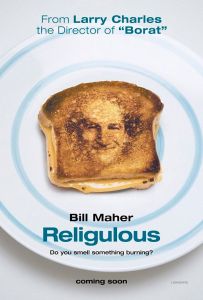 There is no topic in the world more volatile than religion. It dominates cultures, reshapes geography, inspires people to work with the poor, inspires people to attach bombs to their chest, and is as old as time itself. Most civilizations constructed a religion after they grew to a certain size. So who in the world would want to make a sacrilegious opinion-piece documentary that wants to open eyes as well as have a good laugh? Bill Maher is a comedian that respectfully never holds back his true feelings. He’s unflinching in his social commentary on his HBO TV talk show, and religion has often been a thorn in Maher’s side. He personally views it as a mental disorder. Religulous is his eviscerating and intriguing expose as he travels the holiest sites in the globe and asks, “Why?”
For the most part, Religulous doesn’t take a hammer to religion as it does the fundamentalist followers. There are several subjects that cry out for ridicule, like pastors living large and very un-Christ-like on the coffers of their congregations, egomaniacal televangelists that squeeze pennies out of lonely widows, those that babble in tongues, Joseph Smith, Scientologists, and people that celebrate scientific ignorance. Maher is attacking the hypocrisy of fundamentalism, but his condemnation isn’t only reserved for Christianity. He is an equal opportunity offender. In the most surprising venture, Maher takes a trip to the Holy Land and chats with Islamic practitioners about the double standard of its more ardent followers. I suppose repeatedly yelling “Death to Israel” is copacetic but an editorial cartoon that tweaks the religion over its extremist tendencies toward violence is an insult that cannot stand as freedom of speech? Maher really delves into un-PC territory and wants to know why he sees Islamic followers being so overly sensitive to criticism. I think given the fact that like 50 people died as a result of protests over cartoons, there may be room for discussion here. I credit Maher for not ducking away from provocative questions no matter the setting (he even got into the Dome of the Rock mosque!)
 Maher and director Larry Charles follow the same documentary techniques Charles honed as he directed 2006’s Borat movie – a small shambling camera crew that ambushes rubes with tough questions and watches them sputter and squirm. This technique can be amusing when we feel that the harsh inquisition is deserved. Your regular Joe who believes that Jesus is his co-pilot is not deserving of Maher’s smug stares. There’s a moment where he asks a nice guy if he believes that he will reach heaven upon death. He believes he will. “Then why don’t you kill yourself?” Maher asks coldly. It’s uncalled for, and I say all this as a genuine fan of Maher. Still, the movie is regularly funny as it deconstructs religious traditions with quick-cuts to old Hollywood religious epics as cinematic rimshots. One of the better and more convincing moments is when the film compares the theological coincidences between the Egyptian god Horus and Jesus Christ, all set to the Bangles instructional song “Walk Like an Egyptian.”
I personally don’t believe that having faith in the unseen/unknown or being religious equals being stupid. Quite the contrary. However, it’s easy to gather a specious view of religion when all you talk to are ignorant yokels. Maher has perhaps one or two sit-down interviews with people educated in theology, but mostly he sticks to interview subjects that he can mock or those that share his opinion (his extended interview with the leader of Amsterdam’s pot-fueled “cantheism” is irritating). I think Maher is doing a disservice to his film’s target by not discussing theology with learned scholars, with people that can articulate lucid and complete thoughts, with people that have all their teeth. Did he seriously think he was going to able to find a defense for Biblical contradictions at the Holy Land amusement park or at the trucker church? I strongly doubt it. In many ways Religulous strictly sticks to the sideshow of Christianity, peering at the fringe elements. I’m all for grilling fundamentalists that cannot square science and God, but if Maher wants to expose all religious followers as wrong-headed, and not just the ones that think Jesus rode a dinosaur, then he needs to tackle more substantial figures in the field.
 But then Maher fumbles his conclusion and loses me. It is in the closing five minutes that Maher attempts to string together his thesis statement, saying that in order for man to live that “religion must die.” Up until this point Maher has been irascible but committed to his ongoing ideology of “I don’t know.” He professes not to know what will occur after death and wants to press other people into a spirited discussion of the spiritual. But then comes the finish and Maher speaks with the same certainty that he castigated fundamentalists earlier. He is no longer preaching discussion but preaching immediate action to thwart belief. Maher becomes very agitated, his tone gets very sharp, and he steps on the soapbox to once and for all attest that religion of all shapes and measures is rubbish. It’s in these concluding moments that Maher sidesteps from his message of doubt and speaks in aggressive and alarmist hysterics. Maher spent most of [i]Religulous[/i]’ running time attacking hypocrisy but now he demonstrates his own.
I feel that Maher has many good points to make. Religion becomes extremely detrimental when it morphs into nationalism. The Founding Fathers did not envision the United States as a “Christian nation” and were mostly deists with little regard for traditional worship. Questioning and doubt are actually signs of a healthy relationship with faith, because it means that person is active with their faith. Maher showcases the well-known historical grievances caused by religion, or more accurately the followers of religion, but he brushes past the good of religion. It can be a unifying force that calls for people to love thy neighbor as thyself and to turn the other cheek (it’s amazing that the fire and brimstone Bible thumpers forget about the Be-attitudes). Religulous is an entertaining skewer of fundamentalism and close-mindedness, which is why it falls apart when it too turns close-minded.
Nate’s Grade: B-
Share this:

Grace is Gone (2008)
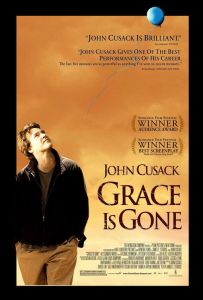 This Iraq War drama means well but it comes across as manipulative and morally questionable. John Cusack stars as a former military man who just found out his wife, on active duty in Iraq, has been killed. The bulk of the film’s conflict deals with how Cusack will tell his two daughters that mommy is not coming home again. Instead of being upfront with his children, he takes them out of school and whisks them away on a family trip to an amusement park. His reasoning is that he wants to squeeze in a few more happy memories before the kids hear the news. To me, this is irresponsible and psychologically damaging; those kids will resent their father holding onto such important information while he encouraged his kids to shop in ignorance. The film is about 80 minutes of watching a guillotine hang over someone’s head, just waiting for the moment to hit. It can get rather uncomfortable. Somewhere in this misguided drama is a poignant look at the domestic cost of the Iraq War from the family’s perspective, a perspective yet to be fully articulated by the movies. Instead, Grace is Gone is a well-acted but contrived drama that favors delaying the pains of reality to the point of incredulity.
Nate’s Grade: C+
Share this:

The Duchess (2008)
 I think I understand the real appeal of costume dramas. No matter what else happens, the costume drama must seem smarter. You have actors, primarily British, waltzing in elaborate costuming in realistic historical settings, each offering demure statements and looking for love and acceptance in a time of chaste expression. You could place Saw 18 in that setting and it would automatically seem smarter. I think the ye olde setting for costume dramas automatically gives these films more plot leeway, but not every film actually proves that it should have earned that leeway. Saul Dibb’s handsomely mounted period drama The Duchess offers little beyond the superficial enjoyment of well-crafted costumes.
In 1770s England, young Georgina (Keira Knightley) has been betrothed to the older Duke of Devonshire (Ralph Fiennes). The newly minted 17-year-old Duchess of Devonshire is whisked away to live in a giant manor. The Duke is rather cold and seems uneasy with human interaction; he shows the most affection for his dogs. He expects Georgina to primarily bear him a son. Several daughters later, the Duke is engaged in affairs and siring illegitimate children. Georgina has become a star of the social sphere, and it is here that she befriends Bess Foster (Hayley Atwell), a woman who is trying to regain her children from her ex-husband. Things get even more complicated when the Duke takes a liking of Bess, and the two become an unofficial union. Georgina has had her only friend taken away and turned into a co-wife. The only solace for the Duchess is in her flirtatious relationship with a politician, Charles Grey (Dominic Cooper). Georgina feels like a prisoner in her own home and yet she cannot desert her children. What’s an oppressed woman to do in 18th century England? That answer should be sadly obvious.
 The Duchess breaks no new ground and, in fact, treads water for the majority of its second half. Georgina was an independent spirit in a time that frowned upon breaking from conformity and tradition. As a woman, she was the victim of a double standard that allowed her husband to sleep with whomever he desired but she could not find physical comfort outside her loveless marriage. Marriage was widely viewed as a means to an end for male progeny, not the culmination of romantic love. Women were pressured into delivering male heirs, despite the fact that men are the ones who determine gender. Typically marriages were family arrangements for class and land ownership, so true passion was procured through marital affairs. I get it because I’ve read Jane Austen novels and seen dozens of period movies that have made the same stilted points. The Duchess presents Georgina as a feminist before her time and then a patriarchal society crushes her spirit. During the second half, when aristocratic life keeps producing heavy obstacles for Georgina, the movie just piles it on. I was left questioning what the point of all this corseted drama actually was.
After a while with my downtime I determined whom this movie is really for – hat enthusiasts. This is a Big Hat movie that puts other hat movies to shame. There are gigantic floppy hats, hats that look like fruit displays, hats that look like eighteen-layer cakes, hats that look like they have their own hat, hats with feathers zigging and zagging in every direction, and hats that look like they are consuming their host’s heads. If you work in the haberdashery industry or have an above average interest in hats and hat-related products, then run, don’t walk to The Duchess. You will be enraptured by the orgy of towering hats that jostle for screen time. Rarely are women seen without hats, so you truly will get your hat money’s worth over the course of the film’s two hours. If there were a specific Oscar category for Hat and Hat-like Accoutrement then The Duchess would dominate. I expect it will get nominated for Costumes, and really that seems like half the point in making these powdered wig period dramas.
I think the other point of The Duchess is to channel the modern story of Princess Diana, who is actually a distant relative of Georgina. The two seem to lead somewhat similar lives since they both married young, both had their husbands prefer the mistresses, both were fashion trend setters, both were beloved by the public, and after death both had their husbands remarry the mistresses. The tagline for the film is, “There were three people in her marriage,” a paraphrased quote that Princess Di said in an interview. The Di parallels seem to be all that the filmmakers intended to do with Georgina as a character; she is the least interesting person in her marriage. The Duke and Bess are far more complex and intriguing figures. I’m sure the Georgina biography that serves as the movie’s source is rich in Georgina characterization and personal detail, but all the movie cares about is establishing her as a marital martyr. There is more to this character but she just endures disappointment and punishment; I cannot fully engage with a character when their only personal attribute is suffering. The movie fails to present any notable reason why this woman of history deserves having a feature film.
 Knightley seems to spend half her film life in corsets. I’m still undecided upon whether she possesses innate acting ability; to me she too often comes across as a pin-up with great cheekbones. That said her eyebrows do a great bit of acting in The Duchess. She has the habit of cocking one ever so slightly and imbuing a scene with a hint of sexual allure or mystique. They’re pretty thick eyebrows too. Knightley does acquit herself well with the material and I doubt this will be the last time I see her in a tremendous silk gown and a humongous hairdo. The most interesting actor is Fiennes because his character is so reserved and awkward in his own skin, so much must be said through the use of gestures, body language, and the perfect execution of line delivery. His character seems just as ill in his setting as Georgina. Atwell is given the most complex character to play. To say that Bess has conflicted loyalties is an understatement. She betrays Georgina but romancing the Duke can ensure that she sees her children once again. Bess should have been the centerpiece of the movie because, as presented, she is far more interesting with more dramatic conflicts and turmoil other than being wronged.
The Duchess is no more and no less than every other costumer period piece you’ve seen before. It starts well but then falls into boring and repetitious plotting (Georgina wants something, she’s denied, she wants something, she’s denied; rather, rinse, repeat, end). The Duchess will delight those in search of yet another unrequited period romance, but I feel that moviegoers should expect more from their entertainment that mechanically fulfilling the period-y checklist. The technical merits like the production art and the costumes, especially the hats, are first rate. There’s little feeling beneath all the fabulous fussing about. It’s too bad the actual drama couldn’t at least be as interesting as the hats.
Nate’s Grade: C+
Share this:

The Wackness (2008)
 Every Sundance Film Festival seems to coronate new talent and new films that never seem to materialize once they step outside of the happy bubble of festival life. It happened with Happy, Texas, with Tadpole, with Hav Plenty, with Primer and numerous others that never managed to get started with the public. At the 2008 Sundance film festival, the biggest buzz followed the documentary American Teen and The Wackness. Writer/director Jonathan Levine’s coming-of-age tale won the Audience Award for Drama and boasts shimmering visuals, formidable actors, and a hip soundtrack. Too bad the drama gets the least attention in that package. I suspect The Wackness will be yet another Sundance buzz flick that, while well made, fails to leave a mark on mainstream crowds (here’s hoping more for American Teen).
Luke (Josh Peck) has just graduated from a New York City high school and is winding down the summer before he moves on to college. He has a unique summer job: Luke sells marijuana out of an ice cream vendor’s box. One of his clients, Dr. Squires (Ben Kingsley), is a therapist. He trades therapy time to Luke for pot. The two of them form an unanticipated bond and Dr. Squires makes it a point to see that Luke is making the most of his youth. Luke is smitten with the doc’s stepdaughter, Steph (Juno‘s Olivia Thirby, gratifyingly authentic), and determined to lose his virginity and find love before the summer fades away.
 The strength of The Wackness is in the unexpected father/son relationship that forms between Luke and Dr. Squires. Kingsley is sensational in his role and provides all the pathos and unexpected discoveries that the coming-of-age genre is associated with. I think that’s what’s most interesting about Levine’s film, is that Kingsley is going through all the coming-of-age moments reserved for teenage protagonists. Dr. Squires and Luke form a surprising and deep relationship where they learn from each other. Luke learns to talk about his life’s sadness and make it a part of his life, instead of sweeping it under a proverbial rug. Dr. Squires learns to re-embrace life and to kick his heavy supply of pharmaceutical prescriptions. He is coming of age at middle age. He even gets to second base with an Olsen twin (Mary-Kate is only in the film for two scenes and an estimated five minutes). Most of all, Dr. Squires needs a friend and Luke fulfills this desperate void. Kingsley is funny, pathetic, and the real star of The Wackness.
My main problem with The Wackness is how familiar it all comes across. It follows the coming-of-age model down to the end, so a savvy audience is going to realize that Luke will fall in love, get his heart broken, stand up for himself, and gather a bit more wisdom by the time the end credits roll. You’ve seen this movie played in a thousand different ways before, and now The Wackness makes it 1001; you will essentially know every beat of this story before it happens. The film doesn’t break any new ground and doesn’t manage to provide much commentary or lasting insight while it comes of age. The screenwriting fails to hide what disinterests Levine. So we get quick glimpses of Luke’s home life and I swear in every one of them his parents are just yelling. That’s all Levine is interested in, setting up one ten second shot of Luke overhearing his parents shouting again and again. Dr. Squires’ wife (Famke Jannsen) gets the same kind of treatment. She gets a cursory amount of screen time to glower and that’s about it. I can tell Levine is only interested in his three main characters (Luke, Dr. Squires, Steph) but then why does he not concentrate on them further and scuttle what he feels is wasted time?
The Wackness is awash in pointless nostalgia. The movie is set during the summer of 1994 for no real reason. The time setting doesn’t impact the film in any manner except for some digs at Mayor Giuliani’s policies (he was only in office for sixth months or so when the film opens). Levine dishes out pop-culture references like the 8-bit Nintendo game system, old chunky GameBoys, Kurt Cobain’s suicide, mix tapes, and lots of rap music. The Wackness is an ode to mid 90s rap music and Luke is a lover of acts like A Tribe Called Quest, De La Soul, and some up-and-coming guy named The Notorious B.I.G. The soundtrack is also meant to convey good nostalgic vibes of a simpler time only — 14 years ago. Setting the film in 1994 is a lazy attempt to cover the lapses in screenwriting with cozy audience nostalgia. And is there anything really culturally transcendent about the summer of 1994?
 Peck may have lost like 100 pounds since he was fat comic relief on a Nickelodeon kids show, and he’s marginally handsome, but this kid needs some more practice before he’s a dramatic actor. I understand that his character gets stoned often and, as a typical teenager, is trying to pull off a too-cool-for-the-world-“whatever” attitude, but he seems freaking catatonic. He’s too aloof for his own good. His acting is dry and monotone and he feels like he’s constantly zoning out. Again, I understand that this works with his stoned persona but Peck is hardly ever convincing in the part and his acting shortcomings rob the role of a greater level of sympathy. A great actor can make you like a character that eats babies and kicks puppies, or the other way around, but Peck is not that actor. I believe that part of The Wackness‘ failure to connect and elevate beyond its genre trappings is due to Peck’s poor performance. He’s just kind of boring character and, to borrow a term from our pals on the other side of the pond, a bit of a wanker.
As a director, Levine has a playful and visually appealing look for the film, bathing it in arid tones to echo the hot summer days. The cinematography is a character all its own, giving the film a colorful and lively flair that makes every scene worth watching even if the script fails to do likewise. Levine has a handful of clever visual tricks up his sleeve, like a middle finger that moves through a crowd of New Yorkers at rapid speed before finding and dialing a pay phone. Levine has definite talent as a director and it shouldn’t be long before Hollywood comes knocking and plucks him away to make The Fast and the Furious 8: The Search for Curly’s Gold.
The Wackness feels like a coming-of-age film that goes through the motions. The main character is stoned to the point of comatose and he’s a rather boring protagonist, made even duller by Peck’s lackluster acting ability. Writer/director Levine flexes enough visual artistry to make him a talent to watch, however, his screenplay is too familiar with little personality or flavor to stand out against the pack. The movie looks good, it sounds good, and Kingsley is certainly good, it’s just a shame that it isn’t his movie. Steph tells the mopey Luke that all she sees is the goodness life has to offer and all he sees is “the wackness” (you can go home happy to understand the title). I guess I similarly be accused of focusing on the “wackness” of The Wackness because it’s certainly not a bad movie. It just happens to be ordinary. Though it does have some torrid Kingsley-on-Olsen Twin action. I suppose that isn’t too wack.
Nate’s Grade: C+
Share this:

Son of Rambow (2008)
 The film takes a few notes from 2005’s Millions and presents an amateurish tale of English schoolboys making their own amateurish sequel to a Rambo film. From a visual standpoint the film looks great, it has a slightly offbeat appeal, but there just isn’t any substance here beyond the imaginative visuals. The friendship between the two boys, one a bully and the other a lonely kid apart of a strict religious sect, doesn’t draw much out of the characters or the actors. The kooky stunts and homemade moviemaking made me smile and gives the film a fun, quirky energy. But then Son of Rambow seems to butt heads when it enters more serious dramatic territory like family loss and betrayal. The tone is uneven and the mixture of slapstick and whimsy and real pain and suffering never fully works. Certain subplots like a cool French foreign exchange student (who may not be so cool after all) feel grafted onto a story that needs direction and depth. They feel like distractions. Writer/director Garth Jennings (The Hitchhiker’s Guide to the Galaxy) tries to imbue the project with a childlike spirit but the story needs a whole lot more emotional focus and a whole lot more work. This ain’t no Millions.
Nate’s Grade: C+
Share this:

The Darjeeling Limited (2007)
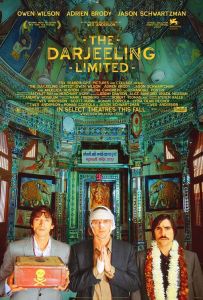 I’m starting to think Wes Anderson may become his own worst enemy. The man seems trapped in his precious, idiosyncratic style that revolves around intricate, dollhouse-style production design, slow-motion and simple pan shots, clever-to-smug characters, family dysfunction that coalesces somewhat by the end, and a soundtrack full of hip, retro songs. I like Wes Anderson; I loved his first three films, was rather lukewarm on 2004’s Life Aquatic, but The Darjeeling Limited is pretty much a bland rehash of the same. Instead of a father reconnecting with his long-forgotten son it’s three brothers reconnecting in the wake of their father’s death and mother’s abandonment. The humor is fairly subdued and while the movie is brief it seems to run out of gas early on and get repetitive. I think Anderson is more interested in showing off his highly elaborate production design than crafting interesting things for his characters to do inside those complex sets. I didn’t feel a blip of emotion for any of the character, all of who have some lasting fear of women ever since their mother ran out to become a nun. There’s kind of an unsettling misogynistic vibe in the movie against women, which is an unfortunate surprise. There’s a spiritual quest that some may relate to but I found it superficial at best, intended to gloss over the plot holes and character miscues. I wish Anderson well, but his next venture behind the camera might work better if he threw out his fraying filmmaker playbook.
Nate’s Grade: C+
Share this:

A Mighty Heart (2007)
 Good intentions and some proficient camerawork can only go so far to make a film worthwhile. Angelina Jolie gives the best performance of her career as kidnapped Wall Street Journal reporter Daniel Pearl’s wife (she’s French and Cuban, making for one really tricky accent). I wanted to like this movie more. The subject matter is serious and timely, the filmmaking has a sturdy docu-drama look, and the acting never comes across as phony, but alas, I think I mentally checked out because much of the film is a detective story that I already know the ending to. Daniel Pearl was infamously beheaded, so watching an hour of his wife, friends, and local police scramble to track down key figures, their allegiances and acquaintances, and the whereabouts of Daniels can come across as fruitless and somewhat cruel. This film doesn’t have the same cathartic feel that United 93 had because that moment was universal, and while I can admire the cinematography and superb acting I can’t ignore the fact that watching people search and fail gives me little emotional reward as a viewer.
Nate’s Grade: B


 nathanzoebl
You must be logged in to post a comment.