Blog Archives
The Room (2003)

I consider myself to be a connoisseur of crappy cinema, thanks in large part to growing up on the fabulous TV series Mystery Science Theater 3000. To me, truly bad movies can be just as enjoyable to witness as great, competent works of filmic art. So imagine my surprise when it I had never heard of a little flick called The Room until a month ago. I was reading an Entertainment Weekly article about this tiny 2003 movie that has developed a rabid cult following. I felt betrayed. How did I go five years without ever hearing about this movie? The Room is writer/director/star Tommy Wiseau’s magnum opus. It must be seen to be fully believed.
To watch The Room is truly a life-altering experience. This movie goes beyond bad. It’s so bad that it almost seems like Wiseau is a mad genius. This movie is bad on multiple levels and hooks you from the beginning, instantly daring the audience to stick around to see if it gets worse. And it does in the most wonderful ways. If I was stranded on a deserted island and could only bring five movies, right now The Room would be one of them (I may even be tempted to just bring five copies of this movie). Wiseau’s film cannot displace Manos: The Hands of Fate as the worst film of all time, but The Room easily belongs in the upper echelon of craptacular cinema among the likes of The Land of Faraway and Lady Terminator and Bulletproof Monk. I am simultaneously appalled, bewildered, fascinated, delighted, and comforted by this movie, comforted by the fact that something this singularly inept could still sneak through the system. But this film is so perfectly inept on a multitude of levels that it feels like it could never be recreated again, like the human race benefited from this chance artistic encounter. The only way I can fully describe my unhealthy appreciation for this cinematic slice of the absurd is to simply list off my list of loves.
 1) The film’s plot involves a love triangle with the three least personable people imaginable. Johnny (Wiseau) is a broad shouldered, marble-mouth Austrian who supposedly works at a bank, we’re told. Lisa (Juliette Danielle) stays in their apartment doing very little, though she says that she shouldn’t have gotten into the computer business because it’s “too competitive.” Lisa declares in damn near every scene that after five years together (though the characters say seven at the end of the film) she no longer loves Johnny. She now loves Mark (Greg Sestero), Johnny’s best friend. And if you forget that key point then Mark will assist you because one third of his dialogue is declarations of “Johnny’s my best friend.” Another third of his dialogue might as well be, “What are you doing?” Mark is one of the thickest dolts in history. Even after Lisa has sex with him twice, calls him repeatedly, and leads him to places where they can be alone and intimate, he looks at her dumbfounded and says, “What are you doing?” like a kid who will never comprehend that 2 + 2 = 4. This is the basis of the plot and yet so much of the movie is gloriously repetitive and involves characters sitting around, saying the same things over, without ever really advancing the plot.
2) The Room hooks you from the start, and it’s all thanks to the weird neighbor kid/surrogate son Denny (Philip Haldiman). This supposed student is an orphan that Johnny has taken a shine to; Denny has his rent and tuition generously paid for by Johnny. In the very opening scene Johnny gives Lisa a slinky red dress as a gift. She tries it on and both Denny and Johnny make favorable remarks. Johnny says he’s a bit tired and leads Lisa by the hand up the stairs. The camera stays on Denny, who, instead of taking the hint and leaving, remains standing, grabs an apple, takes a bite out of it, then slowly walks up the stairs after the amorous couple. He then hops on their bed and joins in on their pillow fight foreplay. The characters have to literally spell it out to the guy that they want some privacy for sex. “I know, I just like to watch you guys,” Denny responds. What? Denny confesses to Johnny about experiencing weird feelings for Lisa. This kid is supposed to be in college but he acts like he’s developmentally challenged. A friend has a theory that Denny has a confusing gay crush on Johnny, but I believe that would be way more deep and subtle than the movie seems capable of.
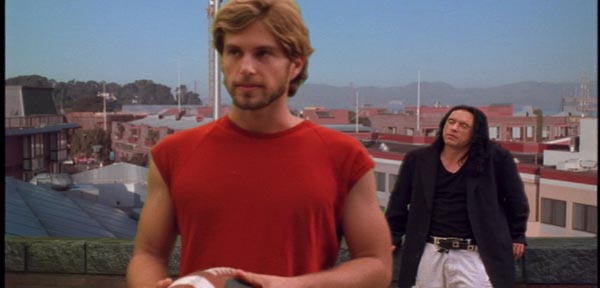 3) The movie is littered with subplots that come out of nowhere and never resurface again. All of a sudden Lisa’s materialistic mother (Carolyn Minnott) announces she has breast cancer. This is never commented upon again. All of a sudden Denny is confronted by an angry drug dealer who wants his money, which means he’s also the world’s worst drug dealer if he’s willing to give out drugs on credit. The characters all collect on the roof and yell. This is never commented upon again. Lisa makes up a story that Johnny hit her. He publicly denies it. This is never dealt with again in any capacity. Lisa lies to Johnny that she’s pregnant, just to “make things interesting.” Her rationale is that they’ll eventually start trying to have a baby anyway, which conflicts with her frequent statements that she doesn’t love Johnny and wants to leave. This fake baby is never commented upon again. About thirty minutes into the movie, another couple sneaks into Johnny’s apartment to have sex. Why I cannot fathom. When Lisa and her mother intrude upon this scene, the mother asks astutely, “Who are these characters?” Exactly madam. The movie keeps going over the same material because nothing new ever sticks.
4) The line readings are astoundingly inauthentic. Half of the film seems to be dubbed, especially Johnny’s lines. Much of the dubbed dialogue fails to match up with the actor’s mouth movements. There is one sequence in a flower shop that is nothing but dubbed dialogue and it happens so quick. The scene itself lasts like 10 seconds but it still manages to squeeze in this entire conversation: “Oh hey Johnny, I didn’t see you there.” “Yep, it’s me.” “Here are the flowers you wanted.” “How much?” “18 dollars.” “Here ya go. Keep the change. Hi doggy.” “You’re my favorite customer, Johnny.” “Byeee.” It happens so rapidly with so little breath in between. Wiseau’s quick changes in temperament with consecutive lines will amaze you. He goes directly from, “I did not hit her! I did not! I did naaaaaaaut,” to a very casual, “Oh hey, Mark,” in a nano-second flat. The speech patterns rarely approach realistic human cadences.
5) Lisa is routinely told by the several male characters that she is exceptionally beautiful and lovely, but this woman’s personality is like a dead plant. Danielle is a fine enough looking woman, though the hair and makeup people do her no help with those thick eyebrows, but as a beauty that could manipulate multiple men? I don’t think so. Danielle has a bit of a tummy to her, which is fine by my standards of beauty, but from a Hollywood perspective a woman that lacks a concave stomach is considered “fat.” Lisa’s friend Michelle (Robyn Paris) is in fact a more attractive female and might have served as a better Lisa. I think perhaps Danielle was willing to do nudity and Paris was not, but really, if you’re a struggling L.A. actor and you’re willing to agree to be apart of something like The Room, surely you’ve already ignored any internal misgivings. What possible hang-ups could there be left?
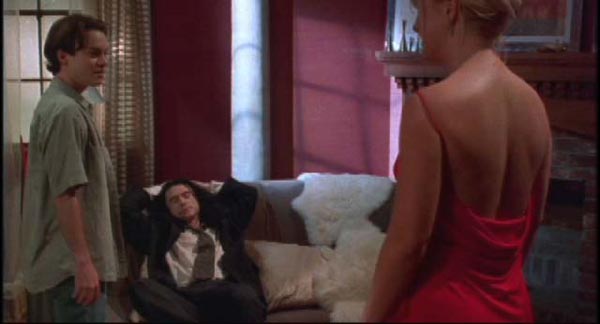 6) The film is structured like the soft-core porn that dot the late hours of premium cable channels. There are four lengthy sex scenes in the first hour, though one of them is composed almost entirely with recycled footage from the first bout of lovemaking between Lisa and Johnny. The sex scenes are deeply un-erotic and consist of several camera angles that make it impossible to see what is actually happening. There is nothing sexy about watching Wiseau’s pasty posterior humping the hips of Danielle (seriously, the body alignments are way off here). When Lisa and Mark have sex on top of a spiral staircase, Wisuea can barely frame the action coherently. Why would anyone want to have sex on a spiral staircase? That’s just asking for chronic back pain. Mark fails to even take his pants off. For such lengthy sex scenes, Wiseau does so little with the talent on display. What makes all the sex scenes even better is that they each get a wretched pop song as a soundtrack. It’s all mid 1990s R&B with some growling sex guitar, and it’s all awful. There’s one song that repeats the phrase “you are my rose” like nine times in a row. If you fail to cringe and howl from the sex scenes then the songs ought to do it.
7) Wiseau makes the most mysterious decisions as an artist. He sticks to a minimum of locations and one of them happens to be the roof of Johnny’s apartment complex. The sensible thing would be to film on an actual roof. Wiseau decided to film on a roof set and use an ineffective green screen backdrop that makes San Francisco look like it inherited Los Angeles’ smog. The film keeps cutting back to exterior stock footage of the city that signifies the passage of hours, a day, or no time whatsoever. When Denny is confronted on the same rooftop about his sudden drug disclosure, Lisa berates him. As she cries and shrieks and overacts, you cannot see it because Wiseau’s camera has cut her facial reactions out of frame. The scene cuts back and forth between Denny facing the camera and the left side of Lisa’s head. At another point Lisa is talking about her cheating ways with her pal Michelle, who seems way too giggly to be disapproving. During this scene Lisa has angled her body in such a manner that when she speaks it appears like a subcutaneous alien is about to burst forth from beneath her neck. Wiseau did not catch this unnerving and distracting sight. The film’s lone idea of male bonding involves tossing a football together. So Mark and Johnny will go out running in a park and toss a football back and forth, all the while having a faint conversation that gets drowned out by an overly anxious score. There will be swaths of the film where the score just competes with the onscreen dialogue.
8) There’s like a whole other level of offhand dialogue throughout, where characters will stand around and Johnny or someone else will mumble to no one in particular. The actual dialogue is full of other memorable head-scratchers, such as:
Random disapproving guy to Mark: “Keep your stupid comments in your pockets!”
Same disapproving man: “It feels like I’m sitting on an atom bomb that is going to explode!”
Michelle using chocolate candies as a means of foreplay: “Chocolate is a sign of love.”
Lisa’s mother: “Nobody ever listens to me.”
Lisa: “You’re probably right about that, mom.”
Johnny’s profound wisdom: “You know, if more people love each other the world would be a better place.”
Johnny refers to someone as a chicken and then proceeds to make this accompanying sound: “Cheep, cheep, cheep, cheeeaaaaaaaaiiiiiiiiiip.” This bizarre chicken impression will be repeated no less than three times.
 This brief exchange at a coffee shop between Mark and Johnny:
Mark: How was work today?
Johnny: Oh pretty good. We got a new client… at the bank. We make a lot of money.
Mark: What client?
Johnny: I cannot tell you. It’s confidential.
Mark: Oh come on. Why not?
Johnny: No I can’t. Anyway, how is your sex life?
And finally, the signature line, where Johnny has had enough of Lisa’s mental games and he roars, “You are tearing me apart, Lisa!”
I could keep citing further evidence of The Room‘s cinematic shortcomings, but listing the faults of one of the worst films ever made can be pointless after a while. The staggering amount of faults in Wiseau’s film is also its combined strength. Most bad movies have a finite level of badness, like a poor plot or some troublesome acting. The Room is a movie composed of nothing but 99 complete minutes of badness at every facet of filmmaking. I am a more complete person having seen this remarkable film. I highly recommend gathering a group of friends around and holding a viewing party; the movie plays to even higher levels of enjoyment with a group atmosphere. The Room is Tommy Wiseau’s accidental masterpiece and, to me, proof that a loving God exists.
Nate’s Grade:
Artistic Merit: F
Entertainment Value: A+
Share this:

The Hurt Locker (2009)
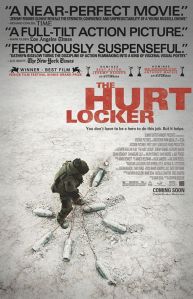 The Hurt Locker is an action movie on a very human scale. Sure there is a time and place for your Michael Bay-esque action vehicles, the type that scorch square miles and leave recognizable world cities in ruins. However, those kinds of action movies are never the kind where storytelling ever enters the fray beyond a meager question of how to get from Point/Explosion A to Point/Explosion B. In fact, Bay openly admits to planning the story of Transformers 2 by working on various action sequences during the 2007 writer’s strike and then tasking screenwriters to connect the dots. The Hurt Locker exists in a frighteningly believable world. This isn’t a movie about explosions but about the extinguishing of explosions. It follows the Explosives Ordinance Disposal (EOD) unit, tasked with detecting and detonating bombs and other improvised incendiary explosives (IED) in the field of combat. You will not be restless for loud “booms” while watching The Hurt Locker. In fact, you will be on pins and needles hoping that you never hear another loud “boom.”
Delta Company are the men responsible for protecting the other soldiers by disposing of bombs. The new team leader, Staff Sgt. William James (Jeremy Renner) has defused over 800 bombs during his tour of duty. He knows he’s the best and he’s addicted to the thrill of being so close to death. He will make occasionally reckless decisions putting himself, but not his fellow company men, at higher risk. This does not sit well with Sergeant JT Sanborn (Anthony Mackie), a by-the-book type that doesn’t appreciate his officer chasing a thrill. The other EOD unit member, Specialist Owen Eldridge (Brian Geraghty), is a man more accustomed to taking orders than giving them, and his indecision may have actually cost the life of the former head of the EOD. Both Sanborn and Eldridge worry that their new team member is going to get them all killed.
 Director Kathryn Bigelow (Near Dark, Point Break) has been directing male-centered action flicks for over two decades; it’s been seven years since her last feature, the regrettable Harrison Ford submarine flick, K-19: The Widowmaker. The Hurt Locker is her finest work to date by far. Her action sequences are visceral and downright agonizing to sit through. She is masterful at setting up the geography of the set piece, ratcheting up the suspense, adding organic obstacles and complications, and then makes sure with her camera and editing that an audience knows exactly what’s happening to whom for every minute that ticks off the clock. Bigelow takes her time to establish the particulars of her locations and sequences, allowing the audience to, surprise, understand what is happening and better engage in the movie. Bigelow chose to shoot the movie in Jordan, the neighboring country to Iraq, and the locations and actual refugee extras add an unvarnished sense of realism. The movie goes without music during much of the action, which makes it all the more uneasy. There isn’t any over eager composer telling you how you should feel, no direction that now things will get even more hairy. You will feel every second of danger, and Bigelow crams in a whole lot of danger. Things can go wrong very, very quickly.
There’s nothing to action cinema quite like the bomb that’s only a few tick-tocks away from doing its dirty work. Do you cut the yellow wire or the green wire? Never cut the red wire. The bombs found in Iraq are a stark range of death. There’s the crude incendiary device just wrapped up in garbage, but then there’s also the fiendishly clever devices with multiple charges and there are grotesque devices as well. At perhaps the film’s most guttural and shocking moment, Staff Sgt. William James finds the corpse of an innocent stuffed with explosives. The easiest thing would be to simply detonate the bomb, but that would also desecrate the body of someone we have come to know. Watching James snip open the crude stitching and dig inside the chest cavity, if we didn’t know then we know now, Bigelow has made sure that The Hurt Locker is the most emotionally resonating contemporary war film in memory.
 Bigelow and screenwriter Mark Boal, an Iraq War journalist, create a vivid sense of dread, antipathy, and most of all, paranoia. Is that a kite flying in the air or is that a signal? Is that a nondescript observer with a cell phone or is that a terrorist with a remote detonator? Is that child being friendly or collecting intelligence? Your mind will race through all these possibilities because Bigelow teases out her action sequences to an unbearably taut level. The audience cares about these soldiers and wants to see them make it back home (we’re informed how many days Delta Company has left on their tour throughout the film), which Bigelow uses to her advantage at every turn. What happens matters. My nerves were frayed during several sequences, including one where the soldiers are pinned down by distant enemy gunfire. The moment turns into a duel and a chess game, as each side tries to adjust their gaze in the searing heat and measure their long-range shot before the other side beats them to it. Then the sequence turns into a waiting game. This is the kind of movie that keeps you poised on the edge of your seat fearful that at any moment something disastrous will suddenly happen. Every time Staff Sgt. William James went back out to defuse another bomb, my sense of dread intensified. I began to doubt everything that I would ordinarily take for granted in other movies.
While being a top-notch action movie, Boal (In the Valley of Elah) has also crafted a great character study. In between the bomb episodes we learn more about these men, which makes it all the more hard to see them then head out to defuse another explosive. The film opens on a quote equating war as a drug, and we explore this notion through the character of Staff Sgt. William James and the weight his unique duty bears. It takes a special person to volunteer for defusing roadside bombs. The defuser must be extremely intelligent, be extremely cool under pressure, and be able to work in a giant suit that makes them look like a chubby astronaut, while enduring debilitating desert temperatures of 110 degrees. It sounds like a suicide mission. James is an adrenaline junkie and war is his drug. He exudes a Zen-like calm in the heat of the moment and this is now the only life for him. Shopping for cereal back home has lost its meaning. Being a husband has lost its meaning. His life now has one purpose. Renner (28 Weeks Later, North Country) gives a stirring performance laced with cavalier confidence and resignation. Mackie (Eagle Eye, We Are Marshall) is also another standout in the pared down cast. When he laments about the dishonor of having no one to remember you in death, you feel the man’s existential sorrow.
 Ignore the political cranks that decry The Hurt Locker as another partisan anti-war film from Hollywood. The American public has been mostly indifferent to any contemporary movie that aims to tackle our current military conflicts in Iraq and Afghanistan, but The Hurt Locker eschews the politics of war to focus on the realities and dangers of its characters. These guys are more concerned with surviving the next bomb than the politics of why they’re in the Middle East. The public has voted with their wallets and does not want to see the reality of war onscreen, or at least the Hollywood version of war reality, but I pray that those same people give The Hurt Locker a fighting chance. There is no preaching to be found here. The Hurt Locker could just have easily taken place during other wars, though the current Iraq War allows for added cultural dissonance (Is the central goal of bomb-defusing a metaphor for our conflict in the region?). This is a film that transcends politics and genre.
The Hurt Locker is more than an action movie, more than a war movie, more than a psychological study; this is an outstanding movie. This movie is a drug to the adrenaline senses and I need another hit. This is one of the finest films of the year and as it expands across the nation, I highly encourage everyone to seek out The Hurt Locker.
Nate’s Grade: A
Share this:

Synecdoche, New York (2008)
 Nothing comes easy when dealing with acclaimed screenwriter Charlie Kaufman. The most exciting scribe in Hollywood does not tend to water down his stories. Kaufman’s latest head-trip, Synecdoche, New York, is a polarizing work that follows a nontraditional narrative and works on a secondary existential level. That’s enough for several critics to hurtle words like “incomprehensible” and “confusing” as weapons intended to marginalize Synecdoche, New York as self-indulgent prattle. I guess no one wants to go to the movies and think any more. Thinking causes headaches, after all.
Caden (Phillip Seymour Hoffman) is a struggling 40-year-old theater director trying to find meaning in his beleaguered life. His wife (Catherine Keener) has run off to Germany with his little daughter, Olive. He also manages to botch a potential romance with Hazel (Samantha Morton), a woman who works in the theater box-office who has an unusual crush on Caden. He’s also plagued by numerous mysterious health ailments that only seem to multiply. While his life seems to be in the pits, Caden is offered a theater grant of limitless money. He has big ambitions: he will restage every moment of his whole life to try and discover the hard truths about life and death. Caden must then cast actors to portray the various people in his life. Sammy (Tom Noonan) argues that no other actor could get closer to the truth of Caden; Sammy has been following and studying Caden for over 20 years (don’t bother asking why in a movie like this). Caden also casts his new wife, Claire (Michelle Williams), as herself. The theater production gets more and more complex, eventually requiring the “Caden” character to hire his own Caden actor. Caden hires Hazel to be his assistant and Sammy falls in love with her. Caden admonishes his actor, “That Hazel isn’t for you.” Caden then tries sleeping with “Hazel” (Emily Watson) to get even with the real Hazel. By producing a theatrical mechanism that almost seems self-sustaining, Caden wants to leave his mark on the world and potentially live forever.
 I heard plenty of blather about how mind-numbing Synecdoche, New York was and how Kaufman had really done it this time when he composed a script that involves characters playing characters playing characters. People told me that it was all too much to keep track of and that it made their brains hurt. The movie is complex, yes, and demands a viewer to be actively engaged, but the movie is far from confusing and any person or critic that just throws up their hands and says, “Nope, too much to think about,” is doing their brain a disservice. The movie is relatively easy to follow in a simple linear cause-effect manner; Kaufman only really goes as deep as two iterations from reality, meaning that Caden has his initial doppelganger and then eventually that doppelganger must get his own Caden doppelganger (it’s not nearly as confusing as it sounds if you see it). Now, where the movie might be tricky to understand is how deeply contemplative and metaphorical it can manage to be, especially at its somber close. That doesn’t mean that Synecdoche, New York is impossible to understand only that it requires some extra effort to appreciate. But this movie pays off in huge ways on repeat viewings, adding texture to Kaufman’s intricately plotted big picture, unfolding into a richer statement about the nature of life and death and love.
Theater has often been an easy metaphor for life. William Shakespeare said, “All the world’s a stage, and all the men and women merely players; they have their exits and their entrances; and one man in his time plays many parts.” Kaufman movies always dwell substantially with the nature of identity, and Synecdoche, New York views identity through the artifice of theater. Caden searches for something brutal and true via the stage, but of course eventually his search for truth becomes compromised with personal interests. Characters in Caden’s life are altered and in the end when Caden steps down, as himself, reality starts getting revised. The truth is often blurred through the process of interpretation. Caden ends up swapping identities with a bit player in the story of his life, potentially finding a greater sense of personal comfort as someone else. Don’t we all play characters in our lives? Don’t we all assume different identities for different purposes? Do we act differently at a job than at home, at church than at a bar? Caden remarks that there are no extras in life and that everyone is a lead in his or her own story.
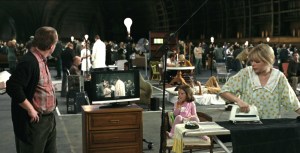 Kaufman’s movie is also funny, like really darkly funny and borderline absurdist to the point of being some strange lost work by Franz Kafka (Hazel even mentions she’s reading Kafka’s The Trial). You may be so caught up trying to render the complexities of the story to catch all of the humor. The movie exists in a surreal landscape, where the characters treat the fantastic practically as mundane. Hazel’s house is constantly on fire and yet none of the characters regard this as dangerous or out of the ordinary. It is just another factor of life. The entire subplot with Hope Davis as a hilariously incompetent therapist is deeply weird. Caden suffers some especially cruel Job-like exploits, particularly what befalls his estranged daughter, Olive. He’s obsessed with her hidden whereabouts and European upbringing, to the point that Caden cannot even remember the name of his other daughter he has with Claire. There is a deathbed scene between the two that is equally sad and twisted given the astounding behavior that Caden is forced to apologize for. There are running gags that eventually transform into metaphors, like Caden’s many different medical ailments and the unhelpful bureaucratic doctors who know nothing and refuse to divulge any info. Kaufman even has Emily Watson, an actress mistaken for Morton, play the character of “Hazel.”
This is Kaufman’s debut as a director and I think the movie ultimately benefits by giving its writer more control over the finished product. The movie is such a singular work of creativity that it helps by not having another director; there is no other artistic vision but Kaufman’s. While the film can feel slightly hermetic at times visually, Kaufman and cinematographer Frederick Elmes (The Ice Storm) pack the film with detail. Stylistically, the film is mannered but this is to make maximum impact for the vast amount of visual metaphors. Synecdoche, New York never feels as mannered as the recent Wes Anderson films, henpecked by a style that serves decoration rather than storytelling. The production design for the world-within-a-world is also alluring and imaginative, like a living, breathing dollhouse.
 The assorted actors do well with their quirky, flawed characters, but clearly Hoffman is the linchpin to the film. He plays a character from middle age to old age, and at every step Hoffman manages to infuse some level of empathy for a man routinely disappointed by his own life. The failed yet lingering and hopeful romance between Caden and Hazel provides an almost sweet undercurrent for a character obsessed with death. Hoffman is convincing at every moment, even as a hobbled 80-year-old man, and gives a performance steeped in sadness but with the occasional glimmer of hope, whether it be the ambition of his theater project or the dream of holding Hazel once more. Morton is also wonderfully kindhearted and endearing as the woman that just seems to keep slipping away from Caden.
There’s no other way to say it but Synecdoche, New York is a movie that you need to see multiple times to appreciate. The plot is so grandiose in scope and ambition that one sitting does not do it justice. Kaufman has forged a strikingly peculiar movie that manages to be surreal and bleakly comic while also being poignant and humane. This is a big movie with big statements that can be easily missed, but for those willing to dig into the wealth of metaphor and reflection, Synecdoche, New York is a rewarding film experience that sticks with you. By the end of this movie, Kaufman has earned the merging of metaphor and narrative. I have already seen the movie twice and still cannot get it out of my thoughts. This isn’t the kind of movie that you feel warm affection for, like Kaufman’s blissfully profound Eternal Sunshine of the Spotless Mind. This movie is less a confounding puzzle than an intellectually stimulating examination on art, the human experience, and, ultimately death. If people would rather kill brain cells watching whatever dreck Hollywood secretes every week (cough, Street Fighter: The Legend of Chun-Li, cough) then that’s their prerogative. Give me a Charlie Kaufman movie and a bottle of aspirin any day.
Nate’s Grade: A
Share this:

The Bank Job (2008)
 An intelligent and rather crackling heist movie that also happens to be based on a true story. The 1971 British bank heist has so many characters involved that you may need a helpful cheat sheet, especially when it comes to varied loyalties. There are three separate groups all playing their own game, and when the heist doesn’t go exactly according to plan, and then the movie gets even more complicated. It’s a flavorful and funny heist movie that also doesn’t ignore the severe repercussions and life-and-death stakes. The Bank Job is an engrossing crime caper that still manages to thrill and surprise an audience.
Nate’s Grade: B+
Share this:

Snow Angels (2008)
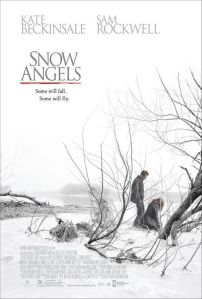 Director David Gordon Green is likely the most observant auteur today when it comes to exploring the realities of life in small towns. Snow Angels is a somber drama that follows an estranged couple (Sam Rockwell, Kate Beckinsale) going through the hard times of life in a snowy rural town. The couple is also beset by some tragic accidents that come in at the appropriate time, an hour into the film, which means that we’ve gotten to know the characters enough to build a relationship with them and also that there will be plenty of time left to watch these characters react. The movie has a handful of interrelated characters that don’t all sustain the same level of interest. Watching a band geek lose his virginity to a smart girl (Oliva Thirlby, deflowering her second 2008 virgin) is just not comparable to other storylines. Snow Angels has an astute sense of resignation throughout, like the characters know they will forever be stuck in dead-end jobs and live the rest of their lonely lives as fated. The movie takes some very dark turns but they feel authentic to the drama. Green creates such a rich portrait of despair and the inequities of small town life.
Nate’s Grade: B
Share this:

An American Carol (2008)
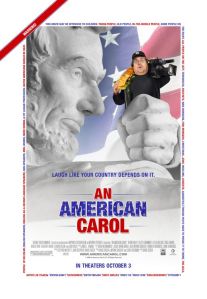 Being a conservative in Hollywood is like being a gay Republican – tough business. Director David Zucker has a notable history with comedy, having helmed Airplane!, the Naked Gun series, and the back half of the Scary Movies. He says that he converted to conservatism in the wake of 9/11, and Zucker actually wrote and directed a short for the 2004 Republican National Convention that was deemed too edgy for the Grand Old Party. Conservatives have also garnered the reputation for not having the best sense of humor, and Zucker’s An American Carol will do little to change this belief.
Michael Malone (Kevin Farley) is an egotistical, fat, liberal documentary filmmaker whose latest work is titled, “Die You American Pigs.” Catchy, ain’t it? Malone wants to abolish the Fourth of July (would we just skip to July 5th?) and plans to protest a Trace Adkins concert for the troops. A batch of inept Islamic terrorists want to bomb the concert and decide into tricking Malone into assisting their goal. He will score them media passes to get onstage at the concert venue. Following the Charles Dickens’ playbook, Malone is first visited by the spirit of his idol, John F. Kennedy (Chriss Anglin), who horrifies Malone by saying war is sometimes necessary (really, conservatives are trying to reclaim Kennedy?). Three spirits will visit him although he spends almost all of his time with the ghost of General Patton (Kelsey Grammer). The ghostly general takes Malone on a trip to see what the alternative versions of U.S. history had the country avoided war at all costs. Malone stays defiant until he meets up with the Angel of Death (also Trace Adkins, because?) and sees the error of his “America-hating” ways. I don’t want to spoil things too much but the movie ends with an expanded Trace Adkins concert saluting the brave men and women in the armed forces.
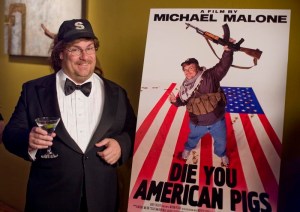 Some from the opposing political viewpoints will find An American Carol to be infuriating. To those angry few I say get over it, because this movie is simply too lazy to get angry over. It barely reaches 77 minutes before the credits roll. Zucker and company tend to stretch their canvas too broadly, to the point that they aren’t exaggerating to lampoon but setting up cheap jokes. Michael Malone is fat. Michael Malone smells. Michael Malone falls down. Liberals hate America and want the terrorists to win. It’s so easy to write this material because there’s nothing topical or nuanced or even socially relevant. The movie beats reliable figures of conservative agita. When the movie tries to slam college professors as being dippy hippies brainwashing teens about the insurmountable ills of America, it just gets dumb (those people spend 10-15 years studying in a specialized academic field). There is no teeth to any of this satire because it’s all just recycled caricatures with the wit ground down. There isn’t anything of true satirical substance here. I don’t even get some of the satire, like the ACLU is depicted as a cluster of zombies with briefcases. What does that mean? Needless to say, the skewering of Arabs is mostly cartoonish and offensive. The flick constantly makes fun of the documentary art form, saying they are inferior to “real movies.” Because Michael Moore has an Oscar does that mean that the history of documentary film has to be slandered as being nothing more than transparent propaganda (at an awards ceremony, the top documentary is honored with the “Leni Riefenstahl Award”)? Marginalizing an entire art form seems rash, especially considering that Moore’s Fahrenheit 9/11 grossed over $220 million worldwide. As of this writing, An American Carol, a “real movie,” has grossed seven million and counting.
The film deals in distasteful absolutes. Every idea is presented crudely in black and white. By the film’s standards, being anti-war and anti-troops are inseparably linked. In my mind, and this might be crazy, but it seems to me that the most pro-troops one could be would be hoping for them all to return home alive and healthy. An American Carol attempts to justify the ongoing War in Iraq, though it conveniently only ever flashes to combat in Afghanistan, the war that a majority of the public agrees with. It makes a case that war is sometimes necessary, though it has to flash back to Hitler and World War II to find a morally justified military engagement that everyone can feel god about. I agree that war is sometimes a reasonable option, but the movie paints all pacifists as wimpy appeasers. George Washington (Jon Voight) even steps in at one point to argue for the necessity of war in reference to the War on Terror. Did the filmmakers forget that Washington spent great expense to keep the nation out of foreign wars in his two terms? Isn’t it also condescending and objectionable to have Washington say freedom of speech is misused when it goes against the government? I think the Founding Fathers would realize the importance of freedom of speech, including offensive speech. Isn’t it also somewhat ironic to use slave-owners as mouthpieces for the merits of freedom? An American Carol says that disagreement is the same as dissent; so refusing to support one’s government blindly during a time of war is traitorous. Criticism is not anti-American. It’s insulting to all rationale human beings. Zucker and crew make their case look just as myopic and dismissive as those they choose to ridicule.
The acting neither hinders nor helps the material. Farley is a game comedian but he cannot do much with such lightweight material. There are several celebrity cameos including James Woods, Dennis Hopper, Bill O’Reilly, Mary Hart, David Alan Grier, Gary Coleman, Leslie Nielsen, Zachary Levi, Kevin Sorbo, and Paris Hilton. When Zucker is calling favors into the likes of Paris Hilton, you know things cannot be solid.
 Here’s the problem. It’s harder to satirize from a conservative point of view. Conservatism believes that the status quo is best or that things were better back in the day. Liberalism believes that society can always improve, so a liberal point of view would tweak the present situation in order to call attention to remaining improvements. A conservative point of view would make fun of that possible change. This is the same reason why documentaries, like it or not, typically have a more progressive bent, and it’s because the filmmakers are presenting a case for change or outrage. Why would anyone devote himself or herself for years to create a film that says the world is peachy? Now I’m not saying that conservatism and humor are conflicting concepts, but it just makes it harder to be smarter. Making fun of Good Night, and Good Luck is not trying hard enough. How dare George Clooney make a film about the media cowering and failing to question our elected leaders and have it be applicable to today’s world.
The Zucker gag-a-minute spoof style doesn’t necessarily translate well to political satire. I wasn’t expecting much with An American Carol. When they exploit 9/11, taking Malone to the wreckage of the World Trade Center to make its case, well the movie stops being a satire and just implodes. It hits its tired targets with a sledgehammer. The satire is extremely lazy, the slapstick is dumb, and the movie specializes in being obnoxious, coloring the world in two extremes. This isn’t satire. This is just cheap and petty. Seriously, making fun of Michael Moore is like four years too late. Moore is a figure worthy of satire but the best that the movie can come up with is he’s fat and hates America? That he’s angry because he couldn’t get girls when he was younger and all those studly military recruits did? That’s not satire, that’s just excessive name-calling. An American Carol presents a new low for Zucker and I think even he knows it. On the DVD commentary track, Zucker, co-writer Lewis Friedman (BASEketball), and actor Kevin Farley basically lambaste the final product, often criticizing their own movie. The derisive commentary track is more enjoyable than the film itself.
Nate’s Grade: C-
Share this:

The Wrestler (2008)
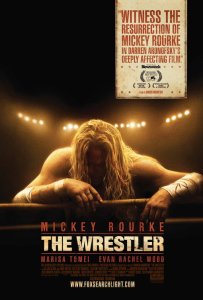 The Wrestler came out of nowhere to be hailed as one of the most stirring dramas of the year. Who would have possibly guessed that a movie that stars Mickey Rourke in spandex would be one of the best films of 2008?
Randy “The Ram” (Rourke) was one of the biggest professional wrestlers in the 1980s. His pay-per-view battle with “The Ayatollah” in 1988 is legendary to wrestling aficionados. But nobody ever stays on top forever. Twenty years later, Randy is a self-described “old broken down piece of meat.” He’s barely staying afloat working at a supermarket during the day. On weekends he adorns his old tights and fights in wrestling bouts at VFW halls, where small numbers still flock to see the scripted carnage. Randy is fighting against the ravages of time and is determined to stick it out with the profession that has both made him a super star and also left him broken and lonely. He can relate to Cassidy (Marisa Tomei), a 40-something stripper that gets disrespected by customers because of her age. Randy seeks out his teenage daughter (Evan Rachel Wood) to attempt to be a father for the first time in the girl’s life. Then a wrestling promoter wants to stage a twentieth anniversary rematch between Randy and “The Ayatollah” (who runs a successful used car business in Arizona now). The opportunity means Randy has one more shot in the limelight before his health sidelines him for good.
 There isn’t a note in The Wrestler that feels misplaced or a moment of drama that feels false or contrived. The scenes of emotional revelation feel genuine and aren’t delivered with deliberate emphasis, like Randy’s moving speech where he tells his neglected daughter how rotten of a father he was, which he accepts bitterly, but he pleads to fashion enough understanding just for his little girl not to hate him. The Wrestler skews against convention and ends on its own terms, following the fated trajectory of its tragic hero. This isn’t a generic or sentimental tale of uplift and redemption. Randy is eager to make amends for a lifetime of bad decisions but he is also keenly aware that he has little to offer and that the outside world has little place for him. The Wrestler is a tender tale about a man trying to find his place in a world no longer familiar to him. Randy tells Cassidy at one point that the only place he ever truly feels pain is outside of the ring.
The film skillfully explores what is fake and what is real in the wrestling world. The matches may be predetermined but the injuries are very real. These muscled warriors are essentially pro stuntmen with some charisma and their bodies are their offering to the screaming masses. They give everything they have for the crowds but what do they get in return once the applause dies down? After witnessing the bloody aftermath of an especially brutal match, which included Randy being lacerated with barb wire and having a staple gun decorate his back, it’s easy to wonder why any sane person would subject themselves to this kind of punishment and for so long. Cassidy is in another profession that tends to grind up and spit out its star attractions. She reaches out to Randy not out of romance (a lesser film would have demanded she fall in love with the big lug) but out of a desire for human companionship, for something real. These two characters are both at a crossroads and must come to grips with the cold realization that the world has passed them by.
 The script by Robert Siegel came alive for me in the details. I love discovering that Randy endures shame that his real name is the more effeminate-sounding Robin. I love that the film shows a scene where a batch of old wrestlers sit next to folding tables and hawk tapes of their greatest matches that no one wants to relive but the old timers. I loved that Randy’s long walk through the bowels of the supermarket to greet his “fans” at the deli counter mirrors his entrances to wrestling bouts.
Astonishingly, Darren Aronofsky directed this movie. The film departs sharply from Aronofsky’s highly artistic yet stylistically mannered previous films, like Requiem for a Dream and The Fountain. He strips away the style pyrotechnics and follows a no-frills docu-drama approach. This dynamic helps accentuate the raw and harsh reality of the film. It’s the most relaxed direction the man has ever done. He’s able to churn the myriad of emotions and broken dreams into a powerful character study that never feels manipulative. The Wrestler feels remarkably intimate and emotionally bruising.
The Wrestler is built to be a one-man show and it’s a terrific show. Rourke’s performance is invigorating and the former Hollywood bad boy channels his own personal history of regret and missed opportunities. The line between character and individual is noticeably blurred. Rourke’s busted and mangled face tells a long history for Randy. The physical shellacking that the 52-year-old Rourke takes is brutal, and you realize that he throws his body into the performance with wild abandon for a man his age. I cannot imagine this film working or having nearly the poignancy with Nicolas Cage in the lead role, which is what was originally planned (Cage might have had a more bizarre haircut). Rourke is the role. It is a perfect marriage of actor and character. The character of Randy is the latest in the long film tradition of the noble loser that must fight to reclaim his victory, which makes for a deeply empathetic experience. Randy is a gentle giant, courteous even to the people that insult him and his glory days. You will feel the man’s every high and low. When he’s working at the deli counter and begins to have fun, joking around with customers, you’ll feel his sense of revelry too. When he’s lonely and invites a neighbor kid over to play an old 8-bit Nintendo video game featuring Randy, you’ll feel the same ache of sadness to connect. When Randy screws up, you’ll feel the same angry disappointment. When Randy is out shopping for wrestling props and playfully involves others in “testing” them, you’ll feel the man’s amusement and sense of peace. Other actors might have given in to the setting and played Randy as a caricature, but Rourke plays with subtlety when he could have gone big. He’s reflective and somber and has a well of repressed anger buried deep within. It’s a performance for the ages and cements Rourke’s cinematic comeback.
 The Wrestler is a rich and engrossing character study that aches and wheezes with the pain of real life. Randy is a man that’s lived a hard life, by design, but at his core he is a kind and decent man. The film takes after its star and proves to be quiet, unassuming, brutally honest, and deeply affecting. Rourke bares his own tortured soul by playing Randy, and his performance is unquestionably one of the best of the year. This is a surprising, heartfelt, and equally heartbreaking movie that finds many truths through the self-dawning of its title hero. It’s not the wrestling matches that I’ll remember most, no sir. I will remember the small interludes, like Randy dancing with his daughter, the beer he shares with Cassidy as they lament the 1990s, the love and brotherhood backstage between with the wrestling opponents, Randy delighting the kids in his trailer park by pretending to fight them. Randy may not find solace or stability outside the ring but the people around him prove that Randy was bigger than “The Ram.”
Nate’s Grade: A
Share this:

Let the Right One In (2008)
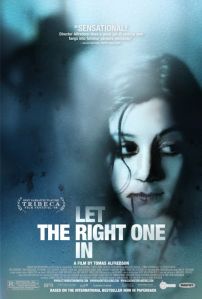 This is a pre-teen vampire love story that is miles away from Twilight folks; it’s solemn, mature, stark, violent, tense, and astoundingly ambiguous. Director Tomas Alfredson pares down the emotions and the entire film takes on a very reserved and curious atmosphere, which I feel heightens the sense of wonder and dread about a supernatural romance. The relationship between 12-year-old Oskar (Kare Hedebrant) and 12-year-old looking vampire girl Elie (Lina Leandersson) is entirely believable and constantly intriguing, as key information is doled out like breadcrumbs. Oskar is negotiating puberty and Elie is well aware of what awaits. The movie works as an example of methodical horror where emphasis is placed upon anticipation and the imagination. The climax at a community pool is one of the best film finishes of the year. I was a tense ball of nerves, and I love the movie’s closing shot. Even better, the movie works as an intriguing and intricate drama about human relationships. I can revisit Let the Right One In and dub it an unconventional and moving romance. Or I can revisit the film and dub it a melancholy examination of a manipulative and parasitic relationship, as Oskar might be doomed to a fated life like Elie’s former guardian. I can keep revisiting this Swedish horror film and discover more to discuss and diagram each time. And I didn’t need a single scene where the vampires played super hero baseball games.
Nate’s Grade: A-
Share this:

Happy-Go-Lucky (2008)
 I wanted to turn this movie off for the first 30 minutes or so and that’s because of Poppy (Sally Hawkins), the deranged optimist that the movie follows. Writer/director Mike Leigh’s latest semi-improvised tale following the English working class centers on a primary school teacher who makes the conscious choice to be happy in life, no matter what life throws her way. Her presence is somewhat exhausting, like a customer who doesn’t know when making jokes has gone from fun to downright annoying. But you know what? Poppy eventually won me over, and I’m all but positive it was the scenes of her and her raging, pessimistic, tightly wound driving instructor (Eddie Marsan) that did it. Before their first driving lesson, I felt like the movie was giving me a slice-of-life that I was hesitant about; Poppy, like anyone who is insanely happy, can be grating. The humor is extremely dry and most of the clever dialogue exchanges will likely go by unnoticed because the actors aren’t delivering big punch lines. Hawkins goes all-out as the unflappable Poppy and she will make you smile through sheer force of will. This was a film I liked more by the time it was winding down, perhaps because Poppy might be easier to take knowing that time is coming to a close much like spending time with a distant relative during the holidays.
Nate’s Grade: B
Share this:

The Visitor (2008)
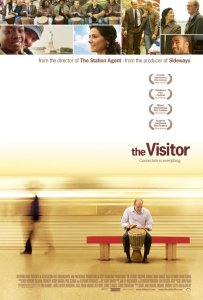 The follow-up by Thomas McCarthy, the writer/director of the sparkling Station Agent, is an affecting indictment on our nation’s immigration policies that manages to say a lot of important things in small touches, ditching histrionic messages. Walter (Richard Jenkins, in a commanding and deeply empathetic performance) discovers a pair of illegal immigrant squatters living in his seldom-used New York City apartment. He strikes up an unlikely friendship that moves in subtle strokes that keeps the movie very character-based. The second half of the film revolves around Walter’s attempts to work within the system to free his new friend from detention. I could have spent more time with Walter and Tariq, the Syrian immigrant who teaches Walter how to play the African drum. The Visitor explores a man learning in his autumn years how to reconnect with people, and it has moments of astonishing emotional clarity. McCarthy is a filmmaker that can spin narrative gold from just about anything; The Station Agent had a hot dog vendor, a single mom, and a dwarf. The Visitor is further proof that McCarthy is an extremely talented man who knows how to target and tap the humanity of his unique characters. There are very few moments in this movie that feel false.
Nate’s Grade: B+


 nathanzoebl
You must be logged in to post a comment.