Blog Archives
17 Again (2009)
 My introduction to tween sensation Zac Efron came last fall. After hearing about the dominance of the High School Musical franchise I decided to finally watch the first made-for-Disney Channel film and see why exactly tween girls were screaming themselves hoarse. And after watching the musical I felt, well, how can I put this diplomatically? It sucked. Hard. First off, the plot only covered auditioning for a musical, not the actual show. What the heck is up with that? How does a movie musical climax around callbacks? Amidst the bland vanilla pop tunes, goofy hoofing, and painfully simplistic life lessons about class-consciousness, there was the overall dreadful acting by the cast. Efron wasn’t the worst actor of the lot but he seemed to go on autopilot, beaming dreamily and leaving his mouth agape long enough to stockpile flies for a long winter. I could not understand why young girls and the media were making such a fuss over Efron. I am clearly not in Efron’s core flock of fawning fans, but after catching his fairly nimble work in 17 Again I think perhaps this guy might be able to break out from the clutches of Disney and grow into his own, unlike Miss Miley Cyrus, who I believe has an ankle bracelet that will detonate if she travels further than 100 feet from the Disney execs. They don’t want another Hilary Duff getting away and sticking a scorpion down her shorts (see: War, Inc.).
Mike O’Donnell (Matthew Perry) hates his life. He’s 37, just been passed over for a promotion at his job, is getting divorced from his wife Scarlett (Leslie Mann), and his two teenage children (Sterling Knight, Michelle Trachtenberg) think dear old dad is a doofus. Apparently, everything was better 20 years ago, in 1989 when Mike was a 17-year-old basketball phenom who had his whole life ahead of him, until he walked out on a climactic game to tend to Scarlett, who just revealed that she was pregnant. Mike wishes he had one last shot to be 17 and have his whole life ahead of him again. Thanks to a magic janitor (I believe it’s really the magic hobo from The Polar Express, except now he’s gone through a work program and become a respectable community custodian), Mike transforms into the visage of his 17-year-old self (Efron). Mike seeks help from his childhood pal Ned Gold (Thomas Lennon), who poses as Mike’s father and enrolls him in the same high school his children attend. This leads to many awkward family encounters.
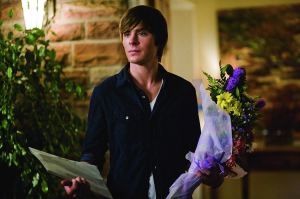 The body swap genre can be counted on for some decent fish-out-of-water laughs and some earned wisdom. Usually transporting young people into older bodies allows for more comedy because it leads to more socially awkward moments and the exaggerations of trying to be old before your time. 17 Again is consistently amusing enough and I was pleased that it found fun plot developments to explore from its body swap angle. So Mike is young once more but that doesn’t stop him from having, on the surface, inappropriate feelings for Scarlett. On top of that, teen Mike must beware the romantic advances of his own teenage daughter. Yes, the movie simultaneously explores robbing-the-cradle romance while dodging incestuous pratfalls al la Back to the Future. There is uncomfortable father-daughter sexual tension without getting too perverse. These two wrinkles nicely take advantage of the older person body swap premise and add some spice to an otherwise safe and sunny movie. Besides that, if you’ve seen any body swap movie from the past (and the 1980s were littered with body swap movies) then you’ll know exactly how everything will turn out with 17 Again. The movie is mostly silly, mostly the fun kind, but it doesn’t dip into being outrightly dumb. It’s derivative but it’s not fluff. I mean the essential premise revolves around a man regretting supporting his pregnant teen girlfriend/eventual wife. You won’t find that in the Hannah Montana Movie no matter how hard you try, perverts.
17 Again isn’t great art but it works as a showcase for its appealing star, the dewy-eyed, shaggy-coifed Efron. The filmmakers clearly know their target audience because Efron is shirtless and sweaty by minute one, displaying killer abs. By minute four, he’s dancing before his big basketball game (does this kid have a clause in his contract that he must play basketball in all his movies?). 17 Again asks little of Efron and he easily delivers on that mandate with a convincing performance that easily charms. He’s also adept at comic timing, particularly when he’s sparring with Lennon. Efron has a fabulous toothy grin and he’s a good-looking pup, but the jury’s still out on whether or not this kid can go the distance. He’s improved considerably since the first High School Musical launched his mug onto thousands of household products. He probably doesn’t have an Oscar in his future but he certainly will be headlining movies for years to come. He’s more movie star than actor, but let’s not mince words, the kid is a star (fun fact: Efron’s first acting credit is for an episode of Joss Whedon’s Firefly).
The supporting cast surrounding Efron greatly add to the film’s surprise enjoyment. The subplot involving adult dweeb Ned romancing the principal (Melora Hardin) is an amusing diversion that manages to make me like all of the characters more. Lennon (Reno 911!) steals every moment he’s onscreen and develops a kooky chemistry with Hardin (TV’s The Office). The more these two actors interacted the more I wanted the movie to ditch everyone else. Mann gets the thankless job as “upset wife” but brings a spark to the character without coming across as grating. Trachtenberg (Euro Trip, TV’s Gossip Girl) is actually 23 years old but her youthful looks seem to lock her into teenage girl roles. Look out for cameos by comedians like Jim Gaffigan and Margaret Cho. Perry must have enjoyed working for about a week and cashing his check. Also, Perry looks absolutely nothing like Efron and appears to be over a foot taller than his younger, more genetically blessed doppelganger.
 I feel sympathy for the editor of 17 Again, because clearly script supervisor Steve Gehrke must have been asleep for the entire film shoot. There are continuity gaps galore in this movie. Now, normally I don’t care so much about mild continuity errors in a movie because that’s just part of moviemaking. So if a character sits up in bed and the sheets are a few inches lower, or in a different ruffled state, well who cares? But when errors compile wildly and become flagrant distractions, then the movie has a problem and the script supervisor, the person in charge of catching those errors in progress, failed miserably. When teen Mike eats a hamburger in the school cafeteria it goes from being in his hands, out of his hands, having a bite out of it, and then magically reformed. Even worse is a moment when teen Mike is nursing a battle wound and his wedding ring keeps changing hands. Why would anyone even bother switching hands for a ring to begin with? That sounds like an easily avoidable hassle. To be fair, there are several factual errors that are not Gehrke’s total fault, though I’m dumfounded why no one else caught these. In 1989, the coach yells at Mike to quite dancing and refers to him as “Vanilla Ice,” but Vanilla Ice didn’t release his debut album until 1990 (apparently the coach knows his underground white hip-hop). What’s even more puzzling is that this pop culture reference is destined to sail over the heads of Efron’s target tween audience. All of this is easily verifiable. I won’t even get into Mike referring to “hippogriffs” 10 years before Harry Potter was published.
17 Again is a pleasant enough confection that is undemanding and yields some laughs and enough heart. The movie manages to be more mature than expected thanks to some kinky-for-PG-13 sexual tension and yet the movie is a harmless good time at the movies. Efron carries the movie ably but he’s got a great supporting cast to help carry the comedy load. Body swap movies are all invariably the same, and truly 17 Again must have been born with the sentence, “It’s reverse-Big.” It’s playful and light and cheery and pretty much an adept project for its star. It’s a small step in the right direction for Efron, and perhaps his fan base will start including more than squealing teenager girls primed to swoon at a moment’s notice. Swooning: it’s not just for the youngsters any more.
Nate’s Grade: B
Share this:

The Wrestler (2008)
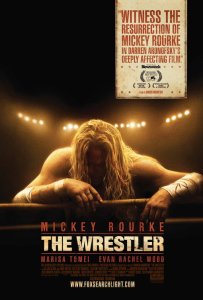 The Wrestler came out of nowhere to be hailed as one of the most stirring dramas of the year. Who would have possibly guessed that a movie that stars Mickey Rourke in spandex would be one of the best films of 2008?
Randy “The Ram” (Rourke) was one of the biggest professional wrestlers in the 1980s. His pay-per-view battle with “The Ayatollah” in 1988 is legendary to wrestling aficionados. But nobody ever stays on top forever. Twenty years later, Randy is a self-described “old broken down piece of meat.” He’s barely staying afloat working at a supermarket during the day. On weekends he adorns his old tights and fights in wrestling bouts at VFW halls, where small numbers still flock to see the scripted carnage. Randy is fighting against the ravages of time and is determined to stick it out with the profession that has both made him a super star and also left him broken and lonely. He can relate to Cassidy (Marisa Tomei), a 40-something stripper that gets disrespected by customers because of her age. Randy seeks out his teenage daughter (Evan Rachel Wood) to attempt to be a father for the first time in the girl’s life. Then a wrestling promoter wants to stage a twentieth anniversary rematch between Randy and “The Ayatollah” (who runs a successful used car business in Arizona now). The opportunity means Randy has one more shot in the limelight before his health sidelines him for good.
 There isn’t a note in The Wrestler that feels misplaced or a moment of drama that feels false or contrived. The scenes of emotional revelation feel genuine and aren’t delivered with deliberate emphasis, like Randy’s moving speech where he tells his neglected daughter how rotten of a father he was, which he accepts bitterly, but he pleads to fashion enough understanding just for his little girl not to hate him. The Wrestler skews against convention and ends on its own terms, following the fated trajectory of its tragic hero. This isn’t a generic or sentimental tale of uplift and redemption. Randy is eager to make amends for a lifetime of bad decisions but he is also keenly aware that he has little to offer and that the outside world has little place for him. The Wrestler is a tender tale about a man trying to find his place in a world no longer familiar to him. Randy tells Cassidy at one point that the only place he ever truly feels pain is outside of the ring.
The film skillfully explores what is fake and what is real in the wrestling world. The matches may be predetermined but the injuries are very real. These muscled warriors are essentially pro stuntmen with some charisma and their bodies are their offering to the screaming masses. They give everything they have for the crowds but what do they get in return once the applause dies down? After witnessing the bloody aftermath of an especially brutal match, which included Randy being lacerated with barb wire and having a staple gun decorate his back, it’s easy to wonder why any sane person would subject themselves to this kind of punishment and for so long. Cassidy is in another profession that tends to grind up and spit out its star attractions. She reaches out to Randy not out of romance (a lesser film would have demanded she fall in love with the big lug) but out of a desire for human companionship, for something real. These two characters are both at a crossroads and must come to grips with the cold realization that the world has passed them by.
 The script by Robert Siegel came alive for me in the details. I love discovering that Randy endures shame that his real name is the more effeminate-sounding Robin. I love that the film shows a scene where a batch of old wrestlers sit next to folding tables and hawk tapes of their greatest matches that no one wants to relive but the old timers. I loved that Randy’s long walk through the bowels of the supermarket to greet his “fans” at the deli counter mirrors his entrances to wrestling bouts.
Astonishingly, Darren Aronofsky directed this movie. The film departs sharply from Aronofsky’s highly artistic yet stylistically mannered previous films, like Requiem for a Dream and The Fountain. He strips away the style pyrotechnics and follows a no-frills docu-drama approach. This dynamic helps accentuate the raw and harsh reality of the film. It’s the most relaxed direction the man has ever done. He’s able to churn the myriad of emotions and broken dreams into a powerful character study that never feels manipulative. The Wrestler feels remarkably intimate and emotionally bruising.
The Wrestler is built to be a one-man show and it’s a terrific show. Rourke’s performance is invigorating and the former Hollywood bad boy channels his own personal history of regret and missed opportunities. The line between character and individual is noticeably blurred. Rourke’s busted and mangled face tells a long history for Randy. The physical shellacking that the 52-year-old Rourke takes is brutal, and you realize that he throws his body into the performance with wild abandon for a man his age. I cannot imagine this film working or having nearly the poignancy with Nicolas Cage in the lead role, which is what was originally planned (Cage might have had a more bizarre haircut). Rourke is the role. It is a perfect marriage of actor and character. The character of Randy is the latest in the long film tradition of the noble loser that must fight to reclaim his victory, which makes for a deeply empathetic experience. Randy is a gentle giant, courteous even to the people that insult him and his glory days. You will feel the man’s every high and low. When he’s working at the deli counter and begins to have fun, joking around with customers, you’ll feel his sense of revelry too. When he’s lonely and invites a neighbor kid over to play an old 8-bit Nintendo video game featuring Randy, you’ll feel the same ache of sadness to connect. When Randy screws up, you’ll feel the same angry disappointment. When Randy is out shopping for wrestling props and playfully involves others in “testing” them, you’ll feel the man’s amusement and sense of peace. Other actors might have given in to the setting and played Randy as a caricature, but Rourke plays with subtlety when he could have gone big. He’s reflective and somber and has a well of repressed anger buried deep within. It’s a performance for the ages and cements Rourke’s cinematic comeback.
 The Wrestler is a rich and engrossing character study that aches and wheezes with the pain of real life. Randy is a man that’s lived a hard life, by design, but at his core he is a kind and decent man. The film takes after its star and proves to be quiet, unassuming, brutally honest, and deeply affecting. Rourke bares his own tortured soul by playing Randy, and his performance is unquestionably one of the best of the year. This is a surprising, heartfelt, and equally heartbreaking movie that finds many truths through the self-dawning of its title hero. It’s not the wrestling matches that I’ll remember most, no sir. I will remember the small interludes, like Randy dancing with his daughter, the beer he shares with Cassidy as they lament the 1990s, the love and brotherhood backstage between with the wrestling opponents, Randy delighting the kids in his trailer park by pretending to fight them. Randy may not find solace or stability outside the ring but the people around him prove that Randy was bigger than “The Ram.”
Nate’s Grade: A
Share this:

Grace is Gone (2008)
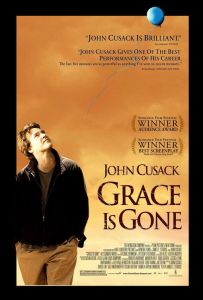 This Iraq War drama means well but it comes across as manipulative and morally questionable. John Cusack stars as a former military man who just found out his wife, on active duty in Iraq, has been killed. The bulk of the film’s conflict deals with how Cusack will tell his two daughters that mommy is not coming home again. Instead of being upfront with his children, he takes them out of school and whisks them away on a family trip to an amusement park. His reasoning is that he wants to squeeze in a few more happy memories before the kids hear the news. To me, this is irresponsible and psychologically damaging; those kids will resent their father holding onto such important information while he encouraged his kids to shop in ignorance. The film is about 80 minutes of watching a guillotine hang over someone’s head, just waiting for the moment to hit. It can get rather uncomfortable. Somewhere in this misguided drama is a poignant look at the domestic cost of the Iraq War from the family’s perspective, a perspective yet to be fully articulated by the movies. Instead, Grace is Gone is a well-acted but contrived drama that favors delaying the pains of reality to the point of incredulity.
Nate’s Grade: C+
Share this:

There Will Be Blood (2007)
 Paul Thomas Anderson is one of the most gifted filmmakers working today, bar none. There Will Be Blood is only his fifth film and marks a radical departure from his intimate, inter-laced character dramas. Blood is an epic in size and scope and has been blessed with numerous awards and vehement praise. Critics say this film is one for the ages. My anticipation was fed to unhealthy proportions thanks to the hyperbolic praise and Anderson’s track record of audacious visionary cinema. There Will Be Blood is certainly audacious, and not just with its bladder-testing running length. This lethargic throwback to 1970 filmmaking exists for the purpose of a single performance and neglects other important tenets of storytelling. At 158 minutes, I can safely assume for many that there will be boredom with There Will Be Blood.
Our first glimpse of Daniel Plainview (Daniel Day-Lewis) is in the pit of a hole. It’s 1898 and Plainview is chipping away at the earth looking for scraps of silver. His meager beginnings set the stage for other mining prospects when, on the hunt for silver, he discovers even bigger riches – oil. Thanks to the advancing automobile age, the world has a thirst for oil that knows no bounds and makes Plainview a wealthy man. He’s an unscrupulous business figure that trots around his “son” HW (Dillion Freasier) as one more angle to fleece gullible townsfolk out of their property rights. HW’s father died in a drilling accident when he was a baby and Plainview has looked after him since.
One day Paul Sunday (Paul Dano) enters Plainview’s office and is willing to name a prime piece of land that oozes oil. Plainview agrees to pay Paul his sum and heads out with crew to Little Boston, California. The small town is easily enamored by Plainview’s promises of riches and prosperity. He purchases as much tracts of land as he can and begins drilling for that valuable black liquid. Eli Sunday (also Dano) is Paul’s twin brother; he wishes to build a church and become a prominent religious figure for his town. He sees the oil as his ticket to a throng of adoring congregants that will do his bidding. Oil is struck and several parties vie for dominance.
 I fear that Blood may be too languid for its own good. I’m all about allowing a film to take its time to establish a world and the people that inhabit it, and to its credit Blood spectacularly recreates turn-of-the-century America and the craze for oil. The cinematography and production design are stunning in gorgeously recreating a bygone era with such dusty detail. The film is packed with evocative imagery that will linger in your memory, like a burning oil derrick that feels like someone just drilled down to hell. The mixture of smoke, fire, and oil set amidst the hazy twilight is a remarkable sight. Visually speaking, this movie is close to flawless.
The nascent plot is what hampers Anderson’s Blood from reaching masterwork territory. The focus is on a misanthropic man who despises people and wants only to seclude himself, and yet he has genuine affection for his son until Daniel feels betrayed by his ambitions. I understand that the movie is a far-reaching character study, and Daniel Plainview is a fascinating and ferocious character, a perfect yet perplexing combination of greed and ambition, but I feel like Anderson has spent so much thought on his characters and forgotten to write a story around them. The silent, early portion of Blood gives us a quick summation of how Plainview rose to fortune and power and it’s rather compelling how much story comes across with no words of dialogue. This wordless pattern seeps into [i]Blood[/i] and there are stretches here and there where you may not hear a wisp of dialogue for, oh, 15 minutes, but by this point the movie is beyond setting up its storytelling universe. Again, I have no issues with the use of silence to convey meaning and metaphor, but it feels downright neglectful for Anderson to have concocted such intense, lively portraits of people and then to encase them in a void of speech.
Significant human interaction is kept to a minimum and I couldn’t help but feel that the movie was uncomfortably coasting without conflict for too long. Blood sets up Eli Sunday and Daniel Plainview as rivals, two men intent on grabbing power and the upper hand. The film takes a winding path to set these players in motion but I was encouraged that now, finally with two adversaries pitted together, the film would kick into another level and showcase a violent struggle worthy of a titan like Plainview. I recall every summary I read of There Will Be Blood noting that Eli is the thorn in Plainview’s side for many years and that their feud took up the bulk of the labored running time. This does not happen at all. Eli drops out for long stretches of plot and is forgotten unless Anderson feels that the character needs to be shoehorned back into the central drama at arbitrary points. This is no battle either, it’s all one-sided; Plainview handles Eli without breaking a sweat. With this in mind, I’m puzzled at how the conflict between Eli and Plainview was supposed to take center stage. Anderson had such wonderful potential to paint a doomed rivalry that eclipsed both men, but instead the external conflict only appears whenever Anderson desires some new sounding board for Plainview. That means that Blood can go for what feel like entire acts before it appears that conflict will be introduced or elaborated upon. There is a vacuum of story here and Eli Sunday, as written and performed, is far too submissive and easily beaten to present any formidable challenge.
 Why present characters at odds if you’re not going to push them further? Why write such vivid and amoral characters if you’re going to have them sit out or stay still? Plainview is the star of the show, I get that, but that isn’t an excuse for underwriting every single other character in an entire 158-minute movie. There are no intriguing character dynamics in this movie. Eli Sunday is forgotten. HW presents the closest insight into the humanity (what’s left) of Plainview, but the character is treated like a mute doll and when HW unexpectedly leaves the story so too does the only significantly interesting emotional relationship. Anderson establishes that greed comes in all shapes and sizes, be it an oil tycoon or a false prophet feasting on the coffers of his congregation. There is great thematic tension between the spiritual and the material but it never comes to a head. I kept waiting for confrontation but what Blood kept dishing out time and again was willful stagnation.
The extended ending forces a marginally contrived final reunion between Eli and Plainview but it doesn’t feel like any sort of payoff. The brutish and abrupt finale will cause many to scratch their heads and say, “That’s it?” until their scalps bleed. It’s a rather unsatisfying end for a film that boasted such grand ambitions.
The musical score by Radiohead guitarist Jonny Greenwood certainly wasn’t bad but it definitely did not mesh with the movie. Greenwood’s score consists mostly of a cacophony of violin strings buzzing about like a swarm of angry bees. The score seems to have a life of its own, intruding upon the scene at whim and upstaging character dialogue at times. The mixture of shrieking violins and some heavy percussion makes the movie feel less like a costume drama and more like a horror movie. The score seems to percolate and signify approaching danger. The score is also overly redundant and feels unnaturally paired to There Will Be Blood. It’s a marriage that doesn’t ever match.
 Day-Lewis doesn’t act often in movies and when he does it’s usually something special. His performance in Blood is outstanding, and it better be, because the film is built exclusively around his performance. He is an angry man bent on crushing opponents and making sure no one else gets sight of success. Day-Lewis is an immense talent and can dabble with multiple emotions with sheer, sightless subtlety. His distinct manner of speaking is finely attuned, though sometimes I felt like I was watching the world’s longest, and best, Jack Palence impersonation.
The other actors fall victim to the one-man show nature of the narrative. Dano comes across as miscast. He seems too youthful and ineffectual for the role. When he’s beaten and bullied his voice goes into a high-pitch squeal that is not becoming for the character. Dano’s acting takes the empty characterization one step further and removes any audience empathy.
Going by the repeated slam that Anderson is less a visionary and more a regurgitation of homage, if Boogie Nights was his Scorsese movie, Magnolia his Altman movie, Punch-Drunk Love his French New Wave movie, then There Will Be Blood is his Kubrick movie. It’s a plodding, challenging, and idiosyncratic movie that hits universal themes like family, greed, desire, and vengeance but does so in a small-scale story that feels intimate and epic simultaneously. The movie is dripping with artistic integrity and breathtaking filmmaking ability; however, it’s also a crushing disappointment. Anderson is a gifted writer/director with few contemporary peers, but he strands such vivid characters in a dessert of storytelling. There is little external conflict and the characters feel neglected or too easily forgotten. The focus is one misanthropic man but the film shortchanges him by not supplying additional substantial characters or conflict. Perhaps There Will Be Blood will stand the test of time and be the classic or landmark that critics are wetting themselves to declare it. It’s just simple economics in my mind: a character study cannot fully resonate without a strong network of supporting characters and/or lasting conflict. I have never been let down by a Paul Thomas Anderson film yet but I suppose there’s a first for everything.
Nate’s Grade: B-
Share this:

Martian Child (2007)
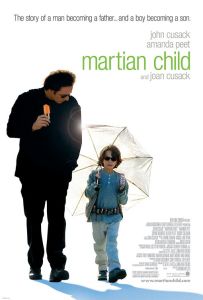 When in doubt for a sentimental story pair up a lonely man with a kid. It worked for Charlie Chaplin, Dustin Hoffman, and even Adam Sandler. There is something fundamentally appealing in an old school Hollywood way about seeing a grown man become kinder, gentler, and loving. Attaching children to slobs and jerks has been historically beneficial in the realm of cinema; they tend to think beyond themselves and become better people. In fact, doctors should take heed and start using children as medicinal services (“Feeling depressed? Raise this adorably precocious child for an indefinite period of time!”). Martian Child is the latest pre-programmed entry in this favorite Hollywood combination.
David (John Cusack) is a science fiction writer still in mourning for his dearly departed wife. He decides to stay true to a plan he and the dead misses had to adopt a child. Enter Dennis (Bobby Coleman), a kid who spends his time in a large box because he believes he’s from Mars. The adoption agency believes that a kid who thinks he’s a Martian would be ideal for a science fiction writer. David reflects that he was an outcast as a kid as well and he sees a side of himself in this spacey kid. David agrees to become a father but is placed on a trial basis because the film needs something to come to a head for Act Three. Dennis says his mission is to learn about “human beingness” but he has other quirks as well; he only eats Lucky Charms cereal, he takes lots of photos as documentation, and he steals items for further study. David learns that parenthood can, shocker, be hard.
 Martian Child champions the tireless idea of the individual in a society of people that follow the herd. You’ll be beaten over the head with the movie’s rampant message of individuality and being true to yourself. David tries teaching his would-be alien tyke that there are benefits in being like everyone else and fitting in, but of course we in the audience know the only reason he would say something against his character’s nature is so that it can be repeated back to him in a time of decision-making. And sure enough, when David’s book editor chastises him for not “being what we want you to be” I felt like Martian Child had given me brain damage with the weight of its browbeating message. The problem, though, is that Dennis is not the center of the film and he’s treated as a gloriously fortuitous writing opportunity. Because of this kiddy K-Pax, David is able to shake off his writer’s block and turn in a story based upon his own experiences being a father to a being from another planet. The point of triumph doesn’t seem to be resolving Dennis’ fragile psyche as it does proving David’s book editor wrong, who we must see gingerly crying as she finishes reading the last page of the manuscript. Take that, heartless barons of mass media!
This would all be fine if Dennis was just different or defiantly eccentric, but Dennis has serious emotional problems and deep psychological issues that David is simply not equipped to handle as a novice parent. Dennis shares a lot of symptoms with Asperger’s Syndrome, a higher functioning level of autism. Watching his developmentally delayed social interaction, his total fascination with a specific topic, and his rigid routine, it seems clear that Dennis does have some form of autism, and autism is a whole lot more than being the fun weird kid that a Hollywood movie can glamorize as an outsider crushed by conformity. The whole setup feels inauthentic and potentially irresponsible.
Much of my displeasure comes back to my feelings about the character of Dennis. Personally I couldn’t stand the kid. Maybe my heart is too cold but I never could find myself getting attached to the pint-sized Martian. In fact, I found him increasingly annoying and his squeaky, horse voice to be like nails on a chalkboard by the end of the film. I was also put off by how the filmmakers seemingly turned little weird Dennis into a miniature version of Michael Jackson – pasty white face, ruby red ring of lips, sunglasses, and a parasol to hide from the oh so hazardous rays of the sun. He does show off some nice Martian dance moves, however, if we recall, Jackson also was adept at walking on the moon.
 Martian Child is also hobbled by a reliance on cloying clichés. Dennis learns to play baseball. Dennis and David have a food fight but not before bonding over smashing a ridiculous number of home items to prove an earth-shattering point that material possessions don’t matter. Inspirational speeches will be recycled later during key points. David is of course a widower because that’s what single men need to be in romantic comedies in order to be acceptable romantic beings. I remember a slew of Disney animated films where most of the main characters had a parent dead or were orphaned, but now it seems that romantic comedies are following suit as well and working under the guideline that it’s better to be dead than divorced. The overt flirtation with his dead wife’s sister (Amanda Peet) seems awkwardly mishandled and needs further elaboration for any of it to sustain credibility. But the most mawkish moment has to be when Dennis is describing his Martian powers and informs us that Martians have the power to grant wishes, and that he will pass one Martian wish over to David to use at his discretion. You better believe that this is going to be referenced during a late third act hug while the music swells. Martian Child may pretend its different but it follows a very well trodden road all the way to the same happy, predictable destination.
I feel bad for Cusack. He deserves better than to headline such a maudlin misfire like Martian Child. This movie wants to aim squarely for the heart but it feels so phony. Watching Cusack interact with a kid is further proof that this man can do damn near anything but he needs some assistance and a sappy story, an annoying child, and a perplexing half-hearted romance aren’t helping. I felt more emotionally involved to the trailer for Cusack’s upcoming Grace is Gone that played before Martian Child than during any of the 108 minutes of this sentimentally cumbersome load. The film is competently made, however, it all comes back to it feeling overwhelmingly phony, being a manufactured tearjerker from the Hollywood factory line. Everything that follows feels like it’s coming from a formula playbook and there’s nothing new or interesting to offer. Perhaps I am jaded and heartless but Martian Child left me envious for the cold reaches of space.
Nate’s Grade: C
Share this:

Jersey Girl (2004)
 Writer/director Kevin Smith (Dogma) takes a stab at family friendly territory with the story of Ollie Trinke (Ben Affleck), a music publicist who must give up the glamour of the big city to realize the realities of single fatherhood. Despite brief J. Lo involvement, Jersey Girl is by no means Gigli 2: Electric Boogaloo. Alternating between edgy humor and sweet family melodrama, Smith shows a growing sense of maturity. Liv Tyler stars as Maya, a liberated video store clerk and Ollie’s real love interest. Tyler and Affleck have terrific chemistry and their scenes together are a playful highlight. The real star of Jersey Girl is nine-year-old Raquel Castro, who plays Ollie’s daughter. Castro is delightful and her cherubic smile can light up the screen. Smith deals heavily with familiar clichés (how many films recently end with some parent rushing to their child’s theatrical production?), but at least they seem to be clichés and elements that Smith feels are worth something. Much cute kiddie stuff can be expected, but the strength of Jersey Girl is the earnest appeal of the characters. Some sequences are laugh-out-loud funny (like Affleck discovering his daughter and a neighbor boy engaging in the time-honored game of “doctor”), but there are just as many small character beats that could have you feeling some emotion. A late exchange between Ollie and his father (George Carlin) is heartwarming, as is the final image of the movie, a father and daughter embracing and swaying to music. Jersey Girl proves to be a sweetly enjoyable date movie from one of the most unlikely sources.
Nates Grade: B


 nathanzoebl
You must be logged in to post a comment.