Blog Archives
Men in Black III (2012)
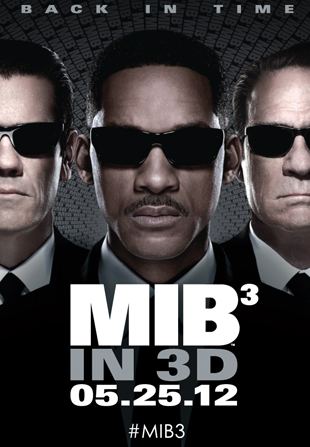 It wouldn’t be a Men in Black film without script problems. The first film languished for some time, originally taking place in Kansas of all places, before director Barry Sonnenfeld became attached and insisted upon a New York City location. The 1997 sci-fi buddy cop comedy was a hit, and rightfully so, and Will Smith became a megastar. Then the 2002 sequel’s climactic action sequence had to be rewritten due to the fact that it was originally going to take place in the World Trade Center. If only that lackluster sequel had gone through more extensive creative revisions. However, these past hiccups don’t seem to come close to Men in Black III, which to Sonnenfeld’s admission, started shooting in late 2010 without a finished script. It had a beginning, an ending, but nothing definite to tie together. So the whole production took eight months off to work on the meat of that movie sandwich. Hollywood movies, especially modern films of huge-scale budgets and set release dates, have routinely started production without completed scripts, including Gladiator, Jaws, Apocalypse Now, and Lawrence of Arabia. Naturally, those are the exceptions to the rule.
Boris the Animal (Jermaine Clement) has escaped from pison and out to seek revenge on the man who put him away and took his arm – Agent K (Tommy Lee Jones). Boris travels back to July 1969, when a young Agent K (Josh Brolin) thwarted the big bad Boris. Boris kills Agent K and alters the future. The Earth is now vulnerable to an alien invasion from Boris’ species. Agent J (Smith) has to travel back in time to save his old partner and the planet.
It’s been ten years since the spotty Men in Black II and almost four years since Smith has been seen in a movie. Where did the time go? Fortunately, this third movie hews closer to the droll brilliance of the first film. Part of that is a sharper story with a more clearly defined goal and a return of the playful exuberance that belies the franchise. Also, I must say that absence has made the heart grow stronger, because I’ve missed Smith’s effortless charisma onscreen. Agent K is such a natural fit for the guy and it’s just fun to watch him stumble through strange alien encounters (this time we learn all super models are aliens; listen good, young women of America who punish themselves to fit this image of beauty). Time travel is usually employed when a franchise seems like it’s all out of gas; it’s usually more focused on the comic fish-out-of-water possibilities, which there are a few in Men in Black III. As one characters notes, 1969 wasn’t exactly a great time for black people in America, and J combats casual racism, black panic, and ignorance with a defiant attitude that is amusing to watch. I’m glad the whole race-relations reality was addressed, though it’s also for the best that the movie doesn’t get bogged down with scenes of Agent J conflicting with bigoted authority. Men in Black III remembers that we’re here to have fun, and the screenplay by Etan Coen (Tropic Thunder) has a light-handed touch. I enjoyed the opening jailbreak sequence with Boris, though I would have thought a lunar prison would have better security. Bill Hader (Superbad) has a fun cameo as a self-hating Andy Warhol, really an undercover MIB agent, though the idea that Warhol’s Factory artists as aliens seem a tad simple. The glaring cameo omission was Jon Hamm (TV’s Mad Men) as a scotch-drinking MIB ladies man of legend.
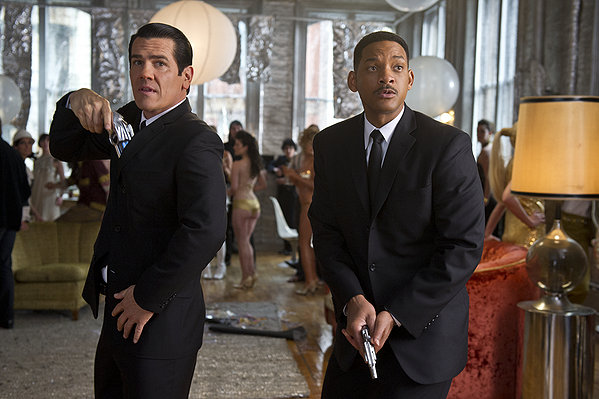 As evidenced from the trailers and marketing, Men in Black III is really Brolin’s movie. The guy establishes an uncanny Tommy Lee Jones impersonation. The eerie brick-faced stoicism, the melodic lilt of his voice, the syncopation of his speech patterns; Brolin nails it all. Watching his interaction with K are the film’s most enjoyable segments. At this point in the series, Agent J and K have gone beyond the rookie/mentor phase and now have something of a friendship, though their arguments at year fifteen of their partnership sound more like the arguments they would have in year two (you need to “open up” and be less grumpy, sounds elementary). Still, there is a personal connection to this case that eluded the last movie, and it gives the film a sense of urgency even when the comic shenanigans seem to hog the spotlight. The personal reveal in the last act didn’t have as much emotional power for me, mostly because I did the math and realized whom a certain unseen character of significance was before we got their true identity. The end does give the film series a circuitous sense of finality.
For a franchise that seems like it can go anywhere at any time with limitless possibilities, the worst thing you can do is be shut off to better avenues of storytelling. Take for instance the climax at Cape Canaveral, which itself is a rather anticlimactic sequence involving the launch of Apollo 11 (don’t they know that alternative 1960s history was sooo summer of 2011?). J has his time travel doohickey that lets him travel back. He gets to use this device once during the climactic fight, allowing him to travel back one minute in time so he knows how to properly duck. That is it. What a fantastic waste. If you’ve got a device that essentially allows for unlimited do-overs, then I want this device to be an integral part of the climax. I want J to have to regularly use it to fix past mistakes and learn more and more from each time jump. Just memorizing how to duck is lame. The entire subplot with Agent O (Emma Thompson in the present, Alice Eve in the past) and her dalliance with K is so carelessly thrown away that I wonder why the filmmakers even bothered to include it. Then there’s our villain, Boris, whose name itself is even lazy. He’s just a bad dude with some sort of insect that lives in his hand and shoots spikes. That is it. He’s a guy who can fire projectiles. So what? What about that makes him interesting? An unrecognizable Clement (Flight of the Conchords) does his best but the character just doesn’t have anything about him that deserves special attention; he could have been any villain (I think Vincent D’Onofrio was undervalued in his go-for-broke physical performance as the first film’s villain). I did like the idea of Present Boris arguing with Past Boris, but like most promising ideas in Men in Black III, this space-time sparring is never fully realized. While enjoyable, there’s little you’ll be able to think back on with Men in Black III and say, “That was well developed.”
Paradoxically, I think Men in Black III has a character that might simultaneously be the best and worst thing about the film. Allow me to explain. About halfway in, we’re introduced to the alien Griffin, played by the great Michael Stuhlberg from A Serious Man and TV’s Boardwalk Empire. He’s a creature who can see nigh unlimited timelines, all the variations of choice and possibility play out before his eyes, one after another. He never knows which timeline he’s in until the moment occurs, thus he’s constantly worried about every moment to come in his life. This foreknowledge sounds like a wretched curse, and with Stuhlberg gives a forlorn edge to his character’s eccentricity. So when J and K meet the guy, there are some clever moments, like when Griffin details every peculiar aspect of chance that lead to the 1969 Mets World Series victory. The moment, and by extension the character, is a nicely reflective idea that every moment is a miracle of causation. Griffin is just an interesting character. Here’s where the worst part comes in. Rarely is he treated as a character because, you see, Griffin is really a magic plot device. He can tell the Men in Black agents whatever they need to do at any point, instantly providing a narrative cheat. When in doubt, just ask the guy who sees the future and he’ll steer you without fail to the next necessary plot point.
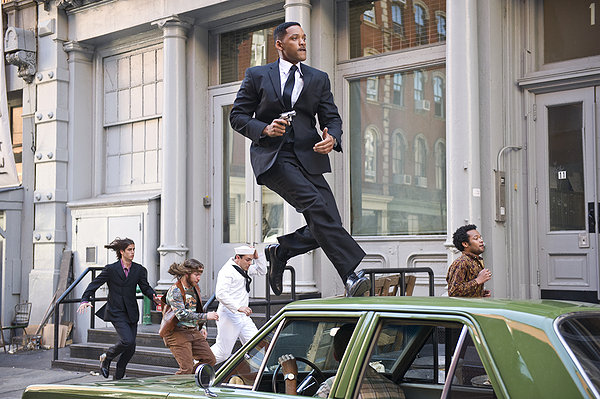 I saw this movie in 3D, not by choice mind you, and for the first half hour it felt like one of the better 3D conversions out there. Sonnenfeld’s camera plays a lot with depth of field and primarily forward-backwards movement, which made for a slightly elevated viewing experience. But somewhere around the halfway mark, I swear the movie forgot it was supposed to be 3D and the dimensional differences became negligent. It never really recovers, and so I advise all potential ticket-buyers to skip the 3D screenings.
With most time travel escapades, there’s going to be some plot holes. Working with a flurry of alien technology, it would have been exceptionally easy for the filmmakers to just explain away the plot holes with some magic device, much like the Paradox Machine in Dr. Who. Hey, there’s a machine that makes sure we don’t have paradoxes? Good enough for me. It’s like in Thank You for Smoking when Rob Lowe’s character explains why actors would be able to smoke in an all-oxygen space environment: “It’s an easy fix. One line of dialogue. ‘Thank God we invented the… you know, whatever device.’” The fact that Men in Black III doesn’t even address its biggest plot hole astounds me. If Agent K is killed in 1969, then he was never alive to recruit Agent J into the service. Let’s even assume that J’s credentials would still get him noticed and staffed with the MIB; if Boris killed Agent K in the past, then there was no reason for Boris in the future to travel back in time to kill Agent K. Again, these aren’t nit-picky gripes, these are major, easily understood plot holes, and I’m dumbfounded why no characters even address them. I could nit-pick over why Boris decides to go to 1969 when he just as readily could have gone to a time when K was a child and thus more vulnerable. Surely a child is easier to dispatch than a 29-year-old man.
Men in Black III is a far improvement over its stilted predecessor, but it still ends up falling well short of the potential it flashes. It’s intermittently amusing with some fun cameos and some visual panache, but this movie should have been stronger, stranger, and more playful with its central time travel conceit. It’s hard to work up that much distaste for the movie, especially since it has such a lively, jocular feel. Not all of the jokes work, but enough do, and the movie maintains an overall pleasant sensibility, zigzagging in imaginative directions that most Hollywood movies never beckon. It’s the stuff that works that illuminates the potential left behind as it goes into summer blockbuster territory. Men in Black III is an example of diminished returns, yes, but some franchises start so high that even latter, lesser sequels will have more entertainment value than their competitors. While it won’t set the world on fire, Men in Black III exceeds expectations and provides enough entertainment that it’s worth a look and little else.
Nate’s Grade: B
Share this:

An Education (2009)
 In 1961 Britain, Jenny (Carey Mulligan) is a 16-year-old schoolgirl plowing away at her education. She?s on track to enroll at Oxford “reading English” and her parents (Alfred Molina, Cara Seymour) have overscheduled the girl with hobbies and clubs to help build her academic portfolio. Then one rainy night she meets David (Peter Sarsgaard), a thirty something man who offers to give her and her cello a ride. This enchanting man keeps coming back around to see Jenny, sweeping her off her feet. He invites her to go to concert recitals with his older friends Danny (Dominic Cooper) and Helen (Rosamund Pike), trips to the country, and even a fabulous getaway to Paris. “You have no idea how boring my life was before you,” she confesses to David. But David is coy about how he can pay for such extravagances. Jenny’s grades begin to suffer and it looks like she may miss out on being able to enroll at Oxford. She has to make a decision whether to continue seeing David or going back to her primary school education.
An Education is a handsomely recreated period drama that manages to be very funny, very engaging, and very well acted. It’s also rather insightful and does an exquisite job of conveying that strange wonderful heartsick of love, maybe better than any movie since My Summer of Love. You can practically just drink in all of Jenny’s excitement. Jenny isn’t a silly girl prone to naivety. She’s a smart and clever girl, and not just because other characters say so or we see her stellar test grades destined for prime placement on the fridge. You witness her intelligence in how she interacts through different social circles. Since the movie is entirely Jenny?s story, we need to be convinced that she’s smart in order to believe her willingness to be duped. She has reservations about David’s habits but doesn’t want to risk going back to a dull life of books and family dinners. She has to be a smart, vibrant girl anxious to keep a good thing going, willing to ignore certain warning signs that otherwise might cause her pause. Even Jenny’s parents get caught up in the seduction, swooning over David and his upper class connections and comforts.
 The teen-girl-with-older-male aspect might make us squirm, but in the realm of 1961 Britain, it’s acceptable. Jenny and David don?t need to hide their affair in dank hotel rooms and avoid any suspicious eyes. We don’t get any agonizing inner turmoil over dating a teenage girl, mostly because it’s from Jenny’s perspective and that everybody else seems okay with it all. This acceptance means that the drama for An Education can focus on something less seamy. That doesn’t mean that everybody approves. While Jenny’s friends think she hit the jackpot, and hang from her every word about her amazing sophisticated boyfriend, her literature teacher (Olivia Williams) sees through David?s whirlwind of charms. This isn’t the tale of some girl being drawn into the dark side, turning into an unsavory, rebellious teenager flouting the law and good manners. Jenny is not that kind of gal.
Mulligan is fantastic and delivers such a sumptuous performance that you feel like a human being is coming alive before your eyes. She lights up with the dawning realization that a charming and worldly man is courting her, and you feel every moments of her swirling delight and awe. Mulligan even goes so far as to get even the small details right, like the way Jenny opens her eyes to peak during a kiss to make sure it’s all not just some passing dream, or the way she has to look away at times and break eye-contact because she’s just so happy, with those twinkling eyes and a mouth curling like a cherry stem. She’s bashfully coquettish in her physical attraction to David, though in my praise it also sounds like I, too, have fallen for the girl. Much ink has been spilled declaring Mulligan as a rising Audrey Hepburn figure, mostly because she sports that famous short bob of a haircut that many girls had in 1961. To me, Mulligan gives a stronger impression as being the luminescent little sister to Emily Mortimer (Lovely & Amazing, Match Point). Mulligan is a fresh young actress that delivers a performance of stirring vulnerability. It’s a breakout performance that will likely mean that Hollywood will come calling when they need the worrisome girlfriend role for the next factory-produced mass-market entertainment (she’s finished filming the Wall Street sequel, so perhaps we’re already there).
 Adapted by Nick Hornby (About a Boy) from a memoir by Lynn Barber, An Education follows the coming-of-age track well with enough swipes at class-consciousness. But man, I was really surprised how funny this movie is. An Education is routinely crackling with a fine comic wit, and Jenny and her father have the best repartee. Molina is an unsung actor and he dutifully carries out the role of “uptight neurotic father” with more than a stiff upper lip; the man puts his all in the role. While he can come across as hysterical at times, Molina is paternal with a capital P. It’s refreshing just to listen to smart people banter at an intelligent level.
The movie’s theme ponders the significance of education. There’s the broader view of education, learning throughout one’s life from new and enriching experiences. She gets to learn a bit more of the way of the world, and Jenny feels that she can learn more and have fun with David than sitting through lectures and slogging through homework. She values what David has to teach her above what she can find in a textbook. Jenny’s father stresses the virtues of learning and thinking but once Jenny has a chance to marry an upper class, cultured male then education no longer matters. She is now set for life through David. All that learning to become a dutiful housewife in a lovely, gilded cage. Is that the real desired end to personal growth: to snag a husband? The school’s headmistress (Emma Thompson in practically a cameo) doesn’t serve as a great ambassador to higher learning: she stresses the lonely hardships, internal dedication, and she herself is openly anti-Semitic, proving that an intelligent mind is not the same as being open-minded. To her, Jenny is jeopardizing her lone chance at a respectable life.
 Jenny rejects the traditional route of education and chooses to pursue a life with David, that is, until the third act complications beckon. Jenny finds out about David’s secret rather too easily, I’m afraid (secret letters should never be hidden the glove compartment). While the end revelations are somewhat expected, what is unexpected is that every character pretty much escapes consequences by the end of the film. No one is really held accountable for his or her decisions. Pretty much everyone is exactly where he or she left off just with a tad more street smarts. It’s the equivalent of learning not to trust every person after getting ripped off.
Despite all the hesitation, and the age difference, An Education is an actual romantic movie. It’s a coming-of-age charmer with all the preen and gloss of an awards caliber film. You feel the delight in the sheer possibility of life for Jenny. The story unfolds at a deliberate pace and allows the audience to feel every point of anxiety and bubbling excitement for Jenny. Mulligan gives a star-making performance and practically glows with happiness during the movie’s key moments, making us love her even more. The plot may be conventional but the movie manages to be charming without much in the way of surprises. Still, An Education is a breezy, elegant, and clever movie that flies by, even if its biggest point of learning is that age-old chestnut that something too good to be true must be.
Nate’s Grade: A-
Share this:

Last Chance Harvey (2009)
 There aren’t too many movies that feature a middle-aged romance. That’s really the sole draw here. Harvey follows the titular dad (Dustin Hoffman) as he travels overseas to his daughter’s wedding. His life is in shambles and he strikes up a friendship with a downtrodden woman (Emma Thompson) that eventually percolates into romance. The interaction between Hoffman and Thompson is relaxed and charming but the storyline is too slight and predictable. This whirlwind courtship spans one single day, so the movie feels too brief. We’re just getting to know these characters and enjoying their chemistry when the movie just limps to a close. Last Chance Harvey feels less like a movie and more like the first act of a movie. The plot is predictable and hits all the resolution points it needs to, which means get ready for tear-jerking wedding toasts from men who’ve changed and grown wiser over the course of 24 hours. Last Chance Harvey is a mildly pleasant diversion with two talented actors making the most of a shopworn and abbreviated story.
Nate’s Grade: B-
Share this:

Stranger than Fiction (2006)
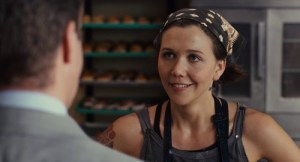
 Ever think your life would make for a good story? Be careful what you wish for. Harold Crick (Will Ferrell) is hearing voices. They aren’t telling him to kill or do anything subversive. In fact it’s just one voice, an English woman, and she isn’t instructing Crick to do anything. No, she’s more so just… narrating. She comes in and out and expresses the doldrums of Crick?s life. He’s an IRS agent whose life revolves around order, repetition, and numbers. We can even see his inner tabulations thanks to some snazzy onscreen visual effects. Crick is sent to audit Anna (Maggie Gyllenhaal), a baker with a disdain for civil servants and authority. Crick is stricken by this shrewd beauty and finds himself wanting her, something the Narrator affirms for him. Crick’s life takes a dour turn when the Narrator lets on that Harold Crick had set in motion his “imminent death.” Crick is confused and seeks advice from Professor Hilbert (Dustin Hoffman) an expert on literature. Then they figure out the Narrator is Kay Eiffel (Emma Thompson), a famous writer who has the unfortunate habit of bumping off every one of her main characters.
Make no mistake, Stranger than Fiction is funny, but it’s a different kind of funny than most people are accustomed to with Ferrell. In my theater, I kept an eye on a gaggle of teenagers sitting several rows in front of me. I just wanted to observe their body language and what I saw was a lot of fidgeting, getting up for trips to bathrooms and popcorn, and lots of whispery talk. I can only imagine the disappointment of those teenagers expecting Ferrell to rip his clothes off and run around like a buffoon. They were likely busily thumbing away at their ever-present cell phones, text messaging their friends. People that are looking for a wild, sidesplitting, slapstick comedy are going to shaking their head. Stranger than Fiction is funny, but it’s in a very dry, witty way, much like British humor; it’s a humor you can admire for being clever but might not make you roll in any aisle.
 The biggest fans of Stranger than Fiction will be bookworms. This is a very literate movie that works better for those with an appreciation or outright love of literature and storytelling. Professor Hilbert doesn’t initially believe Crick until he learns that Crick’s narrator said, “Little did he know.” That, ladies and gents, is all a professor of literature needs. He has to rule out what kind of story Crick may be apart of, so he subjects Crick to a series of hilarious questions along the lines of treasure-inheriting, nemesis-making, and magical-creature befriending. Crick keeps a notebook to tally examples in his life that may point to whether he is part of a Comedy or a Tragedy. Professor Hilton even explains the difference: in grand Shakespearean tradition, a comedy ends with people getting hitched and a tragedy ends with people getting snuffed. This is all fabulously witty and extremely fun, but I can think you’ll see why hard-core fans of Old School and Talladega Nights might be heading for the exits.
Writer Zach Helm has created a wonderfully whimsical tale that’s trippy but manages to still have warmth and a firm heart. It’s far more embraceable a movie than, say, Adaptation, and less smug. He has a smart sense of humor and loves deconstructing literature, like the Jasper Fforde (The Thursday Next books) of screenwriting. We are really sucked into the movie from the moment we can hear Thompson. The story has an innocence to it and this existential comedy feels out there but still grounded; it’s surprisingly poignant and full of dramatic revelations. Even better, Helm has done something that few have achieved: he wrote a story-within-a-story that works. Kay’s narrative voice is highly droll in her observations on Harold Crick’s life. It sounds like a genuine novel, and on top of that, a novel I would enjoy reading. Stranger than Fiction is all the proof I need that Helm is a talent to keep track of.
 The performers all seem to have the same affection for the material. Ferrell is making that leap from funnyman into leading man, the same dramatic territory Robin Williams first tiptoed in Good Morning Vietnam and, likewise, Jim Carrey approached in The Truman Show. Ferrell won’t turn any heads but he underplays his performance maturely, playing a sad but sweet drone of a human being finally taking charge of his life under very insane circumstances. There’s a quiet moment toward the end where Ferrell is told he must accept his fate and he sits, shell-shocked, tearing up, his voice getting softer with every word. It’s only a moment but it piques my interest in what Ferrell may have in the tank. The comedy he can do in spades, including a desperate moment when he tries narrating his own life to coax his Narrator out of hiding.
Who will turn heads, however, is Gyllenhaal. I can already see a nation of teen boys falling in love with her tattooed, punky baker. To them I say, get in line pals, Gyllenhaal has made me dot my I’s with hearts ever since her star-making performance in 2002’s kinky romantic comedy, Secretary. She’s easy to fall in love with and expresses a fragile compassion to her role. The romance between Anna and Crick is unexpected but these two people need each other, and you feel that need as you watch their eyes light up as their relationship blossoms. Late moments between them add to the tenderness of the film and you will be on your knees pleading Crick is spared so he can return to loving Anna. I think Wreckless Eric’s “Whole Wide World” will become a potential staple on romantic teenage mix CDs sent to their sweethearts from now on.
Thompson and Hoffman have appealing supporting performances. Thompson has marvelous fun thinking of different grisly outcomes in store for Crick. Her interaction with the hospital staff to see the “not gonna make it people” is a howl. But Thompson is too good of an actress to play it straight. Once she discovers the life-altering implications of her writing she is crushed by guilt, obsessed over killing good people cruelly. Frankly, if I had anyone narrating my life, Thompson’s voice would definitely rank high. Hoffman plays a dedicated literary professor like a straight man, and everything seems on the level for him, even the fantastic. It’s a nice touch for a film that doesn’t require broad strokes.
 The movie doesn’t have the depth of feeling or dark turnarounds that I know Charlie Kaufman would have done. Stranger than Fiction has a lot of fun with a very ripe premise, and is very intellectually stimulating, but you do feel like it could have gone further, exploring the reaches and implications of its metaphysical setup. What if someone who read Kay’s manuscript thought it was such a masterpiece, a shining light of literature that could move mountains, that they knew Crick must die, and that they must kill him to make certain of it. Or what about the relationship between author and character, and the role each has over the other and perhaps a battle over the future, a typewriter, and a happy ending at the end of a tunnel. However, while all of these options would further explore the novel premise, it would betray the movie’s whimsical tone. This isn’t a very dark movie. It has an authentic sweetness to it, and Crick is a gentle and kind man, and to do anything too heavy would work against the film’s tone. The movie explores existential queries and the topics can be grim, but ultimately Stranger than Fiction is life affirming.
Stranger than fiction also has a buoyant, unexpectedly pleasing romance to it. Again, it doesn’t show the depth of love and human feeling that Kaufman’s Eternal Sunshine could, but this is an unfair comparison. This romance is more a subplot that carries increasing weight thanks to heartwarming performances and the winsomely adorable Gyllenhaal. The romance in Eternal Sunshine was the story, and everything else was outside variable coming into contact. It might sound dismissive to call Stranger than Fiction as decaf Charlie Kaufman, but it really is a compliment. Kaufman is the most exciting, brilliant, creative, insightful, and whacked out screenwriter working today. I would give one of my kidneys to write even one story that could be described as decaf Kaufman. Stranger than Fiction may not examine as many themes, conflicts, or relationships as Kaufman might with the material, but this movie is a sweet fable that floats by like a fluffy cloud on a sunny day. It’s just so damn pleasant you sort of soak it in and fall in love, not wanting to leave.
Stranger than Fiction is strange, all right, but gloriously so. Scribe Zach Helm has concocted an existential fairy tale aimed for bookworms and outsiders. The premise is clever but the film doesn’t stop there, and Helm explores the implications of his premise with whimsy, charm, and a sweetness that is hard to rebuke. The wacky story seems reminiscent of Kaufman’s works, but it has a more heartwarming and embraceable appeal. Great performances from a game cast help to push the material even further into excellence. It has a small handful of flaws, perhaps a too limited scope, but that doesn’t stop Stranger than Fiction from being one of the best stories of 2006 and one of the best movies too.
Nate?s Grade: A-
Share this:

Harry Potter and the Prisoner of Azkaban (2004)
 The first two film adaptations were huge hits, but were derided by some as being too loyal to the books that it stifled the creativity. Now, Harry Potter and the Prisoner of Azkaban is out and its the first film to deviate from the books. How will Potter nation take the news?
Harry Potter (Daniel Radcliffe) is entering his third year at Hogwart’s School of Witchcraft and Wizardry. Harry is also getting older, getting angrier, and learning more and more about his parents. Hes on alert that the murderer, Sirius Black (played the fabulous Gary Oldman), has escaped from Azkaban prison and is out to get Harry. Black had a hand in the deaths of Harrys parents, and now it seems hes looking to finish what he started as a follower of Lord Voldemort. Harry relies on his friends, Ron (Rupert Grint), Hermione (Emma Watson), and a kindly new Defense Against the Dark Arts teacher named Lupin (David Thewlis) to conquer his fears, his burgeoning hormones, and to face Black when the time comes.
The best decision the Harry Potter producers made for this chapter of the series was in getting a new director. Alfonso Cuaron finally infuses the Potter series with a sense of visual life. Instead of Chris Columbus’ stubborn admiration of his fake opulent world, Cuaron keeps things fluid with a constantly roving camera and long takes. For the first time in the series, you can argue that this Harry Potter film looks and feels like its own actual movie. Gone is Columbus annoying penchant for displaying everything in close-ups. The film also benefits from some new realistic exteriors and dressed-down attire, ditching the school uniforms. Theres also a new cinematographer, so instead of Columbus dull amber glow, the series takes a gratifying turn toward the menacing, with an emphasis on dreary blacks and silvers.
 The best improvement of all, however, was in getting away from the apparent slavish loyalty to the books. The third book is the longest of the three but the third film is the shortest; 15 minutes shorter than Sorcerer’s Stone, and 25 minutes shorter than Chamber of Secrets. Thank God. At the rate they were going I thought the next book, Goblet of Fire (700-some pages), was going to be like 9 hours.
So, under Cuaron’s guidance, Prisoner of Azkaban eschews the unnecessary plot elements and details fans will grumble over but moviegoers couldnt care less over (Quidditch?). Cuaron’s film may be heavy with exposition, but it never talks down to its audience. The result is a movie trying to be a movie and not trying to cram in as many details of the world as possible so fans wont have their feathers ruffled.
The young actors of Hogwarts have definitely been struck by puberty, and it has done their acting a world of good. Radcliffe will never be an exceptional actor but here he presents new and interesting dimensions to Harry demonstrating his arrogance and tempestuous anger. Tom Felton, who plays the snarky blonde-haired Draco Malfoy, appears to be maturing into a ganglier Macaulay Culkin. The one actor that truly seems to have a bright future, though, is Emma Watson. You cannot help but love her whenever she’s on screen and she seems to be developing into a fine actress.
The most notable addition to the adult staff in the film is Michael Gambon, replacing the late Richard Harris as Hogwarts headmaster, Dumbledore. Gambon turns the character from a kind-hearted grandfather type to more of an aging hippie but it works. Emma Thomson also appears as some sort of psychic professor, teaching students to read tea leaves; however, her entire role seems superfluous unless it impacts future installments (I have not read a single book). Once again, Alan Rickman rules all and needs to get more time in these movies. I don’t know how, but it needs to happen. Thewlis is the most welcomed addition in his pivotal role as Professor Lupin and delivers some of the more dramatic scenes of the film with radiance and ease. He creates a lovely father-son relationship with Harry that supplies Azkaban with a nice sense of compassion. Oldman is similarly great but unfortunately he shows up so late into the film that he seems terribly underused. There is a scene late into the film, where Thewlis, Oldman, Rickman, and the great character actor Timothy Spall share a scene. I never thought it would be a children’s fantasy series that would finally unite all these talented British stage actors but I’m thankful for it nonetheless.
 Prisoner of Azkaban is the darkest tale yet, and Harry Potter works best when things get scary. The nightmarish element design creates a wonderful sense of dread, and Cuaron deftly handles his young characters dealing with rage and death and, scariest of all, budding hormones. Theres even a sly nod to Cuaron’s steamy coming-of-age film, Y Tu Mama Tambien (it involves a three-way hug between our trio of kids).
he effects of the film are beautiful and greatly add to the entertainment value of the film. The Dementors, cloaked flying guards of Azkaban prison, are terrifying to look at, and their leitmotif of chilling the air when they are near makes for some great visuals and ominous moments. I got actual goosebumps the first time they arrived on-screen, and then when I saw this film a second time, fully knowing the story, my skin still crawled when they arrived. Perhaps the greatest addition to Harry Potter‘s special effects bestiary is the Hippogriff, which resembles a combination between an eagle and a horse. It is a gorgeous creation and worlds better looking than the three-headed dog from the original film. It also provides one of the more breath-taking moments of the film, when Harry goes soaring across a lake on the back of the Hippogriff.
Having said all this, yes Prisoner of Azkaban is the most exciting and visually alluring film of the series, also its darkest, but I couldn’t help feeling disappointed with the central storyline. Most people will love it, especially fans of the books, but after walking out of the theater I could not help but wonder if the film had a climax at all? It really kind of didn’t. There was no sense of real story momentum and the middle had some definite moments of drag. The last act of Prisoner of Azkaban is exactly like Back to the Future Part 2: time-travel, correcting the future, not running into your past selves. This is not a good comparison. So while the characters are getting more interesting as they get older, this plot doesn’t really hold up very well. It almost feels like a preface of whatever events will come in the fourth film.
Prisoner of Azkaban is an interesting watch. I am told it deviates the most from the book and it manages to generate a considerably darker and scarier atmosphere than its predecessors. For my money, any changes are good, as films are about ADAPTATION and not copying, so dispensing with subplots and details is A-Ok with me. But how will the die-hards react? Im sure youll hear plenty of grumbling all over, but Cuaron has injected needed life into this series and presented an idea of what it can grow to be. So, while I think Prisoner of Azkaban has a superior visual sense, pacing, and adaptation; I also feel the story may be the weakest we have been told. I can only imagine what the outcry will be among the fan base when Goblet of Fire is released November 2005 as one film.
Nate’s Grade: B+


 nathanzoebl
You must be logged in to post a comment.