Blog Archives
The Hours (2002)
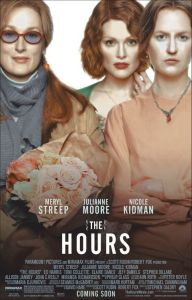 Okay, after watching the Golden Globes award show and seeing The Hours crowned with the highest prize, and hearing incessantly about Nicole Kidman’s fake prosthetic nose in the movie, it was time to venture into that darkened theater and see how good the awards-friendly The Hours was. Little did I fully realize what I was getting myself into.
Nicole Kidman plays Virginia Woolf, who is in the midst of writing her novel Mrs. Dalloway, where she proposes to display a womans entire life through the events of a single day. Julianne Moore plays Laura Brown, a housewife in 1951 having difficulty adjusting to a domestic life that she feels ill equipped for. Meryl Streep plays Clarissa Vaughan, a gay copy-editor in 2001 planning a party for a poet and former lover (an emaciated Ed Harris), who is suffering from the late stages of AIDS. These three storylines will be juggled as the film progresses, with each womans life deeply changing before the end of the day.
The Hours is a meandering mess where the jigsaw pieces can be easily identified. The attempt at a resolution for an ending, tying the three storylines together, is handled very clumsily. The film spins on and on that you start to believe the title may be more appropriate than intended. What this movie needed was a rappin kangaroo, post haste! The film is wrought with victimization and screams ”Give me an award already!” Before you know it youre being bludgeoned to death with what is profoundly the most over serious Lifetime network movie ever assembled. And there’s nothing fundamentally wrong with Lifetime movies but The Hours does not share the sensibilities of its TV brethren.
 Kidman, nose and all, gives a strong performance displaying the torture and frailty of a writer trapped within her own mind but too often relies on wistful staring or icy glares. Moore is effectively demoralized but cannot resonate with such a shallow character. Streep is the least effective of the three and fizzles among an over-stuffed assembly of characters.
The supporting cast is unjustly left for dead. The characters are seen as parody (Toni Collette as Moore’s un-liberated homemaker neighbor), extraneous (Claire Danes as Streep’s daughter, Allison Janney as Streep’s lover, Jeff Daniels as Harris ex-lover, you know what, almost anyone in the Streep storyline), one-note (the workmanlike John C. Reilly who plays yet another doting and demystified husband) or merely obnoxious (Moore’s brat child that refuses to separate from her). It appears The Hours is the three lead actress game, and everyone else is not invited to play along.
Stephen Daldry’s direction shows surprising stability and instinct after his art-house pandering Billy Elliot showed little. The technical aspects of The Hours are quite competent, especially the sharp editing and musical score, which just points out further how slickly hollow and manufactured the film is.
The Hours is an over-glossed, morose film that is too self-important for its own good. It sucks the life out of everything. And for all its doom and gloom and tsunami of tears, the only insightful thing The Hours is trying to pass off onto the public is that women are more depressed than you think.
Nate’s Grade: C
Share this:

Enemy at the Gates (2001)
 Enemy at the Gates tells its tale over the pivotal Battle of Stalingrad where over a million Russians lost their lives to repel the German advancement. The Russians at this point were throwing boys as young as school kids into the battle and arming some of them with nothing. It was an attempt to create wave upon human wave to overrun the Germans. The Battle of Stalingrad was a decisive moment in WWII, but how Enemy of the Gates portrays it – the battle was nothing. The entire war was turned by two men.
The beginning to the film (and also the best part) shows the immediacy of the war and is very parallel to the Omaha invasion. People are shepherded into box cars onto a train, then arrive on the river and travel by barge to the ports of Stalingrad, then are sent up a hill one with a rifle and one with the rifle’s ammunition, and then thrown into the battle on the other side. Literally, an hour could pass from leaving home and death. Enemy at the Gates doesn’t paint a pretty picture of the Russians themselves (this is a Hollywood film after all) and displays the Russian war tactic of firing on your own men if they have the gall to retreat.
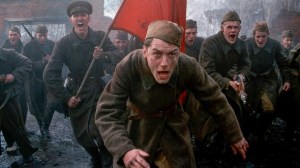 A survivor of the slaughter is Vassily Zaitsev (Jude Law), a rural farm boy with a great shot. He takes out a slew of Germans that have him and fellow Russian Danilov (Joseph Fiennes) trapped in the ruins of a city. Once back to friendly quarters Danilov decides to turn Vassily into a hero and prints numerous propaganda fliers and articles about his many triumphs to increase the morale of the faltering Russian army. Vesilly becomes a hero and a celebrity, though he continues to have his doubts if he can live up to his inflated image.
Rachel Weisz (The Mummy) plays the peppy patriotic girl who comes between our two mates creating an awkward Hollywood favorite: the love triangle. The very fact that she, and other women, are out there on the front lines defending their Motherland should not be taken as something in the advancement of feminist ideals in WWII Russia – at this point in the war them Ruskies would arm dogs and squirrels if they could.
Enemy at the Gates introduces its villain as an expert Nazi sniper played by recently Oscar nominated actor Ed Harris. Harris plays the character cold, yet sincere, like he is following the ways of war but not because he wishes to. He has a duty and he will accomplish it, down to the meticulous wire if he must. Harris’ sniper is sent in to assassinate Vassily Zaitsev and more importantly kill the morale of the Russians. This sets up the film’s showdown between the Law and Harris. Two men who are patient and silent killers dueling to see which one of them blinks first. A cat and mouse game amongst the fallen remains of a once proud city.
At least that’s how it happened in real life. The two men played a waiting game that went on for over two days to see whom would move first. The Nazi slipped and wound up dead. But this standoff where you couldn’t move for fear of being shot at any moment of weakness would’ve been fascinating alone to tell, especially if done straight. Instead we get Hollywood’s Saving Private Ryan.
 A rather peculiar aspect associated with Enemy of the Gates is the amount of people that die from being shot in the head. I mean, I actually looked and counted, there was maybe two people in this film that did not die from bullets that were not exploding through their heads. It gets a little silly as it goes and almost becomes an unintentional joke as we go on with 15… 20… 40 some CGI shots of bullets zipping through people’s foreheads. And the way the snipers are portrayed has it seem like a slasher film – you duck your head around that corner you are instantly dead!
Director Jean-Jacques Annaud’s previous film was the pretty but oh-so-mind-numbing-long Seven Years in Tibet. Here he takes the torch from Spielberg and plays with all the Ryan elements; dabbling with some blues, and muddy browns, and wreckage and what not. Annaud’s film is less a war film and more of a war propaganda film showing the strong effects it can attribute. Annaud also has the distinction of having the most awkward sex scene I’ve ever seen in a film. Weisz comes into where Law is sleeping and sneaks under his blanket. Except Law is sleeping in a row of other soldiers all lying on the cold cement ground with rubble all around them. The scene is very awkward to sit through and I feel will become notorious for it.
The movie isn’t all bad. Some scenes do have good tension and excitement. Law and Harris give credible performances, and Bob Hoskins appears for a very memorable role as Nikita Khrushchev. Enemy at the Gates is a war movie played with Hollywood elements that are as clear as day and weigh down whatever chance the film had. And would it have killed the cast if they could have tried a Russian accent!?
Nate’s Grade: C+


 nathanzoebl
You must be logged in to post a comment.