Blog Archives
The Infiltrator (2016)
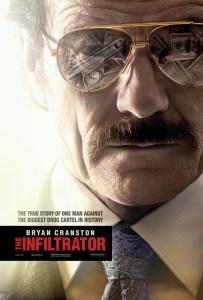 In the mid 1980s, Pablo Escobar and his cartel were responsible for billions of dollars worth of narcotics filtering into the United States. It’s the kind of work that can fill up Robert Mazur’s (Bryan Cranston) career. He works as a Florida Customs agent but his specialty is going undercover for his assignments. He’s called out of retirement with the promise of striking high in the ranks of Escobar’s ring of lieutenants. Mazur’s partner, Emir (John Leguizamo), uses an unreliable informant to start the new identity, and so Mazur poses as a money laundering expert who offers his sundry services to the Colombian cartel. After blurting out that he has a fiancé in lieu of accepting a prostitute’s services as a very 80s way of saying “thank you,” the agency must now provide him with a fake wife, played by rookie agent Kathy Ertz (Diane Kruger). The two have to rely upon one another in a world of criminals and murderers who would have no gutting them.
My main feeling once The Infiltrator had come to its natural conclusion was that everything about this movie should have been better. It’s a terrific premise as we follow the undercover travails of a man trying to stay one step ahead and keep his dual lives separated, invariably having them bleed into one another especially as danger escalates and his cover may be blown. Then you add an untrained partner and the conflict magnifies from there. Then you have Mazur work his way up the food chain to the major lieutenants of Pablo Escobar. This movie should be exploding with dramatic irony, weighty decisions, and magnificent suspense, but it’s really not. So why not?
 One reason is that the movie whiffs with its modest ambitions, namely in its shallow character study of Mazur and the lingering effects of pretending to be a very bad man. Going undercover has to be one of the most stressful jobs in law enforcement, and living two different lives has to have a noticeable psychological impact, eating away at our protagonist and affecting his relationships and sense of self. That doesn’t happen with The Infiltrator as the few glimpses we get of Mazur’s home life are mostly harmless check-ins. A red light is installed in his home to mean a secret special phone line. You would assume that some family situation has to draw out conflict from this scenario, maybe Mazur’s little girl answering the phone before he can reach it. Nothing of consequence happens with daddy’s special red light phone. The family, absent anything important to do but wait at home, becomes a drag on the narrative and doesn’t even fulfill what you would assume would be its primary service: contrast. In the world of The Infiltrator, sex, money, and drugs are rampant, but our protagonist is unaffected. He remains the same character from the beginning of the story to the end. We don’t really learn more about him other than he is skilled at going undercover. We don’t see any particular toll on him psychologically. We don’t feel the threat of what he’s going through because the movie doesn’t pretend it matters enough.
Going undercover with the Medellin Cartel should provide endless suspense scenarios. This movie should be rife with conflict, and yet it consistently finds deflating, coincidental outs to save its characters. As a good screenwriting rue of thumb, it’s acceptable to use coincidence to put your character into greater danger. It’s not a smart idea to use coincidence to save your character from danger. Example: in Donnie Brasco, a man approaches Johnny Depp’s character and clearly refers to him by his agency name, implying working together with the FBI. That’s a good use of coincidence. With The Infiltrator, Mazur’s secret recording in his briefcase is discovered by a mid-level cartel operative, for once it feels like Mazur is vulnerable. Then the movie quickly dispatches with this guy for a rash explanation and so he takes his secret to his grave. There’s another moment where Emir’s informant is about to squeal to some very bad people, with Emir in the room sweating bullets, and he too is wiped out before sharing his privileged information. The movie is filled with these frustrating solutions just when it seems like tensions is developed. The entire appeal of the undercover mob movie is the twists and turns to hide the real identity and make it out alive. I’m genuinely dumbfounded how much of this movie just skates by with little regard to drawing out effective tension.
I think I can crystallize just how poorly The Infiltrator handles its many threads of conflict with one great example. Kathy and Robert Mazur are fake getting married according o their cover stories, so what else does a fake bride-to-be do but seek out her fake husband’s tuxedo that he wore decades prior upon his real wedding to his real wife? Why does Robert need to wear the exact same tuxedo? Can his office not afford to rent a new one that likely more accurately represents his fitting size? Even if this cost-cutting measure was plausible, why must Kathy be the one to pick it up, and from Mrs. Mazur? It’s contrived and forced conflict to shove these two characters together, so that Mrs. Mazur can ask pointedly, “Are you sleeping with him?” Rather than say nothing, or dismiss the assertion, Kathy provides what has to be the most irritating and obfuscating answer: “I think you know the answer to that.” Does she? The film seems to think there is a simmering sexual tension between Kathy and Robert Mazur, but it never materializes. I guess we’re just supposed to assume a sexual tension. This scene is a pristine example of characters operating at a sub-level of intelligence because the movie wants to force contrived drama when there is already plenty of organic drama being ignored.
The last third of the movie is built around the relationship that Mazur and Kathy form with Robert Alcaino (Benjamin Bratt). With an actor of Bratt’s stature, you’d be lead to assume his character will have a significant amount of screen time; however, The Infiltrator also boasts blink-and-you’ll-miss-them performances from Amy Ryan and Jason Isaacs, so maybe not. Bratt’s character is a family man and we’re treated to several scenes with him and his wife. It’s meant to engender sympathy so that when the end comes around we can feel some conflicted emotions. Except this is another area where the screenplay cannot live up to its aims. At no point did I feel sympathy for this mobster. He’s a “family man” and we even see him with his daughter… in one scene who asks to sleep over at a friend’s. Robert preaches about the importance of trust and family in that typical way that all thinly veiled mobsters do in movies, and he even cooks, which is another personality trait I’m sure we’ve never seen in a film about mobsters. The entire last act is predicated on our undercover duo feeling guilt over setting up Robert and his family in an eventual sting, and this guilt feels entirely manufactured.
 Cranston (Trumbo) is the real draw here and it’s easy enough to see how alluring the undercover gig is for an actor of immense talents. In the opening scene we get a sense of Mazur on the job, digging deep into a seedy drug dealer lounging in a bowling alley and making passes at the waitresses. It’s a meaty introduction that whets your appetites for the different personalities that Cranston will have to draw from on his next assignment. Cranston is routinely entertaining to watch but I couldn’t help but feel underwhelmed at what the film was asking him to do and what I fully know he’s capable of delivering. It’s like hiring a world famous chef and asking him to fix your plumbing. The other actors don’t distinguish themselves in their fleeting scenes except for Kruger (Inglorious Basterds) and Joseph Gilgun (TV’s Preacher) as a convict that Mazur likes to have pose as his driver/muscle. In the case of both actors, you wish that more had been made with their dynamic to the mission.
The Infiltrator is based on a true story and I assume that what I see on screen closely echoes Mazur’s real exploits and predicaments, but somewhere along the way the filmmakers lost track on what made this story tick. The psychological aspects are barely touched upon, the family conflicts are given careless lip service, the suspense sequences are clipped, under developed, and often solved by convenient coincidence, and the characters are too shallow to grow out from their stock roles. I know these are real human beings for the most part but they don’t feel anything more than genre archetypes. The Infiltrator does enough at a serviceable level of entertainment that it might pass some viewers’ lower threshold to fill an empty two-hour window. With all of its ready-made suspense possibilities and internal and external conflicts, this real-life story should be far more compelling than the one we’re given, which settles too often. It’s a genre movie masquerading as a character study except it’s blown its cover.
Nate’s Grade: C
Share this:

Neighbors 2: Sorority Rising (2016)
 The first Neighbors was a pleasant surprise, a gross-out comedy with heart, cross-generational appeal, and a surprising degree of sincere attention to round out its cast and supporting characters. For my money it was a comedy that checked all the boxes. Now two years later comes a sequel that looks to repeat just about all the plot mechanics of the first except with a sorority replacing the fraternity. It looks like it’s checking the standard more-of-the-same sequel boxes. I was again pleasantly surprised, especially how little Neighbors 2 repeated the comic setups and jokes of the original (the malignant comedy disease known as Austin Powers Sequel Syndrome) and how much I still enjoyed these characters. Seth Rogen and Rose Byrne are now expecting their second child and trying to sell their house. They have to pass a 30-day escrow period without their buyers rescinding their purchase. That’s when Chloe Grace Moritz transforms the next door home into an off-campus sorority. She’s appalled at the gross and derogatory nature of fraternity-hosted parties and an unfairly arbitrary rule that sororities can’t host parties. She and a couple one-note stock fiends throw a female-friendly party house (Feminist Icon parties and bawling your eyes out to The Fault in Our Stars) where they won’t cotton to uncheck male ego. I was laughing throughout the movie with some big laughs at key points. Rogen and Byrne maintain a wonderful comic dynamic and the warring generations premise can still produce plenty of entertaining set pieces. The jokes can be sly and come at you from different angles, taking you be surprise (a “bun in the oven” joke had me almost spit out my drink). There are some things that don’t quite work, mostly how listless and self-involved the female coeds come across and some of their hollow arguments in the name of feminism. I guess equality does mean that women can behave as badly as men. Neighbors 2 replaces a bit of the heart of the first film with an excess of slapstick. There’s also a weird corporate synergistic tie-in with Minions that never quite settles. Still, Neighbors 2 is a satisfying sequel that reminds you what you enjoyed about the first film while not being indebted to what made it succeed.
Nate’s Grade: B
Share this:

Sicario (2015)
 The word “sicario” is Spanish for hitman, we’re told in a helpful opening text. It’s a term that has greater meaning in the landscape of the war on drugs, a war that has ravaged Mexico and its citizens. Sicario, the film, is grim and gripping and director Denis Villeneuve doesn’t hold back from the brutality of its reality. Sicario is a flat-out tremendous film. It’s the most intense film I’ve sat through since 2012’s Zero Dark Thirty, so much so that for long stretches of the 121-minute film I was literally tearing my hair out with delicious anxiety.
Kate Mercer (Emily Blunt) is a Phoenix FBI Agent called in by her superiors with a very special offer. Matt (Josh Brolin), a government agent whose affiliation is classified, has a task force that he would like Kate to join. She’ll be taking it to the drug cartels by destabilizing their chain of power. Kate accepts the job. Alejandro (Benicio Del Toro) is a foreign agent in alliance with Matt, and he seems to be deeply knowledgeable of the cartel and their practices. As the chaos swirls and the team gets closer to the cartel bosses, Kate has to reckon with what she is part of.
Let Sicario be a blueprint for how to brilliantly develop suspense sequences in mainstream cinema. I’ve written about it before but the key to suspense and horror is simply characters we care about and the worry of what will happen next. Sicario places our characters in the middle of an ongoing battle and serves them up as the change agent, the proverbial stick rattling the hornet’s nest of deadly cartels. There’s a wonderful sequence when Kate joins up with the team for her first mission. She’s been told she’ll be based in El Paso but in reality she and a team of Army Rangers are venturing across the Mexican border into Juarez. They’re picking up a high-level cartel informant and transporting him back to American soil. The ride into the country sets the stage as the caravan of black SUVs tears through the streets of Jaurez, bracketed by Mexican state police vehicles. We’ve previously been told at what points a likely trap might be staged, and so we wait, taking in the terrain, the distance, the exits, the personnel. We’re already sizing up the Mexican state police cars; is that one on the take? It’s at the end that the scene coalesces into an even stronger whole, as we literally have a climax in traffic. The border entrance is backed up, and so Kate and our team wait, all the while identifying some suspicious armed men in traffic lanes parallel to their vehicles. They’re told they cannot fire until deadly force is used, and so they wait and we wait. It’s a top-notch sequence where you’re nervously waiting for the boil, waiting for the explosion.
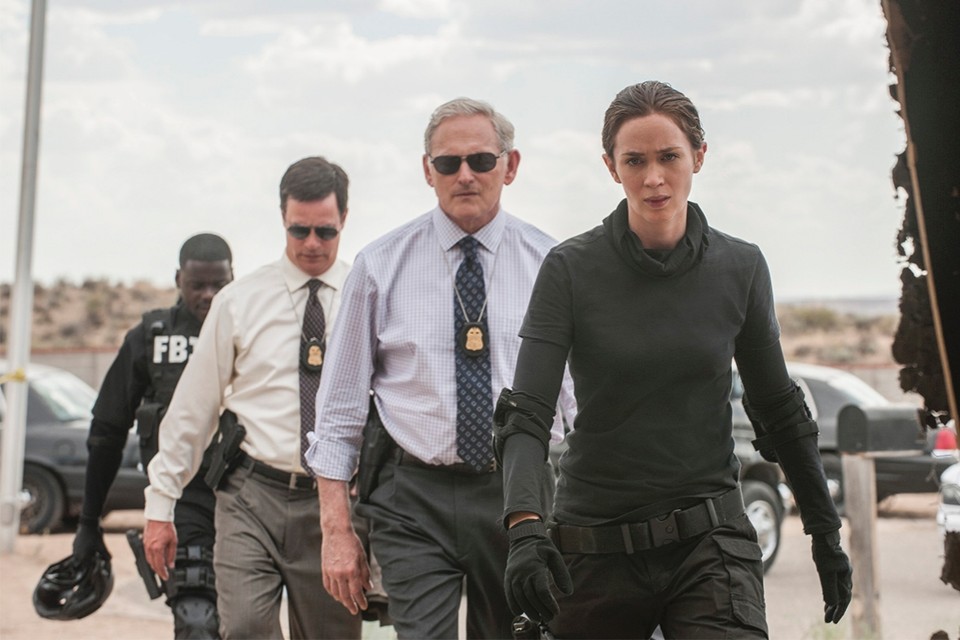 Writer Taylor Sheridan (best known as Deputy Chief Hale on Sons of Anarchy) has taken what could have been an empty Michael Bay-styled drug war thriller and given it a soul. Sheridan’s structure is ingeniously tied into his larger message about the moral futility of the escalating war on drugs. As Kate becomes more immersed into the costs of her new role, of the mounting ethical compromises and legal loopholes, she becomes a background player and Alejandro takes center stage. Rather than simply harden up and sacrifice her ideals for the sake of her mission, Kate holds true to her principles, even if she might be the only one continuing to stick to the rules and a need for oversight. It makes her a far more interesting character and it all comes to a terrific climactic scene that hinges upon two characters at a forceful crossroads, each with diametrically opposed viewpoints. For all the action, Sheridan has found a great way for his story to have a character-based climax that hits harder than simply killing the Worst Bad Guy. As we learn more about the reasons Kate was selected, her literal marginalization in the story makes thematic sense, especially as she’s unwilling to become a “wolf” in a “country of wolves.” Alejandro is that wolf, and in the last act he becomes the film’s focus as the pieces of their destabilization plan fall into place. There’s a scene with Alejandro that is so cold-blooded yet badass that it made my audience gasp. As the bodies drop and blood is shed, Sicario doesn’t lose sight of its characters even to the very end.
Sheridan’s script tackles its subject with a propensity for acknowledging the messy reality. There are no easy solutions and perhaps the best solution is really one that is at odds with conventional legality. The United States is losing the war on drugs, and innocents are suffering in droves. Matt’s cavalier attitude is in response to the overwhelming evidence that the war on drugs has done little except to enshrine certain violent elements into power. He’s trying to clear a path for Alejandro, but for what aim afterward is ethically questionable. When you’ve got nothing but bad solutions, perhaps the best option is still one that’s a step too far. Sicario tackles the harsh realities of the war on drugs without ever dragging out a soapbox. The messages and debates are suffused in every frame, every taut sequence, even pained expression. It’s a message movie where the morality and the escalating action go hand-in-hand.
With Prisoners and now Sicario, Villeneuve has proven to be one of our finest directors when it comes to making adult movies that get your palms sweaty. The execution of these suspense sequences left me breathless. Villeneuve uses long takes of aerial photography hovering over the topography of Mexico and the American southwest. It has the effect of feeling like you’re surveying an alien planet. Added with the ominous score by Johann Johannsson (The Theory of Everything), the tension can feel overwhelming at times. The menacing and percussion-heavy score makes it feel like an army is approaching. The movie also looks absolutely beautiful thanks to the cinematography from Roger Deakens. There are several lovely shots lit with the dying rays of sunlight, which I would admire further if my heart weren’t in my throat while watching. Villeneuve also knows when to pump the brakes, letting his film breathe, and letting his actors take center stage. There are several moments of restraint that allow the actors to flourish. From top to bottom, Sicario is a technical marvel that impresses as it continues to horrify.
Blunt as a badass is nothing new after her killer turn in last year’s vastly underrated Edge of Tomorrow, but there’s way more to her than being a superhero with a gun. She’s the moral conscience of the movie and you may discover, as she does, how irrelevant such a stance may be in this underground world. She’s trying to make sense of it all, trying to go along with what she thinks is right, or at least making a difference, and swallowing her frustrations. She saves the best for last in a finale scene that pushes her character to the breaking point of her ethics, and Blunt floors you. While Blunt is our entry point into this world, and Brolin is amusing as a cavalier rogue agent, this is very much Del Toro’s movie. Alejandro could easily be the slick movie-cool hitman, a soulless killing-machine, but he’s a haunted man who knows he’s damned and goes about his business with steely resolve. Benicio Del Toro can often be confused with doing little acting because he so naturally underplays his characters, but keep watch and you’ll see a man who inherently knows his character. There are subtle shifts and small reveals that open up Alejandro, who is so hardened that this will be all you get.

There have been some complaints citing the film’s lack of perspective from the Mexican side of the border, which is fair but also overlooking Sicario’s complexity. With its fear of cartel war violence spilling over into American neighborhoods, it’s not hard to see this film becoming supposed evidence in a xenophobic political campaign. Surely Donald Trump will be talking about Sicario. There is a small degree of representation with a minor character involved in the drug trade. The movie flashes back to him and his family a few times, setting us up to expect he’ll return at a pivotal moment later. He’s a completely unremarkable character and the brief scenes we spend with him made me anxious to get back to Kate and the main story. I didn’t care, and then he did reappear and I was quite surprised to find myself actively caring for this minor character’s well being. In a scenario where it seems like there’s a lack of vulnerability, this character provides it. He’s not a bad person per se as just another cog in a corrupt machine trying to provide for his loved ones. It’s a window into the larger ramifications of Kate and Matt’s actions. The very last bittersweet image doesn’t feel like victory, more like a warning of impending consequences that will befall innocents, and they aren’t Americans.
It’s rare to get a Hollywood thriller that excels at what it does and exceeds lofty expectations, but Sicario is that movie. Here is a thriller that excites, unnerves, provokes thought as well as terrible anxiety that you sweat in buckets over. The general feeling while watching Sicario is one of disquieting dread. The challenging and disturbing reality of the war on drugs blends with the brilliantly executed suspense sequences. The characters don’t get lost midst the clatter of violence, the direction enhances the actors and allows them to better inhabit their engaging characters, and the overall orchestration of all the many moving parts is so polished, so in tune, so electric that Sicario often does more than just entertain, it forces you to react. Leaving my theater was akin to coming down off an adrenaline high and I wanted to tell everyone I knew to see this movie. That’s the power of great cinema and Villeneuve has created a compelling feature that deserves to be soaked up and studied. This is exhilarating moviemaking, folks.
Nate’s Grade: A
Share this:

Inherent Vice (2014)
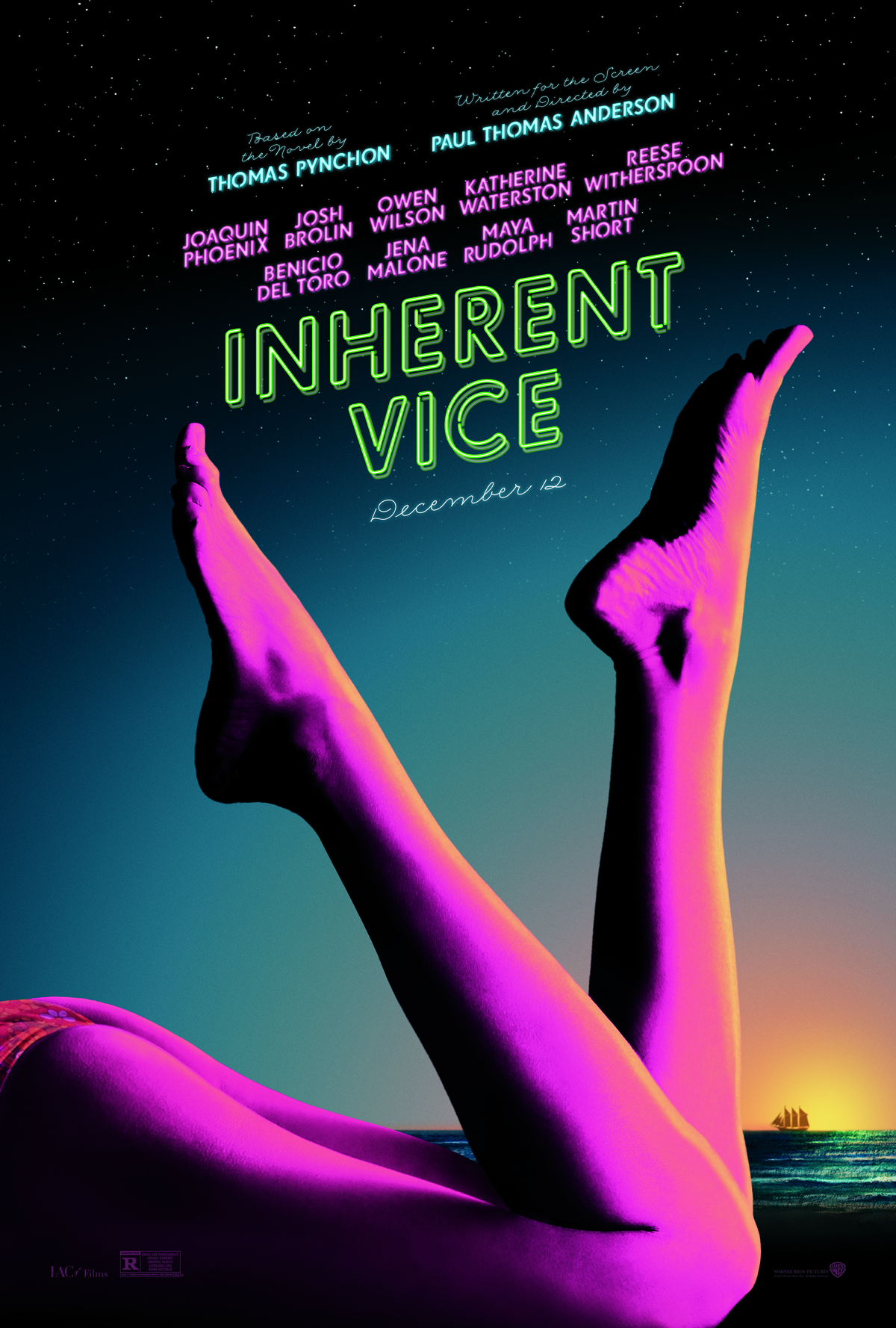 This is one of the most difficult reviews I’ve ever had to write. It’s not because I’m torn over the film; no, it’s because this review will also serve as my break-up letter. Paul Thomas Anderson (PTA), we’re just moving in two different directions. We met when we were both young and headstrong. I enjoyed your early works Paul, but then somewhere around There Will be Blood, things changed. You didn’t seem like the PTA I had known to love. You became someone else, and your films represented this change, becoming plotless and laborious centerpieces on self-destructive men. Others raved to the heavens over Blood but it left me cold. Maybe I’m missing something, I thought. Maybe the problem is me. Maybe it’s just a phase. Then in 2012 came The Master, a pretentious and ultimately futile exercise anchored by the wrong choice for a main character. When I saw the early advertisements for Inherent Vice I got my hopes up. It looked like a weird and silly throwback, a crime caper that didn’t take itself so seriously. At last, I thought, my PTA has returned to me. After watching Inherent Vice, I can no longer deny the reality I have been ducking. My PTA is gone and he’s not coming back. We’ll always have Boogie Nights, Paul. It will still be one of my favorite films no matter what.
 In the drug-fueled world of 1970 Los Angeles, stoner private eye Doc (Joaquin Phoenix) is visited by one of his ex-girlfriends, Shasta (Katherine Waterston). She’s in a bad place. The man she’s in love with, the wealthy real estate magnate Mickey Wolfmann (Eric Roberts) is going to be conned. Mickey’s wife, and her boyfriend, is going to commit the guy to a mental hospital ward and take control of his empire. Then Shasta and Mickey go missing. Doc asks around, from his police detective contact named Bigfoot (Josh Brolin), to an ex (Reese Witherspoon) who happens to be in the L.A. justice department, to a junkie (Jena Malone) with a fancy set of fake teeth thanks to a coked-out dentist (Martin Short) who may be a front for an Asian heroin cartel. Or maybe not. As more and more strange characters come into orbit, Doc’s life is placed in danger, and all he really wants to find out is whether his dear Shasta is safe or not.
Inherent Vice is a shaggy dog detective tale that is too long, too convoluted, too slow, too mumbly, too confusing, and not nearly funny or engaging enough. If it weren’t for the enduring pain that was The Master, this would qualify as Anderson’s worst picture.
One of my main complaints of Anderson’s last two movies has been the paucity of a strong narrative, especially with the plodding Master. It almost felt like Anderson was, subconsciously or consciously, evening the scales from his plot-heavy early works. Being plotless is not a charge one can levy against Inherent Vice. There is a story here with plenty of subplots and intrigue. The problem is that it’s almost never coherent, as if the audience is lost in the same pot haze as its loopy protagonist. The mystery barely develops before the movie starts heaping subplot upon subplot, each introducing more and more characters, before the audience has a chance to process. It’s difficult to keep all the characters and their relationships straight, and then just when you think you have everything settled, the film provides even more work. The characters just feel like they’re playing out in different movies (some I would prefer to be watching), with the occasional crossover. I literally gave up 45 minutes into the movie and accepted the fact that I’m not going to be able to follow it, so I might as well just watch and cope. This defeatist attitude did not enhance my viewing pleasure. The narrative is too cluttered with side characters and superfluous digressions.
The plot is overstuffed with characters, many of which will only appear for one sequence or even one scene, thus polluting a narrative already crammed to the seams with characters to keep track of. Did all of these characters need to be here and visited in such frequency? Doc makes for a fairly frustrating protagonist. He’s got little personality to him and few opportunities to flesh him out. Not having read Thomas Pynchon’s novel, I cannot say how complex the original character was that Anderson had to work with. Doc just seems like a placeholder for a character, a guy who bumbles about with a microphone, asking others questions and slowly unraveling a convoluted conspiracy. He’s more a figure to open other characters up than a character himself. The obvious comparison to the film and the protagonist is The Big Lebowski, a Coen brothers film I’m not even that fond over. However, with Lebowski, the Coens gave us memorable characters that separated themselves from the pack. The main character had a definite personality even if he was drunk or stoned for most of the film. Except for Short’s wonderfully debased and wily five minutes onscreen, every character just kind of washes in and out of your memory, only registering because of a famous face portraying him or her. Even in the closing minutes, the film is still introducing vital characters. The unnecessary narration by musician Joanna Newsome is also dripping with pretense.
 Another key factor that limits coherency is the fact that every damn character mumbles almost entirely through the entirety of the movie. And that entirety, by the way, is almost two and a half hours, a running time too long by at least 30 minutes, especially when Doc’s central mystery of what happened to Shasta is over before the two-hour mark. For whatever reason, it seems that Anderson has given an edict that no actor on set can talk above a certain decibel level or enunciate that clearly. This is a film that almost requires a subtitle feature. There are so many hushed or mumbled conversations, making it even harder to keep up with the convoluted narrative. Anderson’s camerawork can complicate the matter as well. Throughout the film, he’ll position his characters speaking and slowly, always so slowly, zoom in on them, as if we’re eavesdropping. David Fincher did something similar with his sound design on Social Network, amping up the ambient noise to force the audience to tune their ears and pay closer attention. However, he had Aaron Sorkin’s words to work with, which were quite worth our attention. With Inherent Vice, the characters talk in circles, tangents, and limp jokes. After a protracted setup, and listening to one superficially kooky character after another, you come to terms with the fact that while difficult to follow and hear, you’re probably not missing much.
Obviously, Inherent Vice is one detective mystery where the answers matter less than the journey and the various characters that emerge, but I just didn’t care, period. It started too slow, building a hazy atmosphere that just couldn’t sustain this amount of prolonged bloat and an overload of characters. Anderson needed to prune Pynchon’s novel further. What appears onscreen is just too difficult to follow along, and, more importantly, not engaging enough to justify the effort. The characters fall into this nether region between realism and broadly comic, which just makes them sort of unrealistic yet not funny enough. The story rambles and rambles, set to twee narration that feels like Newsome is just reading from the book, like Anderson could just not part with a handful of prose passages in his translation. Much like The Master, I know there will be champions of this movie, but I won’t be able to understand them. This isn’t a zany Chinatown meets Lewboswki. This isn’t some grand throwback to 1970s cinema. This isn’t even much in the way of a comedy, so be forewarned. Inherent Vice is the realization for me that the Paul Thomas Anderson I fell in love with is not coming back. And that’s okay. He’s allowed to peruse other movies just as I’m allowed to see other directors. I wish him well.
Nate’s Grade: C+
Share this:

Limitless (2011)
 With a dream premise for a pill-popping culture, Limitless is a visually fervent thriller that manages to stay a step ahead of the pack. Bradley Cooper takes a pill and can unlock full potential of his brain, which involves, obviously, scoring big paydays and women. It’s a silly fantasy but a universal curiosity of what we could do if given full access to our noodle. Director Neil Burger (The Illusionist) uses every visual trick in the book to represent the new brainpowers, as we watch words, numbers, and memories drift through a colorful explosion of imagery. It’s all very pretty to look at. Burger’s visual prowess elevates the more pedestrian moments of Limitless, but the film has a way of surprising you. The Mob takes an interest in this wonder pill, operating at a new peak of production. A woman being hunted down takes the magic pill and is able to quickly formulate an escape. So what if the profound existential questions regarding human capacity and possibility are thrown aside, we got some nifty visual flourishes and foot chases here people. The pacing is relentless and the plot manages to find intriguing ways to keep a superbrainiac in danger. Limitless is a perfectly enjoyable movie with enough juice to forgive its lamer moments and contrived ending.
Nate’s Grade: B
Share this:

Pineapple Express (2008)
 There’s something to be said about a comedy that requires an audience to puff illegal substances in order to fully be entertained. Somewhere along the line the Judd Apatow comedy unit went down a wayward track with the stoner comedy, Pineapple Express, an amiable goof of a comedy at best. The premise is solid, two stoners (Seth Rogen and James Franco) witnessing a murder and on the run. Rogen and Franco have a great rapport with one another that translates to plenty of good vibes and humor (Danny McBride steals the show as a seemingly indestructible low-rent drug dealer). But the movie veers off into action territory with bloody violence that really harshes your mellow, man. Pineapple Express never really settles on a consistent tone, so when the movie fully transforms into a strained guns-a-blazin’ action caper, the comedy has totally vanished. The realistic violence is intended to get the laughs. When people get shot, it’s ugly, and when ear lobes get blown off it’s just plain gross. There’s no room for humor in the third act and the action is lazy and uninspired. If Rogen and his writing partner Evan Goldberg (who scripted the much funnier Superbad) were aiming to create an action parody, then they didn’t push nearly hard enough. After the movie ended, I thought back to last year’s superior action parody, Hot Fuzz, which had a consistent tone and packed jokes as hard as punches. As a sober moviegoer who has never inhaled any such wacky tobaccy, Pineapple Express just kept eluding me. The movie is too slipshod, too misshapen, and it completely goes up in smoke by the end.
Nate’s Grade: C+
Share this:

Maria Full of Grace (2004)
 No other actress stood out to me this year as 23-year-old Catalina Sandino Moreno. She plays the movie’s Maria, a Colombian woman who agrees to carry 60-something condoms filled with heroin in her gut to the United States. The first half of the film is unjudegmental and nerve-racking, especially when Maria gets snagged by U.S. customs. The second half revolves around Maria trying to land on her feet in an unfamiliar land. The greatness of Maria Full of Grace relies on debut writer/director Joshua Marston framing his story like camera is an invisible voyeur. The film suggests that Maria is only one of thousands that have turned into drug mules to make ends meet or seek better lives. Maria Full of Grace is startling, immersive, delicate and quietly touching as Maria rediscovers the promise of the American dream.
Nate’s Grade: A
Share this:

The Rules of Attraction (2002)
 The Rules of Attraction is based on Bret Easton Ellis’ hedonistic 80s novel about boozing coked-out, aloof teenagers and their rampant debauchery. Roger Avary was Quentin Tarantino’s writing partner for years, with an Oscar sitting at home for co-writing Pulp Fiction. As a director Avary lays the visual gloss on thick utilizing camera tricks like split-screens and having entire sequences run backwards. While Ellis’ source material is rather empty, echoing the collegiate friendships bonded over substances or social lubricants, Avary does his best to represent the dazed world of college.
 We open with Lauren (Shannyn Sossamon) getting raped by some drunk “townie” while the film buff she had her eyes on videotapes it. She’s just broken up with the bisexual and apathetic Paul (Ian Somerhalder), and both are interested in the sociopath Sean Bateman (James Van Der Beek), a self-described emotional vampire. Lauren keeps a picture book of venereal diseases to ward her from her wayward sexual urges. Her roommate Lara (Jessica Biel) needs no such book. Our introduction of Lara has her dancing down a hall, liquor bottle in each fist, bedding an entire sports team. Some attractions connect, many don’t, but the fun is watching the characters interact in their own seedy yet often hilarious ways.
The best thing that The Rules of Attraction has going for it is its about-face, against-type casting. The film is populated with the WB’s lineup of clear-skinned goody-two-shoes getting a chance to cut loose. Van Der Beek broods like a predatory hawk and bursts with spontaneous rage. Biel sexes it up as a cocaine-addicted harlot who asks if she’s “anorexic skinny” or “bulimic skinny.” Even Fred-Wonder-Years-Savage shows up briefly to shoot up between his toes! The adults of this world are no better than the kids. Eric Stoltz has an extended cameo of a duplicitous professor offering a higher GPA if any coeds are willing to go down on their morals. Swoosie Kurtz and Faye Dunaway show us that pill-popping ditherheads may likely breed drug-addled teenagers.
 Attraction may have the most disturbing suicide I’ve ever witnessed in film. After having her advances rejected a woman slips into the bathtub, razor in hand. The scene is as unsettling as it is because the camera hangs on the poor woman’s face every second and we gradually see the life spill out of her as the music becomes distorted, not letting us escape the discomfort.
Some of Avary’s surface artifice works perfectly, like Victor’s whirlwind account of an entire semester in Europe. Some of the visual fireworks are distractions to the three-person narrative but the film is always alive with energy, even when it’s depressing you. What The Rules of Attraction does get right is the irrational nature of attraction. Each character is trying to fill an inaccessible void with what they think is love but will often settle for sex, drugs, or both. The Rules of Attraction is made up of unlikable, miserable characters that effectively do nothing but find new ways to be miserable. It constantly straddles the line of exploitation and excess but maintains its footing. The movie is entirely vapid but it is indeed an indulgently fun yet depraved ride. If you’re looking for degeneracy instead of life-affirmation, then The Rules of Attraction is your ticket.
Nate’s Grade: B
Share this:

Blow (2001)
 The tale of Blow follows a kid named George Jung (Johnny Depp) as he travels to the sunshiny coasts of California. Here he finds everyone with a David Cassidy haircut and an insatiable appetite for pot. He strikes a small scale dealing business with some help from a flamboyant hair dresser (Paul Rubens) and rocket in riches. They eventually discover the powers of cocaine, a.k.a. blow to the uninitiated, and set it loose upon 1970s America. Jung becomes the top trafficker of cocaine and practically single-handily leads to its explosion. And of course, these good times can’t last as Jung’s life falls apart as the 80s go.
 Blow is too stylistically similar to earlier 70s epics of violence and music like Boogie Nights and Goodfellas. The same moves and looks are evident, even the same overall tone, but it is missing all of the feel. Blow moves along and feels like something is missing as it continues to ape the flavor of those earlier excellent films. There’s a distinct feeling while viewing that you aren’t viewing something complete. The sense of loss permeates the screen with Blow.
Depp uses a subtle acting approach making Jung one real mellow dude man. One can never feel a connection for any of the characters because the plot is not interested in the characters and only a masochistic orchestra of bad events that happens to Depp. You feel unattached to the characters as a whole, but you do manage to feel a level of sympathy for Jung. His mother is a card to watch, and it seems history repeats itself when it comes to family squabbles.
Penelope Cruz plays one spoiled hell-cat of a drug lord’s girl, who later becomes Depp’s wife. Cruz’s character is possibly the most horrible love interest I have ever seen on film. She shrieks about money and wealth, acts apathetic to their innocent daughter, and single-handily gets Depp busted a few times without guilt. Upon deeper reflection she seems (if she happened not to actually exist, which she does) like a cheap foil to make the audience sympathy sway dramatically to our “tryin’ to do good” flawed hero in Jung. It almost seems insulting.
 Ray Liotta (who was IN Goodfellas by the way) gets the pleasure of aging through the years with makeup, which basically consists of slapping gray and more skin to his neck. It’s rather humorous that Liotta is playing Depp’s father in the flick when in reality they are roughly the same age. Though I guess it’s better for Liotta to age after seeing Depp’s character age drastically and gain twenty pounds all in his neck. Older Depp looks like a zombie Ludwig von Beethoven.
Blow is written and directed by Ted Demme and is based on the memoirs of Jung while in prison. It is fairly entertaining in its own right but you can’t help but feel you’ve seen it all before and better. Still, with this lackluster year as it is Blow is a decent pic to sit down and chew through a box of overpriced popcorn. Any movie with Franka Potente (my titular hero in Run Lola Run) and Paul Ruebens is worth the price of admission.
Nate’s Grade: B-
Share this:

Traffic (2000)
 The war on drugs may be one worth fighting but it’s a battle that every day seems more and more impossible. Traffic is a mirror that communicates the fruition of our current procedures to stop the illegal flow of drugs.
Traffic is told through three distinct and different narratives. One involves an Ohio Supreme Court justice (Michael Douglas) newly appointed as the nation’s next Drug Czar. While he accepts his position and promises to fight for our nation’s children, back at home, unbeknownst to him, his daughter is free-basing with her bad influence boyfriend. Another story involves a wealthy bourgeois wife (Catherine Zeta-Jones) awakened to her husband’s arrest. Her shock continues when family lawyer Dennis Quaid informs her of her husband’s true source of income. He’s to be prosecuted by two DEA agents (Don Cheadle and Luis Guzman) unless she can do something. The final and most compelling narrative involves Benicio Del Toro as an honest cop in Tijuana battling frustration with the mass corruption surrounding the city. Each story weaves in and out at various points in the film.
 Traffic was photographed and directed by the man with the hottest hand in Hollywood, Steven Soderbergh. He uses a documentary feel to his filming that adds to the realism. Different color tones are assigned toward the three narratives as reflections of the emotional background. Soderbergh expertly handles the many facets of the drug industry and pulls out his typical “career best” performances from his onslaught of actors.
Benicio Del Toro is the emotional center of Traffic. His solemn demeanor and hound dog exterior reflect a good man trying to fight the good fight in a corrupt environment. He effortlessly encompasses determination, courage, and compassion that you’ll easily forget the majority of his lines are in Espanol. Benicio is an incredibly talented actor and one with such vibrant energy whenever he flashes on screen. It’ll be wonderful watching him collect all his awards.
Catherine Zeta-Jones also shows strong signs there may well indeed be an actress under her features. Her role is one of almost terror as you watch her so easily slip into her imprisoned hubby’s shoes. The ease of transformation is startling, but in an “evil begets evil” kind of fashion. The fact that she’s pregnant through the entire movie only makes the shift from loving house wife to drug smuggler more chilling.
 The entire cast does credible acting performances with particular attention paid toward the younger actors deservingly. Don Cheadle throws in another terrific performance showing he’s sublimely one of the best actors around today.
Traffic oversteps its ambitions and aims for a scope far too large. It is based on a 6 hour BBC mini-series, so trying to cram that material into a two hour plus format is taxing. As a result we get an assembly of characters, but too many with too little time in between to do any justice. Screenwriter Stephen Gaghan (Rules of Engagement) condenses the towering impact and influence drugs have well enough, but he intercuts the stories too sporadically that attachment never builds for either of the three narratives. He does balance the Douglas Drug Czar one carefully as not to fall into the cliched vigilante metamorphosis. But the mini-series had more characterization and depth to its tale.
Traffic is a good film but it has edges of greatness never fully visioned. Soderbergh shines bright yet again and all accolades will be deserved. Traffic is undeniably a good film, but it’s one you may not want to watch a second time.
Nate’s Grade: B
Reviewed 20 years later as part of the “Reviews Re-View: 2000” article.


 nathanzoebl
You must be logged in to post a comment.