Blog Archives
Honey Don’t (2025)
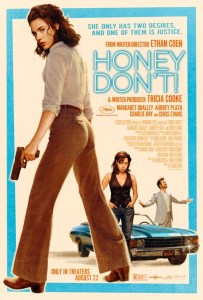 It’s the second collaboration between Ethan Coen and his wife Tricia Cooke and reportedly the second in their “B-movie lesbian trilogy” (the planned third film is tentatively titled Go Beavers). It’s better than 2024’s Drive-Away Dolls, a randy cartoon that was so overpowering and underwhelming. This time the filmmakers play around in the film noir genre with Margaret Qualley as a wily private eye, Honey O’Donahue. The whodunnit plot is a series of disconnected threads and plotlines that don’t connect together in interesting or surprising ways. It begins with an immediate mystery: a woman, dressed right out of Faster, Pussycat! Kill! Kill!, walking down an embankment to inspect an overturned auto and the body inside. Boom. I’m intrigued right away. Sadly, this might be the high point. A third of Honey Don’t involves Chris Evans playing a debauched minister selling drugs on the side and exploiting his congregation. His storyline seems to run in parallel with Honey’s investigation without really crossing in meaningful ways. It even resolves without her intervention. It’s also incredibly dull and repetitive, with Evans’ reverend being interrupted during sex multiple times for comedy, I guess. Honey Don’t exists as a winky flip on the noir genre, this time with lesbians! It doesn’t so much feel like a compelling story with colorful characters as it does a writing exercise. Qualley fares better as the straight-laced yet flirty private eye than she did as the horny caricature in Drive-Away Dolls. She’s got a self-possessed charisma and determination that works. If only the rest of the movie didn’t repeatedly let her down. It’s not offensively bad, or even as aggressively cringey as their previous collaboration, but Honey Don’t is another middling, daffy, disposable genre riff by Ethan Coen that makes me long for an eventual reunion with his brother.
Nate’s Grade: C
Share this:

Drive-Away Dolls (2024)
 Drive-Away Dolls is an interesting curiosity, not just for what it is but also for what it is not. It’s the first movie directed solo by Ethan Coen, best known as one half of the prolific filmmaking Coen Brothers, who have ushered in weird and vibrant masterpieces across several genres. After 2018’s The Ballad of Buster Scruggs, their last collaboration, the brothers decided to set out on their own for an unspecified amount of time. This led Joel Coen to direct 2021’s atmospheric adaptation of Macbeth, and now Ethan has decided that the fictional movie he really wants to make, unshackled by his brother, is a crass lesbian exploitation sex comedy. Well all right then.
Set in 1999 for some reason, Jamie (Margaret Qualley) is an out lesbian who unabashedly seeks out her own pleasures, even if it brings about the end of her personal relationships. Her friend, Marian (Geraldine Viswanathan), hasn’t had a lover in over three years and is much more prim and proper. Together, these gal pals decide to drive to Tallahassee, Florida using a drive-away service, where they will be paid to drive one way, transporting a used car. It just so happens that these women have mistakenly been given the wrong car, a vehicle intended for a group of criminals transporting contraband that they don’t want exposed. Jamie is determined to get laid and help Marian get laid all the while goons (Joey Slotnick, C.J. Wilson) are trailing behind to nab the ladies before they discover the valuable contents inside the trunk of their car.
 Drive-Away Dolls is clearly an homage to campy 1970s exploitation B-movies but without much more ambition than making a loosey-goosey vulgar comedy consumed by the primal pursuit of sexual pleasure. I was genuinely surprised just how radiantly horny this movie comes across, with every scene built in some way upon women kissing, women having sex, women talking about having sex, women pleasuring themselves, women talking about pleasuring themselves, and women talking about pleasuring other women. When I mean every scene I mean virtually every scene in this movie, as the thinnest wisp of a road trip plot is barely holding together these scenes. From a representational standpoint, why shouldn’t lesbians have a raunchy sex comedy that is so open about these topics and demonstrates them without shame? Except it feels like the crude subject matter is doing all the heavy lifting to make up for the creative shortcomings elsewhere in the movie, which, sadly there are many. The script is co-written by Coen and his wife of many years, Tricia Cooke, an out lesbian, so it feels like the intent is to normalize sex comedy tropes for queer women, but the whole movie still feels overwhelming in the male gaze in its depictions of feminine sexuality. I’m all for a sex-positive lesbian road trip adventure, but much of the script hinges upon the uptight one learning to love sex, which means much of the story is dependent upon the promiscuous one trying to then bed her longtime friend and get her off. Rather than feel like some inevitability, the natural conclusion of a friendship that always had a little something more under the surface, it feels more like a horny and calculated math equation (“If you have two gay female leads, you can get them both kissing women by having them kiss each other”).
I’m sad to report that Drive-Away Dolls is aggressively unfunny and yet it tries so hard. It’s the kind of manic, desperate energy of an improv performer following an impulse that was a mistake but you are now watching the careening descent into awkward cringe and helpless to stop. The movie is so committed to its hyper-sexual goofball cartoon of a world, but rarely does any of it come across as funny or diverting. When Jamie’s ex-girlfriend Suki (Beanie Feldstein) is trying to remove a dildo drilled onto her wall, she screams in tears, “I’m not keeping it if we both aren’t going to use it.” The visual alone, an ex in tears removing all the sexual accoutrements of her previous relationship, some of which can be widely over-the-top, could be funny itself. However, when her reasoning is that we both can’t use this any longer, then the line serves less as a joke and more a visual cue for the audience to think about both of them taking turns. It doesn’t so much work at being funny first and rather as a horny reminder of women being sexual together. The same with a college soccer team’s sleepover that literally involves a basement make-out party with a timer going off and swapping partners. It’s not ever funny but features plenty of women making out with one another to satisfy some audience urges. I will admit it serves a plot purpose of first aligning Jamie and Marian into awkwardly kissing one another, thus sparking carnal stirrings within them.
 My nagging issue with the movie’s emphasis is not a puritanical response to vulgar comedy but that this movie lacks a necessary cleverness. It doesn’t really even work as dumb comedy, although there are moments that come close, like the absurd multiple-corkscrew murder that opens the movie. It’s just kind of exaggerated nonsense without having the finesse to steer this hyper-sexual world of comedy oddballs. The crime elements clash with the low-stakes comedy noodling of our leads bumbling their way through situation after situation that invariably leads to one of them undressing or inserting something somewhere. The brazen empowerment of women seeking out pleasure is a fine starting point for the movie, but the characters are too weakly written as an Odd Couple match that meets in the middle, the uptight one learning to loosen up and the irresponsible one learning to be less selfish. The goons chasing them are a pale imitation of other famous Coen tough guys; they lack funny personality quirks to broaden them out. There’s a conspiracy exposing political hypocrites condemning the “gay agenda,” and I wish more of this was satirized rather than a briefcase full of reportedly famous phalluses. If you got a briefcase full of famous appendages, I was expecting more jokes than blunt objects.
I feel for the actors, so eager to be part of a Coen movie, even if it’s only one of them and even if it’s something much much lesser. Qualley (Once Upon a Time… in Hollywood) is a typical Coen cartoon of a character, complete with peculiar accent and syntax. She’s going for broke with this performance but the material, time and again, requires so little other than being exaggerated and horny. There is one scene where her physical movements are so broad, so heightened to the point of strain, that I felt an outpouring of pity for her. It feels like a performance of sheer energetic force lacking proper direction. Viswanathan has been so good in other comedies and she’s given so little to do here other than playing the straight women (no pun intended) to Qualley’s twangy cartoon. Her portrayal of sexual coming of age and empowerment was better realized, and funnier, in 2018’s Blockers, a superior sex-positive sex comedy.
 As a solo filmmaker, Ethan Coen seems to confirm that his brother is more the visual stylist of the duo. The movie is awash in neon colors and tight closeups of bug eyes and twangy accents, but the most annoying stylistic feature, by far, is the repeated psychedelic transition shots, these trippy interstitials that don’t really jibe with anything on screen. It felt like padding for an already stretched-thin movie that can barely reach 75 minutes before the end credits kick in. That’s why the extended sequences where the intention seems exploitation elements first and comedy second, or third, or not at all, makes the whole enterprise feel like a pervy curiosity that has its empowering yet obvious message of “girls do it too” as cover. Agreed, but maybe do more with the material beyond showcasing it. Ethan Coen is a prolific writer who has written short story collections (I own his 1998 book Gates of Eden), poetry collections, and he even wrote five one-act plays before the pandemic struck in 2020. I’d love to see those plays. This man has true talent but it’s just not obviously present throughout this film.
Drive-Away Dolls is an irreverent sex comedy with good intentions and bad ideas, or good ideas and bad intentions, an exploitation picture meant to serve as empowerment but still presents its world as exploitation first and last. It’s just not a funny movie, and it’s barely enough to cover a full feature. I suppose one could celebrate its mere existence as an affront to those puritanical forces trying to oppress feminine sexuality, but then you could say the same thing about those 1970s women-in-prison exploitation pictures. It’s a strange movie experience, achingly unfunny, overly mannered, and makes you long for the day that the two Coens will reunite and prove that the two men are better as a united creative force; that’s right, two Coens are better than one.
Nate’s Grade: C-
Share this:

The Tragedy of Macbeth (2021)
 At this point, William Shakespeare’s tragedy of witchy regicide has been adapted into over 30 movies, most recently in 2015 with Michael Fassbender and Marion Cotilard, so with any new Macbeth the question arises: what will this one offer? The pedigree behind this 2021 film is mesmerizing: Denzel Washington, Frances McDormand, and director Joel Coen. That’s enough reason to see another rendition of the Bard, although the best acting comes from a surprise, theater vet Kathryn Hunter who portrays all the witches as one person (plus more). She’s captivating and haunting and the highlight of the movie. This is the most, for lack of a better term, ordinary film in Coen’s quirky career and his first without brother/collaborator Ethan. It finds a dreamy middle ground between film and theater, utilizing imposing and stark sound stages and striking chiaroscuro black and white photography to feel otherworldly. The eerie, shifting imagery and alien presentation makes the movie feel like a transporting dream oiled by the lugubriousness of Shakespeare’s brilliant words. This version also demonstrates some of the more violent actions typically reserved for offstage implications (poor Macduff son). This Macbeth is also shockingly fast-paced, barely clocking in at 105 minutes, about half of the running time for the unabridged stage play. The acting is uniformly good but I was slightly let down by the leads. I guess I was expecting more indulgence in the sheer thespian feast and was surprised they made more of a tiny meal of things. If you’re familiar with the source material, there should be enough here to appeal to you, though I still hold the Patrick Stewart BBC production as the best film adaptation yet. Go into The Tragedy of Macbeth expecting good, not transcendentally great, and lean back and enjoy the aural pleasures of theater.
Nate’s Grade: B
Share this:

The Ballad of Buster Scruggs (2018)
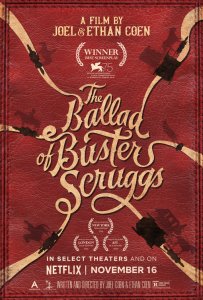 Netflix might just be the best pasture yet for brothers Joel and Ethan Coen. The Oscar-winning filmmakers were reportedly creating a Western series for the online streaming giant but that has turned into an anthology film, The Ballad of Buster Scruggs. The Coens’ love of the beautiful, the bizarre, the bucolic and the brazen are on full display with their six-part anthology movie that serves as reminder of what wonderfully unique cinematic voices they are. The Ballad of Buster Scruggs is uneven, as most anthology films tend to by design, but it reaches that vintage Coen sweet spot of absurdity and profundity.
The best segment is also the one that kicks things off, the titular adventures of Buster Scruggs, a singing Gene Autry-style cowboy who manages to get into all sorts of scrapes. The tonal balancing act on this one is pure Coen, at once inviting an audience to nostalgically recall the Westerns of old while kicking you in the teeth with dark, hilariously violent turns that veer into inspired slapstick. There is a delightful absurdity to the segment thanks to the cheerful sociopath nature of Buster Scruggs, the fastest gun in the West that’s eager to show off at a moment’s notice. He’s a typical Coen creation, a wicked wordsmith finding himself into heaps of trouble, but through his quick wits and sudden bursts of violence, he’s able to rouse an entire saloon full of witnesses to his murder into a swinging, carousing group following him in song. I laughed long and hard throughout much of this segment. I was hooked and wanted to see where it would go next and how depraved it might get. Tim Blake Nelson (O Bother Where Art Thou) is wonderful as Buster Scruggs and perfectly finds the exact wavelength needed for the Coen’s brand of funny and peculiar. He’s like a combo Daffy Duck and Bugs Bunny breaking the fourth wall to let the audience in on his merry bravado. The segment ends in a fitting fashion, another song that manages to be hilarious and strangely poignant at the same time. The Coens allow the scene to linger into a full-on duet of metaphysical proportions. I could have watched an entire series following Buster Scruggs but it may have been wise to cut things short and not to overstay its novelty.
 The other best segments take very different tonal destinations. “All Gold Canyon” is a slower and more leisurely segment, following Tom Waits as a prospector who systematically works the land in search of a hidden trove of gold he nicknames “Mr. Pocket.” The step-by-step process has a lyrical nature to it, and it reminded me of the opening of There Will Be Blood where we follow Daniel Plainview’s initial success at unearthing the beginning of his fortune. Waits is fantastic and truly deserving of Oscar consideration as the prospector. He’s hardscrabble and resilient, and there’s a late moment where he’s narrating a near escape from death where he’s tearfully thankful, possibly losing himself in the moment, and so grateful that it made me tear up myself. The segment ebbs and flows on the strength of the visual storytelling and Waits. It’s a lovely short with a few hidden punches, which is also another fine way to describe the other best segment, “The Gal Who Got Rattled.” It stars Zoe Kazan (The Big Sick) as a woman making her way to Oregon with a wagon train. She’s heading west for a new life, one she was not prepared for and only doing so at the urging of her pushy brother who dies shortly into the journey. Now she’s on her own and struggling to find her own place in the larger world. There’s a very sweet and hopeful romance between her and Billy Knapp (Bill Heck), one of the wagon train leaders who is thinking of settling down. It’s also a segment that slows down, accounting for the longest running time of the six. It goes to great care to establish the rhythms of life on the road, where many people walked the thousands of miles across the plains. The budding courtship is at a realistic simmer, something with more promise than heat. It’s such an involving story that its downturn of an ending almost feels criminal, albeit even if the tragic setups were well placed. Both of these segments take a break from the signature irony of the Coens and sincerely round out their characters and personal journeys and the dangers that await them.
 The remaining three segments aren’t bad by any stretch (I’d rate each from fine to mostly good) but they don’t get close to the entertainment and artistic majesty of the others. The second segment, “Near Algodones,” has some fun moments as James Franco is an inept bank robber who seems to go from bad situation to new bad situation, getting out through miraculous means until his luck runs out. The interaction with a kooky Stephen Root is a highlight but the segment feels more like a series of ideas than any sort of story. Even for an anthology movie, the segment feels too episodic for its own good. The third segment, “Meal Ticket,” is about a traveling sideshow in small dusty towns in the middle of winter. Liam Neeson plays the owner and the main act is a thespian (Henry Melling, best known as Dudley Dursely in the Harry Potter films) with no arms and no legs. The thespian character says nothing else but his prepared oratory. It makes him a bit harder to try and understand internally. I was also confused by their relationship. Are they father/son? Business partners? It’s also the most repetitious short, by nature, with the monologues and stops bleeding into one another, giving the impression of the thankless and hard life of a performer trying to eek out a living. It’s a bit too oblique. The final segment, “The Mortal Remains,” is like an Agatha Christie chamber play. We listen to five characters engage in a philosophical and contentious debate inside a speeding stagecoach that will not slow down. It’s an actors showcase with very specifically written characters, the Coens sharp ear for local color coming through. The conversation takes on a symbolism of passing over to judgment in the afterlife, or maybe it doesn’t and I’m trying to read more into things. You may start to tune out the incessant chatter as I did. It’s a perfunctory finish for the movie.
 Being a Coen brothers’ film, the technical merits are mesmerizing. The cinematography by Bruno Delbonnel (Amelie, Inside Llewyn Davis) is sumptuous and often stunning. The use of light and color is a gorgeous tapestry, and some of the visual arrangements could be copied into ready-made scenic postcards, in particular “Meal Ticket” and “All Gold Canyon.” The isolation, hostility, warmth, majesty of the setting is expertly communicated to the viewer. The production design and costuming are consummate as well. The musical score by longtime collaborator Carter Burwell is classic in its use of melancholy strings and motifs. It’s a glorious looking movie made with master craft care.
Before its release, the Coens had talked about how hard it was to make their kind of movies within the traditional studio system, even with their 30 years of hits and classics. Netflix is desperately hungry for prestige content, so it looks like a suitable match. I’d happily welcome more Coen brothers’ movies like The Ballad of Buster Scruggs, a goofy Western that’s equally heart wrenching as it is heart-warming, neither shying away from the cruelty and indifference of the harsh setting nor neglecting to take in its splendor. Just give them whatever money they need Netflix to keep these sort of movies a comin’.
Nate’s Grade: B+
Share this:

Suburbicon (2017)
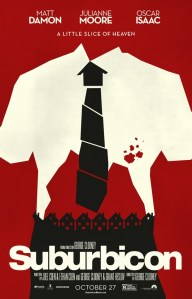 Suburbicon began as a script written by Joel and Ethan Coen back in the 1980s. They shelved it and went on to other stories and justifiable acclaim. George Clooney came across the old screenplay and rewrote it with his longtime partner Grant Heslov (Monuments Men). Clooney’s version of suburban strife is a wash and also easily the worst effort of Clooney’s Oscar-nominated directing career. I wish Suburbicon would make up its mind on which of the three different movies it wants to tell. This is possible proof that Coen brother stories should best be left chiefly to the Coens.
Set amidst the 1950s, an African-American family moves in to an all-white suburban neighborhood and instantly changes the climate. The Mayers have upset the other middle-class white neighbors who want them gone, and they don’t mind subjecting this black family to all forms of harassment to get the job done. Meanwhile, Gardener (Matt Damon) and his wife (Julianne Moore), her twin sister (also Moore), and his son, are threatened by loan shark goons. The family is never the same but there’s more than meets the eye to this domestic tragedy, and the costly cover-up ensnares everyone in danger.
 This is a movie that feels badly stitched together with competing ideas and storylines. Two of these competing movies are so haphazard and lazily explored that it feels like Clooney and company tacked them on for some sort of extra failed social commentary about The Way We Live Now. The shame of it is that either of these vestigial storylines could have existed as their own compelling movie. The integration of the suburbs with a black family brings about an intense reaction. Fellow suburbanites harass the family at all hours of the day, destroy personal property, and do everything to let them know they are unwelcome in this “good-natured” community. The reactions are so virulent and disgusting, and all for a family just existing on the block, shopping at the same grocery store, thinking they too were eligible for the American Dream. There’s a movie there in its own right because, as evidenced in Suburbicon, it’s just background for a larger indictment on suburban values hypocrisy that never generally materializes. At no point does Clooney give the racist response any depth, nuance, or even a deserving spotlight. The only thing we learn is that it’s wrong, which should already be obvious. The entire storyline feels so unfairly attached to another unrelated movie. This family’s story is worth telling right rather than just having something else to cut back to.
Then there’s the larger satire on suburbia itself and its reported family values philosophy. Just because bad people exist and bad things happen in a “nice” community does not mean your satirical work is done. You’re just supplying air quotes to your location. This is the most facile form of irony, lazily slapping together something vulgar against an idyllic setting of morality. That’s why I had no interest in The Little Hours, a comedy that looked to be built around one sole joke, unexpectedly offensive nuns (“Oh ho, that pious person used profanity, and that will never not be funny”). Suburbicon is a story that could have existed in any setting, which further devalues any attempt at legitimate social satire. This isn’t about The Way We Live Now or Even Then.
If you look closely you can see the bones of a Coen brothers’ story here, the only movie of the three that could have worked for Suburbicon. An insurance fraud scam that involves murder and complications is a juicy start for a thriller with some dark comedy edges. This aspect of the movie is the most compelling because it’s obvious that the most attention has been paid to it. Also, there are reversals and unexpected turns that keep the story twisting and turning while accessible. However, the impact of the story is limited by the fact that none of the characters are generally likeable or that interesting. You won’t really feel anxiety over whether or not these people get away with their scheme, which deflates the film’s acceleration of tension despite the best efforts of Alexadre Desplat to replicate an ominous Carter Burwell, a.k.a. “Coen brother,” score. If you don’t care about the characters then they better get into some crazy escalating collateral damage. For a while, it feels like Clooney and Suburbicon understand this principle and begin to ratchet up a body count, though oddly it’s far too fast. Oscar Isaac (The Force Awakens) turns up as a nosy insurance investigation and is taken care of only in his second appearance. The film doesn’t take the time to force the characters to luxuriate in the unease. It just goes straight for the sudden violence, and after awhile it becomes pat and expected.
 This is Clooney’s weakest directorial effort yet. He’s clearly working from the visual framework of the Coen brothers’ classics, using the cookie-cutter production design of colorful suburbia for intended kitschy menace. Even some of the camera angles feel like something lifted from the Coen brothers. Alas, Clooney is not the Coens. He is a director capable of great things depending upon the subject matter, but this movie is a misfire from the start. Clooney cannot decide what the tone is supposed to be, so different actors seem to be operating in their own separate, competing movies. Damon (The Martian) is at either turn hapless or malevolent. I never knew what his read on his character was supposed to be. Moore (Kingsmen: The Golden Circle) is so over-the-top as a distressed housewife that you think she might start bouncing off the walls. It’s only Isaac that feels like he finds the sweet spot of what Clooney must have been going for, and thus it’s even more disappointing about his character’s limited screen time.
Messy, tone deaf, and lacking greater commentary, Suburbicon is a fatally flawed, overbearing dark comedy that has things on its mind and no clear idea about how best to articulate them. It feels like dissonant movies badly stitched together. The overall execution is lazy and relies upon the simplest form of irony to substitute as subversive suburban satire. The tone veers too wildly and the actors are desperate for some better sense of grounding. The characters are pretty flat and poorly developed. It’s an altogether mess that has a few inspired moments and a whole lot more uninspired. The victimized black family deserves to have their own movie and not be the backdrop of somebody else’s broad comedy. The racism is far too real to mesh with the comic goofiness of the rest of the criminal shenanigans. Clooney needed to settle on the movie he wanted to tell. I doubt the final version of Suburbicon that I saw is close to the Coen’s original screenplay. There may have been a good reason that they originally shelved it. Clooney shows that replicating the Coen look and style can be a fool’s errand even by an otherwise talented director. This is the worst Coen brother movie and it’s not even theirs.
Nate’s Grade: C-
Share this:

Hail, Caesar! (2016)
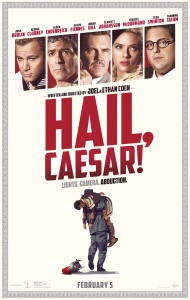 The biggest enemy of the celebrated Coen brothers always seems to be expectations. I count only two misfires during their storied filmmaking careers, but sometimes their larks are pilloried for not quite measuring up to their masterpieces. Hail, Caesar! is on par with Burn After Reading and O Brother, Where Art Thou? It’s still a fun, fizzy, and entertaining film and a celebration of Old Hollywood and its movie magic. Loosely centered on an embittered studio head (Josh Brolin), the film is a series of vignettes highlighting different 1940/50s pastiches, including the realms of Esther Williams, Carmen Miranda, Gene Kelly, and John Wayne. If you’re a fan of the old Hollywood pictures and their stars, the indulgences will play better; you can certainly feel the warmth the Coens have for the films of yesteryear. The plot kicks off with a major star (George Clooney) kidnapped, but it’s really the small side stories and moments that are most memorable, and the Coens are still unbeatable when it comes to being silly and clever. I loved a scene where Brolin asks religious advisors for approval over the script of his biblical epic and they offer legitimate notes over flawed story logic. There’s also a delightful song and dance numbers with a group of sailors lamenting the lack of ladies (“But mermaids ain’t got no gams”). The real star of the movie is Alden Ehrenreich (soon to be young Han Solo) as singing cowboy-turned-actor-turned-studio-sleuth. The sequence where his character tries to rapidly adapt into a “serious actor” on the set of some British melodrama makes for great fish-out-of-water comedy, gamely matched by an increasingly exasperated Ralph Fiennes as the director. The ending doesn’t exactly tie everything together but Hail, Caesar! is more a movie of distractions, of spinning plates, or bumbling bosses trying to hide bad behavior from the press and keep hold of their sanity. If you’re a fan of old Hollywood, there should be just enough to make you smile. If you’re not a fan, then you’ll shrug off the Coens and their latest film lark.
Nate’s Grade: B
Share this:

Bridge of Spies (2015)
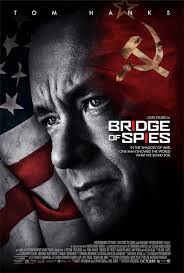 An intriguing behind-the-scenes negotiation during a heightened period of danger, Bridge of Spies relies upon its history to do the heavy lifting and it’s plenty enough for a handsomely made, reverent, and engaging legal procedural that’s also hard to muster great passion over. Tom Hanks is again a noble everyman, this time an insurance lawyer, James Donovan, called in to defend a mild-mannered Russian spy (Mark Rylance) captured during the Cold War. Things get even more complicated when spy pilot Francis Powers is shot down over Soviet airspace. The movie’s civil liberties arguments are pretty clear and still applicable to our modern era, but the movie becomes exponentially more interesting once Powers is captured and Donovan travels to Eastern Berlin to negotiate a prisoner swap while trying to work three sides, the Americans, the Russians, and the Eastern Germans who were hungry for legitimacy. It’s during these back-and-forth negotiations and posturing that the movie really hits its stride, pulling incredible facts together while forcing our protagonist to be the world’s greatest poker player. It’s the details of this story that makes it feel more fulfilling from spy techniques to the new life on the other side of the Berlin Wall. The acting is robust and Rylance (TV’s Wolf Hall) makes a strong impression in a role that requires him to be cagey to a fault. Hanks is his usual determined, inspirational self, which plays all the right emotions in a way that still feels expected and a little boring. Bridge of Spies is a slighter Steven Spielberg affair, a good story well told with good actors but a movie missing essential elements to plant itself in your memory. It’s a fine movie but sometimes fine is just not enough, and considering the talent involved in front of and behind the camera, I expect better.
Nate’s Grade: B
Share this:

Inside Llewyn Davis (2013)
 “There’s no success like failure. And failure’s no success at all,” Bob Dylan wrote. He could have been talking about any number of characters in the oeuvre of master filmmakers Joel and Ethan Coen. Losers and has-beens and could-have-beens fascinate the brothers, and their newest film certainly follows this model. Llewyn Davis (Oscar Isaac) is a struggling musician in the 1961 Greenwich Village, New York folk scene. He rotates crashing with various friends, unable to scrounge up enough money to ever pay his own way. His musical partner recently killed himself and Llewyn has been trying to get traction with his first solo record. His world gets even more complicated when Jean (Carey Mulligan) reveals that she’s pregnant; the baby’s father may be Llewyn or Jean’s husband and fellow performer, Jim (Justin Timberlake). Llewyn can’t catch a break.
Inside Llewyn Davis is a classic Coen creation, a character study of a misanthropic loser trying to find direction in a comical universe of indifference. I greatly look forward to every Coen picture and that’s because nobody writes characters like they do. There are no throwaway characters in a Coen universe. Even minor characters like the elevator Attendant or Manager’s Secretary are given sparks of personality, each fully formed figure creating a richer canvas. There is great pleasure in just listening to their characters speak, in natural cadences yet elevated with grace. Inside Llewyn Davis is no exception. Their storytelling is always rife with wonderful comic surprises and pit stops. The Coens are such brilliant technical craftsmen, that every shot is gorgeously composed, even without longtime cinematographer Roger Deakens (to give you an idea how old this movie was, Deakens was busy filming Skyfall). The music, supervised by O Brother maestro T. Bone Burnett, is impeccably performed and quite lovely to the ear, if you’re into folk music arrangements. If you’re not, well, it’s going to be a long movie experience.
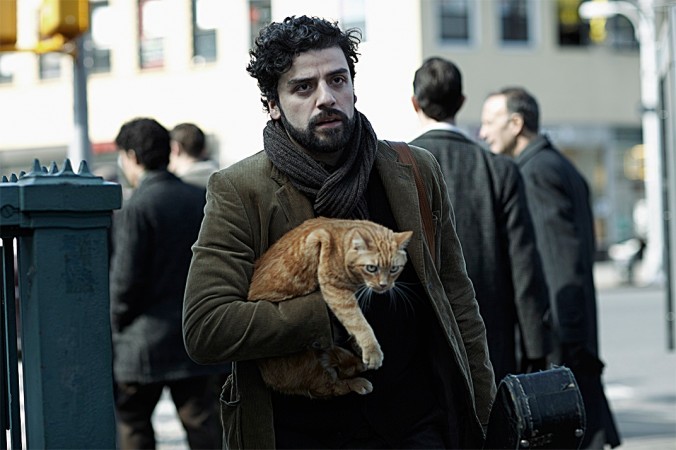 But here’s the problem with Inside Llewyn Davis: the film will likely turn off most people. It’s not a comforting movie by any means. We’re stuck following a self-destructive struggling musician bounce around couch-to-couch, chasing dreams that will never seem in reach. And Llewyn is a tough character to love. He’s surly, careless, selfish, egotistical, and also jaded. And he’s just about the only character in the movie. Most of the other famous faces are fleeting supporting players. Only Mulligan (The Great Gatsby) is given a plurality of scenes to expand her perturbed character, and even those may not be enough. Much like Llewyn’s musical direction, this is a one-man show, and he’s not cuddly. But an unlikable protagonist is not uncommon. The Coens tease so many different directions for Llewyn to go that it’s likely that audiences will feel some degree of disappointment where the film does end up. It’s a circuitous path, proving Llewyn is the architect of his own fate, but at that point audiences may not care. They may just be happy to watch Llewyn punched in the face. The plot is pretty light, running into a series of various self-contained scenes, and there isn’t much in the way of closure. I’ve watched the film twice and while I appreciate it more I’m certain that Llewyn Davis will leave a majority of people feeling cold, more so than even A Serious Man.
Unlike former Coen creations, notably in A Serious Man and Barton Fink, our titular character is the architect of his own misery. He is a musician that identifies with an older class of folk artists, something that strikes him as genuine and touching the soul. He cannot stand artistic compromise. He won’t even accept a winter coat from his music manager. He wants no handouts. He chastises Jean about her and Jim’s attitudes toward the business, calling them “careerist” and “a little bit square.” To Llewyn, to sell out is the worst crime. Jean says that they’re just doing what they can to raise up the musical ranks, and maybe the songs aren’t top-notch, like a catchy but instantly dated novelty song about the Space Race (the sure-to-be Oscar-nominated “Please Mr. Kennedy”), but they’re commercial, they’re finding an audience, they’re making inroads, partially as a husband/wife act and partially due to their own physically attractive appearances, and it frustrates Llewyn greatly. A great example is early in the film a young Army vet on leave performs a wonderfully pure song with a beautiful voice. Llewyn scoffs at the mawkish nature of the tune. “He’s a great performer,” Jim advises. Llewyn takes umbrage at the distinction; a performer is not the same as a musician. The people getting ahead are the performers, the sellouts. One of Jean and Jim’s rising hits, “500 Miles,” lyrically suggests it was an old slave song that has been repackaged and homogenized for safe consumption. Llewyn is going to stick to his guns and make it on his own terms, with expected results. Late in the movie, after Llewyn performs before a record exec (F. Murray Abraham), so aching and affecting as he puts it all into the song, the exec simply responds: “I don’t see a lot of money here.” However, the exec offers Llewyn a chance to be in a trio he’s putting together, if he cleans up and knows how to keep to the background. It’s a real opportunity. Just not for Llewyn.
It all comes down to legacy and Llewyn contemplating what his will be. His singing partner is now defined by his death, finding cruel irony in their song, “If I Had Wings.” His father is known for his long dedication to the Navy, but now he sits alone in a nursing home, a prisoner to his own infirmary and defeated mind. A road trip partner, the pompous jazz musician Roland Turner (a royally hilarious John Goodman), seems like a Ghost of Christmas Future visit from a possible future Llewyn, the artist who’s an iconoclast only in his own mind. Throughout the film, Llewyn is beset with choices, different options he could take, one in particular stemming from a revelation involving an old girlfriend. And yet, much like the thematic nature of folks songs, we’re told, Llewyn looks for something new with something old, be they routines, goals, or occupations. The folk music scene is on the cusp of change with a more commercialized pendulum swing, as evidenced by a surprise new performer at the Gaslight in the closing minutes. Llewyn is contemplating his life beyond the world of show business and where he goes next.
 And if there is a sad aspect to the Coens’ tale, it’s that Llewyn really is a talented musician. This is a breakout role for Isaac (Drive, Robin Hood) especially when you consider that he did all his own singing and guitar playing. It’s one of the most astonishing musical performances by an actor I’ve ever seen in a movie. The level of craft at command, the different slivers of passion he carefully puts into the performances, the trembling emotion, the merging of himself with the song. There’s a reason the Coens open the movie with Isaac performing the full rendition of “Hang Me, Oh Hang Me.” It crystallizes right away where the man’s talent level is, both the character and the actor. We’re left to then wonder why he hasn’t found his place in the industry, and the rest of the film is the explanation. This is the first film since perhaps 2007’s Once where full-length performances of songs really do move the story forward (I’m obviously excluding traditional musicals). Some have labeled the heavy use of song as lazy, distracting from an undercooked narrative, but I can literally go through every song in the film and justify its existence. Each tune, and the performance and performers, gives insight to character, plot, and state of mind.
Inside Llewyn Davis is an easy movie to admire but a harder one to love, unless you’re a fan of the Coen brothers or folk music in general. The protagonist is unlikable, his struggles his own doing either by hubris or integrity, the plot is rather loose with scattered supporting characters, and the film ends on a somewhat lackluster note that feels inconclusive. But then I keep going back to the richness of this world, the pop of the characters, the lyrical beauty to the unvarnished songs, and the concept of folk music as its own sense of purgatory (here me out, folk fans), the idea that we seek something new with something old, and so we follow in circles, like Llewyn’s onscreen journey. Isaac gives such a strong performance that you almost wish his character could catch a break. Almost. This is another technical marvel from the Coens, filled with their dark humor and their sense of cosmic melancholy, but Inside Llewyn Davis may ultimately find some strange sense of uplift as Llewyn continues to hold to his ambitions even as the world around him is changing, losing sight of artists like him. As long as we have the Coens, the Llewyn Davis’s of this world will get their due in one form or another.
Nate’s Grade: A-
Share this:

True Grit (2010)
 It may sound like sacrilege to some to remake True Grit. What can the Coen brothers add? Can Jeff Bridges fill in the boots of John Wayne? Those familiar with the 1969 original will recognize many of the same elements and a solid 70% of the dialogue is the same owing to the fact that both films come from the same source, Charles Portis’ novel. Where the Coens step out is placing the story’s focus on Mattie Ross (Hailee Steinfeld), the 14-year-old seeking vengeance for her dead father. Marshall Rooster Cogburn is a rascally often drunken cynic, so it’s easy to get swept up in the amusing character, initially played by the Duke and now played with great gruffness by Bridges. But the Coens know this is Mattie’s story, and apologies to Kim Darby, but Steinfeld looks like a 14-year-old. Every second onscreen reminds you how truly vulnerable she is, that is, until she opens her mouth. Steinfeld is remarkable and so self-assured. She holds her own with the stars. This is a young actress that has a bright future in Hollywood.
The Coens have put together such richly drawn characters, so it’s a tremendous pleasure just to watch the people interact, luxuriating in that old West speaking style that actors chew over like gumbo. It takes a while for the film to assemble its pieces, but once the gang is underway you just want to spend. As anyone who has ever seen a Coen brothers’ picture, the movie is technically flawless. Whether it be the sumptuous old west cinematography by the best man in the industry, Roger Deakens, the stirring score by Carter Burwell, impeccable sound design, or the overall languid yet authentic pacing of the whole film. There are moments of offbeat humor, moments of quiet tension, explosions of brutish violence, but I had to ask what it all added up to. It’s a good time spent with some nice characters, but it’s hard to shake the idea that the movie falls short of greatness. The Coens can’t be expected to make a masterpiece every time they step behind a camera. But the films that fall short of the M-word generally can be slotted in the “mostly very good” category (O Brother, Burn After Reading). You’re left with a somewhat sour resolution and it starts you thinking whether or not the film had anything substantial to say about vengeance, friendship, community, or a legion of topics. It turns out, True Grit is a solid two hours of great actors working through an entertaining story. For any other filmmaker, that would be all you could ask for. For the Coens, it means the film only can be classified as “very good.”
Nate’s Grade: B+
Share this:

A Serious Man (2009)
 The Coen brothers, Joel and Ethan, have been making stupendous movies for three decades, but they have never really gone too introspective. Usually their movies follow quirky characters making poor decisions and getting in too deep in a cruel world. A Serious Man is the first Coen film that feels personal. Set in the same landscape of the Coen’s own upbringing, 1960s Minnesota, A Serious Man gives a few insights into how these two remarkable men became who the filmmaking geniuses they are today. But if that isn’t enough for film fans, the movie is also hilarious and brilliant.
It’s 1967 in suburban Minneapolis. Larry Gopnik (Michael Stuhlbarg) is a meek physics professor up for tenure. Larry is beset at all sides, from his redneck neighbor encroaching on his land, to being bribed by a Korean student unhappy with his grade, to the news that his wife, Judith (Sari Lennick) is leaving him for his colleague, the more dignified Sy Ableman (Fred Melamed). Sy suggests that the best course of action is for Larry to move out to a hotel: “The Jolly Roger is eminently habitable.” The tenure board is having second thoughts because of anonymous letters, Larry’s daughter is stealing money from his wallet for a nose job, his son spends more time getting high than practicing for his bar mitzvah, and Larry’s unemployed, socially awkward brother (Richard Kind) is sleeping on his couch. Larry seeks counsel from three rabbis and tries to find meaning as to why his life is spinning out of control.
 This is a bleak comedy with almost all of the laughs coming from how much worse things get for Larry. Now, it’s not a pitch black comedy, something akin to being loathsome and eager to push an envelope; you simply can’t help but laugh at how he universe is ganging up on this poor man. His life is spiraling out of control and he is helpless to stop it, and his search for some sort of theological wisdom just leaves him more confused. The various rabbis don’t really have an answer to explain his suffering, and instead they each give comically nonsensical answers or stories. The junior rabbi, projecting his own low stature, asks Larry to seek God in small things, like the parking lot highlighted by his office’s lone window. “Just look at that parking lot,” he gushes hopefully. One rabbi gives a fantastic story about a Jewish dentist discovering a strange Hebrew message carved on a patient’s (a goy’s) teeth. The story eventually goes nowhere and the rabbi’s advice is merely a shoulder shrug and this bit of feeble wisdom: “Helping others? It couldn’t hurt.” To the Coens, Larry is the modern-day equivalent of Job, befalling misery and looking heavenward to ask, “Why me?” He could easily be any one of us. In the face of turmoil, it feels like the Coens prescription is to laugh, the only way to remain sane in this world. And so we do laugh, dubiously, and this is how we cope with life and its ongoing uncertainty.
And A Serious Man is seriously funny. I snorted out loud three times, unable to control my growing guffaws. The supporting group of characters is all wonderfully utilized, popping in for a perfectly timed plot development or a joke. This movie is relentlessly funny, structured like a runaway car that picks up momentous speed. Not a single frame feels at waste. The conversations between the supporting characters are priceless; every character has their precise place in this narrative, and the Coens manage them brilliantly. The writing is intricate and the Coens again showcase their magnificent ear for local color. Each of these people has a different speech pattern, from one Hebrew school kid’s abundant use of the F-bomb, to Larry’s daughter insisting she has to use the bathroom to always wash her hair, to Larry’s bathroom-hogging brother’s conditional response of, “Out in a minute.” It’s almost like a musical how well the various comedic elements harmonize. The mostly unknown cast of actors is all superb; I love how the Coens select actors with such great, easily recognizable faces. These people stand out just visually. Stuhlbarg, a theater veteran, is a terrific lead, and his performance is steeped in pursed-lip incredulity. I loved every conversation with the powerfully unctuous Sy Ableman, a character who hides his distaste in pompous vocabulary. I loved Larry’s interactions with his South Korean blackmailer and his broken English. I loved how Larry’s son will interrupt important occasions just to complain about the TV picture quality of F-Troop. I loved that the only person concerned for Larry’s well-being is the Columbia records salesman who signed up Larry for a subscription because he failed to reject their offer.
 I haven’t done extensive research on this one, but A Serious Man may be the most Jewish film ever, or at least since Barbara Streisand cross-dressed in Yentl. I’m not talking movies that explore a significant chapter in Jewish history, like the Holocaust, but I can think of no other movie so steeped in the minutia of Jewish culture. A Serious Man even opens with a seemingly unrelated anecdote with a 19th century Eastern European Jewish couple arguing, completely in Yiddish, whether a guest is alive or a dybbuk (demon). Not only do we get notable religious events and observances like bar mitzvahs, sitting shiva, counsel from rabbis, the concept of a religious divorce known as a get so that a “serious man” could remarry in the faith, but the Coens get everything right down to the tiniest detail, like the exact sound of soup slurping. Even the overall tone, perseverance in the face of struggle, is an extremely Jewish perspective given what has transpired historically to the Jewish people.
The abrupt ending will likely win no favors from the people that thought they were shortchanged by No Country For Old Men‘s anticlimactic close, but it certainly fits the movie’s bleak worldview. Larry is, by his own accounts, trying to be a “serious man” in an ever-changing community, so beware what happens if he compromises his moral values. The pessimistic finale leaves much to the imagination and whether you want to connect the events as uncoordinated random plot points, or as an ongoing celestial judgment, well the Coens are canny enough to let you figure it out. They don’t have any more answers than the rabbi and the goy’s teeth.
This will not be a movie for everyone, especially considering 90 percent of the laughs come from one man’s unrelenting misery. Larry isn’t exactly the deepest character, making it spotty to emotionally invest in his troubles. However, I found him to be an everyman cipher allowing the audience a safe entry point into the Coen spectacle of doom. The Coen brothers have always been technical marvels, but they seem to have raised their inconsiderable talents at the close of this decade. No Country for Old Men was a genre masterpiece, Burn After Reading was an entertaining farce, but perhaps A Serious Man is the most lasting picture. How do we explain bad things and bad things happening to people striving to be serious men and women in the world? I?’m not sure if the Coens have an answer or even think the answer is important. I think their viewpoint is to enjoy the ride and laugh while you can. As the Korean student’s father puts it, “Accept the mystery.”
Nate’s Grade: A


 nathanzoebl
You must be logged in to post a comment.