Blog Archives
12 Years a Slave (2013)
 In 1841, free black man Solomon Northup (Chiwetel Ejiofor) lives in Saratoga Spring, New York, performing as a trained violinist. Some traveling performers offer him serious money if he’ll play with their circus act in Washington, D.C. Solomon bids goodbye to his family, never knowing he will not see them again for a dozen years. He’s kidnapped, imprisoned, and sold down South to a series of plantation owners. He insists he is a free man, but who will believe him? He’s a black man in chains, and frankly many people just do not care. He learns to adjust to the rules of his new life, finding some companionship with the fiery Patsey (Lupita Nyong’o), and looking for a trusted source to mail a letter to Solomon’s family. It’s a life of daily terror and Solomon could be killed at any moment if word got out that he knew how to read and write.
12 Years a Slave is, as expected, a hard movie to watch at times but it is an essential movie to be seen. A friend of mine literally had this conversation with a movie patron (I wish I was only making this up):
Customer: “Yeah, I don’t think I’ll end up seeing 12 Years.”
Friend: “Oh. Well it is a hard movie to watch.”
Customer: “It’s not that. I’m just waiting for a movie that finally shows all the good slave owners doing nice things. It wasn’t all bad.”
 This brief conversation exemplifies for me why a searing drama like 12 Years of a Slave is still vital in 21st century America. This is a slice of history that cannot be forgotten, but just as sinister is the amelioration of its cruelty. As time passes, and those with direct personal experience are long gone, then the mitigation begins, and you have ignorance consuming people who want to whitewash America’s original sin, like the above movie patron. I’ve even read, simply on message boards for this very film, a dubious prospect I admit, people arguing, “Can’t we just move on already?” and posing false equivalences like, “Well the poor Southerners who worked as indentured servants had it just as bad.” I swear I am not deliberately setting up a straw man argument, these are actual gripes people have. It’s as if acknowledging the totality of the horror of slavery is, in itself, some kind of insult to people today. It’s history and vital history that need not ever be forgotten or mitigated, and we need more films dealing with this subject.
There is zero equivalency to treating people as subhuman property, stripping them of all human rights and dignity, separating them from their families, beating them, raping them, murdering them without consequence, being punished for defending yourself, and kept in a constant state of terror where anything horrible can happen to you at any time without reason. Sorry slavery apologists, but even the notion of a “kindly slaver,” which the movie actually showcases, is erroneous. Whether they don’t beat their slaves as often or addressed them as people, slave owners are still profiting from the institution of slavery, and as such the notion of a “good slave owner” is antithetical to the very insidious nature of plainly owning another human being.
With all that said, 12 Years a Slave is an unflinching look at the cruel reality of slavery but one that demands to be seen. Director Steve McQueen (Shame, Hunger) doesn’t pull his punches when it comes examining the unrelenting misery of slavery. There’s a whipping scene where he are in the safe position of focusing on the faces of those involved, studying their horror, but then McQueen has the camera turn around and you see, in graphic detail, the ravaged back of an innocent woman, the bloody result of every one of those whippings that we watched at a comfortable distance at first. This is a gory example, and the film is rather restrained when it comes to this aspect. This is not simply wallowing in sadism. Hollywood has yet to have a definitive film showcase the traumatic reality of slavery. 1997’s Amistad gave you glimpses, but most of Steven Spielberg’s movie was set in courtrooms arguing the philosophical nature of inherent rights. I wish they would remake the classic miniseries Roots; today’s TV landscape would be more permissible at showing the graphic terror of slavery than 1970s network television. With 12 Years a Slave, there are several uncomfortable moments that will make you gasp, but overall, while retrained on the gore, you feel the overall devastation of a slave’s predicament. Every moment of life was at the whims of another, and a victim could be trapped at every turn. Solomon is beaten soundly, and after he defends himself, he is rounded up to be lynched for his audacity. The aftermath is portrayed with stark tension, as Solomon is left hanging by a noose, his feet barely touching the muddied ground, trying to maintain his stance or else choke to death. And like the long takes in shame, McQueen’s camera just holds us there, trapping the audience in the same strenuous dilemma. The worst goes to Patsey, who is raped by her master and tormented by the master’s jealous wife. Both Solomon and Patsey are damned with every decision. By the end, Solomon is rescued and reunited with his family, but you can’t help but think about all those other unfortunate souls left to mire in slavery. For millions of them, there was no set limit to their desolation.
 From a script standpoint, the movie flows more as a series of scenes rather than a traditional three-act arc. Writer John Ridley (Red Tails, Three Kings) works from Solomon’s own autobiography and does an incisive job of recreating the dimensions of mid-19th century America and the diseased mentality that accepted slavery. No more is this evident than in the frightening character of Edwin Epps, played with chilling absorption by Michael Fassbender, McQueen’s favorite collaborator. Epps is the kind of man who uses selective Scripture to justify his heinous actions. “A man can treat his property how he likes,” he quips with authority. Epps’ plantation is the worst along Solomon’s hellish odyssey. Fassbender (X-Men: First Class, Prometheus) spookily possesses Epps with great ardor, bringing out the snarling dangers of a man and his unsavory convictions. You’ll cringe over all the unwanted lascivious attention he gives to Patsey. He is a weak man through and through, but one who rages against others with his weaknesses. Fassbender is electric and keeps an audience extra alert when onscreen.
The acting is exceptional and infuriating. Ejiofor (Serenity, Salt) is commanding in a performance that stays with you. There is so much the man has to communicate with his eyes, those great orbs of his. Because of his circumstances he must hold back his ire, do what he can to make it another day, and his adjustment to the horrors of slavery are heartbreaking in itself. He must always be cautious, and when he dares to risk trusting a white man, we feel the same tremors of trepidation. There’s a great scene where Solomon, having been betrayed, has to come up with a credible alternative in the moment, with so much riding on his improvisation skills. It’s as suspenseful a moment as most Hollywood thrillers. The most heartbreaking performance, though, belong to Nyong’o, who is making her film debut in a major way. As Patsey, she symbolizes the mounting torment of unremitting victimization, a woman begging for death but too proud to make it happen. She has some intense monologues where not one word feels false. She is a broken woman struggling to find her footing, and watching her get abused in so many different ways is gut wrenching. She’s more than a martyr and Nyong’o shows you that.
Undeniably a good movie, there are still enough filmmaking choices that hold it back for me, and it all comes down to Solomon as the protagonist. The movie’s center was not as strong as it needed to be, and that is chiefly because our focal point, Solomon, is not well developed as a character. I feel pings of something approaching shame just bringing up the subject, but I must profess that Solomon is just not given much to do beyond suffer. As a free man, his adjustment to the absurd cruelty of the institution of slavery is meant to serve as an entry point for a modern audience, to have the safety of our lives suddenly stripped away. But if I had to describe Solomon as a character, I could say that he mostly vacillates between two modes: shock and solemn dignity (“I don’t want to survive. I want to live.”). Strange that Patsey and Epps and even Epps’ wife are shown more dimension than the lead character. I’m not asking for Solomon to suddenly become a more active character and to rise up, Django Unchained-style; the context of slavery limits his opportunities to express himself. I just wanted more to this guy to separate him from the others suffering onscreen. And maybe, ultimately, that’s the point, that Solomon is, at heart, no different than any other slave. I can agree with that in philosophy, however, this approach also nullifies my ultimate investment in the protagonist. I feel for him because he suffers, I feel for him because I want him to find some semblance of justice (an impossible scenario given the circumstances, I know), and I feel for him because he is a good, honorable man. But I do not feel for him because I have an insight into the character of Solomon Northup. Fortunately, Ejiofor does a superb job of communicating as much as he can non-verbally. It just wasn’t enough for me.
 To criticize 12 Years a Slave makes me feel awkward due to the seriousness of its subject matter, but hey, plenty of people make mediocre movies exploring Holocaust atrocities too (does anyone ever dare say, “Get over it,” to Holocaust survivors?). A horrifying historical subject does not give filmmakers cart blanche to slack when it comes to the important elements of storytelling, like story and characterization. 12 Years a Slave, by extension, is an exceptionally made movie with moments to make you wince and cry, gifted with powerful acting and sensitive direction. It is a searing recreation of the many facets of slavery, not just the sheer brutality of the beatings. You will understand on multiple levels the terrorism that was the institution of slavery, a vicious reality that should never be forgotten by a complacent citizenry. I can applaud 12 Years a Slave for its technical excellence, depth of performance, and historical accuracy; however, my personal investment in the protagonist was somewhat limited because Solomon Northup was not developed sufficiently enough. I certainly empathized with the man, but too often I felt like I was watching Solomon as a suffering symbol rather than a character. He’s obviously an interesting figure and I wanted more dimension. While not exactly rising to the level of a Schindler’s List for the institution of slavery (as some have dubbed), 12 Years a Slave is an enthralling movie in so many ways. It’s just a shame that an underdeveloped protagonist would hobble a film so otherwise worthy.
Nate’s Grade: B+
Share this:

Salt (2010)
 Congrats to the Columbia marketing team for what is by far the most imaginative advertising campaign ever. Weeks before Salt was going to open nationwide, the most bizarre story broke this summer. A dozen American citizens were revealed to be deep cover Russian agents. Apparently, their purpose, as given in the mid-to-late 1980s, was to infiltrate American society and get cozy with policy makers (and yet not one became a lobbyist). Instead they mostly raised families and lived in the suburbs of New Jersey. It’s unclear exactly what they accomplished. This hearkens back to a simpler age where we had clearly identifiable “enemies” that existed as nation states. Things are just too complicated in the post-9/11 age of the War on Terrorism. The dozen Russian spies were deported to Russian in an exchange for three American spies. I feel somewhat sad for these dozen Russian spies, especially Anna Chapman, the red-haired femme fatale that became the face of the scandal. These people grew up in the United States and for many that’s all that they know, and now they have to live in picturesque Russia. I wonder how long before they themselves defect back to the States.
Evelyn Salt (Angelina Jolie) is a CIA agent who?s just about to go home after a long night of CIA stuff. An old Russian agent has defected, and Salt is the best interrogator they have to separate the real from the nutso. As she?s about to leave, the Russian talks about a plot to assassinate the Russian president, and the killer will be a Russian spy posing as an American, Evelyn Salt. Her superior (Liev Schreiber) wants to clear things up with nervous government officials, but Salt bails. She’s concerned that her German national husband (August Diehl from Inglorious Basterds) has been abducted. She races to find her husband, outrun U.S. agencies on her trail, and maybe assassinate the Russian president as foretold.
 Believability is a fluid reality. When it comes to action thrillers, if they’re hitting the right numbers hen you give them a bit of a pass. What might normally kill a mortal can merely incur a flesh wound. Salt is packed with thriller absurdities, especially toward the end, but I posit that this movie is no less believable than most of what we see in the Bourne trilogy. The trick with Salt is that the pacing doesn’t ever let up; as soon as she?s slotted as a potential Ruskie spy, she goes on the run and the movie doesn’t slow down. It hops from action sequence to chase sequence to real-life Frogger sequence on a busy highway, all the while Evelyn performs miraculous feats of derring-do, impervious to normal rigors that would severely injure the rest of humanity. But you see, she’s a trained spy, and therefore can handle it all with aplomb. She can create her own missile thanks to an office desk and a fire extinguisher and some ordinary household chemicals (don’t try this at home, kids). In the opening seconds of the movie, Evelyn is being harshly tortured and interrogated in a North Korean prison (in her bra and panties for extra exploitation value). If she can survive that, surely this Superwoman Spy could survive escaping a batch of really lousy guards and National Security agents who seem bewildered by such art of deception like the masterful Putting on a Hat, or the more dangerous Dying One’s Hair a Darker Color (that can stain, you know).
Let?s briefly talk about the entire premise of Salt. Before this summer, naturally, this Cold War holdover plot device would seem ludicrous. Such deep cover Manchurian Candidate-like operations that take decades upon decades of time seem like a crapshoot. As proven by this summer’s most bizarre story, people who go deep under cover for extended periods of time are rarely able to snake their way into the corridors of power. It’s not like these people are planted to marry ambassadors or up-and-coming politicians. It’s essentially like a horse race, except you have to bet on which pony 25 years down the line will be the winner or spawn the winner. The odds of success seem remote at best and a waste of resources. This Cold War program also stipulates that these sleeper agents would still hold allegiance to Mother Russia nearly 20 years after the dissolution of the U.S.S.R. It’s this same mistaken idea of delayed national allegiance that surfaces when Chinese politicians try and justify how they will solve the guy/girl population disparity in their country. The Chinese politicians feel that the men of their country will come to America and find all those Chinese orphans that were adopted by American parents. Somehow these former Chinese orphans who have grown up in a different culture, in a different family, and with different gender rights and freedoms, will suddenly say, “Of course I will go back to the country that gave me up as valueless!” It’s this same basis at work for the Russian sleeper agent plan. But yet these super sleeper agents have miraculously found their ways in high positions of power. Maybe that’s the secret to educational reform. Students are more likely to be self-starters when they’re determined to bring down the infrastructure of another country.
What saves Salt is that the action sequences are good. Director Phillip Noyce has extensive experience in Hollywood and working with large stars. Noyce directed the stellar Jack Ryan thrillers Patriot Games and Clear and Present Danger; he even has experience with Jolie, having helmed 1999?s boring Bone Collector. Noyce has a great presence of mind and knows how to fill the frame up to please the senses. He knows how to compose a nice action sequence and, here?s the shocker given modern action cinema, allows the audience to fully understand what is going on. The chases have genuine excitement and the escapes come across as organic instead of contrived, which is something of a compliment for a spy film. Evelyn Salt hopping from car to car across a highway is cut together into one smooth sequence to rattle the nerves. There are some spectacular car crash images in the film, particularly when Salt escapes from police custody by driving off an overpass. Noyce finds a way to make the screen both frenetic and oddly pretty, without being self-conscious about its popcorn purposes.
 Jolie has proven herself to be more than capable when it comes to handling action. She doesn’t look as spookily thin as she did in 2008’s Wanted, which is good when you want to believe that she can be a world-class brawler. She’s tough as nails and plenty easy on the eyes. The role doesn’t require much of Jolie’s exceptional sex appeal. In fact, she’s rather maternal and her driving motivation is to rescue her husband. There are all sorts of needless flashbacks to her wedding day, little snippets to remind you that she loves her husband, in case you forgot. Jolie’s character is a bit of an enigma by design. Obviously given the star power and the fact that it?s a summer movie, you expect Jolie and her character to be in the right by the time the end credits roll. And yet the movie and screenwriter Kurt Wimmer (Thomas Crown Affair, Equilibrium) spends about half of its running time letting you fully believe that Evelyn is a turncoat (though if she was originally Russian, would she be a turncoat?). The most interesting aspect for me regarding Salt’s character was when we flashed back to the 11-year-old version (Cassidy Hinkle) of her after a car accident. Her head is bandaged, and because the girl is the younger version of Jolie, her lips look like those wax novelty lips to match Jolie’s signature pillowy pout.
Salt is a rather nuts-and-bolts thriller that balances absurdities with efficient action. With pacing so swift, you don?t have time to start nit-picking the small things, and the big things you just swallow as part of the overall package. Salt needs you to be caught up in the moment, in the chase, and not second-guessing all the plot fallacies. The film pretty much follows Jolie’s lead and is straight-faced nerve. It provides the thrills you’d want in a summer popcorn blockbuster without getting too serious. As a spy thriller it goes down like a shamelessly entertaining beach read. After all, what are the odds that your friends and neighbors of twenty years could actually be decades-in-the-making Russian sleeper agents? Well, do they look like Anna Chapman?
Nate’s Grade: B
Share this:

Children of Men (2006)
 Alfonso Cuaron is a master filmmaker and a gifted storyteller. He excels at telling entertaining stories whether they be about kids or adults. His Harry Potter film is still the most watchable and imaginative, and his earlier children’s movie, 1995’s A Little Princess, has enough power to still get me misty. Even when Cuaron sets his sights on a sex comedy (Y Tu Mama Tambien) he can’t help but turn it into an affecting art movie. This man just knows how to tell a good story. Children of Men, a bleak science fiction thriller, is just the latest example of how effortless Cuaron makes it all blissfully appear.
In the year 2027, and the world is on the brink of annihilation. It’s not plague or rampant warfare that are the obvious culprits. The reason for mankind’s end is something more natural and depressing — women have stopped being able to make babies. England seems to be the lone country with some fraction of stability. Illegal immigrants are rounded up and housed in refugee camps for deportation. Cages full of crying and pleading foreigners are on many street corners. In a world of danger and hopelessness, always count on the kindness of xenophobia.
Theo (Clive Owen) is a bureaucrat that combats the future with cynicism. He can barely escape getting blown up for his morning coffee. Theo used to be an activist and married to Julian (Julianne Moore), the current leader of the Fishies, deemed a terrorist group by those in power. She finds him and asks for one last favor. Her people need transit papers to get Kee (Claire-Hope Ashitey), a refugee, and Miriam (Pam Ferris), a former mid-wife, to safety. Then Theo discovers the importance of his assistance. Kee is eight months pregnant. The government would never admit that that the first baby in 18 years belongs to a refugee, and political groups would like to use Kee and her baby as a rallying point for an uprising. But first Theo must get her out of harm’s way.
 The idea of a world of infertile women is fascinating and full of big questions. This dystopian future must confront its own mortality in a very real way. Theo asks a friend hoarding classic art why he bothers. There will be no one alive in 100 years to even see them. Miriam says strange and heartbreaking things happen to a world that forgets the sound of children’s voices. Plenty of heady discussion is generated from a premise that affects every person on the planet. Why can’t women have babies? No explanation is given and none would seem credible. A religious faction believes this is the punishment of a vengeful God. People forget what babies even look like and what is commonly done for their care. The film also has a stark and timely portrait about the treatment of illegal immigrants. Children of Men is an intellectually stimulating movie that never rubs your nose in it. It trusts the intellect of the audience enough to leave many unanswered questions left to chew over and debate long after the movie ends.
The answers Children of Men finds seem reasonable and appropriate. Home suicide products exist for people that want to take back some control over their life, or at the least, are sick of waiting for the even more inevitable. It also seems entirely likely that this future world would turn the youngest living person (“Baby Diego” at 18-years-old) into a celebrity worthy of incredible mourning upon his untimely demise. These coping elements feel dead-on and only enhance the realistic tone of the film.
The film is a beguiling think piece but it also succeeds magnificently as a straightforward thriller. The majority of the second half is built around chase scenes and navigating to perilous outposts of safety that eventual crumble. Cuaron has a dizzying sense of believability as he puts together his world, and his roving camera feels like an embedded reporter on the front lines of chaos. The gorgeous cinematography and realistic set design contribute to the visceral sensation Cuaron sets alive with his visuals. There are long stretches where the camera continues rolling for nine minutes uninterrupted. I was left spellbound and felt trapped in this world just like the people onscreen. I was also wondering how much planning it took to coordinate and choreograph these long takes.
There are two very memorable scenes to quicken the pulse and both of them involve Cuaron’s mobile unblinking camera. The first involves a car chase perhaps unlike any I’ve ever seen before. Theo is leading an escape at dawn and robs the other cars of their keys. However, his own escape car refuses to start and the bad guys take notice. The sequence seems to last forever as Theo is forced to literally roll the car down a hill to outrun his pursuers who continually catch up with him. The second sequence follows Theo making his way through a refuge camp in the midst of a violent uprising being put down by heavily armored government troops. We watch every excruciating second of his survival as he navigates past gunfire, tanks outside a hotel, and then climbs through the different levels of the hotel being bombarded until we see, at a distance, where Theo’s trek all began. Exhilarating might just be the best word to describe Children of Men.
 But nothing feels cheap or too sentimental in this world. This is a harsh and dark world where anything can happen, so the audience is left in constant peril worrying about the fates of every person onscreen. Like Casablanca, it strips away idealized notions of bravery and duty and just shows humanity for what it is and what it can be. That is gutsy but then that’s Cuaron as a filmmaker.
Speaking of Casablanca, Owen seems like a modern-day Bogart in this role. He’s ruggedly good looking but also a sly charmer. I’ve stated before my undying man-crush on Owen and Children of Men has only added to it. Owen has a remarkable way of playing detached but still noble and conflicted. He has the best slow burn in movies. The moments of wonder for him become our moments of wonder and worry. The rest of the actors appear in limited functions but provide good work. Michael Caine practically steals the movie as a crude yet philosophical hippie.
This is science fiction at its best. Children of Men is stark and realistic and truly immersive; you really feel like a member of this tumultuous future. It works simultaneously as a thought-provoking what-if scenario and as an exciting thriller. Simply put, this is a highly engrossing movie that separates itself from the pack. Cuaron has created a disquieting and entertaining sci-fi think piece that succeeds on its numerous merits. I knew half way into the movie that the newly minted wife, Mrs. Me, was only going to want a baby more from what we were watching. At least she now has a new argument: “It’s for the good of humanity.”
Nate’s Grade: A
Share this:

Inside Man (2006)
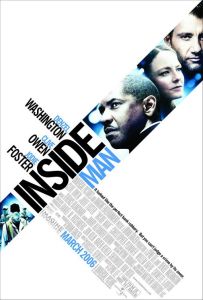 Spike Lee is one of the most recognizable names in film. Usually, the edgy, pointedly opinionated director sets his sights on racial strife, human relations, and satire. So what is Lee’s name doing attached to the Hollywood heist flick, Inside Man? For starters, it’s his most commercial film of his career, a sharp, engrossing thriller that doesn’t blunt his distinct voice.
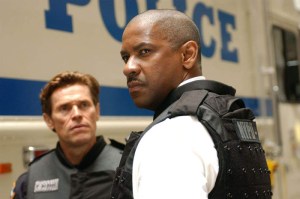
Dalton Russell (Clive Owen) has set forth the perfect bank robbery. He and a handful of associates, dressed as painters with their faces obscured, have locked down a bank in downtown Manhattan. They’ve rounded up everyone inside, robbed them of their trusted cell phones, and ordered them to wear identical painter suits and masks. Detective Keith Frazier (Denzel Washington) is tasked with resolving this standoff, which the media is all too eager to cover in its escalation. What could the crooks be after? Well, bank owner Arthur Case (Christopher Plummer) is certainly nervous about a key document he has inside a safety deposit box, a document linking him to scratching the backs of Nazis. He pits Madeline White (Jodie Foster) to retrieve the document at any cost, and she has the tenacity to wedge herself between her political contacts and the police. All the characters keep their cards held close and try and outfox the other, while figuring out what exactly is going on inside that bank.
This movie is a born crowd pleaser. The heist and ensuing complications really grab an audience early on. There’s a certain thrill watching Dalton, so cool and clam, plot out his bank robbery like the script is still in hand. The crooks are always one step ahead of the police as well as the audience, and I mean that in the best terms. It’s great fun just wondering how Dalton’s team is going to get out of their many jams, and the results are rarely unsatisfying. Inside Man knows exactly when to tantalize with intrigue, inject humor (“Penalty of code 36DD?”), or tighten the tension. The filmmakers know exactly what button to press and at what time. For a two-hour plus film, Lee keeps the film at a swift pace and smoothly weaves his characters in and out. The draw of Inside Man is watching the tit-for-tat game between Frazier and Dalton, too stone-faced pros trying to outsmart each other. Lee smartly allows his characters and story to take center stage and refrains from goosing a strong genre flick with some annoying, superficial artistic artifice.
 Inside Man is a heist that’s refreshingly grounded in reality. Nothing is altogether too out there or complicated to the point where you’d need a score sheet to follow along. Dalton is the movie’s star and Inside Man gives him the center stage to draw us in and keep us guessing. In fact, the flick is so grounded in the plausible that mainstream audiences might be put off by the fact that there isn’t any super twist saved for the end. I think the same audiences Inside Man is so fine-tuned to entertain will discover the lack of a last-second twist as underwhelming. I hope we’re not to the point, as an audience, where we’d rather have an illogical, forced twist ending than something that closes our story with satisfying maturity and finesse. The biggest plot hole you’ll have to swallow with Inside Man is that a businessman would keep a document that linked him to the Nazis. What’s that about? Sentimental value? I’m also still a bit hazy on the motivation of our crooks.
Even though this is a crowd-pleaser, the film is not without its missteps. Inside Man has one of the worst scores I have heard for a movie, ever. Allow me to explain why I feel so brutally, and I do. The score flashes inappropriate mood all throughout the film, robbing many sequences of drama and calling attention to itself. Take for instance a phone conversation between Frazier and Dalton; we cut back and forth between the two and each actor has a different music score. Frazier’s is a jaunty jazz riff, while Dalton’s is the more traditional brooding orchestral number. Because of the schizophrenic musical score this moment becomes funny. The best example of how this score is dreadful is during a scene late where SWAT storms inside the bank. The camera takes their point of view and creeps through the bank lobby, and then you hear a horn (trumpet?) reverberate. It gets louder and then quieter in beats, like a high school brass orchestra just whizzed by in a race car. Then it keeps going but in another direction. At first I was confused, and then I thought, “Did Dalton actually set up a horn section to distract the police?” No, it’s just the awful Inside Man score that totally takes you out of the movie. Scores should enhance the movie, not turn drama into comedy.
Lee also doesn’t help his story by including so many flash-forwards in time. They mostly rob Inside Man of key suspense points. Now we know the bank robbers get away, we know their identities are still unknown, and we know no one died. Luckily, the charisma of the leads and the clever storyline can survive Lee shooting the movie in the foot. The movie also has what feels like the longest denouement since 2003’s Return of the King 20-minute hug fest.
 The quality cast definitely gives Inside Man a boost. Washington is on autopilot but is still charming as ever while being intense and intuitive. Foster is like a female version of Mr. Wolf (Pulp Fiction) but full of steely determination. It says something when really talented actors like Willem Defoe and Chiwetel Ejiofor take tiny roles. As it should be, Owen is the standout. He’s so menacing and composed that you not only want Dalton to get away with the bank holdup, you want him to humiliate and embarrass his opponents even more. I?m convinced that in the world of film there’s no cooler actor than Clive Owen at this point. He adds a touch of badass to every role, with the notable exception of Derailed. At this point, I would pay to hear him recite the phone book and walk away going, “Wow, I didn’t know Aaron A. Anderson of 1200 West Avenue sounded so kickass!” Clive Owen is that cool.
Inside Man is a sharp, intelligent, mostly satisfying heist flick with a terrific ensemble. Lee’s most mainstream picture ever is a born crowd-pleaser, despite some missteps here and there (flash forwards, a poor score). The acting all around is top-notch, and the flick works as a tight and mature genre piece, simultaneously covering all its genre bases and playing up the smarts. I hope audiences appreciate the sense of believability with the film and don’t walk away irked that there is no super last-second twist. Inside Man isn’t anything groundbreaking but it knows how to tease an audience and tell a good guessing game of a tale.
Nate’s Grade: B
Share this:

Dirty Pretty Things (2003)
 Director Stephen Frears (Dangerous Liaisons, The Grifters) has shown an unflinching eye at the fringe elements of society. In the new thriller Dirty Pretty Things the focus is on the struggling lives of illegal immigrants in over their heads.
The London that Frears displays is the sordid underbelly, the type that hasn’t seen the light in ages. These people are treated like theyre disposable. Those with whatever menial amount of power, even if its a single step higher, prey on these immigrants. ”How come I haven’t seen you before?” one character asks another. ”Because we are the people who are not seen,” he replies.
The heart of the film (you’ll get the pun soon) follows the lives of two immigrants. Okwe (Chiwetel Ejiofor) is from Nigeria and works days as a cab driver and nights as a front desk clerk at a hotel. Senay (Amelie’s Audrey Tatou) is a Turkish housekeeper at the same sleazy hotel trying to stay one step ahead of immigration police. Okwe is instructed to ignore all the salient comings and goings of the hotel. People come to us to do dirty things, says the creepy hotel manager Mr. Sneaky (yes, that is his name). Its our job to make things pretty the next morning. Things get more complicated when Okwe discovers a human heart clogging a room toilet. It seems that for some who check into the hotel, they dont check out. Okwe and Senay become entangled in a bloody scheme that threatens their lives and their immigration status.
Dirty Pretty Things is never boring, sometimes compelling, and more thrilling than you would believe with a plot concerning immigration. The characters earn our attention and emotions with Senay’s vulnerability to Okwe’s tenderness and resolute integrity. They draw us in and we genuinely care what happens as they are snared into the creepy clutches of Mr. Sneaky.
 It’s here that I feel obliged to mention that Steven Knight, the writer of Dirty Pretty Things, is the co-creator of Who Wants to Be a Millionaire?. Just consider the possibilities of future game show creators-turn-thriller screenwriters: Merv Griffin’s hard hitting thriller on the lives of firemen, anyone? It could have the corny tagline, ”There’s only one rule of firefighting – never fall in love.” Maybe this only fascinates me.
Frears’ direction is rock solid. He plays to the best aspects of thrillers, like a suffocating feeling of paranoia but doesn’t suffer the thriller flaws because of such resonant and buoyant characters. Frears is confidant to not overcompensate with his storytelling and lets the grimy locations create his stark mood for him. You can almost taste the stale air.
The acting is exceptional. Ejiofor is amazing. He gives a stellar performance rich in complexity, anxiety, uncertainty, and just plain goodness. He seems to be the last honest man in all of London. There are several scenes you can feel the debate of emotions raging inside him. Tatou, in her first English language role, gives a strong performance, though I’m curious as to where her Turkish accent went. With her penetrating dark eyes and elfin smirk, Tatou is still one of the most adorable actresses on either side of the pond.
Dirty Pretty Things is a searing look at the faceless underprivileged seeking a new life, and those who would deviously prey upon them. The film is a smart, superbly directed, and wonderfully acted thriller. It’s a thriller without weird kids who see ghosts, or lesbians with ice picks, but Dirty Pretty Things is a film thatll stay with you long after the lights go up in the theater.
Nate’s Grade: A


 nathanzoebl
You must be logged in to post a comment.