Blog Archives
Beauty and the Beast (2017)
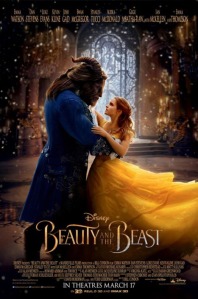 Disney has been on a tear lately with its slate of live-action remakes but Beauty and the Beast is the first title to come from the relatively recent Renaissance period of the early 1990s. The 1991 classic, based upon the French fairy tale, was the first animated film ever nominated for Best Picture, and back when the Academy was only proffering five nominees for the category (Toy Story 3 and Up earned Best Picture nominations after the category expanded up to ten). This is a beloved movie still fresh in people’s minds. I was curious what Disney and director Bill Condon (Dreamgirls) would do with the material, what potential new spins, and how faithful they might be. Regrettably, the 2017 Beauty and the Beast is a charmless, inferior remake of a Disney classic. In short, there is no reason for this movie to exist.
Belle (Emma Watson) is a small French town’s least favorite daughter, namely because she always has her nose in a book and wants “more than this provincial life.” Gaston (Luke Evans) is the most popular man in town and a dreamboat that ladies savor, and maybe also Gaston’s silly sidekick, LeFou (Josh Gad). The hunk is determined to marry Belle at all costs but she wants nothing to do with the brute. Belle’s father (Kevin Kline) falls prisoner to a ghastly Beast (Dan Stevens), a monster who used to be a prince who was cursed for his vanity. The Beast’s servants were also cursed, turned into living objects, like cowardly clock Cogsworth (Ian McKellen), lively lamp Lumiere (Ewan McGregor), and a tea kettle (Emma Thompson), feather duster (Gugu Mbatha-Raw), harpsichord (Stanley Tucci), dresser (Audra McDonald), and probably a chamber pot somewhere. Belle trades places with her father, becoming the Beast’s captive. The servants encourage the Beast to put on a charm offensive and change his ways to woo Belle, because if he cannot earn reciprocal love before the last pedal falls from an enchanted rose, then they will all be doomed to live their current fates.
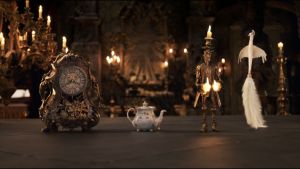 I figured, at worst, I would be indifferent to the live-action version of a great animated musical, especially since they were following the plot fairly closely. I was not indifferent; I was bored silly, and as the boredom consumed me I felt the strong urge to simply get up and leave. Now I didn’t do that, dear reader, because I owed all of you my complete thoughts on the complete film. I’d be lying if I didn’t say I debated escape, which is a rarity for me (I’ve never walked out of a movie, but Beauty and the Beast now joins a small number of films where I considered the inclination). The source of my urges spring directly from the realization that I knew exactly what was going to be coming at every step, even down to shots, and I knew it was going to be worse than the source material. It felt like watching the soul slowly get sucked out of the 1991 film. It was imitation that squeezed out all the delightful feelings from the original, stamping out joy and replacing it with an awkward, stilted facsimile. There’s also the problem of live-action being a medium that distorts some of the charming elements from the animated movie. The anthropomorphic servants are especially unsettling to watch.
The new additions are few and completely unnecessary, adding a half hour to a classic’s efficient running time. It’s kind of like remaking Casablanca and adding forty minutes of stuff that doesn’t belong, which might as well be known today as Peter Jackson Syndrome. With Beauty and the Beast, there are four or five new songs added, and they are awful and needless. Two of them are back-stories for Belle and the Beast/Prince, both of which were already covered earlier either explicitly or implicitly. They are the clear clunkers and further evidence that the 2017 additions are artistic anchors hampering an otherwise great musical. The Prince is given more screentime pre-Beast transformation but it covers the same ground that a simple voice over achieves in the original. I don’t think much is added seeing Stevens get gussied up and partying with the pretty people of his village except as an excuse for costuming excess. Some of the elements added also feel remarkably tacked on and feebly integrated, like the Beast’s magic teleportation book. He has a book that will take the user anywhere in the world, which Belle uses once to visit her parents’ old home and learn redundant information. At no point is this powerful magical device ever used. Why introduce a teleporting book and never bring it up again, especially if only to reveal something superfluous? Why does the Beast need a magic mirror to spy on people if he can teleport there? These are the unintended questions that befall poorly planned story elements that nobody asked for.
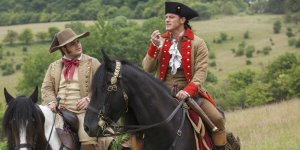 The 2017 Beast also wants to celebrate itself for being more inclusive, feminist, and forward thinking than its predecessor, but this claim is overblown. Much has been made out of Condon’s claims of an “exclusively gay moment” in the movie devoted to LeFou, which wouldn’t be that surprising considering his Gaston-adoring behavior walks a homoerotic line in the original. This “exclusive” moment is LeFou dancing with another man and seeming to enjoy himself, or at least not hating the idea. It lasts for a grand total of two seconds on screen as part of a closing epilogue scanning across our happy characters reunited on the dance floor. It seems like much ado about nothing, especially since the 1991 film had the exact same comic beat of a man discovering an unknown joy of dressing in women’s clothing. Watson has been an outspoken actress, a UN human rights ambassador, and has said in multiple media interviews that it was important to make Belle a more actionable feminist figure. There was certainly room for improvement considering it’s a romance that many have cited as a clear case of Stockholm syndrome. If a modern remake of Beauty and the Beast were going to make socially conscious strides, it would be here, naturally. It’s pretty much the same movie except now she creates a washing machine by completely occupying the town fountain. That’s it. Considering that the movie added thirty minutes to the running time, you would think a majority of that would be judiciously devoted to building a plausible bridge from the Beast being Belle’s captor to being her lover. Nope. It’s a more forward thinking movie in fairly superficial ways that feel overly designed to warrant applause, like the inclusion of two interracial couples in the small staff of a seventeenth century French castle.
I went in and thought, if all else, I would at least have the instantly humable and highly pleasurable songs to fall back on. Then I realized this imagined respite was a fallacy. Like every other element in the film, the singing was going to be worse than the originals, and it was. The biggest aural offender belongs to our heroine, Miss Watson (The Bling Ring), whose singing vocals are Auto tuned within an inch of their lives. I have no idea what Watson’s singing voice sounds like in real life but I can almost assuredly bet it does not sound like what comes out of her mouth in this movie. The Auto tune effect was immediate, and overwhelming, and it felt like daggers in my ears for the entirety of the film. Auto tune flattens out a singer’s vocals and makes them sound tinny, unreal, almost like the comedown from sucking helium. I listened attentively to the other performers and it seemed like Watson was the only one given this exaggerated treatment. I’ve said before I’m not a fan of Watson as an actress, feeling she plateaued at a young age from the Harry Potter series, and her performance here will not change my mind. Similarly, the Beast’s vocals are so enhanced with bass that it would be hard to judge Stevens authentic singing voice. McGregor (T2 Trainspotting) has proven his singing chops before but a French accent was clearly something that got away from him. Evans (The Girl on the Train) is acceptable as a singer but lacks something of the brio that makes Gaston a larger-than-life pompous ass. Gad (Frozen) is right at home with musical theater. If I had to pick a musical highlight I would cite “Be Our Guest” simply for the visual barrage of colors and playful imagery that is absent most of a rather dreary looking movie. The other performers are adequate and sing their parts with equal parts gusto and reverence, but they’re all clearly weaker singers than the less known cast of the 1991 edition. It leaves one with the impression of a shabby celebrity karaoke version of a better movie.
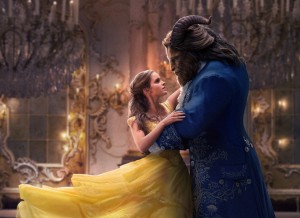 Beauty and the Beast isn’t just a disappointment, it’s an artistic misfire on multiple fronts that is looking for applause but doing too little to even earn such consideration. It wants to be forward thinking for a contemporary audience but they’re empty gestures, as it just copies the 1991 movie down to similar shot selections. The 1991 movie is great, no question, but I don’t need a Gus van Sant Psycho-style remake that only serves to make me appreciate the original more. This movie has no reason to exist outside of the oodles of cash that Disney will probably collect from repackaging its much beloved classic to a new generation of fans and an older generation seeking out millennial nostalgia. The singing is off, especially from a painfully Auto tuned Watson, the new songs and scenes are pointless, and even some of the production design resembles a play that ran out of budget halfway through. If you’re a fan of the original, you may find entertainment just reliving the familiar beats and notes from the 1991 film, just to a patently lesser degree of success. It’s not like Disney’s other live-action remakes of their extensive back catalogue of titles. The Jungle Book and Pete’s Dragon were sizeable improvements, and the agreeable Cinderella found some welcomed maturity to go with its fairy dust. Those movies found new angles, and in some cases had little relationship to their original material as in the case of the wonderful and heartfelt Pete’s Dragon. These are examples of filmmakers who were inspired by their sources but told their own stories. Beauty and the Beast, in contrast, is just the hollowed out husk of the original, now made putrid.
Nate’s Grade: C
Share this:

Breaking Dawn: Part Two (2012)
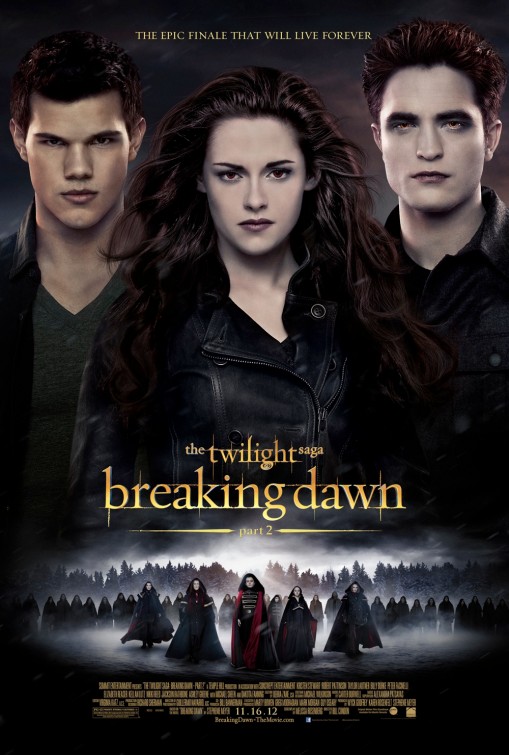 Ignoring the ironic nature of the Breaking Dawn Part 2 poster taglines declaring love to be “forever,” the box-office juggernaut that is the Twilight franchise is coming to an end. Based upon Stephenie Meyer’s outrageously popular series of books, we’ve followed the love life of Bella Swan as she’s experimented with human, vampire, and werewolf. The studio heads decided to take Meyer’s final book and split it into two books. Breaking Dawn Part 1 had a wedding, honeymoon, pregnancy, supernatural birth, and Bella’s death/resurrection. And yet, that movie was still crushingly boring. My hopes were substantially low for Part 2, despite director Bill Condon’s (Dreamgirls) best efforts to jazz up all the awful plotting, characters, and romance. Then a funny thing happened. I started enjoying myself, and then the movie took some chances that I felt were daring considering its rabid fanbase. And then watching Breaking Dawn Part 2 became more than watching the film, it was also the experience of watching the audience. To that end, the movie delivers and I may rue these words but I kinda sorta almost liked enough of it.
Bella Cullen nee Swan (Kristen Stewart) and her husband, immortal vampire Edward (Robert Pattinson), have gone through the wringer. In her waning days as a human, Bella got knocked up during her honeymoon, and her half-human half-vampire baby killed its mama on the way out. Now Bella’s a vampire and a mom (note to self: start writing new script – “Single Mom Vampire”). Her daughter, Renesmee (Mackenzie Foy’s face on a whole lot of other people’s bodies), is rapidly growing. She’s mistaken for a vampire baby, which is a punishment worthy of death. This news gets Aro (Michael Sheen) to rustle up his Volturi forces, a group of vampires with super powers. They’re coming for the Cullens and little Renesmee. The friendly vampires scour the world, gathering “witnesses” to the tyke’s half-vampire status, but really they’re gathering an army to defend themselves. It’s super vamp against super vamp and heads will roll.
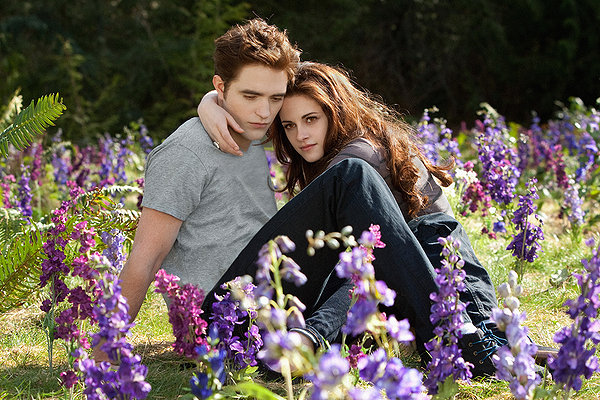 I clearly understand that I am in no way the target audience for this franchise and that my reams of pithy words will find little traction in the hearts of the Twi-hard faithful, but I’d like to state that I’ve never been a hater of the movies. Well, let me rephrase that. My thoughts ping-pong from liked okay (Twilight) to hated (New Moon) back to liked okay (Eclipse) back to hated (Breaking Dawn Part 1), and now here we back are to liked okay. Consider it a double-dip recession in quality. I still view the whole franchise as an exercise in pre-teen wish fulfillment, but I’ve already written extensively upon that theory so I won’t bother re-litigating that battle. With all that said, I found myself oddly enjoying myself for sustained durations. It’s just as silly as the other movies but finally we can move on from mopey Bella and her dubious romantic triangle. Finally we don’t have to suffer through two hours of kids making (new) mooneyes at each other (did I just out myself as “old”?). By this I mean finally something ELSE happens rather than the incremental coupling of Bella and Edward. Granted their kid is really more a prop than a character, but at least the story has taken one gigantic leap forward. Finally Stewart can actually smile and, you know, do things of actual consequence!
It’s no secret that the Twilight saga, as its monetary benefactors would like to dub the franchise, has noticeably been better the less time it spends with its female protagonist, Bella. Breaking Dawn Part 2 might just be the least Bella-filled episode yet, a cause of celebration for my brethren who view Ms. Cullen as an infuriating, insufferable, insulting protagonist. At least in this movie she develops a sense of self-identity, though too often that identity falls into the camps of Wife and Mother. With this movie, she’s adjusting to life as a vampire, so we get cutesy scenes of her hunting prey, learning how to fake looking like a puny human, and arm-wrestling the strong cocky vampire guy to, you know, for the strides in girl power. Too little too late, Bella. I find it more than a little funny that Bella’s super power is passive in nature, fitting a passive protagonist that waist for people to give her meaning and tell her what to do. I should stop before another rant unspools as I’ve done on previous Twilight writing occasions. In short: Bella sucks.
We’re introduced to a lot of new characters in this movie and each brings some sliver of backstory to develop. I’m not saying they’re all deserving of attention or interest, but at least these new clans of vampires brought some much-needed life to what has often been a claustrophobic, monotonous love triangle. Opening up Meyer’s world and seeing other vamps with special powers are a fun detour that I wish had taken place sooner. I liked seeing Lee Pace (TV’s Pushing Daisies) as a soldier from back to America’s colonial days. I’m left scratching my head why certain vampire members were added to the ranks when they didn’t even show up for the final showdown. What was the point of having Joe Anderson (Across the Universe) show up and be all skeptical about the group’s chances of winning… and then not have him join? So he was skeptical from the start and then remained so, choosing to sit the finale out. Well I’m sure glad we spent time on him then. Also, the movie falls into the trap of establishing super-powered beings that are too powerful. We get one guy who can control the elements. Not just one or two but freaking all of the elements. He’s like Captain Planet minus that dumb kid with the lame heart power. During the climactic battle, this kid uses his power ONCE. How do you give him a wealth of super powers and then sideline him? There’s also an Amazon vampire who can control people’s vision, namely making them see whatever she wants. How are these two assets not utilized for tactical supremacy?
 I had the suspicion that Breaking Dawn Part 2 might be the best film in the series simply by the fact that it’s the one with the most Michael Sheen. God I love this man. His last-minute turn in the appalling New Moon banished the suicidal thoughts swirling in my head. Even when he’s in bad movies, Sheen is usually the best thing about them (see: TRON: Legacy or the Underworld films). Here’s an actor who knows exactly how ridiculous everything about this universe is, and by God he sinks his teeth in. The benefit of added Sheen cannot be overstated. The movie greatly benefits by having a strong outside threat early. Only the third movie, Eclipse, had an external threat from the start, and that gave the film a much-needed sense of urgency. I was with Sheen and the Volturi on this one. They were merely following the laws of vampires meant to protect their own kind. Vampire babies are a no-no since they cannot control their otherworldly urges, so they and their makes must be destroyed. You know you’re in for a darker Twilight when early on we witness a baby getting tossed into a roaring fire. I admit that I have a susceptibility to falling under the sway of magnetic villains. Perhaps this speaks to some character defect of my own. It probably just speaks to the fact that movies often have boring heroes and charismatic villains. Sheen is so hammy and delightful and I just wanted more of him amidst the melee that punctuates the end. The man even looks like he’s about to lead a marching band during the battle and he’s still badass. Such is the awesomeness of Michael Sheen. Of this there can be no question.
But then the Condon and series scribe Melissa Rosenberg do something almost extraordinary given the slavish devotion to the series fans have. They divert from the source material in broad strokes during the climactic vampire brawl. I won’t go into exact details but the preview audience I was with was absolutely losing their collective minds. Women were screaming, cries of “Nooo” rang through the room; all around me was the echo of consternation and shock, women trying to absorb the reality of what they were viewing. Sitting with them, taking in their shrieks and lamentations, the general horror of what might happen next… it was a thing of beauty. I can almost recommend seeing Breaking Dawn Part 2 simply to be part of this experience. However, you’ll have to act quickly and be selective. You’ll need a packed theater filled with vocal Twi-hards, likely an opening weekend evening crowd, the kind that openly cheer shirtless revelries from the male co-stars. And then just sit and wait, knowing that soon all that revelry will turn to shock. I sound so mean-spirited explaining this and that’s not my intention. I didn’t necessarily enjoy the discomfort of the Twi-hards. I enjoyed the bewilderment. It felt like the theater was alive, coursing with the energy of alert uncertainty. Anything could happen, including some very not nice things. To be one tiny drop in an ocean of furious estrogen, well it’s an experience that deserves mentioning. Its strange experiences like this that make me love going to the movies, and that, ladies and gentlemen, is a combination of words I’d never thought I would write about any Twilight film.
Also, though my expectations were never that high to begin with, I have to credit Condon with fashioning a fairly exciting action brawl, one that’s surprisingly graphic at spots for a PG-13 movie primarily aimed at young girls. The series has been building up to a massive showdown, and the movie itself has been putting the feuding factions into place, so it’s satisfying that the finale truly feels climactic and delivers some thrills. For the record, Meyer’s book was free of any climactic battle. This movie is chock full of decapitations. I cannot recall another PG-13 film that had this many beheadings. I think you could watch a drama set during the French Revolution and you wouldn’t witness this many people lose their heads. Is there no other ay to kill a vampire? What ever happened to the good old fashioned staking of the heart? These kids these days; all they want to do is decapitate. To dull the grisly spectacle, the beheadings are weirdly bloodless. Condon does a bangup job of setting up plenty of mini-payoffs and duels throughout his busy action centerpiece. Then when it looks like the carnage is at an end, the movie takes a page from the Final Destination playbook, which Twi-hards will probably find relieving. I thought it was a major cop-out but whatever. Let the kids have their happy ending.
 Before you get your hopes up too extravagantly, this movie still offers plenty of stupid. I don’t care how you explain it, the imprinting thing is stupid incarnate. I still find it eternally creepy that Jacob couldn’t have the mother so he settles for the daughter. The fact that everyone treats this development so seriously makes me laugh. And oh boy, let’s talk about those Amazon vampires. First off, I find it hilarious that Meyer’s vision of vampire clans from around the world really just boils down to Europe and the Amazon. When they stepped onto screen wearing, and I kid you not, loin clothes and tribal markings, I was flabbergasted. Doesn’t anyone find this depiction to be at least deeply ignorant and culturally insensitive? I’ll stop short of calling it quasi-racist; though attaching “quasi” to anything lets you get away with most declarations (“This movie is quasi-watchable”). But when our big battle over a frozen lake takes place, why are these Amazon characters STILL wearing loincloths in the frozen landscape? Then there’s the annoying fact that Renesmee rapidly grows, meaning that Bella and Edward get to skip out on actually raising a baby. If Meyer intended to punish these kids for having sex in Part 1, then she needs to follow through on her antiquated sexual hang-ups.
As the franchise draws to a close, I’m trying to take stock of the five films and their overall impact (sadly, we all know with the potential riches, a reboot is likely only five years out). The end credits play out like a gauzy yearbook for the franchise, visually highlighting every significant speaking role, including the two different actresses who played villainous Rachel. The Twilight series has been very good to me as a writer; I’ve produced long-winded reviews with each new entry, and the opening-day people watching has become part of the spectacle I enjoy. That’s really what we’re dealing with here – spectacle. It’s all gooey romantic fantasy nonsense with some pretty bland characters, questionable messages for young girls, and such deadly seriousness. If we were grading on a curve, I’d say Breaking Dawn Part 2 is actually tolerable thanks to nominal character development, less whiny Bella, an influx of new characters, extra Sheen time, a better sense of humor, and a climax that truly feels climactic.
I can’t say the Twilight movies have gotten better as they’ve gone, though Condon has proven to be an apt choice to steer this franchise to a close. He’s given the franchise a bit more life, a bit more blood. I’ll never admit that the love story of Bella and Edward deserved five full-fledged movies, but I recognize the significance Twilight stands in many young girls lives. Fans will eat this stuff up. They’ll certainly enjoy the Bella/Edward sex where she doesn’t end up bruised. For them, it ends in a fitting sendoff, even after the jolts of text deviation morphs into giggled recounts on car rides home. For them, Breaking Dawn Part 2 will be the perfect ending to their beloved series. I can’t imagine anyone indifferent to the series working up that much interest, but I can say with sincerity that Breaking Dawn Part 2 is the best film in the Twilight series and potentially worth seeing for the rollercoaster ride of bewildered fan reactions. Now that the last blood has been drained from this franchise, let’s move on to more important items… like the next Hunger Games movie.
Nate’s Grade: B-
Share this:

Breaking Dawn: Part One (2011)
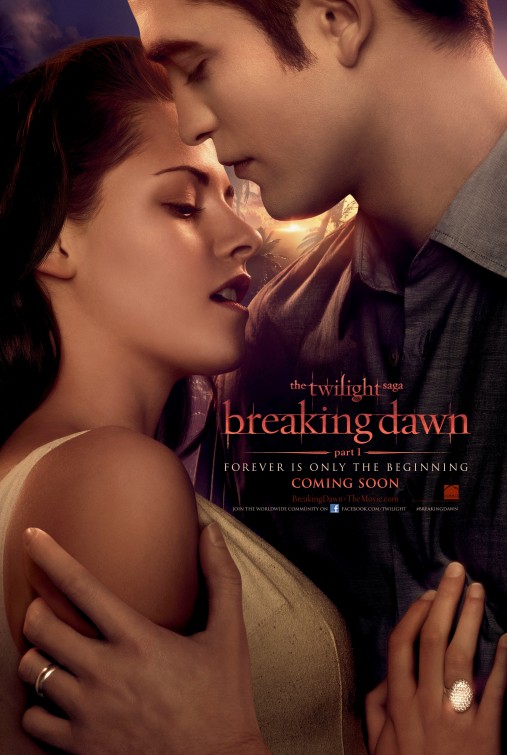 Taking a cue from the blockbuster film franchise of our age, the Harry Potter series, the producers and studio heads decided to split the final Twilight film into two separate movies. Yes, for you cheerless, unfortunate males dragged along to author Stefenie Meyer’s estrogen-drenched soap opera, hoping to be done with Bella Swan and her sparkly vampire boyfriend, well your pain soldiers onward another year. If Breaking Dawn: Part One is any indication, we’re all in for a world of hurt come November 2012.
Wedding bells are ringing for Bella Swan (Kristen Stewart) and her undead boyfriend, noble vampire/undead heartthrob, Edward Cullen (Robert Pattinson). Bella’s persistent demand to be turned into a vampire is finely about to come true. She wants to stay human a bit longer, to savor her last days on Earth before sipping blood through a bendy straw. Her always-in-second best bud, Jacob (Taylor Lautner), is worried for Bella’s well being. The wedding is like a fairy tale and Edward sweeps his new bride away to a tiny island off of Rio de Janeiro, where the housekeepers illogically speak Spanish. The couple makes the most of their time alone, and by this I mean they have sex (I refuse to believe this couple would play chess in their newlywed downtime). Edward withholds any second rounds of sex, fearing he’ll seriously harm his bride (he destroyed the bed in mid-copulation). No matter because Bella gets pregnant right out of the gate. We’re told this is impossible, yet her half-human/half-vampire fetus is rapidly growing inside momma’s belly. The baby is also destroying its host, eating away Bella’s body. Edward demands to kill the baby but Bella will have none of it. She’s going to deliver this baby even if it kills her. If it does kill her, then the truce between the werewolves and vampires will be broken, and Jacob’s feistier tribe mates will be knocking down the Cullen doors looking for some tasty vampires to chomp.
 Director Bill Condon, he of Dreamgirls fame and an Oscar-winner for 1998’s Gods and Monsters, goes hog-wild with the emotions, fittingly reminiscent of the life-and-death swings of emotional polarity that orient a teenager’s life. Condon plays all of the ridiculous melodrama straight. It successfully channels the feelings of teenage angst and obsession, much like the first Twilight film. This Teutonic exhibit of buzzy hormones is like catnip to the Twilight faithful. Finally, they get what they’ve been waiting for, and Condon and screenwriter Melissa Rosenberg delay that gratification even longer. This is the longest wedding I’ve seen on screen since The Godfather. It takes up about 45 minutes of the movie. The protracted walk down the aisle literally takes longer than the rest of the ceremony combined. I can already envision thousands of young girls asking for the “Bella dress” when their time down the aisle comes. At no point does the movie address the fact that the “groom’s side” probably are all absent a heartbeat (“Hmm, extreme paleness? Are you with the bride or the groom? I’m at a loss.”). That’s a missed comedic opportunity. What’s with the wedding guests played by name actors like Maggie Grace (TV’s Lost, Taken)? Did they hire recognizable actors for one-line bit parts? They better have larger roles in the second feature. Under Condon’s direction, the film looks marvelous, and even the long-awaited love scene has some discernible heat to it that will give teen girls “funny” dreams for the next few months. Condon’s also helming the next and final film, so I can at least say it’ll look swell.
This last film was broken into two parts due to the mountains of money the studio would make. It surely wasn’t for some sort of artistic necessity. The plot of BD: Part One is stretched mighty thin. It’s no joke that the wedding and honeymoon takes up half the running time. The baby drama is handled so amateurishly, and the plot ramps up the incubation time so that everything happens too fast for the audience to adjust to how stupid everything truly is. The first half of the movie is free of meaningful conflict. It’s just concerned with payoffs. From everything I’ve read online, and from female friends who have partaken of the series, BD: Part One pretty much covers most of the plot of the 400-page book. What’s left? I would totally give the series a pass if the second movie started with Bella, hair a knotted mess, holding a shrieking baby. Edward sits at the table, drinking. “When are you gonna get a job?” she yells. “When are you gonna stop being a bitch?” he retorts, then gulps down a swig of booze. This domestic downer of an ending would almost make the whole series worth sitting through. Truthfully, as the teaser during the end credits advertises, if Michael Sheen (Frost/Nixon) has a larger part in BD: Part Two, it automatically becomes, sight unseen, the best movie of the series. Thus is the awe-inspiring power of Michael Sheen.
This has long been a silly franchise filled with poorly veiled messages that seem less empowering to teenage girls than reassuring to their parents. Long a heavy-handed message about abstinence, the characters finally get to have sex, after they’re properly married of course (does God really object more to vampire-human relations or when it occurs?). And you better believe the moment Edward and Bella eventually do the deed is a moment that teen girls, and their mothers, around the nation have been anticipating for three long, hard years. The buildup to the carnal climax is a rapturous release for the audience of Twi-hards; my theater felt like it exploded in pubescent hormones and giggling as soon as the proverbial train entered the station. Speaking of euphemisms, I find it telling that not a single character ever refers to sex as, well, “sex.” They keep dancing around the term, referring to it as indistinct pronouns like “this” or “that” or the slightly more specific “honeymoon activities.” It’s like the characters can’t talk about a mature topic without a case of the giggles. There’s even a scene where Jacob talks about Bella’s forthcoming tangle between the sheets, openly, and with alarm: “You’ll kill her,” he tells Edward. He doesn’t kill her but he does leave bruises all over her body. Bella assures her new husband that he’s not to blame, arguing, “You just couldn’t control yourself.” What kind of irresponsible message is that sending to teenage girls? But after enduring three movies of “save it until marriage,” the message is made even clearer when Bella, after one bout of sex, gets pregnant. Boom. Bella breaks the news by saying, “The wedding was 14 days ago, and my period’s late.” Edward stares dumbfounded and replies, “What does that mean?” Apparently, after graduating from high school 200 times just for kicks, Edward must have been absent every damn time for sexual education (“Condoms go OVER? Oh! This whole time I thought they went UNDER, you know, to hold everything in.”).
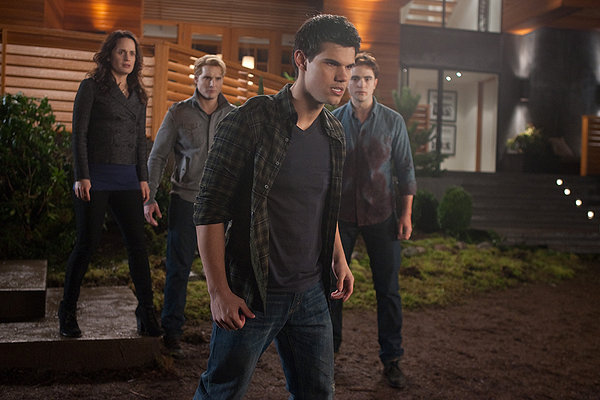 It’s here where the movie awkwardly shifts into a relentlessly pro-life message on legs. I’m not against movies presenting messages, but when a movie is as narratively empty and transparently padded as BD: Part 1, then the movie just gets swallowed up by the clumsy message. It doesn’t matter that Bella’s unborn hell spawn is literally killing her, sucking her dry from the inside out, she’s going to have this baby no matter what, even if she dies in the process. Okay, Meyer, we get it. Here’s a question for the world: can anyone really tell that much difference between emaciated Kristen Stewart and her normal self? She always appears a little sickly and hollow-eyed, but maybe that’s just me. The baby is basically the only conflict the movie presents and it happens so late in the film. Thanks to a fast gestation period, the demon fetus is determined not to wait until Part Two to make its grand entrance. Now that Bella is preggers, she’s become instant buddies with Rosalie (Nikki Reed, a long way from Thirteen), and the two of them begin a war against non-gender pronouns (its vs. he/her). The baby conflict would be more interesting if it was a tad more ambiguous, but the fact that it literally is killing Bella, not to mention its monstrous possibilities, and yet she persists to give birth is less characterization and more stubbornness. If Bella’s worried she’ll never have another chance to have a flesh-and-blood daughter, then explore this. Otherwise it makes Bella look blithely cavalier with her own life.
It’s here where Meyer and the Twilight franchise, already deliriously high on teen angst, goes off the charts into weirdo territory (some spoilers will follow). Never mind where the werewolf boys (and a girl) manage to find new clothes after they destroy them after each beastly transformation, we’ve got far weirder moments to process. There’s a vampire C-section via biting. There are giant wolves communicating via growling telepathy and bad CGI. There are Bella’s completely batshit names for her child; if it’s a boy she wants to combine Edward and Jacob’s names because that’s not awkward (“See, son, you’re named after the other guy I could have slept with but decided to just string along instead.”). And if it’s a girl she wants to combine her mother’s name and Edward’s mother’s name forming the atrocious “Reneesmee.” Excuse me? That makes “Apple” seem as traditional as apple pie. No one tells Bella these names are horrific because she’s pregnant, naturally. I imagine all the characters broke out into laughter as soon as Bella left the room to go puke into a bucket. Easily the weirdest and dumbest thing in the history of the Twilight franchise occurs as a contrived deus ex machina and a tidy solution to Jacob’s eternal, annoying pining. Jacob is determined to slay the monster he believes responsible for killing his unrequited love, Bella, but then he looks into those cute little baby eyes and… swears devotion to this newborn babe. He “imprints” on her, which means that they are meant to be together, and thus the werewolf/vampire truce holds. “Of course,” Edward intones, “Imprinting is their number one law. They cannot break it.” Of course! This reminded me of the scene at the end of the second Harry Potter movie where a phoenix comes from nowhere and cries into a wound (“Of course, phoenix tears can heal anything,” Harry informs while I was physically smacking myself in the head). Doesn’t anyone else find this whole plot development creepy? Jacob can’t have the mother, so he’s going to have the baby? And he’s got to wait 18 years if he wants their coupling to be legal on top of that. I think a messed up name is the least of this kid’s worries.

- Does she look like a healthy person? This is pre-baby succubus.
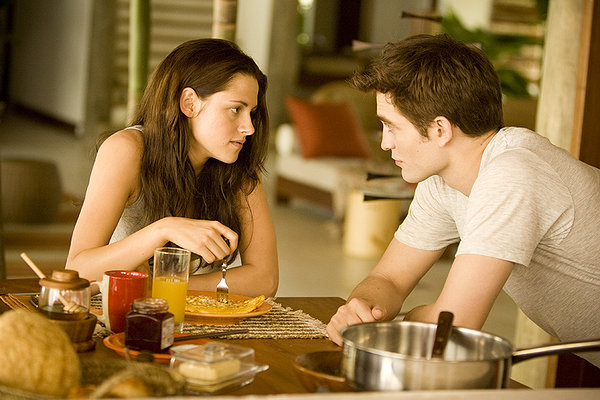
It all comes down to the heroine of the franchise, Miss Bella Swan (sorry, Bella Cullen now). I just don’t get what all the fuss is about. To me, Bella isn’t worth the effort. She’s never really been anything close to a fully formed character. Bella Swan has always defined herself by having a boyfriend, and when he was gone it was about pushing her friends away and moping until she finally found a new guy. She has zero self-identity, no center, she is an empty shell, there is no there there. She’s a cipher, meant for the teenage readership to plug themselves into her place. I won’t restate my theory that the Twilight series is glossed-up pre-teen wish fulfillment, but there you have it. Yet there are sneaking moments where Bella seems almost shockingly… human. Her anxious montage of preparation before her first night of sex is relatable and sympathetic (what outfit to wear? Shave the legs? What kinds of makeup?). Too bad this relatable side of her character vanishes all too quickly. Before Bella defined herself by her boyfriend and now she defines herself by her baby. She’s still the same whiny, selfish, morose, and cruelly manipulative Bella, though. She can’t let Jacob alone; she has to continue stringing him along, bringing him into inappropriate personal matters. Jacob’s always been a bit of a control freak who seems to spout quasi-rapist dialogue (the classic “You love me, you just don’t know it yet.”), but the guy’s always gotten a raw deal as far as I’m concerned. Betrothed to a baby is not a worthwhile parting gift. I worry that young, impressionable girls are going to look at Bella as an influential figure. If these same gals want a literary heroine they could truly look up to, they should feast their eyes on Katniss Everdeen, proactive and laudable star of the Hunger Games and forthcoming movie of the same name.
The three actors have been playing the same character notes for so long that they could all just go on autopilot and collect their paychecks. Stewart (Adventureland) is less annoying than she has been in previous films. I’m trying not to take out my disdain of her character on the actress, who I’ve genuinely liked in pre-Twilight projects (even her Joan Jett performance was pretty decent). Pattinson (Water for Elephants) seems to shrink into the background for this movie. There are a lot of long, ponderous, somehow meaningful stares between the two, with the soundtrack trying to communicate emotions that the screenplay has failed to do (a little more variety on the soundtrack next time, fellas? I think I tuned out after the twelfth melancholy piano ballad). Luckily, Pattinson does have something of a screen presence to go with those abs. Unfortunately, the same could not be said for Lauthner (Abduction). The young buck, formerly of Shardkboy fame, just cannot act. He has a nostril-heavy manner of expressing emotion that makes you wonder if he’s about to blow your house down. It’s telling that within mere seconds of the film beginning, the guy rips off his shirt, the peak of his acting abilities. I suspect it will not be long before Lautner and his six-pack and sitting at home, unemployed, and indulging in a different six-pack.
 Breaking Dawn: Part One is certainly not intended for critics of the book and film series or really any audience member lacking ovaries. But I think that even the most ardent Twi-hards will walk away giggling at the silliness of the overripe melodrama. I try not to be out rightly dismissive of the whole series, but the bad characters, bad plotting, and questionable messages make it hard to continue bending over backwards to find slivers of quality to support. I get the appeal of the series, the fact that Bella Swan is a cipher to exercise frothing teenage wish fulfillment, but that doesn’t excuse the movies from being so bad. This isn’t the painful abomination that was 2009’s New Moon, but it’s come the closest. Only the promise of more Michael Sheen makes me hopeful that BD: Part Two will be better than its predecessors. When you’re talking about an obscenely popular moneymaker, quality becomes secondary to delivering a product that is recognizable to the demands of the screaming fans. BD: Part One is less a payoff than a warning. There is more to come, and if you thought Bella was intolerable before just wait until her vampire growing pains.
Nate’s Grade: C-
Share this:

Dreamgirls (2006)
 When the smoke cleared after the 2006 Academy Award nominations, there were some media members in disbelief. How could Dreamgirls, an expensive, glitzy musical that many perceived as the front-runner for Best Picture, fail to even get nominated in the Best Picture category? Theories abounded; the mostly white Academy couldn’t acknowledge a movie steeped in black culture, the film fell prey to backlash against a momentous hype machine that rubbed people the wrong way, or even that it was unfairly judged against recent musicals, like 2002’s Best Picture winner Chicago, instead of being judged on its own merits. After having now seen the film, I have an altogether simple explanation: the Academy thought there were better movies and I couldn’t agree more. Here are five reasons why Dreamgirls just didn’t cut it.
1) The film just falls apart after the halfway mark. The focus is on the rise of the all girl group the Dreamettes in the 1960s Detroit music scene. Effie (Oscar-winner Jennifer Hudson) is the strong-willed lead singer with big curves and a big voice. She’s pushed out of the way by her band mates so pretty face Deena (Beyonce Knowles) can front and sell records. Effie is our star and she doesn’t take the news well, and explodes in an emotional fury that results in the film’s true showstopper song, “And I Am Telling You I Am Not Going.” Trouble is, there’s still an hour of movie left. The second hour of Dreamgirls feels like a plot layover, as our characters don’t do much more than stuff their hands in their pockets and grumble. It’s astonishing how deflating the second hour to this movie is, and the film cannot sustain a viable interest or energy, leaving the audience to tap their toes to songs that already ended an hour prior. It’s a troubling sign when a film peaks at the halfway point and seems to only stall and sputter after.
 2) The songs are not that special. Dreamgirls would have been far more entertaining if what we got was some honest, soulful, groove-inducing Motown music. Instead, what we get is the same pop filler that the characters bemoan what commercialism has transformed their music into. None of these ditzy ditties are very memorable and many of them start to just blend together, thanks in part to montage-obsessed editing. The other focus of Dreamgirls is on the rise of Motown, how a very Berry Gordy-like figure, played by Jamie Foxx, patterned black music and made it hit for white listeners. I think this was the most depressing part of the film for me, the fact that I could have done without the music in a musical.
3) The tone lacks clarity and can be grating. For about 80% of the movie when the characters sing it’s on stage as performance. Then two characters sing their displeasure with each other and the audience is like, “What the hell?” I accept the laws that govern musicals, and people spontaneously bursting into song and choreographed hoofing does not bother me, but whatever the choice it needs to be consistent. When the audience is used to seeing the singing contained to the stage, it becomes jarring when it transpires in reality. Director Bill Condon (Kinsey, Gods and Monsters) cleverly worked around this problem in his screenplay for Chicago by placing all the song-and-dance moments as glimpses into one woman?s musical-obsessed psyche. It seems so careless and easily remedied, so what were they thinking?
4) Dreamgirls is desperate for Oscar attention. At the end of the movie, after an awfully messy run to the finish line, come the end credits, however they aren’t so much as end credits as they are “for your consideration” ads. When the director of photography credit appears you see a man in a camera crane. When the costume designer is credited we see her sketches and the real outfits side-by-side. Some of it is silly, like when the casting director is listed and we see, no kidding, a checkerboard of faces, like the movie is saying, “This is what a casting director does, look.” The sequence is moderately annoying and a little patronizing, but it is a splendid example of the filmmaking ethos. It feels like the over zealous studios thought that by throwing together a bunch of musical staples and covering it with fancy decoration that they could fool audiences into thinking they saw a full-blooded story.
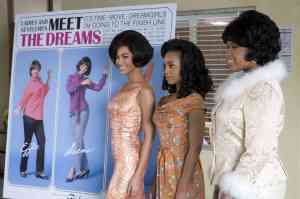 5) You fail to feel for any of the characters. In the rush of production numbers and period detail, the characters all suffer horrendously. The Dreamettes are obviously a take on the Supremes, and Deena is obviously supposed to be Diana Ross; they even recreate iconic Diana Ross pictures with her. By this token, it seems like the filmmakers felt they could slack off on characterization and just banish their actors to the ghettos of genre archetypes. I didn’t feel for anyone, even Effie once she got her walking papers for being essentially fussy, overweight, and sticking with her integrity. She tries to pick up the pieces of her life but even she seems disinterested once the stage lights no longer shine upon her. The characters have about a dewdrop of depth to them and can be summarized each by one sentence. Shallow characters and a less-than-compelling second half doom the movie.
There are enjoyable aspects to Dreamgirls, notably the performances from the supporting players. Eddie Murphy experiences nothing short of a career resurgence playing Jimmy Earl Haley, a groundbreaking soul singer with a fiery stage presence. Murphy puts his all into the performance and is such a live wire that Dreamgirls seems downright downtrodden without him. Former American Idol contestant Hudson has been collecting accolades for her diva-like performance, and while her singing is full of bluster and verve, I cannot say the same for her acting. She gives a solid overall performance but doesn’t try hard to hide her inexperience with acting. I wouldn’t have given Hudson an Oscar, but then I wouldn’t have given Oscars to a lot of the eventual winners (Julia Roberts, your hardware rightly belongs to Ellen Burstyn).
Film critic David Poland was nearly beside himself with Dreamgirls‘ omission from the Best Picture contenders. He argued that had it been nominated it would have won (I’m not sure how that logic works, but I do have a bridge I’d like to sell Poland). Dreamgirls is not bereft of technical charms and entertainment, but to posit this as anything above a mediocre musical is just plain madness. The characters barely leave an impact, the music is the same pop pap it laments, and the movie just simply peaks too soon. There’s nothing daring or innovative with this song and dance revue, and for long periods it feels like a pandering exercise in dress-up and nostalgia. I suppose in the end the Academy just thought there were five better movies than Dreamgirls, and, for once, I agree with them.
Nate’s Grade: C+
Share this:

Kinsey (2004)
 Bill Condon’s probing, fascinating biopic of Indiana University sex pioneer Kinsey (Liam Neeson) could not come out at a more important time. Kinsey lived in the Dark Ages of sexuality and fought against what he saw as “morality disguised as fact.” Kinsey broke barriers studying the science of sexuality and gathered nationwide statements to amass the first thorough book on what’s under the sun and what’s going on under the sheets. Today, we live in a splintered world where people listen to information that affirms their beliefs, and tune out contradictory evidence even if it’s fact (look at the latest report on abstinence-only programs dishing out highly erroneous information). Kinsey railed against this dangerous line of thinking. The man was no saint and had issue comprehending some of the more complicated human emotions. Kinsey is exceptionally well acted and Neeson gives a career best performance. Kinsey is fearlessly graphic in its frank discussion but also enormously intelligent. The fact that conservative groups are actually protesting it shows that Kinsey’s work is far from over.
Nate’s Grade: A-


 nathanzoebl
You must be logged in to post a comment.