Monthly Archives: May 2025
The Fountain of Youth (2025)
 Ever since Indiana Jones famously swashbuckeled his way onscreen in 1981, studios have been chasing after recreating that dashing action-adventure treasure hunting caper that can win over mass audiences. The tough love is that there are very few that actually succeed. The closest might be the 1999 Mummy movie or perhaps the popular Uncharted video games. For some the National Treasure movies might apply. Unfortunately, most of these Indiana Jones hopefuls end up being proven unworthy of one’s time and especially in comparison to the great Dr. Jones, and so The Fountain of Youth also fails to recapture that excitement. The reportedly $180-million Apple TV original is directed by Guy Ritchie (Aladdin, The Gentlemen) and stars John Krasinski and Natalie Portman as the Purdue siblings who are racing to discover the famed Fountain of Youth before another team of shady corporate archeologists (booo!), that feature’s an ex-girlfriend (Eiza Gonzalez) of our lead, gets there first. He’s a wild adventurer trying to clear his disgraced father’s name, and she’s a professor who’s settled down with a family and needs a reminder of her adventurer roots. These kinds of movies live and breathe by their set pieces and charm. The problem with The Fountain of Youth is how forced everything feels. Krasinski can be a very charming actor, as evidenced to any fan of the American Office, but he’s the wrong kind of energy for this role. His carefree attitude comes across as smarmy and detached. Portman is also completely wrong for her role, never finding a degree of fun for her character, only becoming the nagging tag-along. There are some intriguing set pieces, especially aboard the literal Lusitania as it’s dredged back to the surface and then begins sinking again. That’s the highlight of the movie and it happens before the hour mark of a two-hour experience. Ritchie feels restrained in his application of his signature style, once more feeling like a journeyman for hire. The final setting whereupon our characters do find the Fountain of Youth is anticlimactic and builds up its magic hokum with late rule-changing as well as the most telegraphed villain turn. The movie’s tone is aiming for frivolity but because everything feels so forced and empty it instead comes across as obnoxious and tiresome. The drought continues.
Nate’s Grade: C
Share this:

Heart Eyes (2025)/ Fear Street: Prom Queen (2025)
Slasher movies have been a popu;ar staple of horror, enough so to go through different phases of resurgence and ironic reinterpretation. They rose to prominence in the 1980s but are still wildly popular today, perhaps proving that there’s something timeless about a masked maniac chasing after dumb teenagers with his or her weapon of choice. Mix in heavy amounts of blood and gratuitous nudity, and it’s easy to see why this cost-effective entertainment strategy continues to endure. Two new 2025 slasher movies show the highs and middling lows of this horror genre known for its graphic kills and little else.
 Heart Eyes is ostensibly about a romance-hating masked killer who stalks happy couples on Valentine’s Day and gets all stabby with their insides. However, it’s really a pretty charming romantic comedy that just so happens to also have a healthy amount of gore. The clever screenplay follows many of the same tropes we come to expect from the rom-com genre but now with a twist. It’s Boy Meets Girl, as Jay (Mason Gooding) and Ally (Olivia Holt) are forced to work together to save a romantic ad campaign gone wrong. It’s Girl getting over the pain of her recent breakup with the emergence of a handsome new man in town. It’s Guy and Girl butting heads before creating sparks. And then they’re chased repeatedly by the masked killer. They yell, “We’re not even a couple,” but it makes no difference; their chemistry is just that undeniable. In that regard, this murder menace is actively driving these two would-be lovebirds together, forcing them to rely upon one another for survival, and revealing parts of themselves. If you cut out all the horror parts, it would still work as a romance, but it’s even more entertaining to watch how the two genres, both beholden to their formulas, mash so bloody well. The banter is witty, the silly are over-the-top gory, and this is a rare movie that could be loved by gorehounds and foolish romantics. It’s an elevation that is self-aware but not obnoxiously, more silly tongue-firmly-in-cheek. You can tell there is a love for both of these genres from the filmmakers. Heart Eyes is a fun and refreshing spin on the old.
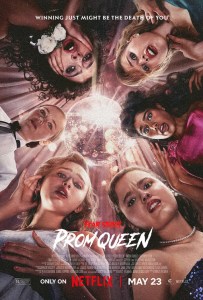 The newest Fear Street movie, based on the scream teen novels by R.L.Stein, is by far the weakest in the Netflix horror anthology series. Prom Queen is a pretty straightforward rehash of your 1980s high school movie staples of horny teens, bitchy popular girls, the less popular girl striving for Prom Queen and having to reconcile the changes she’s willing to make to be a winner, and a knife-wielding killer. Ah, the nostalgia. The issue is that there’s nothing separating this movie from, say, Prom Night, either the 1980 original or the PG-13 remake in 2008. The most thought put into this movie is the gruesome kills with some decent gore, but the whole movie doesn’t even play like a cartoon. It plays like a TV special you’ve watched before, something not just outdated but that’s been iterated upon iterations, a bland copy of a copy of a copy. The mystery of who might be the killer has some slight fun but the culprit should be easy enough to suss out when you take into account what actors have names that you remember. There’s nothing wrong with emphasizing the more gruesome exploitation elements of the genre, but the kills aren’t that memorable or clever, nor are the characters that interesting even as generic stock roles. I found myself confusing many of the multiple Prom Queen candidates (why are there so many pale brunettes?). The previous Fear Street movies released in 2022 had an interesting gimmick connecting them with the history of the town going back centuries to explain its crushed nature. Prom Queen just exists in this space without doing anything to connect to the larger Shadyside mythos and cross-generational storytelling. It feels so dreary and perfunctory and rather boring, shuffling along like a zombie wearing the husk of Fear Street. It’s just not fun. It’s not outlandish enough to be silly and too dumb to be self-aware. It’s mostly unimaginative cliches warmed over and unrelated to a far more stylish and ambitious horror series. This is a Prom Queen that deserves a bucket of blood and social ostracism instead of any accolades.
Nate’s Grades:
Heart Eyes: B+
Fear Street: Prom Queen: C-
Share this:

Until Dawn (2025)

I’m going to do something I don’t know if I’ve ever really done before in my twenty-five-plus years of toil as a film critic. I’m going to devote almost the entirety of this review to try and make sense of the ending and its cascading choices that confound and astound me. I’ll present some spoiler-free analysis beforehand but, dear reader, this is going to be a spoiler-heavy review because, quite simply, it’s all I want to talk about as it concerns Until Dawn. The horror movie is an adaptation of a 2014 PlayStation video game that itself was fashioned like a ten-hour horror movie. It was a love letter to the horror genre and your goal was to keep as many of the characters alive as you could through quick-time events and choices that could have lingering and unexpected consequences later in the game. It was, above all else, fun, and news that Hollywood was going to turn it into a movie made a degree of sense. After all, it was practically an interactive movie to begin with. Then news matriculated that they weren’t really adapting the game and instead were making something new and different, so why call it Until Dawn? Beyond the cash-grab from the use of a familiar name, if you’re going to be Until Dawn in name only, why not just be that original horror idea and let someone else actually adapt Until Dawn as it was? You’re not going to get another crack at this title, so why is the first attempt one that could be done without the game existing? Regardless, the movie is a bad adaptation of the game and a bad use of dwindling brain cells.
Five teenagers make a trip to search of Clover’s (Ella Rubin) missing older sister. They trace her last recording to a gas station just outside the mining town of Gore County. The gas station attendant (Peter Stormare) lets these curious kids know that weird things happen in town, and sure enough the weird stranger is right. The teens take refuge in a visitor center with a guestbook and a peculiar hourglass time piece on the wall. Soon enough they’re beset with masked killers and monsters and each of the five friends is slaughtered. Then they wake up back in the visitor center with the hourglass starting over. They have to learn about this mysterious location to try and stay alive all the way… until dawn!

Before the heavy spoilers begin, I’ll provide a few accolades to what the movie does well. Director David F. Sandberg (Shazam!, Lights Out) has a clear affinity for the horror genre and can summon some pretty effective and skin-crawling imagery. I actually like the premise of a horror time loop, though this was also covered with the tongue-in-cheek genre tweak that was 2017’s Happy Death Day. However, that movie primarily dealt with a slasher scenario whereas Until Dawn can mix and match different genres, which makes each new iteration feel like a blank slate to explore. I loved the shortest loop, where the characters hold up in a bathroom and gruesomely discover what happens if you drink the local water. It’s the best development in the movie and one I’m glad the script revisits from time to time. With most time loop movies, once the characters adjust to the reality that death is not final, they get a little more loose with their physical well-being. I enjoyed some of the turns the characters make with the understanding that they’ll come back again. The visual nods and connections to the game are there without feeling too gimmicky. Plus, having Stormare come back to play a variation on his nattering psychiatric weirdo from the game is exactly what the movie adaptation needs. Stormare is on his own unique wavelength.
Now, the madness. Abandon all hope ye who enter the spoiler section of this review.
I don’t understand this movie. At all. I read over its Wikipedia summary and watched a few of those YouTube explanation videos to see if it was just me and I missed important pieces of information that would connect the various elements together. It’s not me, folks. These story elements don’t connect. They don’t form a coherent whole. I don’t need a reason why time loop scenarios happen; they never explained it with the genre grandaddy Groundhog Day, and if it’s good enough for Groundhog Day, it’s good enough for your movie. The problem is when they try to explain and it actively makes things worse, because now you begin to question everything. I liken it to 2019’s Us, a movie with plenty of outlandish story elements including the existence of a same-age evil twin for every person but living in a subterranean mimicry of surface life. I would have happily accepted that as-is, but then the movie tries to find a real explanation for where these people came from and why, and now the illusion of ignorance is shattered. Now all those pesky questions start flooding the mind that could have before been kept at bay.

Let’s examine the explanations for the two primary mysteries: 1) why there are monsters, and 2) why there is a time loop trap. Again, both of which didn’t even need explanations but here we go.
The mythology of the game gets ported over in starts and stops, but the movie keeps the setting of a mining town that had a tragic collapse that devastated the town. In this version, the majority of the town fell into a sinkhole below the earth. Do we get to explore these exciting and creepy locations? Nope. One of the town’s psychiatrists (Stormare) is still alive and continuing his mad experiments for… reasons. Like the game, there is a curse wherein if you resort to cannibalism you will become a spooky wendigo monster, so the creatures are a result of the former townspeople and other past residents from the previous time loops. Fine. I can accept that. However, late in the movie, our creepy psych doc clarifies for Clover that things aren’t just all in her head, a nod to the original game. Except that ending would have made more sense. The new ending says that Clover’s fears are responsible for manifesting the different antagonistic monsters and killers. Okay, so we’re externalizing the internal, fine, but why her? Why not any of the other friends? Does this mean every previous group was also responsible for manifesting their own tormentors based upon personal psychological fears? Why are we including this roulette wheel of terrors on top of the constant of the wendigo creatures? How is this even happening because the movie gives no scant indication? Do the deadly rules get reset with each new group? In our story, the characters can’t drink the water, but what about other groups? If every group is manifesting the same avatars of fear then why not just adopt them as stable rules? Why is this one man staying behind to catalogue the results? He’s mortal so he just lives in the sinkhole or works at the gas station, waiting for wayward teens to stumble into his next experimental group? Who is keeping the lights on in this visitor center? What does this guy do during the “off season” when there are no looky-loos? Does he have to feed the existing wendigos like some kind of demented zoo? What is to be gained from all these experiments? Is he planning on publishing his research later? What is this guy’s regular life like?

Then there’s the time loop explanation which is -wait for it- nothing. Absolutely nothing. Why are characters getting second and third and thirteenth chances to survive until dawn? Why is it thirteen? The movie doesn’t even have the time to demonstrate thirteen loops, instead jumping from like the fourth straight to the last one through the annoying use of, “Oh, let’s watch these film clips we took that we don’t remember.” If you didn’t have the interest or time for thirteen loops, why even make it thirteen? Why does the number matter if they inevitably turn into wendigos from desperate cannibalism? You would think the loops should be infinite to guarantee this result. Why would the other victims bother writing their name in the guestbook every loop? It establishes a timeline of sorts, but if writing can last in this guestbook, why doesn’t anyone write anything other than their name over and over? Detailing your experiences and lessons learned as a living record might be helpful to future loopers. Also, what obligations do these people feel about signing their names in the guestbook? Who accepts getting murdered over ten times but is still being a stickler for signing their name, and for what? Are they getting some little feeling of superiority that they were able to scribble their name thirteen times? Where did the hourglass come from? It definitely looks like it was installed with purpose, so did these just materialize? Why do the timeloops even consider having a mechanism for letting participants win and escape? What about the other quirks like how the weather is affected by the bad vibes of this place? Even the rain knows better.
So, in summation, the time loops and manifesting monsters are unrelated to one another and there is no added context provided for like some ancient curse or witchy magic or anything to cause this mess. There is one nefarious wacko doctor who just hangs around for kicks, though why he is immune from the loops or the larger effects of the manifested monsters is beyond me. Is he recruiting the monsters like some sort of work foreman, telling this gnarly creature, “Need ya to pull a double today, Fangy.” It just all feels like scary elements working in parallel and occasionally drifting into one another’s orbit, but there’s no fitting or acceptable explanation, so why does the movie even try to present one in the first place? I’m stunned at how Until Dawn just completely unravels into incoherent madness by the conclusion, which sets up that there might be a larger universe of these doctors overseeing experiments. At that point, you might as well be watching The Cabin in the Woods. If you have no allegiance or familiarity with the video game, you might find enough to amuse you, at least for fleeting moments. I was open-minded to what an Until Dawn-in-name-only adaptation could do with a time loop gimmick, but the final results feel like an uneven grab-bag of imagery and ideas and directions that go nowhere.
Nate’s Grade: C-
Share this:

Another Simple Favor (2025)
 The sly 2018 original was a tart breath of fresh air, chronicling a friendship between two moms, one of means and one of lesser means, that unraveled a conspiracy of death, lies, secret twins, ransom, and murder. It was an enjoyable diversion that was elevated by snappy banter, a combustible chemistry between Anna Kendrick and Blake Lively, and some dishy twists. I wasn’t expecting a sequel, but with the same director and principal cast returning, I was at least a little intrigued as to what they would cook up. Instead Another Simple Favor is a warmed-over retread of the original. This time we travel to scenic Italy where Emily (Lively) has been released from prison and is now marrying a wealthy Mafia scion and wants Stephanie (Kendrick), her old frenemy, to be her maid of honor. At its best, the sequel has glimmers of the spiky fun of its predecessor thanks to the serviceably witty banter and ongoing fun between its lead actresses. Mostly, it’s a tangled mess chasing after what made the original entertaining and adult. I can pretend I fully understood the plot with its assault of soapy revelations, character intersections, and convoluted machinations, but that would be a lie. There are times where the movie feels like an overburdened runaway “yes and…” improv game, where anything and anything is accepted and absorbed into the script. I wonder if every additional movie is just going to add more versions of a certain character. If you’re a fan of the 2018 original there might be enough here to prove fleetingly engaging, like the fabulous villas and extravagant costumes, but mostly Another Simple Favor doesn’t feel like it’s doing anyone a real favor.
Nate’s Grade: C+
Share this:

Black Bag (2025)
 It’s Steven Soderbergh’s second movie of 2025, also with screenwriting vet David Koepp, and this time they’re tackling the spy thriller, centering on a marriage between two spies. Michael Fassbender and Cate Blanchett play a couple who both have clandestine lives, and when either one ventures into sharing sensitive details, they utter the code “black bag” as a conversation-ender. There’s a mole in the agency and Fassbender is tasked with uncovering the identity of the culprit, but he worries this investigation might ultimately point toward his own wife and then what’s a man to do? Black Bag is one of those more realistic, exacting spy thrillers, which means it’s churning at a very slow pace with minimal stakes before things ratchet up late. The parallels between trust in a marriage and trust in a spy agency are there but never explicitly explored for thematic richness. You know where the ultimate goal is, finding the mole, but every scene plays out more like a couples drama of squabbling, unhappy upper class winos with secrets and grudges. I had to occasionally remind myself, “Oh yeah, these are spies.” I never fully got on board the wavelength of this movie, finding its detached sexy vibe to be more glossy and meandering. The characters just weren’t that interesting to me. I kept waiting for things to pick up, and even when characters are murdered the tension level still feels unchanged. It’s all a little too heavily submerged under the icy tranquil surface for me. Black Bag is a sedate spy thriller presented as sophisticated but comes across a tad too detached and ultimately tedious.
Nate’s Grade: C+


 nathanzoebl
You must be logged in to post a comment.